
In the realm of railway freight transportation, the integrity and performance of coupling devices are paramount for operational safety and efficiency. The knuckle, a pivotal casting part within the coupler assembly, endures immense mechanical stresses, particularly under the escalating demands of high-speed and heavy-haul operations. Traditionally, the manufacturing of this critical casting part relied on conventional sand casting methodologies, which, while functional, were plagued by recurrent defects that compromised quality and yield. My research and development efforts were driven by the necessity to systematically overhaul these processes, aiming to achieve a quantum leap in both the internal soundness and external finish of the knuckle casting part. This document details a multi-faceted investigation into工艺 innovations, material science applications, and tooling redesigns, which collectively transformed the production landscape for this essential component.
The foundational challenge stemmed from the inherent limitations of the established “traditional-type” process. This method employed a single-inlet pouring cup, sand-formed runner systems, and manually drilled vent holes within the sand mold. When coupled with the use of a large 25-ton Ladle Furnace (LF) bottom-pour refining ladle for浇注, a series of interrelated problems emerged. The high metallostatic head and rapid flow of molten steel created turbulent conditions, leading to sand erosion (washing) within the sand-made runners. This eroded sand was then entrapped within the solidifying metal, resulting in sand inclusion defects. Furthermore, the single pouring cup often induced vortexing, drawing air into the stream and leading to gas porosity. The venting system was equally problematic; drilling operations could leave loose sand in the airways, causing inclusions, and subsequent cutting of these vent risers posed a risk of damaging the casting part itself, creating ‘missing meat’ defects. Internal cavities, formed using core sands with high gas evolution, contributed to sub-surface porosity. As a result, the qualified rate for these crucial casting parts languished around a mere 82%, with defects concentrated in critical load-bearing zones like the upper pull lug and impact lug.
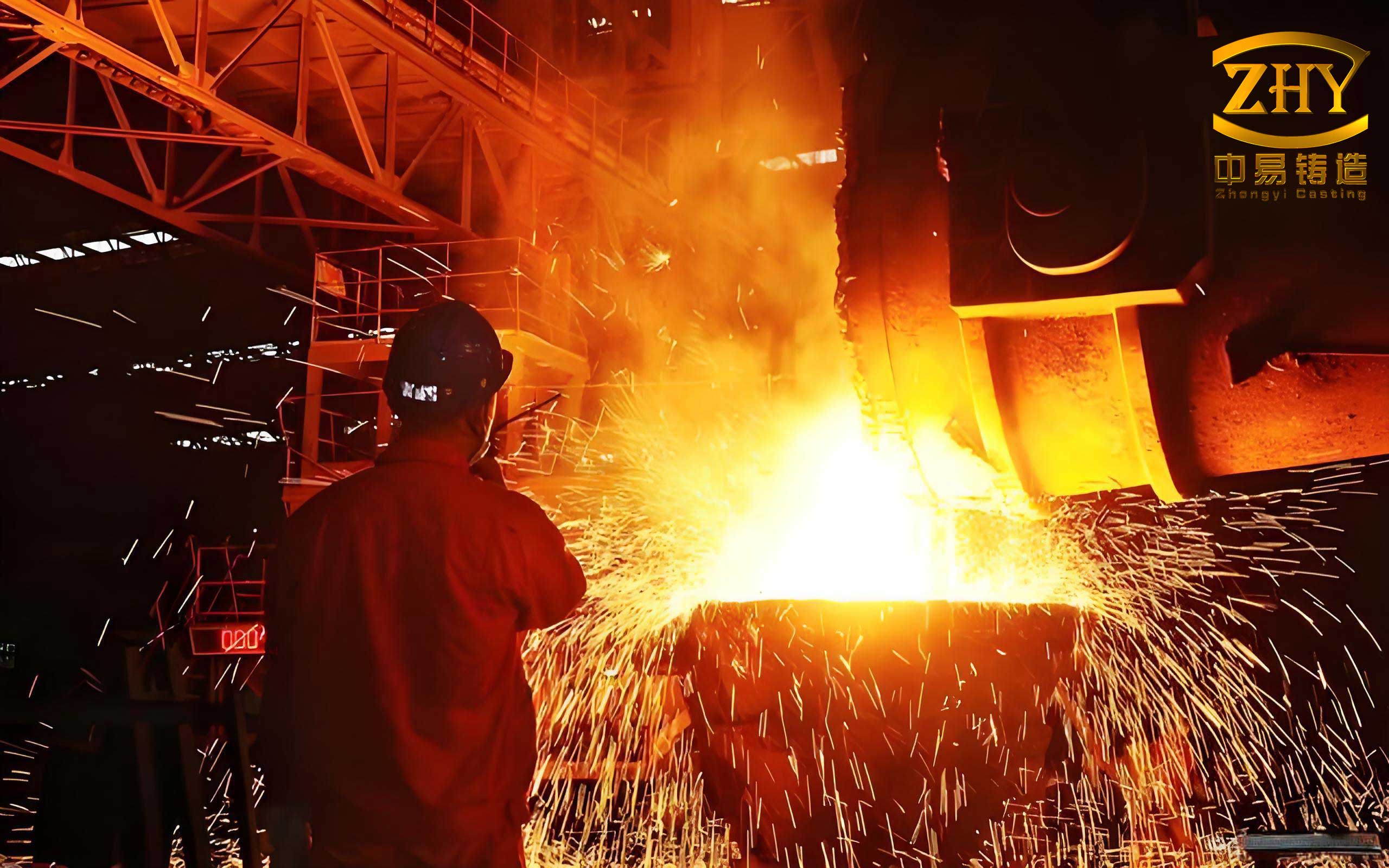
A detailed analysis of the fluid dynamics and thermal interactions within the mold cavity was essential. The initial浇注 system failed to ensure laminar flow. The velocity of the molten metal, a critical parameter, was excessively high. Using principles of fluid mechanics, the initial flow condition can be described as turbulent, characterized by a high Reynolds number ($Re$):
$$Re = \frac{\rho v D}{\mu}$$
where $\rho$ is the density of molten steel, $v$ is the flow velocity, $D$ is the hydraulic diameter of the runner, and $\mu$ is the dynamic viscosity. A high $Re$ significantly increases the shear stress on the sand mold walls, leading to erosion. The goal was to reduce $Re$ by modifying the system geometry to increase $D$ and, more importantly, to drastically reduce $v$ through redesigned gating.
Systematic Process Innovations and Redesign
The improvement strategy was holistic, targeting every stage from metal delivery to mold venting and core material.
1. Redesign of the Pouring System for Laminar Flow
The first intervention was the complete redesign of the pouring basin and runner assembly. We replaced the single conical pouring cup with a custom-designed, refractory-made “Double-Pass Double-Injection” pouring cup. This cup featured two separate down-sprue inlets. This design serves two primary functions: it effectively reduces the dynamic pressure head of the incoming steel stream by splitting the flow, and it minimizes vortex formation by providing a symmetrical fill. The cup dimensions were optimized to 316 mm × 235 mm × 200 mm to ensure it could act as a reservoir, maintaining a consistent metal level during浇注.
Complementing this, we introduced an integrated, pre-fabricated refractory runner system. This system replaced the vulnerable sand-formed横浇道. The runners were made from high-alumina refractory pieces designed to interlock, creating a smooth, continuous channel from the pouring cup to the ingates. This innovation was revolutionary because it completely eliminated the contact between the high-velocity molten steel and the green sand mold in the runner sections, thereby eradicating the root cause of sand wash and associated inclusions in the final casting part. The filling sequence became markedly smoother.
The浇注 procedure itself was refined. Instead of a continuous pour, we adopted a two-stage method: initially pouring at a high rate to fill the double cup to about two-thirds of its capacity, then switching to a slow, controlled pour to complete the mold filling. This ensured the sprue inlets in the cup were always submerged, preventing air aspiration. The quantitative impact on浇注 time is summarized in Table 1.
| Parameter | Original Process | Optimized Process | Impact / Rationale |
|---|---|---|---|
| Pouring Cup Type | Single-inlet, conical (sand-faced) | Double-inlet, rectangular (refractory) | Reduces metal head pressure, minimizes vortex. |
| Runner Material | Ester-hardened sodium silicate sand | Pre-fabricated refractory segments | Eliminates sand erosion source. |
| Average Pouring Time (for one mold) | 18-28 seconds | 30-45 seconds | Slower fill promotes laminar flow and better degassing. |
| Flow Regime (Estimated Re) | Turbulent (Re > 4000) | Transitional/Laminar (Re < 3000) | Directly reduces shear stress on mold walls. |
The new浇注 time ($t_{pour}$) can be related to the volume of the casting ($V_c$) and the effective flow rate ($Q$) using a simplified model:
$$ t_{pour} \approx \frac{V_c}{Q} + t_{delay} $$
where $t_{delay}$ accounts for the initial fast-fill stage of the cup. The deliberate increase in $t_{pour}$ was a key controlled variable to ensure proper mold filling.
2. Advanced Venting Technology: The Porous Grid Exhaust Valve
To address the deficiencies of drilled vent holes, we pioneered the use of a ceramic Porous Grid Exhaust Valve. This component is a small, cylindrical insert made from a high-thermal-shock-resistant ceramic with an interconnected open-cell porous structure. It is placed in the mold at the locations of traditional vent risers. Its function is threefold: it acts as a filter, preventing any loose sand from falling into the cavity; it allows gases generated during浇注 to escape freely due to its permeability; and it provides a well-defined, mechanically stable point for later removal, eliminating the risk of切割 damage to the casting part. The permeability of the valve can be characterized by Darcy’s law for flow through porous media:
$$ Q_{gas} = \frac{k A \Delta P}{\mu L} $$
where $Q_{gas}$ is the volumetric gas flow rate, $k$ is the intrinsic permeability of the ceramic, $A$ and $L$ are the cross-sectional area and thickness of the valve, $\Delta P$ is the pressure differential, and $\mu$ is the gas viscosity. This ensured efficient dezincification without compromising mold integrity.
3. Core Sand Material Science Investigation
The internal cavity of the knuckle casting part is formed by a core. The gas evolution ($G$) from this core during metal pouring is a critical factor for internal porosity. We conducted a structured Design of Experiments (DoE) evaluating six different core sand binders within identical mold setups. The primary metric was gas evolution volume per unit mass, measured via standard laboratory tests. The performance data for the most promising category—coated sands—is shown in Table 2.
| Heat/Batch No. | Gas Evolution (mL/g at 850°C) | Room Temp. Tensile Strength (MPa) | Hot Strength (MPa) | Collapsibility Rating |
|---|---|---|---|---|
| 1 | 12.6 | 3.8 | 4.5 | Excellent |
| 2 | 15.7 | 4.6 | 1.4 | Good |
| 3 | 15.6 | 3.5 | 4.3 | Excellent |
| 4 | 16.6 | 4.4 | 1.3 | Fair |
| 5 | 16.7 | 4.5 | 1.6 | Fair |
The gas evolution can be modeled as a first-order kinetic reaction in some contexts: $G = G_0 (1 – e^{-kt})$, where $G_0$ is the total potential gas volume. Batch #1, with the lowest gas evolution (12.6 mL/g) coupled with adequate hot strength and excellent collapsibility, was selected. This choice directly reduced the internal gas pressure ($P_{gas}$) within the mold cavity, which is a component of the total pressure acting on the solidifying metal skin. Lower $P_{gas}$ decreases the driving force for pore formation, as described by the equilibrium condition for pore nucleation: $P_{gas} + P_{met} > P_{atm} + \frac{2\gamma}{r}$, where $P_{met}$ is metallostatic pressure, $P_{atm}$ is atmospheric pressure, $\gamma$ is surface tension, and $r$ is pore radius.
4. Dedicated Tooling and Mold Design Optimization
Recognizing that standard large flasks led to excessive sand usage and consequently higher total gas generation, we engineered a dedicated, optimized molding flask specifically for the knuckle casting part. This flask had a reduced height, minimizing the volume of ester-hardened sodium silicate sand required. Furthermore, its internal reinforcement bars (crossbars) were strategically positioned to avoid interference with the locations of the new refractory runners and the porous exhaust valves. This optimization reduced the overall gas load from the mold itself. The reduction in sand mass ($\Delta m_{sand}$) directly translates to a reduction in potential gas volume ($\Delta V_{gas}$) from mold decomposition:
$$ \Delta V_{gas} = \Delta m_{sand} \cdot g_{sand} $$
where $g_{sand}$ is the specific gas evolution of the molding sand. This contributed to a cleaner casting environment for the casting part.
Rigorous Validation and Results
The efficacy of this multi-pronged approach was validated through a phased testing protocol.
Phase 1: Small-Batch Pilot Trials. Three molds (24 casting parts) were produced using the full suite of optimized parameters. From these, six casting parts were randomly selected for destructive analysis. Longitudinal sections through the critical B-B and C-C planes (corresponding to high-stress areas) were meticulously examined. The results showed a dramatic improvement: the internal structure was dense and continuous, with no signs of shrinkage porosity, macro-inclusions, or gas holes. The microstructure was significantly refined compared to historical baselines.
Phase 2: Full-Scale Production Trial. Encouraged by the pilot results, eight full heat cycles (melting furnace batches) were run, producing a total of 40 molds (320 casting parts). From each heat, two casting parts were sectioned for analysis (16 total). The consistency of quality was remarkable. The internal soundness met and exceeded the stringent requirements of railway standards (e.g., TB/T 456), achieving density ratings of Grade 2 and 4 (where 1 is the densest).
The definitive metric of success was the final qualified yield. The historical rate of 82% was decisively surpassed. The integrated process improvements yielded a consistent合格 rate exceeding 96%. This represents not just a quantitative leap but a fundamental enhancement in the reliability of this safety-critical casting part.
Conclusion and Theoretical Synthesis
This comprehensive study demonstrates that overcoming chronic defects in complex steel castings like the railway knuckle requires a systems engineering approach. The innovations—the double-pour cup, refractory runner, porous vent valve, low-gas core sand, and dedicated tooling—each targeted a specific weakness in the process chain, and their effects were synergistic.
The fundamental principles applied can be generalized. The浇注 system redesign focused on controlling the Reynolds number to promote laminar flow and reduce erosive forces:
$$ Re_{new} \ll Re_{old} \implies \tau_{wall, new} \ll \tau_{wall, old} $$
where $\tau_{wall}$ is the wall shear stress. The venting strategy ensured that the gas evacuation rate ($Q_{gas, out}$) always exceeded the gas generation rate ($Q_{gas, gen}$) from sands and cores:
$$ Q_{gas, out} \geq Q_{gas, gen} = \sum (m_i \cdot g_i) $$
This prevented gas pressure buildup. The material selections minimized the source terms $g_i$ in the above equation.
The success of this project underscores the importance of moving beyond empirical fixes to solutions grounded in fluid dynamics, heat transfer, and materials science. The methodologies developed—particularly the use of non-erodible refractory flow channels and engineered porous vents—have broad applicability across the spectrum of steel casting production, especially for other high-integrity, complex geometry casting parts. The substantial increase in yield and quality provides a compelling economic and technical rationale for the adoption of such integrated advanced casting工艺s, ensuring the reliable production of vital components that form the backbone of modern heavy-haul rail transport. Every optimized casting part that leaves the foundry embodies the confluence of these precise scientific and engineering interventions.