
In the automotive industry, the demand for higher emission standards and lightweight designs has driven the widespread adoption of vermicular graphite iron (VGI) materials for engine blocks and cylinder heads. These casting parts offer superior mechanical properties, but their dimensional consistency becomes a critical factor when scaling from prototype to mass production. Compared to gray iron, VGI casting parts exhibit poorer machinability, leading to stricter customer requirements for dimensional accuracy and stability. This, in turn, increases the difficulty of foundry process control. Based on our experience with high-volume production using static pressure molding lines, I will analyze and propose solutions for factors affecting the dimensional accuracy of VGI engine casting parts, such as blocks and heads.
The production of these casting parts involves complex processes, and initially, we faced significant dimensional variations, resulting in severe customer complaints and substantial tooling compensation claims. To enhance the precision of casting parts, we undertook comprehensive improvements in process design, core dimension control, and melting operations, ultimately meeting client specifications.
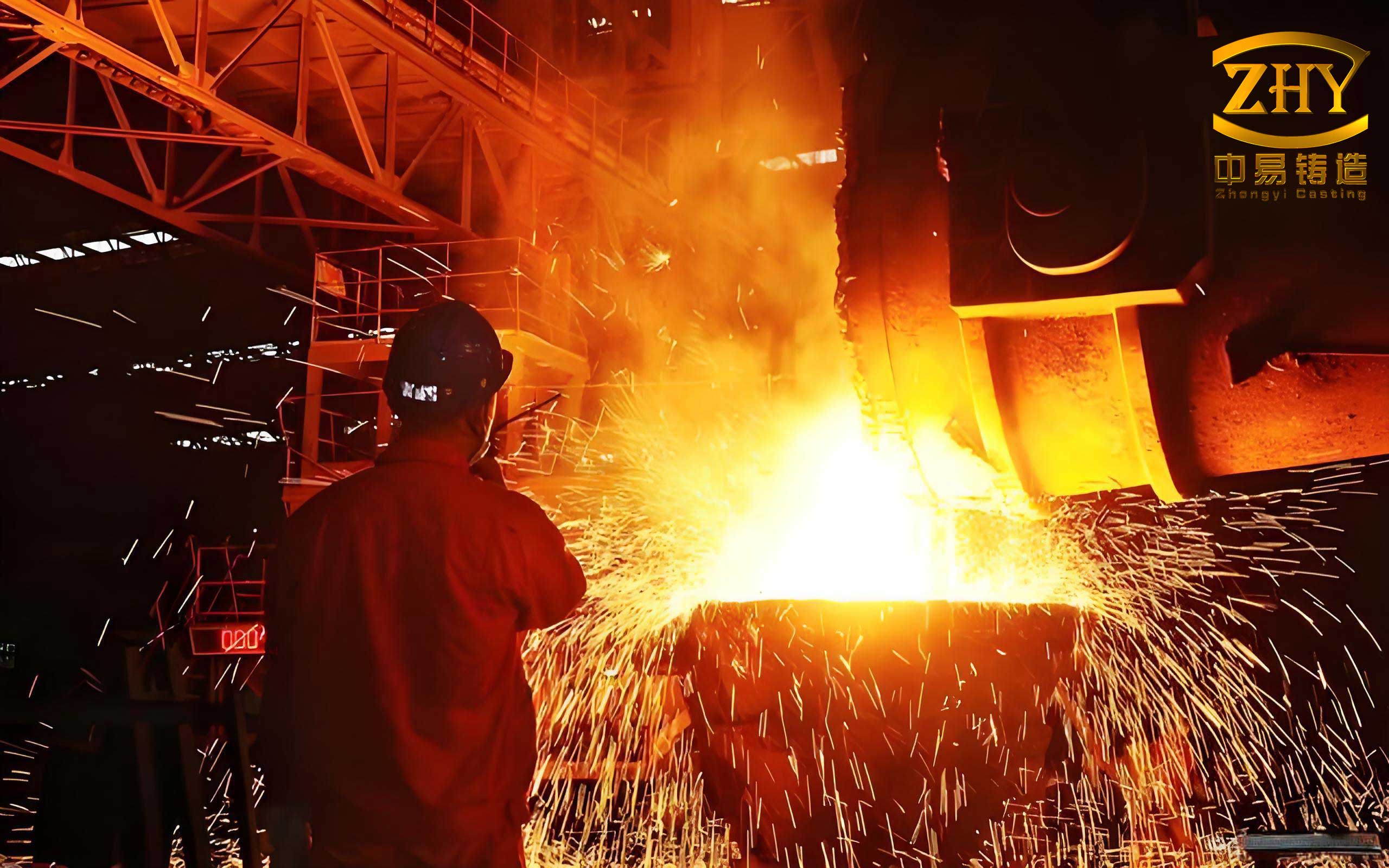
Product and Process Overview
We produce heavy-duty truck engine blocks and cylinder heads as key casting parts. The process utilizes cold-box resin sand for core making and green sand static pressure molding lines for high-volume output. Annual demand reaches approximately 100,000 tons, with VGI accounting for about 70% of the production. The material grades are RuT450 and RuT500, and the minimum wall thickness of these casting parts is 4.5 mm. The dimensional tolerances for rough casting parts adhere to DIN 1686-1 GTB15, as detailed in Table 1.
| Dimension (mm) | Tolerance (mm) |
|---|---|
| <18 | ±0.85 |
| 18–30 | ±0.95 |
| 30–50 | ±1.0 |
| 50–80 | ±1.1 |
| 80–120 | ±1.2 |
| 120–180 | ±1.3 |
| 180–250 | ±1.4 |
| 250–315 | ±1.5 |
| 315–400 | ±1.6 |
| 400–500 | ±1.7 |
| 500–630 | ±1.8 |
| 630–800 | ±1.9 |
| 800–1000 | ±2.0 |
The complexity of manufacturing these casting parts, with numerous influencing factors, initially led to substantial dimensional fluctuations. Through targeted efforts, we achieved stable dimensional control, ensuring that all casting parts conform to the required standards.
Casting Shrinkage Rate
The casting shrinkage rate, also known as linear shrinkage rate, is defined as the percentage contraction of a casting part from the start of solidification to room temperature. It is expressed as:
$$ \text{Shrinkage Rate} = \frac{L_{\text{pattern}} – L_{\text{casting}}}{L_{\text{pattern}}} \times 100\% $$
where \( L_{\text{pattern}} \) is the pattern length and \( L_{\text{casting}} \) is the actual length of the casting part. This rate depends not only on the metal’s inherent shrinkage but also on factors like casting part geometry, mold type, and gating system design.
Initially, lacking specific data for VGI casting parts, we referenced similar gray iron components. By pouring VGI molten metal and measuring representative dimensions, we derived preliminary shrinkage patterns. Tables 2 and 3 summarize part of the trial data for blocks and heads, respectively.
| Position | Design Value (mm) | Measured Average (mm) | Shrinkage Rate (%) | Average Shrinkage (%) |
|---|---|---|---|---|
| Width Direction | 576 | 569.2 | 1.12 | 1.13 |
| Width Direction | 535 | 529.2 | 1.08 | |
| Width Direction | 489 | 483.1 | 1.21 | |
| Width Direction | 206 | 203.8 | 1.07 | 1.02 |
| Width Direction | 200 | 197.9 | 1.05 | |
| Width Direction | 161.6 | 160.1 | 0.93 | |
| Height Direction | 409 | 405.1 | 0.95 | 0.98 |
| Height Direction | 348.5 | 344.8 | 1.06 | |
| Height Direction | 410 | 406.2 | 0.93 |
| Position | Design Value (mm) | Measured Average (mm) | Shrinkage Rate (%) | Average Shrinkage (%) |
|---|---|---|---|---|
| Length Direction | 1040 | 1026.8 | 1.27 | 1.23 |
| Length Direction | 800 | 790.2 | 1.22 | |
| Length Direction | 356 | 351.7 | 1.21 | |
| Width Direction | 324 | 320.2 | 1.17 | 1.18 |
| Width Direction | 256 | 252.9 | 1.21 | |
| Width Direction | 189 | 186.8 | 1.16 | |
| Height Direction | 156 | 154.2 | 1.15 | 1.16 |
| Height Direction | 120 | 118.7 | 1.08 | |
| Height Direction | 88 | 86.9 | 1.25 |
Based on these average shrinkage rates, we designed the initial process for formal sample production. However, full-size measurement revealed that shrinkage varied significantly across different regions of the casting parts. After iterative adjustments and process compensations, we established a standardized design specification for VGI engine casting parts, as shown in Table 4.
| Product | Length Direction Shrinkage (%) | Other Directions Shrinkage (%) | Process Compensation |
|---|---|---|---|
| Engine Block | 1.1 | 1.05 | Separate corrections for water jacket, cylinder bore, and crankcase partitions |
| Cylinder Head | 1.2 | 1.15 | Separate corrections for valve seat and injector holes |
This tailored approach ensures that each casting part achieves consistent dimensions, critical for subsequent machining operations.
Sand Core Dimension Control
For complex engine casting parts like blocks and heads, sand cores are essential in defining internal geometries. The dimensional accuracy of these cores directly impacts the final dimensions of the casting parts. In our production, a block comprises 12 cores, and a head comprises 14 cores, all made via cold-box resin sand process with over 80% automation in core handling and assembly. While cold-box cores enhance precision, high automation demands stricter stability in core dimensions. Core assembly dimensions are influenced by individual core accuracy and assembly techniques, sometimes leading to out-of-spec assemblies even with合格 individual cores. Therefore, core process design must holistically address these factors.
Core Process Design
Coating Thickness Design: Cold-box cores typically require coating application, and the thickness varies with coating type and density. This coating affects core dimensions, so we account for it during design. Coating thickness, measured after dipping and drying, is generally set between 0.2 mm and 0.5 mm, depending on the casting part structure and coating used.
Initial Strength Design: Automated core handling and assembly necessitate sufficient initial strength to resist deformation during clamping. Core strength depends on sand mixture, binder type, and dosage. For instance, cylinder bore and frame cores use standard resin, while water jacket and air passage cores require high-strength resin. Our control standards are outlined in Table 5.
| Core Type | Initial Strength (MPa) |
|---|---|
| Main Cores (e.g., thick sections) | ≥0.7 |
| Thin-Wall Cores (e.g., water jacket) | ≥1.2 |
| Intake/Exhaust Passage Cores | ≥1.0 |
Core Fit Dimension Design: With multiple cores of varying structures, precise fits and定位基准 are vital for assembly accuracy. We design定位间隙 of 0.15 mm for positioning surfaces and 0.3 mm for other fits, with maximum轮廓间隙 of 0.5–1 mm.
Core Box Negative Allowance Design: Similar to mold parting allowance, core box negative allowance compensates for dimensional increase due to core box deformation, clamping force during shooting, and sealing strip effects. By removing a specified value from core box surfaces, we ensure core dimensional accuracy. Typically, we set this at \( (0.6 \pm 0.1) \) mm, adjusted based on production realities.
Overall core assembly dimensions are also affected by core drying processes, fastening methods, and torque settings, all of which we monitor closely.
Core Box Quality Control
Material Selection: Core box material significantly influences dimensional precision. We choose 4Cr5MoSiV1 for main bodies due to its wear resistance and anti-deformation properties, with surface hardness of 38–40 HRC. Shooting plates and blow plates are made from QT500 cast iron.
Machining Requirements: Precision relies on advanced machining equipment. Sharp corners are processed via EDM, and mating surfaces are hand-fitted to avoid polishing that could alter dimensions. Surface treatments like carburizing (0.5–1.2 mm depth) or nitriding (0.1–0.3 mm depth) are applied when necessary. Key specifications are in Table 6.
| Core Box Component | Tolerance | Surface Roughness | Fit Accuracy |
|---|---|---|---|
| Main Body | ±0.1 mm | Ra 1.6 | ≤0.05 mm |
Maintenance and保养: Wear on core box surfaces and定位销套 over time can cause dimensional deviations. We implement a dedicated maintenance schedule: online cleaning every 200–300 cycles, offline cleaning every 500–600 cycles, and replacement of定位销套 when wear exceeds 0.2 mm. Similar protocols apply to molding plates, flasks, and fixtures.
Mold Sand and Mold Hardness Control
The mold is another critical element in shaping casting parts dimensions. Beyond pattern accuracy, mold strength and sand properties affect surface finish and dimensional precision. We control mold hardness using high-pressure molding to achieve a plane hardness ≥16 and vertical hardness ≥11 (measured with PFP hardness tester), providing sufficient rigidity to resist casting part收缩膨胀. Additionally, we use high-quality composite sands to ensure optimal casting performance. Key parameters include:
- Permeability: 130–170
- Green compressive strength: 0.12–0.15 MPa
- Compactability: 30–34%
The green compressive strength can be expressed as:
$$ \sigma_g = \frac{F}{A} $$
where \( \sigma_g \) is the green strength (MPa), \( F \) is the force at failure (N), and \( A \) is the cross-sectional area (mm²). By maintaining these parameters, we stabilize the dimensions of casting parts.
Melting Process Control
VGI production has a narrow process window, where fluctuations in vermiculizer composition, particularly magnesium content, significantly affect molten metal shrinkage and thus casting part dimensions. Through long-term monitoring, we tracked how different composition sets influenced dimensional stability of casting parts. Analysis revealed that elements like magnesium have a pronounced impact. Based on this data, we established a controlled melting process with strict limits on magnesium and other key elements. The relationship can be modeled as:
$$ \Delta D = k \cdot \Delta[Mg] + C $$
where \( \Delta D \) is the dimensional change in casting parts, \( \Delta[Mg] \) is the variation in magnesium content, \( k \) is a proportionality constant, and \( C \) accounts for other factors. By minimizing \( \Delta[Mg] \), we reduce dimensional scatter in casting parts.
Casting Distortion Control
Distortion is common in cylinder head casting parts, caused by铸造应力 from hindered contraction during cooling. In a stressed state, elastically stretched regions compress, while compressed regions stretch, leading to warpage. For instance, in a plate-like casting part, slower cooling at the center creates tensile stress, causing concave deformation, while faster-cooling edges develop compressive stress, resulting in convex distortion. The distortion \( \delta \) can be approximated by:
$$ \delta = \alpha \cdot \Delta T \cdot L^2 $$
where \( \alpha \) is the thermal expansion coefficient, \( \Delta T \) is the temperature gradient, and \( L \) is a characteristic length.
To mitigate distortion, we focus on reducing铸造应力 by slowing cooling rates to minimize temperature differences. We experimented with延长 cooling time in the mold for cylinder head casting parts, observing its effect on distortion, as summarized in Figure 3 trends. Data showed that distortion decreases with longer in-mold cooling, stabilizing after about 6 hours. Implementing extended cooling times effectively reduced distortion in production casting parts. For specific dimensions requiring further correction, we apply process反变形 allowances.
Conclusion
The dimensions of engine block and cylinder head casting parts are highly sensitive to production variables, but through systematic工艺 design and control, we can achieve effective stabilization. Key measures include:
- Selecting differentiated shrinkage rates for different dimensions of casting parts.
- Designing appropriate core initial strengths and negative allowances based on process requirements.
- Specifying strict material and machining criteria for core boxes and molds.
- Accounting for molten metal shrinkage effects on casting parts dimensions.
- Extending in-mold cooling time to minimize distortion in casting parts.
By integrating these approaches, we ensure that VGI engine casting parts consistently meet DIN 1686 GTB15 tolerance standards, enhancing reliability for machining and end-use applications. The continuous improvement in dimensional accuracy of casting parts underscores the importance of holistic foundry process management.