
In the context of global energy transitions and carbon neutrality goals, the efficiency improvement of coal-fired power plants remains a critical focus. As an expert involved in the manufacturing of large casting parts for supercritical and ultra-supercritical units, I have extensively studied the thermal processing challenges associated with 9Cr ferritic-martensitic steel casting parts. These casting parts, such as turbine casings and valves, operate under extreme conditions of temperature (590–610 °C) and pressure (22–34 MPa), necessitating superior high-temperature strength, creep resistance, and microstructural stability. However, traditional thermal processing routes for these casting parts often result in prolonged production cycles, microstructural inheritance, and frequent repair welding, leading to increased costs and delivery delays. Through rigorous experimentation and production trials, I have developed optimized thermal processing parameters that address these issues, significantly enhancing the efficiency and quality of 9Cr steel casting parts. This article delves into the material characteristics, existing problems, and detailed optimization strategies, employing tables and formulas to summarize key data and principles.
The 9Cr steel used for casting parts in supercritical units is a modified version of P91 steel, optimized for precipitation hardening through the formation of Laves phases, MX carbonitrides, and M23C6 carbides. Its chemical composition is meticulously controlled to achieve a fully martensitic structure without deleterious δ-ferrite, which can impair toughness and promote cracking during processing. The nominal and target chemical compositions for these casting parts are outlined in Table 1, reflecting stringent internal standards to ensure performance consistency.
| Element | Range | Target Value |
|---|---|---|
| C | 0.10–0.14 | 0.13 |
| Si | 0.20–0.35 | 0.30 |
| Mn | 0.40–0.60 | 0.50 |
| P | ≤0.020 | 0.015 |
| S | ≤0.005 | 0.005 |
| Cr | 8.80–9.40 | 9.10 |
| Mo | 0.95–1.05 | 1.00 |
| V | 0.20–0.25 | 0.21 |
| Nb | 0.06–0.08 | 0.07 |
| Ni | 0.20–0.60 | 0.40 |
| Al | ≤0.020 | 0.015 |
| N | 0.04–0.06 | 0.045 |
A key aspect in the design of these casting parts is preventing δ-ferrite formation, which is achieved by balancing chromium and nickel equivalents. The empirical relationship, derived from modified Schaeffler diagrams, ensures a fully martensitic matrix: $$ \frac{Ni_{eq}}{Cr_{eq}} \geq 0.42 $$ where $$ Ni_{eq} = \%Ni + 30\%C + 0.5\%Mn $$ and $$ Cr_{eq} = \%Cr + \%Mo + 1.5\%Si + 0.5\%Nb $$. This ratio guarantees that the casting parts exhibit optimal strength and toughness without brittle phases. Additionally, nitrogen plays a crucial role in forming MX-type precipitates (e.g., (Nb,V)(C,N)), which contribute to dispersion strengthening. The nitrogen-to-aluminum ratio must be maintained above 2:1 to prevent AlN formation, which would deplete nitrogen and coarsen carbides, degrading high-temperature performance.
The continuous cooling transformation (CCT) behavior of 9Cr steel casting parts is fundamental to thermal processing design. Using simulation software like JMatPro, the CCT curve for a typical composition (0.11% C, 0.32% Si, 0.47% Mn, 8.50% Cr, 0.85% Mo, 0.22% V, 0.076% Nb, 0.038% N) reveals critical temperatures: $$ Ac_1 \approx 810 \, ^\circ\text{C} $$, $$ Ac_3 \approx 920 \, ^\circ\text{C} $$, $$ M_s \approx 385 \, ^\circ\text{C} $$, and $$ M_f \approx 105 \, ^\circ\text{C} $$. The high hardenability implies that even slow cooling in molds can induce martensitic transformation, leading to cracking due to volumetric expansion. This necessitates controlled cooling strategies throughout the production of casting parts.
Traditional thermal processing for these casting parts involved cooling to room temperature in molds, which for heavy sections (e.g., 105-ton valve bodies) took up to 40 days, severely impacting production cycles. Moreover, preliminary heat treatments like homogenization annealing at high temperatures (e.g., 1050 °C) often resulted in microstructural inheritance, where coarse prior austenite grains persisted through subsequent normalizing, causing ultrasonic testing issues in thick-walled casting parts. Repair welding posed another challenge: preheating to 250 °C (between $$ M_s $$ and $$ M_f $$) and immediate post-weld tempering without complete martensitic transformation led to delayed cracking as retained austenite transformed during cooling, necessitating multiple repair cycles and tempering operations. These issues underscored the need for optimized thermal processing of casting parts.
To address these problems, I have developed and implemented a series of optimized steps for casting parts, focusing on shakeout, pre-heat treatment, tempering, repair welding, and controlled heating/cooling rates. Each optimization is backed by metallurgical principles and practical considerations for casting parts.
Optimized Shakeout Process: Instead of cooling casting parts to room temperature in molds, high-temperature shakeout is employed to shorten production cycles by 15–20 days. Based on high-temperature tensile tests of as-cast 9Cr steel casting parts, the strength at 450 °C exceeds 340 MPa, sufficient to prevent deformation during handling. Therefore, shakeout is conducted when the casting parts temperature reaches 400–450 °C, above the $$ M_s $$ point, ensuring the microstructure remains austenitic and less prone to cracking. Precautions include avoiding drafts in cold weather to prevent rapid local cooling. The shakeout procedure involves lifting casting parts slowly with multiple support points, vibrating out sand cores, and transferring to annealing furnaces preheated to 200–300 °C. Residual sand in internal cavities must be partially retained to avoid cracking during subsequent heating, but passages should be cleared to ensure proper heat treatment.
Optimized Pre-Heat Treatment (Annealing): To eliminate microsegregation and refine grain size in casting parts, pre-heat treatment is performed near the $$ Ac_3 $$ temperature. Traditional diffusion annealing at high temperatures (e.g., 1050 °C) causes grain coarsening and inheritance. By annealing at $$ Ac_3 + (30–100 \, ^\circ\text{C}) $$, typically around 950–1000 °C, austenite recrystallization occurs, forming spherical primary austenite grains and breaking the K-S orientation relationship. This refines the grain structure, enhancing ultrasonic inspectability and mechanical properties in thick-walled casting parts. After annealing, casting parts are cooled to 400 °C before removal for riser cutting and cleaning, with temperature maintained above 350 °C to prevent cracking. If cutting operations are prolonged, casting parts should be reheated in furnaces at 400 °C.
Optimized Repair Welding and Post-Weld Heat Treatment: Repair welding is critical for casting parts, especially for defects like shrinkage porosity. The optimized protocol includes preheating to 200–250 °C, with interpass temperature controlled below 300 °C to avoid hot cracking and allow partial martensitic transformation between weld passes. After welding, casting parts must be cooled to below $$ M_f $$ (≤80 °C) to ensure complete martensitic transformation in the weld zone, preventing delayed cracking. A key innovation is the addition of a dehydrogenation treatment before final tempering: casting parts are heated to $$ 425 \pm 10 \, ^\circ\text{C} $$ and held for at least 4 hours (based on section thickness, as per Table 2), then slowly cooled to room temperature. This reduces hydrogen content, minimizes the need for multiple tempering cycles, and allows for non-destructive testing and re-welding if needed, ultimately reducing repair cycles from 3–4 to 1–2 for casting parts. Final post-weld tempering is conducted at 720 °C for a minimum of 8 hours to achieve tempered martensite with optimal precipitate distribution.
Optimized Heating and Cooling Rates: Due to the low thermal conductivity and high coefficient of thermal expansion of 9Cr steel casting parts, controlled heating and cooling rates are essential to prevent thermal stresses and cracking. Heating rates are generally limited to 50 °C/h, while cooling rates (except during quenching) are kept below 30 °C/h. These rates facilitate uniform temperature distribution and minimize distortion in casting parts. The heating process also influences alloy element dissolution and precipitate formation, which can be modeled using kinetic equations. For instance, the dissolution of carbides during heating can be described by: $$ \frac{dC}{dt} = -k (C – C_{eq}) $$ where $$ C $$ is the concentration of solute, $$ C_{eq} $$ is the equilibrium concentration, and $$ k $$ is a rate constant dependent on temperature and diffusion coefficients specific to casting parts.
The overall optimized thermal processing parameters for 9Cr steel casting parts are summarized in Figure 4 (referenced from original work, but not shown here). A detailed breakdown of soaking times for different heat treatment stages is provided in Table 2, based on section thickness of casting parts.
| Symbol | Heat Treatment Procedure | Soaking Time Requirement |
|---|---|---|
| A | Annealing and Normalizing | 25 mm/h, minimum 8 h |
| B | Tempering | 25 mm/h, minimum 12 h |
| C | Dehydrogenation | 25 mm/h, minimum 4 h |
| D | Post-Weld Tempering | 25 mm/h, minimum 8 h |
For casting parts with wall thickness exceeding 450 mm, double tempering is recommended to ensure complete precipitate coalescence and stress relief. Additionally, if standard specifications mandate diffusion annealing for casting parts, an intermediate annealing at 900 °C can be inserted between diffusion annealing and normalizing to refine grains and prevent mixed grain structures.
In production practice, these optimized parameters have been successfully applied to various casting parts for supercritical units, such as turbine cylinders and valve bodies. The implementation has demonstrated tangible benefits: high-temperature shakeout reduces production time by 15–20 days; pre-heat treatment near $$ Ac_3 $$ eliminates microstructural inheritance and refines grains; controlled cooling after welding and dehydrogenation cuts repair cycles; and regulated heating/cooling rates effectively prevent cracks in casting parts. The mechanical properties, including tensile strength, impact toughness, and creep resistance, meet or exceed standard requirements for casting parts.
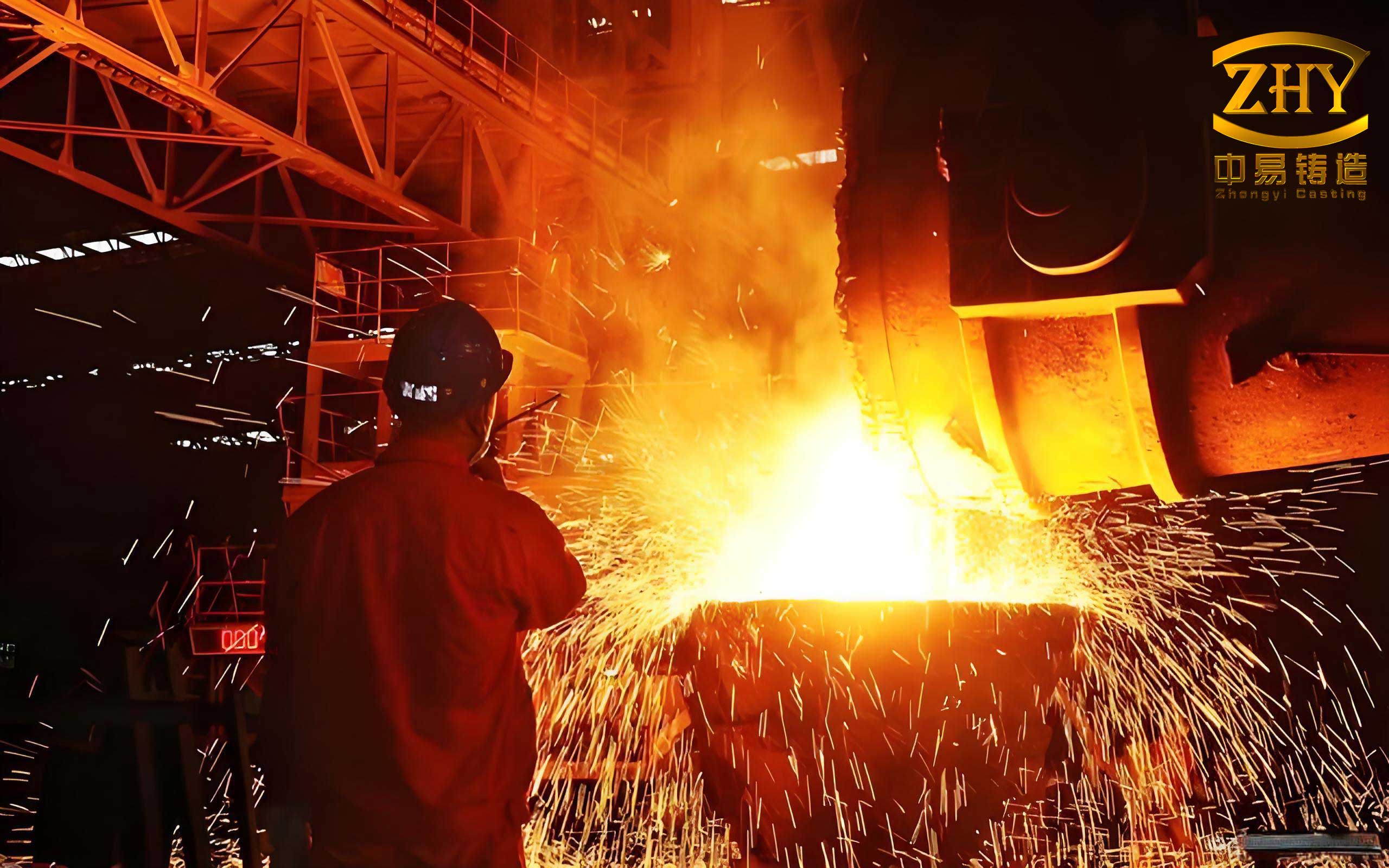
The microstructural evolution in these casting parts during thermal processing can be further analyzed using phase transformation models. For example, the kinetics of martensitic transformation upon cooling can be expressed by the Koistinen-Marburger equation: $$ f = 1 – \exp[-k(M_s – T)] $$ where $$ f $$ is the volume fraction of martensite, $$ T $$ is the temperature, and $$ k $$ is a material constant. Similarly, the growth of precipitates like MX and M23C6 during tempering follows Ostwald ripening theory: $$ r^3 – r_0^3 = K t $$ where $$ r $$ is the average precipitate radius, $$ r_0 $$ is the initial radius, $$ K $$ is a temperature-dependent rate constant, and $$ t $$ is time. These models help optimize tempering temperatures and times for casting parts to achieve desired precipitate sizes and distributions.
Furthermore, the design of casting parts must account for thermal stresses during processing. Using finite element analysis, the temperature distribution and stress fields can be simulated to prevent hotspots and cracking. The governing heat transfer equation is: $$ \rho c_p \frac{\partial T}{\partial t} = \nabla \cdot (k \nabla T) + Q $$ where $$ \rho $$ is density, $$ c_p $$ is specific heat, $$ k $$ is thermal conductivity, and $$ Q $$ is internal heat generation (e.g., from phase transformations in casting parts). Coupled with constitutive models for creep and plasticity, this allows for predictive optimization of heating and cooling schedules for casting parts.
In conclusion, the optimized thermal processing strategy for 9Cr steel casting parts in supercritical units addresses critical issues of production efficiency, microstructural control, and defect prevention. By adopting high-temperature shakeout, refined pre-heat treatments, controlled repair welding with dehydrogenation, and regulated heating/cooling rates, casting parts manufacturers can achieve shorter cycles, reduced costs, and enhanced reliability. These advancements are vital for meeting the growing demand for high-efficiency power generation components, supporting global energy transitions. Future work may focus on integrating real-time monitoring and adaptive control systems to further tailor thermal processing for individual casting parts, leveraging data-driven approaches for continuous improvement.