
In modern foundry operations, the cooling of casting parts is a critical process that directly impacts product quality, operational safety, and cost-efficiency. As an engineer specializing in casting equipment design, I have been involved in developing and implementing advanced cooling solutions. This article presents our work on an intelligent water spray cooling system for casting parts, detailing its necessity, structural components, control principles, and programming. The system leverages automated proportional valve control based on heat transfer calculations, ensuring precise temperature management for casting parts. We will explore this topic through extensive analysis, incorporating formulas and tables to summarize key concepts.
The necessity of cooling casting parts on molding lines cannot be overstated. During casting, molten metal solidifies into casting parts, releasing substantial heat. Without proper cooling, several issues arise, which we have categorized into four main areas. First, safety concerns: the excessive heat can lead to equipment overheating, potentially causing fires or mechanical failures. Moreover, high temperatures pose health risks to workers, such as heat stress or burns. Second, damage prevention: casting parts at elevated temperatures exhibit reduced rigidity, making them susceptible to磕碰 (impact) damage during subsequent processes like shakeout or vibration conveying. For instance, in vibratory feeders or shot blasting, hot casting parts may suffer from over-cleaning or surface defects due to high-speed projectile impacts. Third, quality enhancement: high temperatures alter the physical properties of molding sand, affecting dimensional accuracy and surface finish of casting parts. By cooling, we stabilize the sand’s performance, minimizing defects like shrinkage or warping. Fourth, equipment longevity: thermal stress from prolonged exposure to heat accelerates wear and tear on machinery, shortening its lifespan. Effective cooling reduces this stress, lowering maintenance costs and extending service life. These points underscore why cooling is indispensable in casting production.
To address these needs, various cooling methods exist, such as water quenching, air cooling, sand immersion, and forced air cooling. In our system, we focus on water spray cooling, which involves atomizing cooling water through nozzles onto hot casting parts. This method utilizes water’s high heat capacity and latent heat of vaporization for efficient cooling. The structure of our intelligent water spray cooling system comprises several key components, as summarized in the table below.
| Component | Description | Function |
|---|---|---|
| Nozzle Array | Multiple nozzles arranged along the conveyor line | Spray atomized water onto casting parts |
| Proportional Control Valve | Electronically controlled valve for water flow regulation | Adjusts water volume based on real-time data |
| Temperature Sensors | Infrared or thermocouple sensors at multiple points | Monitors temperature of casting parts |
| Conveyor System | 鳞板机 (pallet conveyor) for moving casting parts | Transports casting parts through cooling zone |
| PLC Controller | Programmable Logic Controller (e.g., Mitsubishi R series) | Executes control algorithms and data processing |
| Human-Machine Interface (HMI) | Touchscreen for monitoring and parameter setting | Displays real-time status and allows user input |
| Water Supply System | Includes filters, pressure regulators, and pumps | Provides consistent water pressure and quality |
| Ventilation Fans | Exhaust fans to remove steam and hot air | Maintains a safe working environment |
The system is designed as a modular setup, with multiple cooling zones along the conveyor. Each zone has independent control to handle varying temperatures of casting parts. For illustration, here is a visual representation of a typical cooling zone setup:
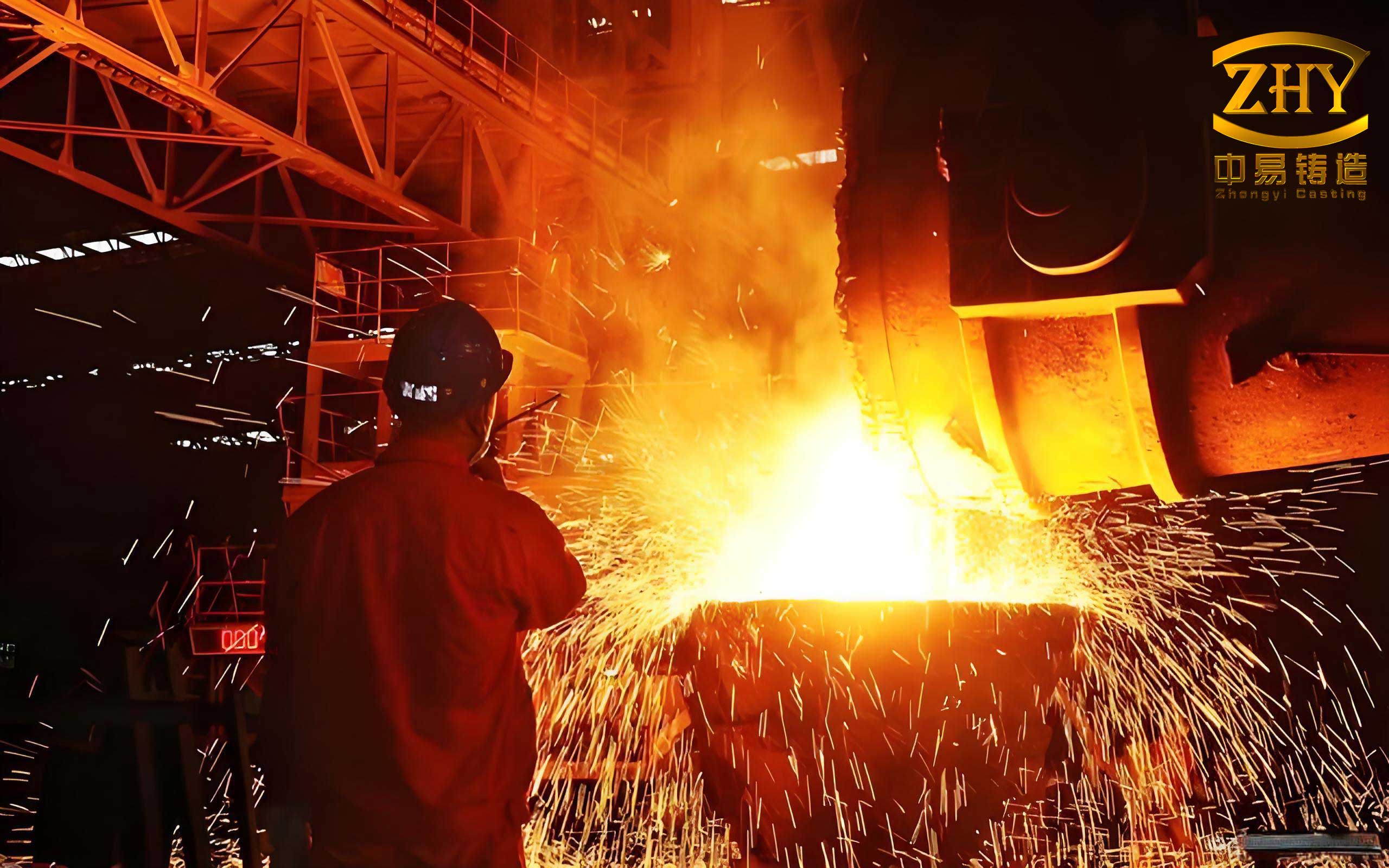
In this configuration, casting parts move on the conveyor through zones where temperature sensors detect their heat, and nozzles spray water accordingly. The ventilation fans help dissipate steam, ensuring visibility and safety. This setup is crucial for handling diverse casting parts, from small components to large assemblies.
The core of our intelligent system lies in the control principle based on heat conservation. We calculate the required water spray volume using fundamental thermodynamics. The heat released by casting parts during cooling must equal the heat absorbed by the water. This involves two phases: water heating and water vaporization. Let’s derive the formulas step by step.
First, the heat released by casting parts, denoted as Q (in joules), is given by:
$$ Q = m \cdot c \cdot \Delta T $$
where:
– \( m \) is the mass of casting parts (in kg),
– \( c \) is the specific heat capacity of the casting material (in J/(kg·K)),
– \( \Delta T \) is the temperature change of casting parts (in °C or K, since the difference is the same).
Next, the heat absorbed by water includes two components: the sensible heat for temperature rise and the latent heat for vaporization. We express this as:
$$ Q_{\text{water}} = Q_1 + Q_2 $$
where \( Q_1 \) is the heat for water heating:
$$ Q_1 = m_1 \cdot c_1 \cdot \Delta T_1 $$
and \( Q_2 \) is the heat for water vaporization:
$$ Q_2 = m_2 \cdot L $$
Here:
– \( m_1 \) is the mass of water that heats up (in kg),
– \( c_1 \) is the specific heat capacity of water (approximately 4186 J/(kg·K)),
– \( \Delta T_1 \) is the temperature change of water (assumed constant in our system, e.g., from ambient to near boiling),
– \( m_2 \) is the mass of water that vaporizes (in kg),
– \( L \) is the latent heat of vaporization of water (approximately 2.26 × 10^6 J/kg).
In our system, we assume all sprayed water vaporizes upon contact with hot casting parts, so \( m_1 = m_2 = m_w \), where \( m_w \) is the total water mass sprayed. Thus, the heat conservation equation becomes:
$$ m \cdot c \cdot \Delta T = m_w \cdot c_1 \cdot \Delta T_1 + m_w \cdot L $$
Simplifying, we solve for \( m_w \):
$$ m_w = \frac{m \cdot c \cdot \Delta T}{c_1 \cdot \Delta T_1 + L} $$
This formula is pivotal for our control system. The variables \( m \) and \( \Delta T \) are dynamic, depending on the casting parts being processed, while \( c_1 \), \( \Delta T_1 \), and \( L \) are approximately constant. We use this to compute the required water flow rate in real-time. To illustrate, consider typical values for casting parts made of cast iron: \( c \approx 460 \, \text{J/(kg·K)} \), initial temperature of casting parts at 800°C, target temperature at 200°C, so \( \Delta T = 600°C \). Assuming water source temperature at 20°C and vaporizing at 100°C, \( \Delta T_1 = 80°C \). For a casting part mass of 10 kg, the water mass required is:
$$ m_w = \frac{10 \times 460 \times 600}{4186 \times 80 + 2.26 \times 10^6} \approx \frac{2.76 \times 10^6}{3.35 \times 10^5 + 2.26 \times 10^6} \approx \frac{2.76 \times 10^6}{2.595 \times 10^6} \approx 1.06 \, \text{kg} $$
This translates to about 1.06 liters of water per casting part, given water’s density. In practice, we adjust for conveyor speed and multiple casting parts.
To handle such calculations efficiently, we implemented an intelligent proportional valve control system. The proportional valve regulates water flow based on the computed \( m_w \), with feedback from flow meters and temperature sensors. The control schematic involves multiple stages: water supply passes through filters and pressure regulators, then to the proportional valve, which adjusts the flow to nozzles. We use PLC programming to automate this process. The key parameters are set via the HMI, including target temperature, casting part mass, water source temperature, and spray duration. The PLC continuously monitors inputs and outputs control signals to the valve.
Our programming approach uses function blocks for modularity. For each cooling zone, we call a program block that calculates the water flow rate. The HMI displays real-time data, such as conveyor speed, water pressure, flow rates, and casting part temperatures. We have designed three main screens: operational status, detailed monitoring, and parameter setting. The setting screen allows operators to input variables like casting part mass per second (based on conveyor speed), cooling water temperature, and desired temperature drop. The PLC then computes the proportional valve opening using the derived formula. Additionally, we included a simulation mode to predict the final temperature of casting parts under given conditions, aiding in system tuning.
The benefits of this intelligent system are manifold. First, it enables rapid cooling of casting parts, reducing cycle times and increasing productivity. Second, it promotes energy efficiency by minimizing water usage through precise control—this aligns with environmental sustainability goals. Third, the system is versatile, applicable to various casting parts and materials. Fourth, the automated operation reduces labor intensity and human error. To quantify these advantages, we conducted tests comparing traditional cooling methods with our intelligent system. The results are summarized in the table below.
| Aspect | Traditional Cooling | Intelligent Water Spray Cooling | Improvement |
|---|---|---|---|
| Cooling Time for Casting Parts | 30-60 minutes | 5-10 minutes | Up to 80% reduction |
| Water Consumption per Ton of Casting Parts | 500-1000 liters | 200-400 liters | 50-60% savings |
| Defect Rate in Casting Parts | 5-10% | 1-2% | Significant quality enhancement |
| Energy Usage | High due to inefficiencies | Optimized via proportional control | Approximately 30% lower |
| Operational Safety | Moderate, with heat hazards | High, with automated monitoring | Enhanced worker protection |
These improvements highlight how intelligent cooling transforms casting part production. Moreover, the system’s adaptability allows for integration with broader Industry 4.0 initiatives, such as data logging for predictive maintenance and quality traceability.
In terms of implementation, we faced challenges like sensor accuracy and water quality management. For instance, temperature sensors must be calibrated regularly to ensure reliable data for casting parts. We addressed this by incorporating auto-correction routines in the PLC. Water filters prevent nozzle clogging, maintaining consistent spray patterns. The proportional valve’s response time is critical; we selected high-speed valves to match dynamic changes in casting part temperatures. The programming logic also includes fail-safes, such as automatic shutdown if abnormal conditions are detected, ensuring system robustness.
Looking ahead, the future of casting part cooling lies in further智能化 (intelligence). We envision systems that use machine learning to predict cooling requirements based on historical data, adapting to variations in casting part geometry and material composition. IoT connectivity could enable remote monitoring and control, reducing downtime. Additionally, advancements in nozzle technology may improve water atomization, enhancing heat transfer efficiency. Our ongoing research focuses on integrating these elements to create even more responsive and sustainable cooling solutions for casting parts.
In conclusion, the intelligent water spray cooling system represents a significant leap in foundry technology. By leveraging heat transfer principles and automated control, we achieve precise temperature management for casting parts, boosting quality, safety, and efficiency. As casting parts become more complex and production demands grow, such智能化 systems will be essential for competitive manufacturing. We are committed to refining this technology, contributing to the evolution of smart foundries where every casting part meets exacting standards with minimal resource expenditure.