
The development of high-integrity casting parts, such as engine cylinder blocks and heads, has historically been governed by a costly and time-intensive paradigm of trial-and-error. This traditional approach is intrinsically limited by the experience of foundry engineers, the prohibitive costs of physical prototyping, extended development cycles, and the complex, multivariate nature of the casting process itself. Consequently, achieving an optimal casting process recipe for a new product on the first attempt was often an elusive goal. The advent and maturation of Computer-Aided Engineering (CAE) technologies have fundamentally altered this landscape. Today, the use of specialized simulation software to analyze the casting process is not merely an advanced tool but an indispensable standard for predicting process robustness, feasibility, and potential defects prior to any metal being poured.
In the critical phase of new product introduction, CAE simulation plays a pivotal role. It enables engineers to proactively identify risks within a proposed casting process, dramatically shortening the development and production ramp-up timeline, thereby ensuring a smoother and more reliable launch. Equally important is its application in the continuous improvement of existing casting parts, where it serves as a diagnostic and optimization tool to enhance yield and quality. The core methodology involves simulating various process scenarios—analyzing mold filling, solidification, stress development, and microstructure—and iteratively refining the virtual model based on correlation with physical validation results. This cyclical process of simulation, validation, and model calibration enhances the predictive accuracy of the CAE system, transforming it into an ever-more effective guide for both production and R&D.
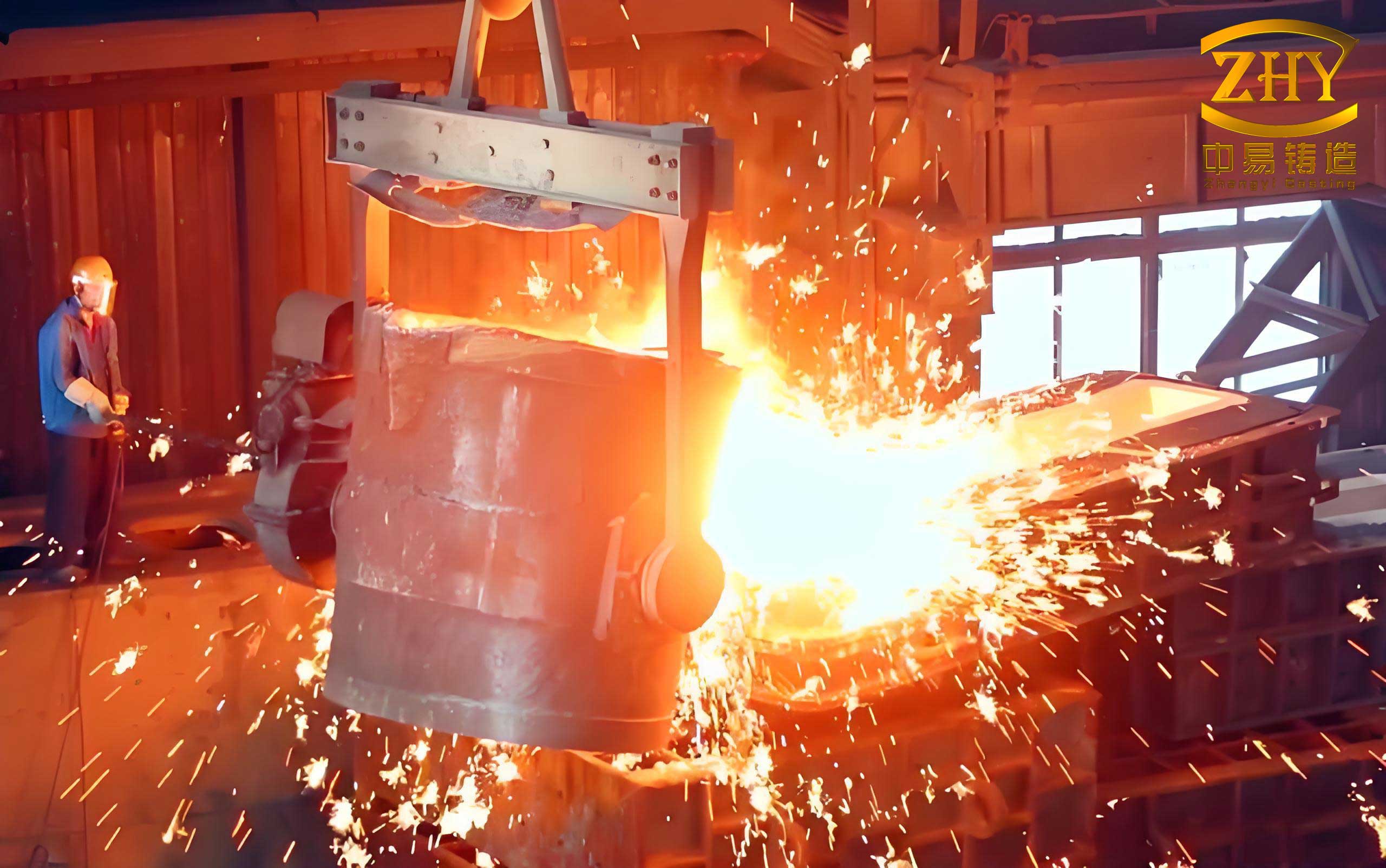
This article synthesizes principles and applications from contemporary foundry practice to elaborate on how CAE simulation, exemplified by platforms like MAGMASOFT®, is utilized to iteratively optimize casting processes for complex casting parts through systematic analysis of filling, solidification, and material properties.
1. CAE Simulation in the Casting Development Workflow
1.1 Filling Process Simulation and Optimization
The mold filling stage is a critical determinant of final quality in casting parts. Turbulent flow can lead to a host of defects. CAE simulation allows for a detailed prediction of parameters such as melt front temperature, velocity fields, and air entrainment, enabling engineers to assess the rationality of the filling pattern and mitigate potential risks.
1.1.1 Analysis and Mitigation of Air Entrainment & Gas Porosity
Gas porosity defects in casting parts primarily originate from air or gases being entrapped within the molten metal during filling and failing to escape before the metal solidifies. CAE software can visualize areas prone to air entrainment based on fluid dynamics simulation.
A key principle for gating system design is to maintain a “choked” or pressurized system where the cross-sectional area decreases towards the ingates, ensuring the runners remain full throughout filling. This minimizes air aspiration. For multi-level gating systems commonly used for tall casting parts like cylinder blocks, the filling sequence is paramount. The molten metal should first flow through the bottom ingates, allowing the cavity to fill progressively and calmly. Premature activation of middle or top ingates can cause metal splash, significantly increasing air entrainment. This is often corrected by adjusting the cross-sectional area ratios between different ingate levels to control the pressure balance within the system.
Furthermore, the temperature field at the end of filling is crucial. As temperature drops, the solubility of gases in the melt decreases. Isolated cold spots at the end of fill can trap gases, leading to porosity. Optimizing the gating design to ensure faster filling or improved thermal uniformity can raise the temperature in these critical areas, reducing porosity risk. The governing fluid flow equations solved during filling simulation are the Navier-Stokes equations for incompressible flow, often coupled with a volume-of-fluid (VOF) method to track the melt front:
$$ \rho \left( \frac{\partial \mathbf{v}}{\partial t} + \mathbf{v} \cdot \nabla \mathbf{v} \right) = -\nabla p + \mu \nabla^2 \mathbf{v} + \rho \mathbf{g} $$
$$ \nabla \cdot \mathbf{v} = 0 $$
Where \( \rho \) is density, \( \mathbf{v} \) is velocity, \( p \) is pressure, \( \mu \) is dynamic viscosity, and \( \mathbf{g} \) is gravity.
| Filling-Related Defect in Casting Parts | Primary CAE Prediction Parameter | Typical Mitigation Strategy |
|---|---|---|
| Gas Porosity (Entrained Air) | Air Entrainment Index, Filling Temperature | Optimize gating to reduce turbulence, ensure pressurized system, improve venting. |
| Sand Inclusions / Erosion | Velocity at Ingates & in Cavity, Flow Direction | Limit ingate velocity, design gating to avoid direct impingement on sand cores. |
| Cold Shuts / Misruns | Melt Front Temperature, Filling Time | Increase pouring temperature, modify gating to shorten flow paths or increase feed pressure. |
| Dross/Slag Inclusion | Flow Trajectory of First Metal | Design effective overflow wells to trap and isolate oxide-laden first metal. |
1.1.2 Analysis of Sand Erosion and Inclusion Defects
Sand-related defects in casting parts occur when the mold or core surface is eroded by high-velocity or impinging metal flow, with the dislodged sand particles becoming trapped in the casting. Empirical knowledge and simulation guide that for medium to large castings, the metal velocity at the ingates should typically be maintained below a critical threshold, often in the range of 1.0 – 1.2 m/s, to prevent erosion.
CAE simulation allows for the placement of virtual velocity sensors at critical points—such as at the choke, each ingate, and within the cavity—to verify that the design intent is met. The analysis confirms whether the choke maintains the highest velocity (as designed) and whether the cavity fills smoothly with velocities well below the erosion limit.
For multi-level gating, it is also vital to ensure that the metal stream from middle and top ingates falls onto the already filled molten metal pool below, not directly onto vulnerable sand surfaces. Direct impingement is a major cause of local sand erosion. This can be corrected by increasing the cross-sectional area of the lower ingates to delay the activation of the upper ones.
To mitigate slag or dross inclusions, which are often oxides carried with the initial, cooler metal stream, the design of overflow wells is critical. CAE simulation of particle or “first metal” trajectory tracking can visually confirm whether these overflows successfully capture the contaminated front of the melt, thereby protecting the integrity of the main casting parts.
1.2 Solidification Process Simulation and Optimization
The solidification phase dictates the soundness of casting parts by influencing shrinkage porosity and microstructure. CAE simulation predicts the evolution of the solid fraction, temperature gradients, and feeding paths to identify potential shrinkage defects and guide the placement of feeders and chills.
1.2.1 Prediction and Control of Shrinkage Porosity
Shrinkage defects form in isolated liquid pockets that become cut off from the feeding source (riser or feeder) during solidification. CAE software calculates the time-dependent liquid fraction, allowing engineers to visualize the progression of solidification fronts and the location of last-to-freeze zones.
By comparing different process scenarios, such as with and without chills, the effectiveness of directional solidification strategies can be assessed. For instance, in a cylinder head, critical areas like fuel injector bosses are prone to hot spots. Adding chills adjacent to these bosses accelerates local cooling, changes the solidification sequence, and eliminates or reduces the size of isolated liquid pools. The solidification process is governed by the heat transfer equation, which includes the release of latent heat \( L \):
$$ \rho c_p \frac{\partial T}{\partial t} = \nabla \cdot (k \nabla T) + \rho L \frac{\partial f_s}{\partial t} $$
Where \( c_p \) is specific heat, \( k \) is thermal conductivity, \( T \) is temperature, \( t \) is time, and \( f_s \) is solid fraction. The Niyama criterion is a widely used metric derived from simulation data to predict shrinkage porosity risk, expressed as:
$$ N_y = \frac{G}{\sqrt{\dot{T}}} $$
Where \( G \) is the temperature gradient and \( \dot{T} \) is the cooling rate at the end of solidification. Regions with a Niyama value below a critical threshold are predicted to be prone to microporosity.
The ultimate validation of a solidification process is the predicted size and location of shrinkage cavities. Simulation provides a quantitative volume of macro-porosity, enabling direct comparison between alternative designs. The optimal design is the one that minimizes both the volume and the criticality of the location of predicted shrinkage in the final casting parts.
| Solidification Strategy for Casting Parts | CAE Analysis Metric | Impact on Defect Risk |
|---|---|---|
| Riser/Feeder Design & Placement | Feeding Path, Pressure Drop, Solidification Time | Directly controls macro-shrinkage location; ensures adequate pressure for feeding. |
| Chill Placement | Local Cooling Rate, Thermal Gradient, Liquid Fraction Plot | Promotes directional solidification, eliminates isolated hot spots, reduces microporosity. |
| Mold Material & Coating | Interfacial Heat Transfer Coefficient (IHTC) | Influences overall solidification rate and temperature gradient; key boundary condition. |
2. Simulation and Validation of Material Properties in Casting Parts
Modern CAE tools extend beyond defect prediction to the estimation of as-cast mechanical properties, linking the simulated thermal history to microstructure and performance. This capability is crucial for casting parts with stringent, location-specific property requirements.
2.1 Predictive Modeling of Strength and Hardness
Based on the simulated thermal history (cooling rates) at every point within the casting parts and a defined chemical composition, CAE software can estimate local microstructure features (like dendrite arm spacing, graphite nodule count in ductile iron) and subsequently predict mechanical properties such as hardness (HBW) and ultimate tensile strength (UTS).
For example, consider a cylinder block where the main bearing cap section (a critical load-bearing area) is required to meet a minimum UTS. If initial production samples show lower-than-specified strength, metallurgical analysis might indicate coarse microstructure due to slower cooling in that region, potentially caused by its proximity to a gating element. A process modification, such as reducing the local ingate size to increase the cooling rate, can be proposed.
This modification’s impact can be virtually tested. The simulation for the original and modified processes would predict property maps. The improvement can be quantified by comparing predicted values at the specific test location using formulas often based on empirical relationships with cooling rate, such as for secondary dendrite arm spacing (SDAS, \( \lambda_2 \)) and its influence on strength:
$$ \lambda_2 = A \cdot (\dot{T})^{-n} $$
$$ \sigma_{UTS} \propto (\lambda_2)^{-1/2} $$
Where \( \dot{T} \) is the cooling rate, and \( A \) and \( n \) are material constants. A successful virtual modification would show a clear increase in predicted UTS and hardness at the target location, justifying a production trial.
2.2 Correlation with Physical Production and Model Calibration
The true test of any simulation lies in its correlation with physical reality. After implementing the optimized process in production, samples from multiple batches are tested. The results are then compared to the simulation predictions.
| Property & Location | Simulated Value (Opt. Process) | Average Measured Value (Production) | Trend Correlation |
|---|---|---|---|
| Hardness at CP2 (HBW) | 211.2 | 202.5 | Good (Consistent Offset) |
| Hardness at CP3 (HBW) | 207.7 | 192.8 | Good (Consistent Offset) |
| Tensile Strength at CP2 (MPa) | 252.8 | 239.4 | Good (Consistent Offset) |
| Tensile Strength at CP3 (MPa) | 248.3 | 236.2 | Good (Consistent Offset) |
As seen in the table above, the simulation accurately predicted the trend of improvement from the old to the new process. The consistent offset between simulated and measured absolute values is expected and highlights the importance of model calibration. This discrepancy may arise from simplifications in the material model, assumptions about graphite formation, or variations in actual process parameters not fully captured in the simulation (e.g., exact mold sand properties, minor chemistry variations). This correlation exercise provides vital data to further refine the simulation’s boundary conditions and material database, enhancing its predictive accuracy for future development of casting parts.
3. Conclusion
The integration of CAE simulation into the development and production of critical casting parts represents a paradigm shift from reactive problem-solving to proactive process engineering. By systematically analyzing the filling and solidification processes, potential defects such as gas porosity, sand inclusions, and shrinkage cavities can be identified and mitigated in the virtual realm, long before tooling is committed. Furthermore, the ability to predict local mechanical properties links process parameters directly to performance requirements, enabling the design of robust processes that yield high-integrity casting parts consistently.
Key outcomes of applying CAE simulation include:
- Defect Prevention: Filling analysis ensures a non-turbulent, thermally balanced fill to minimize air entrainment and sand erosion. Solidification analysis guides the strategic use of chills and risers to promote soundness and eliminate shrinkage.
- Process Optimization: It enables rapid, cost-effective iteration of gating, feeding, and cooling system designs to achieve optimal results, dramatically reducing the number of physical trials required.
- Predictive Performance Engineering: By estimating mechanical properties from the thermal history, simulation helps ensure that casting parts meet their functional specifications, contributing to overall product reliability.
- Knowledge Capture & Continuous Improvement: The correlation between simulation and production results refines the virtual model, building a company-specific knowledge base that makes future development cycles for new casting parts even faster and more accurate.
In essence, CAE simulation has evolved from a specialized tool into a foundational element of modern foundry practice, essential for achieving quality, efficiency, and innovation in the production of complex metal casting parts.