
In the production of large gantry worktable casting parts, achieving high dimensional accuracy, mechanical properties, and surface quality is paramount. These casting parts are typically rectangular with substantial dimensions, demanding stringent hardness, appearance, and process performance requirements. In my experience, most machine tool casting parts in our industry utilize furan resin sand molding, a mature process known for its stability. This method offers high strength, excellent shape retention during casting, reduced defect probability, and improved precision for complex geometries. However, it has inherent drawbacks: harmful gas emissions during curing, high raw material costs, and significant gas generation. To address common defects like blowholes, slag inclusions, and shrinkage porosity in T-slot surfaces, I embarked on optimizing the pouring process, focusing on a bottom-up (reverse bottom) pouring technique. This article details my first-person perspective on the improvement journey, incorporating theoretical insights and practical applications to enhance the quality of these critical casting parts.
The gantry worktable casting parts discussed here are designed for lightweight gantry machining centers, serving as stable supports for workpieces. After machining, the casting parts exhibit dimensions of 4000 mm × 2500 mm × 255 mm, with a material specification of HT300 and a hardness range of HBW 170–230, where the variation must not exceed 25 HBW. The as-cast mass is approximately 4950 kg per piece, and dimensional tolerances adhere to the GB/T 6414-2017 standard, specifically DCTG11 grade. These casting parts feature T-slots on a large planar surface, which are prone to defects due to their geometry and solidification characteristics. In planning the process, I carefully considered the parting line location, opting to position the highest large plane as the parting surface. This ensures that the quality-critical T-slot surface resides in the drag portion of the mold, minimizing turbulence and defect formation. The core for the internal cavity was designed with side prints resting on the drag, supported by a robust weldment of ϕ20 steel bars to prevent cracking. Venting ropes were wrapped around the core prints, and vents were incorporated at the parting line to facilitate gas escape, crucial for producing sound casting parts.
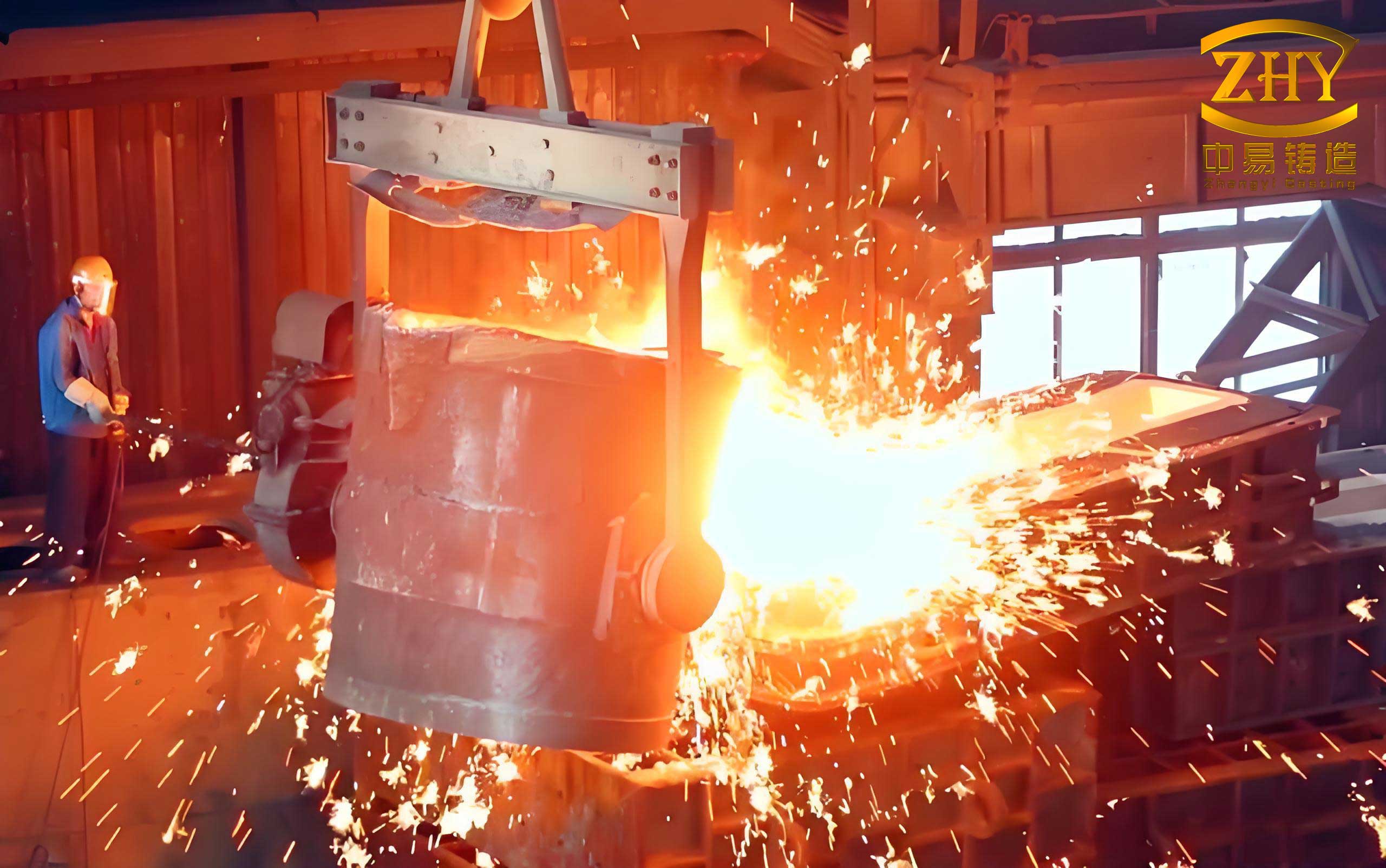
The core of my improvement lies in the bottom pouring process design. Unlike traditional top pouring, which often leads to turbulent flow and gas entrapment, bottom pouring involves placing ceramic pipes on the T-slot large plane to allow molten metal to enter from the bottom and rise steadily. The gating system is a closed-type design symmetrically distributed along both sides of the worktable’s width, with sprue located at the lateral ends and overflow gates at the longitudinal ends. To combat shrinkage in the T-slot area, I incorporated chill slots placed with chills, promoting directional solidification. Additionally, pads were designed at ingate locations to prevent metal erosion. The advantages of this approach for casting parts are multifaceted: it reduces blowholes by enabling gradual gas expulsion, enhances feeding through sequential solidification, improves dimensional accuracy by minimizing turbulent冲击, and yields smoother surfaces. However, it increases ceramic pipe usage and setup time. To quantify the benefits, I compared it with traditional pouring, where defects like porosity and shrinkage often manifest in specific zones, as illustrated in prior observations. The table below summarizes key differences between the two methods for producing these casting parts:
| Aspect | Traditional Pouring Process | Bottom Pouring Process |
|---|---|---|
| Gate Position | Top of mold | Bottom via ceramic pipes |
| Flow Characteristics | Turbulent, prone to air entrainment | Laminar, steady upward fill |
| Defect Incidence in Casting Parts | High in T-slots and thick sections | Significantly reduced |
| Solidification Pattern | Random, leading to shrinkage | Directional, aiding feeding |
| Cost and Time | Lower initial cost, faster setup | Higher ceramic cost, longer setup |
Coating application is vital for these casting parts. After molding and core assembly, I ensured that both molds and cores were brushed with high-temperature-resistant coatings, maintaining a Baume concentration of 38–42 °Bé. This step prevents metal penetration and improves surface finish. During coating, I inspected for exposed core prints or cracks, as these could lead to gas defects in the final casting parts. The placement of ceramic pipes was meticulously supervised—traditionally, they were arranged haphazardly, but in the bottom pouring process, they are strategically positioned along the T-slot plane to optimize metal flow. This attention to detail is crucial for achieving defect-free casting parts.
Melting and pouring parameters play a decisive role in the quality of casting parts. For HT300 material, I controlled the chemical composition within strict ranges, as shown in the table below, which is critical for achieving desired mechanical properties in these casting parts:
| Element | Target Composition (wt.%) | Allowable Range |
|---|---|---|
| Carbon (C) | 3.05 | 3.00–3.10 |
| Silicon (Si) | 1.45 | 1.40–1.50 |
| Manganese (Mn) | 1.10 | 1.05–1.15 |
| Phosphorus (P) | ≤0.08 | Max 0.08 |
| Sulfur (S) | 0.060 | 0.055–0.065 |
| Copper (Cu) | Specified per grade | As required |
The pouring temperature was maintained at 1390–1410°C. To enhance metal quality, I implemented high-temperature holding and ladle transfer processes. Specifically, after melting to 1450°C for sampling, the temperature was raised to 1520°C ± 10°C and held for 5–8 minutes. This was followed by transferring to a ladle, holding for 3–5 minutes, and returning to the furnace at 1480–1490°C before tapping and inoculation. This procedure refines graphite structure, reduces oxygen content via self-deoxidation, and improves homogeneity—key factors for superior casting parts. The underlying theory can be expressed through solidification kinetics. The solidification time \( t_s \) for a casting part can be estimated using Chvorinov’s rule:
$$ t_s = B \cdot \left( \frac{V}{A} \right)^n $$
where \( V \) is the volume of the casting part, \( A \) is its surface area, \( B \) is a mold constant, and \( n \) is an exponent typically around 2. For the worktable casting parts, with a large \( V/A \) ratio in T-slot regions, \( t_s \) is longer, promoting shrinkage. By using chills in bottom pouring, the effective \( A \) increases locally, reducing \( t_s \) and encouraging directional solidification. Additionally, fluid flow during pouring affects defect formation. The Reynolds number \( Re \) indicates flow regime:
$$ Re = \frac{\rho v L}{\mu} $$
where \( \rho \) is density, \( v \) is velocity, \( L \) is characteristic length, and \( \mu \) is viscosity. In traditional pouring, high \( v \) leads to turbulent flow (\( Re > 4000 \)), causing gas entrapment. Bottom pouring reduces \( v \), maintaining laminar flow (\( Re < 2000 \)), which minimizes defects in casting parts. To optimize feeding, the feeding efficiency \( \eta_f \) can be modeled as:
$$ \eta_f = \frac{V_f}{V_c} \cdot \frac{\rho_s}{\rho_l} $$
where \( V_f \) is feeder volume, \( V_c \) is casting volume, \( \rho_s \) is solid density, and \( \rho_l \) is liquid density. For these casting parts, I designed risers with adequate \( V_f \) to ensure \( \eta_f > 1 \) for effective shrinkage compensation.
In actual production, the bottom pouring process yielded remarkable results for the casting parts. After machining, the T-slot surfaces, parting planes, and slider surfaces showed no casting defects, with a qualification rate exceeding 98%. This demonstrates the efficacy of the改进 in producing high-integrity casting parts. To summarize the defect prevention strategies, I implemented a multi-faceted approach. First, structural design adjustments aimed at uniform wall thickness reduced isolated heavy sections in casting parts. Second, gating and riser optimization ensured平稳 metal flow and adequate feeding. Third, venting enhancements allowed proper gas evacuation from molds. Fourth, melting control via high-temperature holding minimized impurities. Fifth, mold compaction was rigorously monitored to prevent loose sand issues. Sixth, meticulous molding practices included cleaning cavities and covering risers. Finally, only machined chaplets were used to support cores, avoiding rust or contamination. Each step contributed to flawless casting parts.
The economic and qualitative impact of this process on casting parts is significant. While bottom pouring increases ceramic pipe usage by approximately 20%, the reduction in scrap rate from 5% to under 2% translates to substantial cost savings per unit of casting parts. Moreover, the improved mechanical properties enhance the longevity and performance of these casting parts in machining centers. For future iterations, I plan to explore automated ceramic pipe placement to reduce setup time and further refine chill designs using simulation software. The table below compares defect rates before and after implementing the bottom pouring process for these casting parts, highlighting its effectiveness:
| Defect Type | Incidence in Traditional Process (%) | Incidence in Bottom Pouring Process (%) |
|---|---|---|
| Blowholes in T-slots | 15 | 2 |
| Slag Inclusions | 10 | 1 |
| Shrinkage Porosity | 12 | 1 |
| Sand Inclusions | 8 | 1 |
| Overall Rejection Rate | ~20 | <2 |
From a theoretical perspective, the success of bottom pouring for these casting parts can be attributed to enhanced thermal management. The temperature gradient \( G \) and solidification rate \( R \) influence microstructure; an optimal \( G/R \) ratio reduces shrinkage. In bottom pouring, chills increase \( G \) locally, while controlled filling maintains a favorable \( R \). This aligns with the principle of directional solidification, expressed as:
$$ \frac{dT}{dx} > 0 $$
where \( dT/dx \) is the temperature gradient along the feeding path. For casting parts with complex geometries like worktables, maintaining this gradient is crucial. Additionally, the modulus method can be used for riser sizing. The modulus \( M \) of a casting part section is:
$$ M = \frac{V}{A} $$
Risers are designed with \( M_{riser} > M_{casting} \) to ensure they solidify last. In my design for these casting parts, I calculated \( M \) for T-slot regions and sized risers accordingly, often using exothermic sleeves to enhance feeding efficiency.
In conclusion, the bottom pouring process has proven transformative for producing large gantry worktable casting parts. By integrating careful工艺 planning, optimized gating, controlled melting, and rigorous defect prevention, I achieved a significant uplift in quality and yield. The repeated emphasis on casting parts throughout this journey underscores their importance in industrial applications. Looking ahead, continuous improvement in materials, simulation tools, and automation will further elevate the standards for these essential casting parts. The journey from defect-prone casting parts to reliable components exemplifies how innovative foundry practices can drive excellence in manufacturing.