
In the automotive industry, the crankshaft serves as a critical rotating component within the engine, directly influencing performance, longevity, and comfort. As a high-speed part, any imbalance in the crankshaft can lead to vibrations that scale quadratically with rotational speed, thereby increasing bearing loads, reducing service life, and elevating power consumption. To mitigate these adverse effects, dynamic balancing correction is essential during manufacturing. This article, based on my firsthand experience in developing casting parts for a 1.0-liter three-cylinder hollow crankshaft, delves into the challenges and solutions associated with achieving acceptable dynamic balance quality. Initially, the rejection rate for dynamic balance in machining exceeded 55%, but through systematic analysis and optimization, it was drastically reduced to below 0.1%. The focus here is on how casting parts, particularly their design, processing, and dimensional characteristics, impact dynamic balance, with an emphasis on practical improvements that enable mass production.
The crankshaft in question is a hollow design, weighing 8.34 kg, with four main journals and three crankpins. Its initial imbalance specifications were set at 157.9 g·cm at 24° for the flange end and 165.5 g·cm at 203.3° for the post end, with a final allowable imbalance of less than 10 g·cm. However, during early production, significant variability in dynamic balance performance was observed, especially when casting parts were machined at different facilities. This highlighted the intricate relationship between casting quality, machining processes, and final product stability. As casting parts form the foundation of such components, any deviations in their geometry or material distribution can propagate through subsequent operations, leading to imbalances that are costly to correct. The following sections explore the root causes and corrective actions, underpinned by data analysis, technical adjustments, and a deep understanding of casting part dynamics.
To quantify the imbalance, the fundamental equation is used: the imbalance vector \( U \) is defined as the product of the unbalanced mass \( m \) and its distance from the axis of rotation \( r \), expressed as \( U = m \times r \). In dynamic balancing, this is often resolved into components for correction, where the total allowable imbalance \( U_{max} \) must satisfy \( U_{max} \leq 10 \, \text{g·cm} \) for this application. However, initial measurements revealed discrepancies far beyond this threshold, prompting a detailed investigation into casting part variations and machining methodologies.
The first major factor identified was the machining positioning method and its interaction with casting part features. Two different machining locations yielded disparate results: one site had a rejection rate of 4.9%, while the other suffered from 55% rejects, with clear correlations to specific casting molds. Analysis showed that the positioning strategy—whether three-point or four-point clamping—significantly influenced the centering accuracy during initial machining operations, such as drilling center holes. For casting parts, especially hollow crankshafts, the location of clamping points relative to core parting lines or seams can introduce offsets, as summarized in the table below:
| Machining Location | Clamping Method | Rejection Rate | Key Issue |
|---|---|---|---|
| Location A | Three-point clamping on M4 and M1 journals | 4.9% | Minimal influence from casting part seams |
| Location B | Four-point clamping, including a point on core parting line | 55.0% | Offset due to irregular surface at seam |
This table underscores that three-point clamping tends to better accommodate casting part imperfections, as it avoids over-constraint and reduces sensitivity to local geometry variations. In contrast, four-point clamping, when applied to areas with core seams—common in casting parts—can lead to misalignment. Mathematically, if a clamping point deviates by \( \Delta x \) from its ideal position, the resulting center hole offset \( \delta \) can be approximated by \( \delta = k \cdot \Delta x \), where \( k \) depends on the fixture geometry. For this crankshaft, an offset of 0.1 mm could induce an imbalance of approximately 35 g·cm, as per the relation \( \Delta U = m_{eff} \cdot \delta \), with \( m_{eff} \) being the effective mass distribution. Thus, optimizing clamping strategies is crucial for casting parts to maintain balance integrity.
Further dissection of the data revealed patterns linked to specific casting molds. For instance, molds 2 and 3 consistently produced casting parts with lower contour dimensions on the post-end balance blocks, compared to molds 1 and 4. This dimensional variation, though within nominal tolerance bands, contributed to imbalance angle deviations. The initial imbalance angles for the post end were designed at 203.3°, but measured values ranged from 50.3° to 154.7°, indicating severe misalignment in mass distribution. To analyze this, consider the imbalance vector addition: if \( U_1 \) and \( U_2 \) represent imbalances from two planes, the resultant \( U_{total} = \sqrt{U_1^2 + U_2^2 + 2U_1U_2\cos(\theta)} \), where \( \theta \) is the angle difference. For casting parts, variations in balance block contours alter both \( U \) and \( \theta \), leading to unpredictable final imbalances. The following table quantifies these mold-based differences in contour means, measured at key points on the post-end balance blocks:
| Casting Mold ID | Post-End Balance Block Contour Mean (mm) | Deviation from Optimal (mm) | Estimated Imbalance Contribution (g·cm) |
|---|---|---|---|
| 1 | 0.07 | -0.13 | +20.8 |
| 2 | -0.11 | -0.31 | +49.6 |
| 3 | -0.12 | -0.32 | +51.2 |
| 4 | 0.08 | -0.12 | +19.2 |
Here, the contour mean is derived from multiple measurements on each casting part, with negative values indicating under-sizing. The imbalance contribution is estimated using the formula \( \Delta U_c = C \cdot \Delta d \), where \( C = 160 \, \text{g·cm/mm} \) for this geometry, based on empirical data. This shows that even small dimensional changes in casting parts can have large effects on dynamic balance, necessitating tighter control.
The core issue was traced to the casting process itself, where sand core parting lines intersected with machining clamping zones. In casting parts, cores are used to form hollow sections, but their parting lines can leave seams or irregularities on the surface. When machining fixtures clamp over these areas, inconsistent contact occurs, causing the casting part to shift during center hole drilling. To address this, the sand core design was modified to fully encapsulate the clamping region, eliminating seam interference. This improvement reduced the rejection rate from 55% to around 2-2.5%, demonstrating the importance of integrating casting part design with machining requirements. The optimization can be modeled by considering the surface roughness \( R_a \) of the clamping area: before improvement, \( R_a \) was high due to seams, leading to a clamping error variance \( \sigma^2_{clamp} \); after improvement, \( R_a \) decreased, reducing \( \sigma^2_{clamp} \) and thus the overall imbalance variance \( \sigma^2_U \), as per \( \sigma^2_U \propto \sigma^2_{clamp} + \sigma^2_{contour} \), where \( \sigma^2_{contour} \) accounts for other casting part variations.
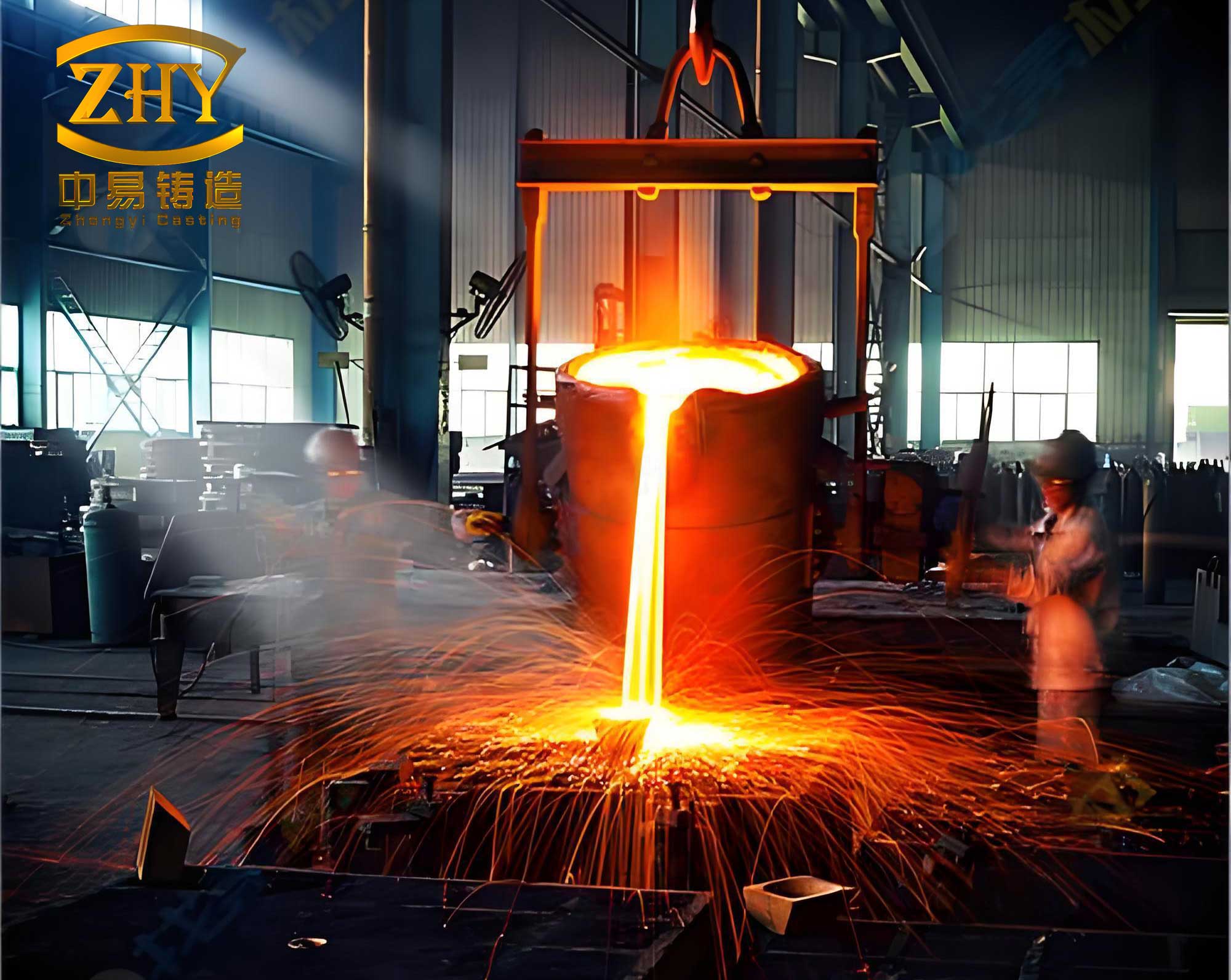
This image exemplifies the precision required in casting parts, such as steel crankshafts, where surface integrity and dimensional accuracy are paramount for dynamic balance. In our case, after initial improvements, residual rejections persisted, primarily linked to contour dimensions of balance blocks. Statistical analysis of casting parts from molds 2 and 3 showed that their post-end balance block contours averaged 0.18-0.2 mm lower than those from molds 1 and 4. To compensate, the contour was intentionally increased by 0.3-0.4 mm via mold adjustments, ensuring the mean stayed in the upper half of the tolerance band (0.1-0.5 mm) without exceeding the maximum allowable of 0.8 mm to avoid interference with the engine block. This adjustment leveraged the relationship between contour dimension \( d \) and imbalance \( U \): \( U = \alpha \cdot d + \beta \), where \( \alpha \) and \( \beta \) are constants derived from calibration. For every 0.1 mm increase in \( d \), \( U \) increased by approximately 16 g·cm, helping align the initial imbalance closer to the target.
However, relying solely on casting part tolerances proved challenging due to inherent process variability. Casting parts typically adhere to CT7-CT8 tolerance grades, but dynamic balance required CT6-level control (0.8 mm tolerance). To achieve long-term stability, the balance block arc surface was transitioned from an as-cast surface to a machined surface. This shift allowed for precise control via machining, reducing the dependency on casting accuracy. The benefit can be expressed in terms of process capability indices: for casting parts, the Cpk for contour dimensions might be below 1.0, whereas machining can achieve Cpk > 1.33, ensuring consistent balance performance. The decision involved cost-benefit analysis, but for high-volume production of casting parts like crankshafts, it was justified by the drastic reduction in scrap rates.
Further enhancements included refining the machining sequence and inspection protocols. For instance, implementing a fixture-based gauging system at the first operation (OP10) to verify center hole position reduced measurement errors and subsequent offsets. The cumulative effect of these improvements is summarized in the table below, comparing key metrics before and after optimization:
| Metric | Before Optimization | After Optimization | Improvement |
|---|---|---|---|
| Dynamic Balance Rejection Rate | 55.0% | <0.1% | ~99.8% reduction |
| Post-End Contour Mean (mm) | -0.11 to 0.08 | 0.28 to 0.29 (adjusted) | Increased by 0.39-0.41 mm |
| Clamping Error (mm) | 0.2-0.4 | ≤0.1 | Reduced by 50-75% |
| Overall Machining Scrap Rate | >55% | 1.68% | Significant cost savings |
The mathematical underpinning of these improvements can be encapsulated in a holistic model. Let \( U_{final} = f(U_{casting}, U_{machining}) \), where \( U_{casting} \) represents the imbalance contribution from casting part variations, and \( U_{machining} \) from machining errors. By minimizing both terms through design and process changes, \( U_{final} \) is brought within limits. Specifically, \( U_{casting} = \sum_{i=1}^{n} (m_i \cdot r_i \cdot \Delta c_i) \), with \( \Delta c_i \) as contour deviation at point \( i \), and \( U_{machining} = m_{total} \cdot e_{offset} \), where \( e_{offset} \) is the axis offset. Optimization aimed to reduce \( \Delta c_i \) and \( e_{offset} \) via the described measures.
In conclusion, the journey to improve dynamic balance quality for three-cylinder hollow crankshaft casting parts involved a multi-faceted approach. Key lessons include: (1) three-point machining positioning is superior to four-point for accommodating casting part irregularities, (2) clamping areas must be free from core seams or parting lines, achievable through integrated core design, (3) increasing balance block contour dimensions to the upper tolerance limit enhances balance outcomes, and (4) transitioning critical surfaces from as-cast to machined ensures long-term stability. These principles not only resolved the immediate issue but also provide a framework for similar challenges in casting parts manufacturing. The success is evidenced by the sustained rejection rate below 0.1% over mass production, highlighting how meticulous attention to casting part details can yield dramatic quality enhancements.
Ultimately, the experience underscores that casting parts, while foundational, require synergistic design with downstream processes to meet stringent dynamic criteria. Future work could explore advanced simulation models to predict imbalance during the casting design phase, further reducing trial-and-error. For now, the improvements stand as a testament to the value of data-driven optimization in the realm of precision casting parts.