
The relentless advancement of technology and the push for industrial modernization place significant strategic importance on the domestic mastery of high-end manufacturing technologies. High-temperature alloy casting parts are indispensable hot-section components in major industrial equipment. In recent years, the increasing operational temperature demands for large-scale industrial equipment components have driven the evolution of superalloy precision casting parts towards larger dimensions, more complex geometries, and thinner walls. This trend imposes stricter requirements on both materials and manufacturing processes for high-temperature components. Investment casting technology has emerged as the dominant manufacturing method for engine structural parts due to its advantages of high dimensional accuracy, low surface roughness, and near-net-shape forming capability. However, as the thin-walled areas of these casting parts expand and their structures become more intricate, coupled with higher demands on surface quality, traditional gravity casting often encounters limitations. The inherent constraints of gating system design and insufficient static pressure make complex structural areas prone to defects such as shrinkage porosity and cavities, resulting in a typically low yield of only around 20%.
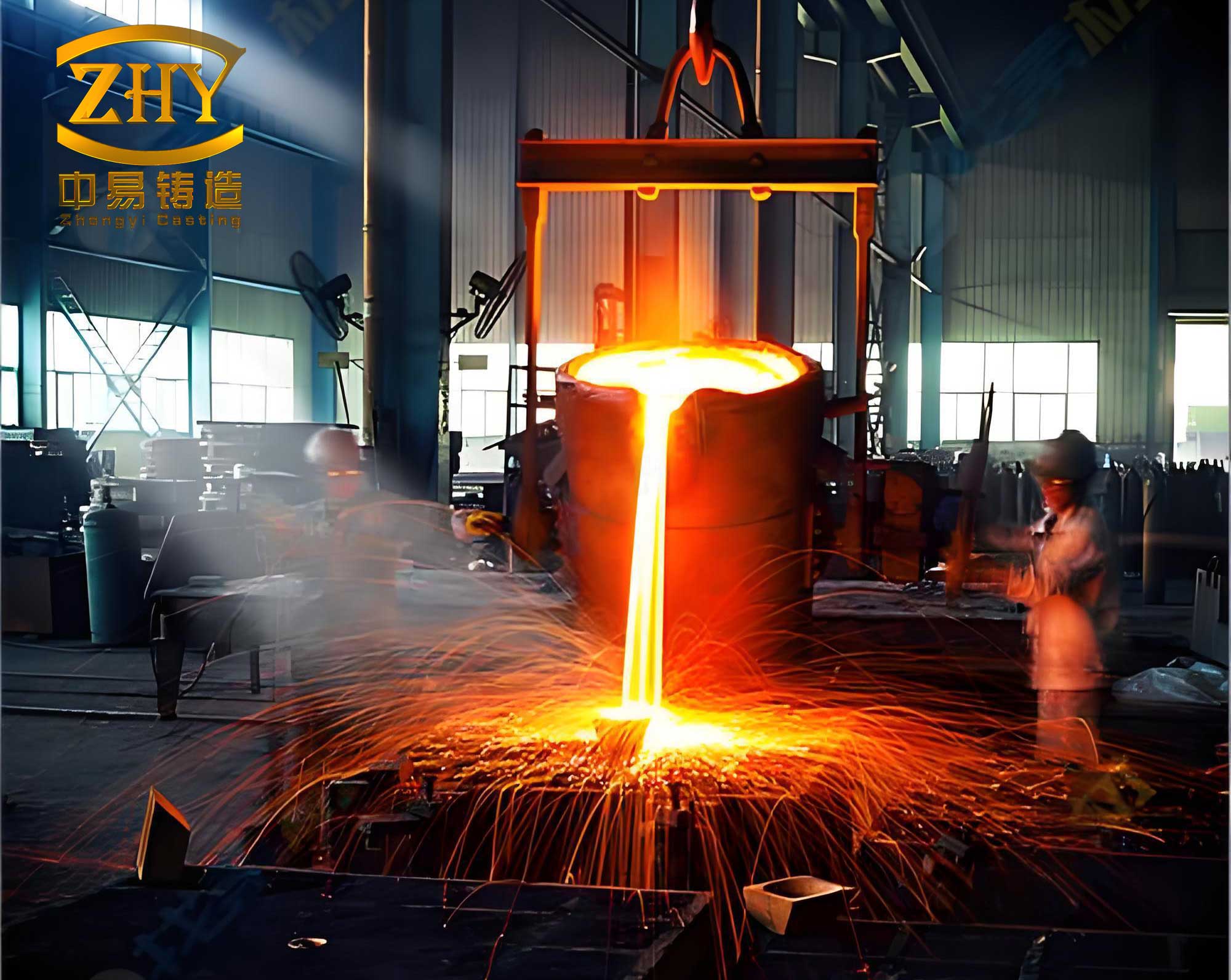
The adjustable pressure casting (APC) method, first proposed in the 1990s, utilizes controlled gas pressure instead of gravity as the driving force for mold filling. Characterized by “vacuum degassing, negative-pressure filling, and positive-pressure solidification,” this technique effectively overcomes the challenges of filling large, complex, thin-walled castings. It compensates for the shortcomings of other counter-gravity casting methods and shows excellent application potential for such demanding components. Concurrently, the rapid development of computer science has elevated numerical simulation technology to a crucial role in engineering practice. It serves as an optimal tool for design and casting process validation, not only providing guidance for production but also significantly reducing development costs, and has been widely adopted in investment casting and other industrial fields.
This study focuses on a complex, thin-walled engine casing component manufactured from K418B superalloy. The objective is to systematically investigate the filling and solidification process of this superalloy under the APC process, examine the influence of the process on the microstructure, defects, and mechanical properties of the final casting parts, and verify the reliability of numerical simulation in guiding practical production. A combined approach of numerical simulation and physical experiment is employed. The ProCAST software is utilized to simulate the APC process, analyzing filling behavior, solidification sequence, and predicting the formation of potential defects like shrinkage. Based on the simulation insights, the APC process parameters are optimized, and actual casting trials are conducted. Subsequently, samples are extracted from key characteristic locations of the produced casting parts for comprehensive microstructural characterization using optical microscopy (OM) and scanning electron microscopy (SEM), and for mechanical property evaluation through quasi-static tensile testing at both room temperature and 750°C. Fracture surfaces are also examined to understand the failure mechanisms. This work aims to elucidate the forming laws of such complex thin-walled casting parts via the APC method, providing a foundational reference for its broader application in manufacturing high-performance superalloy components.
Numerical Simulation of the Casting Process
Material and Component Geometry
The alloy used for the casting parts is K418B, a nickel-based superalloy. Its primary chemical composition and key thermophysical properties, essential for accurate simulation, are provided in the tables and description below.
| Ni | Cr | B | Mo | Nb | Al | Ti | C | Zr |
|---|---|---|---|---|---|---|---|---|
| Bal. | 11.8 | 0.01 | 4.5 | 2.1 | 6.1 | 0.8 | 0.05 | 0.09 |
The thermophysical parameters, including solid fraction, density, enthalpy, and thermal conductivity as functions of temperature, are critical inputs for the simulation. These data govern the latent heat release, fluid flow, and heat transfer during the process.
The geometry of the casing component presents significant manufacturing challenges. It is a large, complex thin-walled structure with a maximum outer diameter of 217.9 mm. The design incorporates numerous irregularly shaped bosses on its surface and a substantial number of internal circular holes, with the smallest hole diameter being only 2.55 mm. Crucially, the wall thickness varies considerably across the component, featuring several sections with minimal thicknesses as low as 1.25 mm. This extreme thinness, combined with the complexity, poses a high risk of defects such as mistruns, gas entrapment, shrinkage porosity, and cracks during conventional filling, demanding a highly controlled process like APC.
Finite Element Model Setup
Given the component’s complexity, a top-gating system is typically employed for APC, as the controllable pressure facilitates smooth bottom-up filling. The three-dimensional CAD model of the component, including the gating and risering system, was imported into ProCAST. The model was meshed using the Visual-Mesh module with an element size of 2 mm, resulting in a high-quality mesh consisting of approximately 168,724 surface elements and 965,486 volume elements (tetrahedra), totaling over 1.13 million elements. This refined mesh is necessary to capture the details of the thin sections and complex features of the casting parts.
The initial process parameters were set based on empirical knowledge for this class of alloys and the APC process: a pouring temperature of 1500°C and a mold preheat temperature of 1000°C. The interfacial heat transfer coefficient between the ceramic shell and the metal was defined as 1000 W/(m²·K), while the shell’s outer surface was set to lose heat to the environment via air cooling with a coefficient of 10 W/(m²·K) at an ambient temperature of 20°C. The defining feature of the simulation is the pressure boundary condition. Unlike gravity casting, APC uses a precise pressure-time curve to drive the process. The curve was defined with a pressure increase rate of 3 kPa/s, a filling pressure differential of 40 kPa, a crystallization pressure boost of 5 kPa, and a final pressure holding time of 600 s.
| Parameter | Value / Setting |
|---|---|
| Pouring Temperature | 1500 °C |
| Mold Preheat Temperature | 1000 °C |
| Metal-Mold HTC | 1000 W/(m²·K) |
| Mold-Air HTC | 10 W/(m²·K) |
| Pressure Rise Rate | 3 kPa/s |
| Filling Pressure Differential | 40 kPa |
| Crystallization Pressure | 5 kPa |
| Pressure Holding Time | 600 s |
Simulation Results and Analysis
The simulated filling sequence confirmed the effectiveness of the APC process for these complex casting parts. Metal filled the mold cavity smoothly from the bottom upwards, initiated at 2.12 seconds. By 2.7 seconds, metal had entered the main cavity from the top runners and begun descending into the thin vertical ribs, while simultaneously rising from the bottom runners into the lower flange area. The two metal fronts met at the rib sections without turbulent impingement, and the liquid metal level subsequently rose steadily until the entire cavity was filled. The simulation indicated a slight temperature drop in the lower flange and thin-wall regions during filling, confirming their faster cooling tendency, but no visible jetting or severe mold wall冲击 was observed.
The solidification analysis is paramount for predicting soundness in the final casting parts. The simulation of solidification time revealed a generally desirable top-down directional solidification trend. The risers at the top solidified first, acting as feeders. The thin-walled sections solidified relatively early due to rapid heat extraction. However, regions like the junctions between the vertical ribs, lower flange, and the ingates exhibited more complex solidification patterns due to geometrical effects and multiple heat flow paths.
The defect prediction modules provided critical insights. The shrinkage porosity prediction, based on the Niyama criterion (a function of local thermal gradient G and cooling rate R), indicated that the majority of potential microporosity was concentrated in the gating system and risers. Within the actual component casting parts themselves, defect indications were minimal. The calculated volumetric shrinkage cavity percentage for the entire casting system was only 0.22%, with the most susceptible areas being the junctions of ingates and the component, as well as locations near bosses where section changes are abrupt. This aligns with the expectation that these areas are last to solidify and most difficult to feed.
The simulation also provided a prediction of the Secondary Dendrite Arm Spacing (SDAS), a key microstructural feature influencing mechanical properties. The results showed a relatively fine and uniform SDAS distribution across the casting parts, with an average value of approximately 24 µm. As expected, regions within the thick gating system, which experienced slower cooling, displayed noticeably larger SDAS compared to the thin-walled sections of the component itself. This correlation between cooling rate and SDAS can be expressed by a relationship of the form:
$$ \lambda_2 = k \cdot (T)^{-n} $$
where $\lambda_2$ is the secondary dendrite arm spacing, $T$ is the local solidification time or cooling rate, and $k$ and $n$ are material constants.
The Niyama criterion ($N_y$) is often used to predict shrinkage porosity and is given by:
$$ N_y = \frac{G}{\sqrt{R}} $$
where $G$ is the temperature gradient and $R$ is the cooling rate. Regions with a lower $N_y$ value are more prone to shrinkage formation. The simulation maps effectively identified these critical zones within the complex geometry of the casting parts.
Experimental Methodology and Results
To validate the numerical predictions and thoroughly assess the quality of the APC-produced casting parts, experimental analyses were conducted on samples extracted from key locations: the upper flange, lower flange, a vertical support plate (rib), and a representative thin-wall section.
Microstructural Characterization
The as-cast microstructure of the K418B alloy from all sampled locations revealed a typical dendritic morphology. The dendrites were fine and densely packed, indicating a relatively rapid solidification process. Solidification occurred via the growth of primary dendrite arms along preferred crystallographic directions, followed by the development of secondary arms. Solidification ends when the dendrite tips impinge on the diffusion fields of neighboring grains, after which coarsening of the secondary arms occurs.
SDAS was measured quantitatively using image analysis software. The results confirmed the fine microstructure. The overall average SDAS for the casting parts was about 26.82 µm. The upper flange section, directly connected to the massive riser, showed the coarsest structure with an average SDAS of 30.03 µm due to its slower cooling rate. In contrast, the thin-wall section exhibited the finest dendrites, with an average SDAS of 25.82 µm. This location featured distinct, elongated primary dendrite trunks aligned with the heat flow direction, adorned with numerous fine, uniformly distributed secondary arms. This refinement is attributed to the high temperature gradient and cooling rate in thin sections, as well as potential dendrite fragmentation and transport under the applied pressure during filling.
The comparison between the simulated and experimentally measured SDAS values showed good agreement, with an error margin consistently below 15%, demonstrating the predictive capability of the numerical model for this microstructural feature in the final casting parts.
| Location | Simulated SDAS (µm) | Experimental SDAS (µm) | Error (%) |
|---|---|---|---|
| Upper Flange | ~28.5 | 30.03 | ~5.1 |
| Lower Flange | ~25.0 | 26.15 | ~4.4 |
| Support Plate | ~24.5 | 25.82 | ~5.1 |
| Thin Wall | ~23.0 | 25.82 | ~10.9 |
| Overall Average | ~24.0 | 26.82 | ~10.5 |
Grain size analysis was performed using the linear intercept method on backscattered electron (BSE) images. The grain structure was also relatively fine. The flange areas, experiencing slower cooling, had larger average grain sizes (e.g., ~226.77 µm for the upper flange). The support plate and thin-wall sections, which solidified much faster, exhibited significantly finer equiaxed grains, with an average size of about 158 µm. This refinement in thin-section casting parts is a direct consequence of the higher undercooling and increased nucleation rate associated with rapid heat extraction. The Hall-Petch relationship, which describes the strengthening effect of grain boundaries, highlights the benefit of this fine grain size:
$$ \sigma_y = \sigma_0 + \frac{k_y}{\sqrt{d}} $$
where $\sigma_y$ is the yield strength, $\sigma_0$ and $k_y$ are material constants, and $d$ is the average grain diameter. Finer grains (smaller $d$) contribute to higher strength.
| Sample Location | Avg. SDAS (µm) | Avg. Grain Size (µm) | Primary Observation |
|---|---|---|---|
| Upper Flange | 30.03 | 226.77 | Coarsest dendrites & grains |
| Lower Flange | 26.15 | 198.50 | Moderate refinement |
| Support Plate (Rib) | 25.82 | 162.30 | Finer, dense structure |
| Thin Wall Section | 25.82 | 158.00 | Finest grains, aligned dendrites |
Mechanical Properties and Fractography
Tensile tests were performed on specimens machined from the flange regions at room temperature and at the service temperature of 750°C. The engineering stress-strain curves demonstrated that the casting parts possess high strength. The average tensile strength for both upper and lower flange specimens exceeded 900 MPa at both temperatures. Specifically, the upper flange exhibited an average strength of 966 MPa but with a relatively low elongation of about 2%. This lower ductility is likely linked to the presence of minor micro-shrinkage in this region, which acted as crack initiation sites, a finding consistent with the numerical simulation’s defect prediction for this area of the casting parts.
The lower flange specimens showed an excellent combination of strength and ductility. The average tensile strength was 944 MPa at room temperature and 922 MPa at 750°C, with a maximum elongation reaching approximately 15%, indicating good overall mechanical performance for these critical casting parts.
Fracture surface analysis via SEM revealed a ductile fracture mode for the lower flange specimens. The fracture surfaces exhibited a characteristic dimpled morphology, with numerous, fine, and uniformly distributed equiaxed dimples at room temperature. The high-temperature fracture surface showed larger and deeper dimples. Both observations confirm the ductile nature of failure, involving the nucleation, growth, and coalescence of microvoids. The presence of these shear lips and dimples correlates well with the respectable plastic elongation measured, underscoring the integrity of the produced casting parts when significant shrinkage defects are minimized.
Discussion
The integration of numerical simulation and experimental validation in this study successfully demonstrates the capability of the Adjustable Pressure Casting process to manufacture high-quality, complex K418B superalloy casting parts. The simulation accurately captured the fundamental physics of the process: the smooth, controlled filling driven by the pressure differential and the largely directional solidification pattern. The prediction of defect-prone zones, particularly at geometric complexities and ingate junctions, was corroborated by the microstructural and mechanical property findings from specific locations on the actual casting parts.
The effectiveness of APC in producing sound casting parts stems from its unique characteristics. The negative pressure phase aids in mold cavity evacuation, reducing the risk of gas entrapment. The controlled filling velocity minimizes turbulence, promoting a quiescent metal front that reduces oxide formation and mold erosion. Most importantly, the application and maintenance of a positive pressure during solidification significantly enhances feeding efficiency. This pressure compensates for shrinkage, suppresses the formation of gas porosity, and forces interdendritic liquid into incipient pores, thereby dramatically reducing the volume fraction of shrinkage defects—as evidenced by the simulated 0.22% and the generally dense microstructure observed. The relationship between applied pressure ($P_a$) and the critical pore nucleation pressure ($P_c$) can be conceptually framed: when $P_a$ is maintained above the sum of local metallostatic pressure, capillary pressure, and gas pressure ($P_c$), pore formation is inhibited.
$$ P_a > P_c = P_{hyd} + P_{cap} + P_{gas} $$
The microstructural results underscore the link between process, local solidification conditions, and final properties in the casting parts. The fine SDAS and grain size, especially in thin sections, are direct outcomes of the rapid cooling inherent to those geometries. Since SDAS is inversely related to cooling rate, it serves as an indicator of local solidification conditions. Finer SDAS implies a more homogeneous distribution of secondary phases and reduced microsegregation, generally leading to improved yield strength and fatigue life. The Hall-Petch relationship further explains the contribution of the fine grain size observed in thin walls to the overall strength of these casting parts.
The mechanical property results, particularly for the lower flange, validate the overall quality achieved. The high strength levels meet the demanding requirements for superalloy hot-section components. The good ductility, reflected in the high elongation and dimpled fracture surfaces, indicates adequate material integrity and toughness, which are essential for reliability under thermal and mechanical loads. The slightly inferior ductility in the upper flange highlights the critical importance of effective feeding and risering design, even in APC, to ensure consistency across all sections of complex casting parts.
Conclusion
This comprehensive investigation into the manufacturing of K418B superalloy casing components via Adjustable Pressure Casting, supported by numerical simulation and experimental analysis, leads to the following key conclusions:
- Process Simulation and Validation: The ProCAST numerical simulation effectively modeled the APC process for complex thin-walled casting parts. It predicted smooth filling behavior, a predominantly favorable top-down solidification sequence, and identified potential shrinkage zones primarily in the gating system and at geometric complexities. The experimental observation of minimal casting defects in the component body validated these predictions, confirming the reliability of numerical simulation as a powerful tool for guiding the design and optimization of the APC process for high-integrity casting parts.
- Microstructural Quality: The APC process successfully produced K418B casting parts with a refined and uniform as-cast microstructure. The typical dendritic structure exhibited fine secondary dendrite arm spacing (average ~26.82 µm) and relatively fine grain size, particularly in thin-walled sections (~158 µm). The measured SDAS showed good agreement with simulation predictions (error < 15%). The overall dense microstructure with minimal shrinkage porosity confirmed the excellent feeding capability provided by the controlled pressure during solidification.
- Mechanical Performance: The produced casting parts exhibited excellent mechanical properties, suitable for demanding high-temperature applications. The average tensile strength exceeded 900 MPa at both room temperature and 750°C. A maximum elongation of approximately 15% was achieved, indicating a good balance of strength and ductility. Fractographic analysis confirmed a ductile dimple-rupture failure mode, consistent with the measured plasticity. These results demonstrate that the APC process can yield superalloy casting parts with superior comprehensive mechanical performance.
In summary, the synergy of the Adjustable Pressure Casting technique and numerical simulation provides a robust and reliable pathway for manufacturing large, complex, and thin-walled superalloy casting parts with enhanced structural soundness, refined microstructure, and high mechanical properties. This approach offers significant potential for advancing the production of critical components in aerospace, energy, and other high-tech industries.