
In my extensive experience with foundry engineering, producing sound, high-integrity thick-walled and geometrically complex ductile iron castings remains one of the most significant challenges. The inherent tendency of ductile iron towards shrinkage porosity demands a profound understanding of its solidification physics and a meticulous approach to process design. This article synthesizes key principles and presents a detailed methodology, emphasizing the use of advanced simulation and specialized molding techniques to achieve defect-free components.
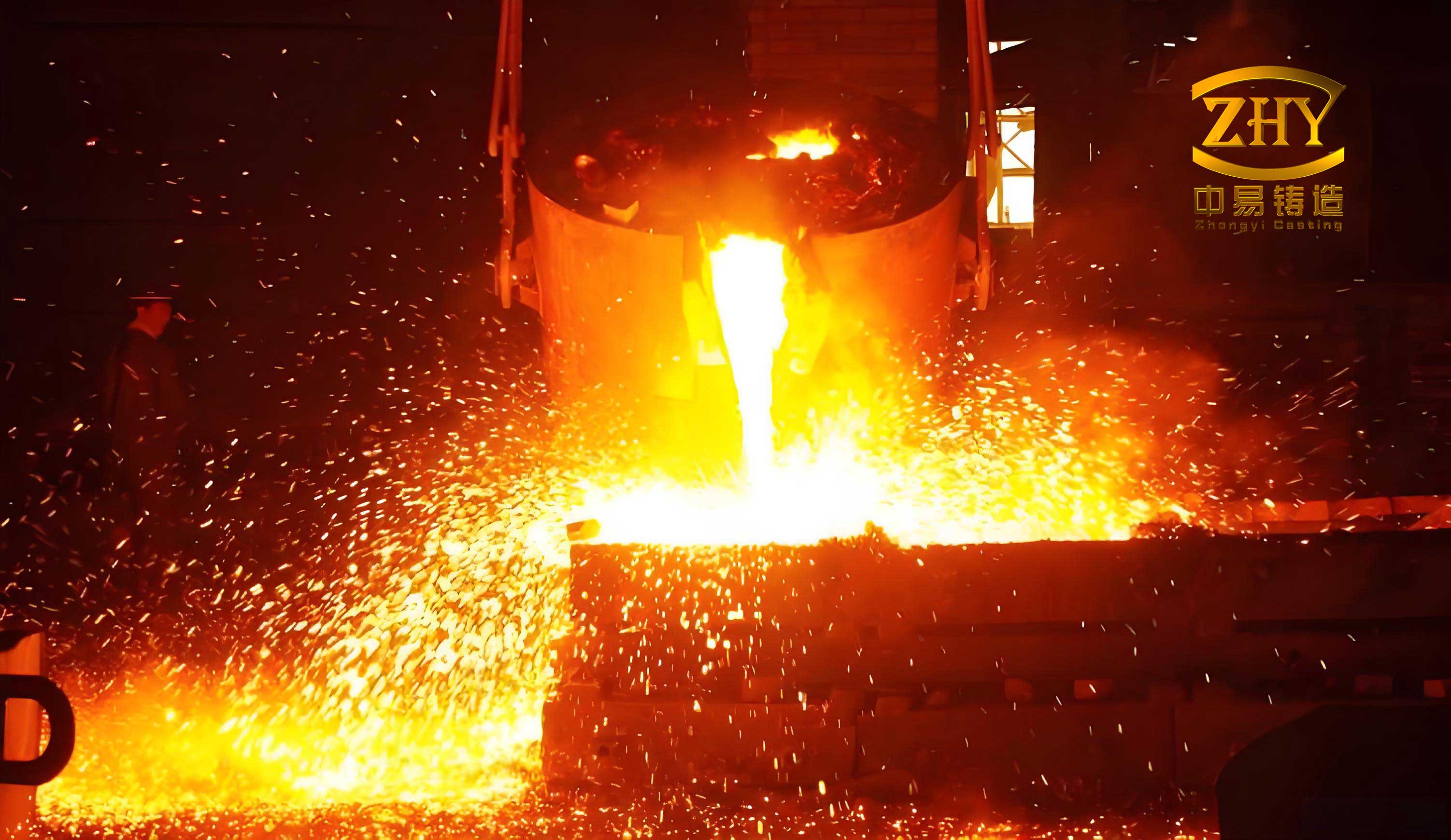
The success of any ductile iron casting project hinges on first understanding its unique solidification behavior. Unlike gray iron, ductile iron solidifies in a mushy, or pasty, manner. This is due to the formation of austenite shells around the growing graphite nodules, which impedes the diffusion of carbon. Consequently, the eutectic reaction occurs over a wide temperature range, leaving a vast region of the casting in a solid-liquid slurry state for an extended period. This mushy zone can readily block the feeding paths necessary for liquid metal to compensate for shrinkage.
Furthermore, the volumetric changes during the solidification of ductile iron casting are complex and non-linear. The process is not simply one of contraction. A typical sequence involves: initial liquid contraction, followed by a pre-eutectic expansion (if graphite precipitates from the liquid), then eutectic contraction as the austenite matrix forms, and finally, a significant eutectic expansion driven by the precipitation of graphite within the austenitic shell. The net result—whether the casting exhibits overall expansion or contraction—is not fixed. It is a dynamic balance influenced by multiple factors, as summarized in the table below.
| Factor | Influence on Eutectic Expansion | Primary Mechanism |
|---|---|---|
| Carbon Equivalent (CE) | Maximum near eutectic composition. | Maximizes graphite volume fraction. |
| Mold Rigidity | Higher rigidity reduces net expansion. | Restrains mold wall movement, increasing internal pressure. |
| Inoculation Level | Increased inoculation raises expansion. | Increases number of eutectic cells/nodules. |
| Section Modulus (M) | Larger modulus increases expansive pressure. | Longer solidification time allows greater expansion force buildup. |
| Graphite Nodularity & Count | High nodularity and count increase expansion. | More, well-formed nodules generate greater volumetric expansion. |
The interaction between the casting’s expansion and the mold’s behavior is critical. The mold cavity is not a static void; its dimensions change during pouring and cooling due to thermal expansion of the mold material and, in sand molds, due to pressure from the metal. This phenomenon, known as mold wall movement, can be detrimental. If the mold yields outward during the critical feeding period, it effectively creates a larger cavity to be fed, exacerbating shrinkage issues. Therefore, the concept of “mold rigidity” is contextual: a truly rigid mold is one that resists expansion after the feeding gates have solidified, allowing the internal graphite expansion to compensate for shrinkage.
The selection of molding process is therefore paramount for successful ductile iron casting. Let’s compare the common options for heavy-section castings:
| Process | Advantages for Ductile Iron | Disadvantages for Thick Sections | Impact on Shrinkage |
|---|---|---|---|
| Resin-Bonded Sand | High strength, good dimensional stability, suitable for complex cores. | Slow cooling, high gas generation, high sand-to-metal ratio, environmental concerns. | Slow cooling promotes prolonged mushy zone; mold wall movement possible unless highly compacted. |
| Green Sand | High productivity, low cost, suitable for automation. | Low inherent rigidity, high mold wall movement, moisture-related defects. | Significant mold wall movement often necessitates large, inefficient feeders to overcome shrinkage. |
| Iron Mold with Sand Lining (Furan Sand Coated Iron Mold) | High rigidity, fast cooling, excellent dimensional accuracy, low sand consumption. | Higher initial tooling cost, design complexity for the iron mold. | Fast cooling reduces mushy zone time; high rigidity harnesses eutectic expansion for self-feeding. Ideal for ductile iron casting. |
For demanding ductile iron casting applications, the iron mold with sand lining process offers a compelling advantage. The thin, cured resin-coated sand layer provides a smooth casting surface and allows for complex geometries, while the massive, rigid iron mold backing provides exceptional cooling and, crucially, resists mold wall movement. This combination enables the foundry engineer to strategically exploit the graphite expansion for internal feeding, often allowing for feederless or minimal-feeder designs in suitable geometries. The cooling power can be approximated by considering the combined thermal resistance of the sand lining and iron mold. The heat flux, \( q \), can be modeled as:
$$ q = \frac{T_{melt} – T_{mold}}{R_{sand} + R_{iron}} $$
where \( R_{sand} \) and \( R_{iron} \) are the thermal resistances of the sand lining and iron mold wall, respectively. The high thermal conductivity of iron minimizes \( R_{iron} \), leading to rapid heat extraction.
Modern computational simulation is an indispensable tool for navigating the complexities of ductile iron casting. It transforms the invisible thermal and volumetric processes into visual, quantifiable data. The core of solidification simulation for predicting shrinkage solves the heat transfer equation alongside a criterion for pore formation. A simplified energy equation is:
$$ \rho C_p \frac{\partial T}{\partial t} = \nabla \cdot (k \nabla T) + \rho L \frac{\partial f_s}{\partial t} $$
where \( \rho \) is density, \( C_p \) is specific heat, \( T \) is temperature, \( t \) is time, \( k \) is thermal conductivity, \( L \) is latent heat, and \( f_s \) is solid fraction. The software tracks \( f_s \) over time, identifying isolated liquid pools that cannot be fed. The Niyama criterion, \( G/\sqrt{\dot{T}} \), where \( G \) is thermal gradient and \( \dot{T} \) is cooling rate, is often used as a porosity indicator for ductile iron casting, with lower values suggesting a higher risk of microshrinkage.
Through simulation, I can virtually prototype and optimize several key aspects before any metal is poured:
1. Solidification Sequence: Visualize progressive solidification to ensure directional solidification towards feeders.
2. Feeder Efficiency: Optimize the size, shape, and location of feeders (especially exothermic ones) to ensure they remain liquid longest.
3. Chill Design: Strategically place chills within the iron mold to control local cooling rates and eliminate isolated hot spots.
4. Process Yield: Minimize the total poured weight by optimizing the feeding system, directly impacting the cost-effectiveness of the ductile iron casting production.
A summary of common simulation outputs and their use is shown below:
| Simulation Output | What It Visualizes | Key Decision Support |
|---|---|---|
| Temperature Field | Real-time cooling patterns, thermal gradients. | Identify hot spots, validate chill placement, predict grain structure. |
| Solid Fraction | Progress of liquid/solid interface over time. | Determine feeding paths, locate last-to-freeze regions. |
| Porosity Probability | Predicted areas of macro- and micro-shrinkage. | Objectively compare different gating/feeding designs. |
| Filling Pattern | Flow velocity, temperature loss during mold fill. | Prevent cold shuts, mistuns, and dross entrainment. |
To illustrate the integrated application of these principles, let’s examine a detailed case study for a thick-walled, complex ductile iron casting. The component was a large sheave wheel, a rotational symmetric part with significant variation in wall thickness, from 15 mm in the spokes to 85 mm at the hub and rim junctions. The material specification was a high-strength ductile iron (analogous to QT600-3 but with a tensile strength requirement exceeding 750 MPa and specific hardness uniformity). The casting had to pass 100% ultrasonic inspection, mandating a sound, pore-free internal structure.
The foundation was metallurgical control. The charge consisted primarily of steel scrap, treated with a high-quality graphite-based inoculant. The melt was treated with a low-rare earth magnesium ferrosilicon alloy using the sandwich method in a preheated ladle, followed by intensive inoculation. The target chemical composition for this ductile iron casting was tightly controlled:
| Element | Target Range (wt.%) |
|---|---|
| C | 3.6 – 3.8 |
| Si | 2.2 – 2.4 |
| Mn | <0.4 |
| P | <0.03 |
| S | <0.015 |
| Mgres | 0.040 – 0.050 |
Two distinct feeder designs were engineered and simulated for the iron mold process. Scheme A utilized a tangential gating system on the flange with conventional sand risers and several internal chills in the iron mold, aiming for a balanced solidification. Scheme B employed a top-feeding system via a large exothermic sleeve riser placed over the central hub, supplemented by three smaller exothermic side risers on the rim. This design aimed for a strong directional solidification pattern. The modulus method was used for initial riser sizing, where the riser modulus \( M_r \) should satisfy \( M_r > 1.2 \cdot M_c \) for effective feeding, where \( M_c \) is the casting modulus. The solidification time \( t_f \) is related to the modulus by Chvorinov’s rule:
$$ t_f = k \cdot M^n $$
where \( k \) is a mold constant and \( n \) is typically close to 2 for sand molds but lower for metal molds due to faster cooling.
The simulation results were decisive. Scheme A showed several isolated liquid regions, particularly at the junctions between the spokes and the heavy rim/hub. While some of this might have been compensated by graphite expansion, the risk of subsurface shrinkage was high. Scheme B, however, demonstrated a clear solidification sequence: the thin spokes solidified first, followed by the heavier sections, with the exothermic risers remaining liquid as the last-to-freeze hotspots. The feeding paths from the risers to the thermal centers remained open until the end of solidification. The porosity prediction map for Scheme B was virtually clean in the critical areas.
The production validation confirmed the simulation. Castings from Scheme A, when sectioned, revealed unacceptable spongy shrinkage at the thick junctions. Castings from Scheme B were sound. Mechanical tests from coupons taken from the casting itself exceeded requirements. The microstructure in the critical heavy sections showed a nodularity above 90% with a predominantly pearlitic matrix, consistent with the high-strength targets for this ductile iron casting.
| Property | Result from Casting (Scheme B) | Specification Requirement |
|---|---|---|
| Tensile Strength | 858 MPa | >750 MPa |
| Elongation | 5.2% | >3% |
| Hardness (HB) | 242 – 255 | 240 – 270, Uniform |
| Nodularity | >90% (Grade II) | >80% |
In conclusion, the production of high-integrity thick-walled ductile iron casting is a multidisciplinary endeavor. It requires a deep understanding of the alloy’s expansive solidification behavior, the selection of a molding process with sufficient rigidity (like the iron mold with sand lining) to harness that expansion, and the rigorous application of simulation technology to design and validate an optimized feeding system. This case study demonstrates that by coupling a controlled metallurgical process with a rigid mold and strategically placed exothermic feeders—all validated through advanced simulation—it is entirely feasible to produce complex, heavy-section ductile iron castings that meet the most demanding mechanical and quality specifications. The key is to move from empirical trial-and-error to a physics-based, digitally-verified methodology for ductile iron casting.