
In the rapidly evolving field of rail transit, the demand for lightweight components has become paramount. Lightweighting not only reduces vehicle weight and material usage but also minimizes traction and braking forces, leading to significant energy savings and reduced emissions. As such, the pursuit of high-performance, lightweight castings is a key objective in the foundry industry. Traditional rail transit components have often relied on low-grade ductile iron castings, such as QT400 to QT600 grades, which offer adequate strength but limited potential for weight reduction. However, the emergence of austempered ductile iron (ADI) presents a transformative opportunity. ADI combines superior mechanical properties—including high strength, toughness, and wear resistance—with a lower density compared to steel, making it an ideal candidate for lightweight applications. This study focuses on the development of high-grade ADI, specifically QT800-10, for rail transit shell castings. Through a systematic approach involving computational simulation, process optimization, and detailed material analysis, we aim to produce ductile iron castings that meet rigorous performance standards while advancing lightweighting goals.
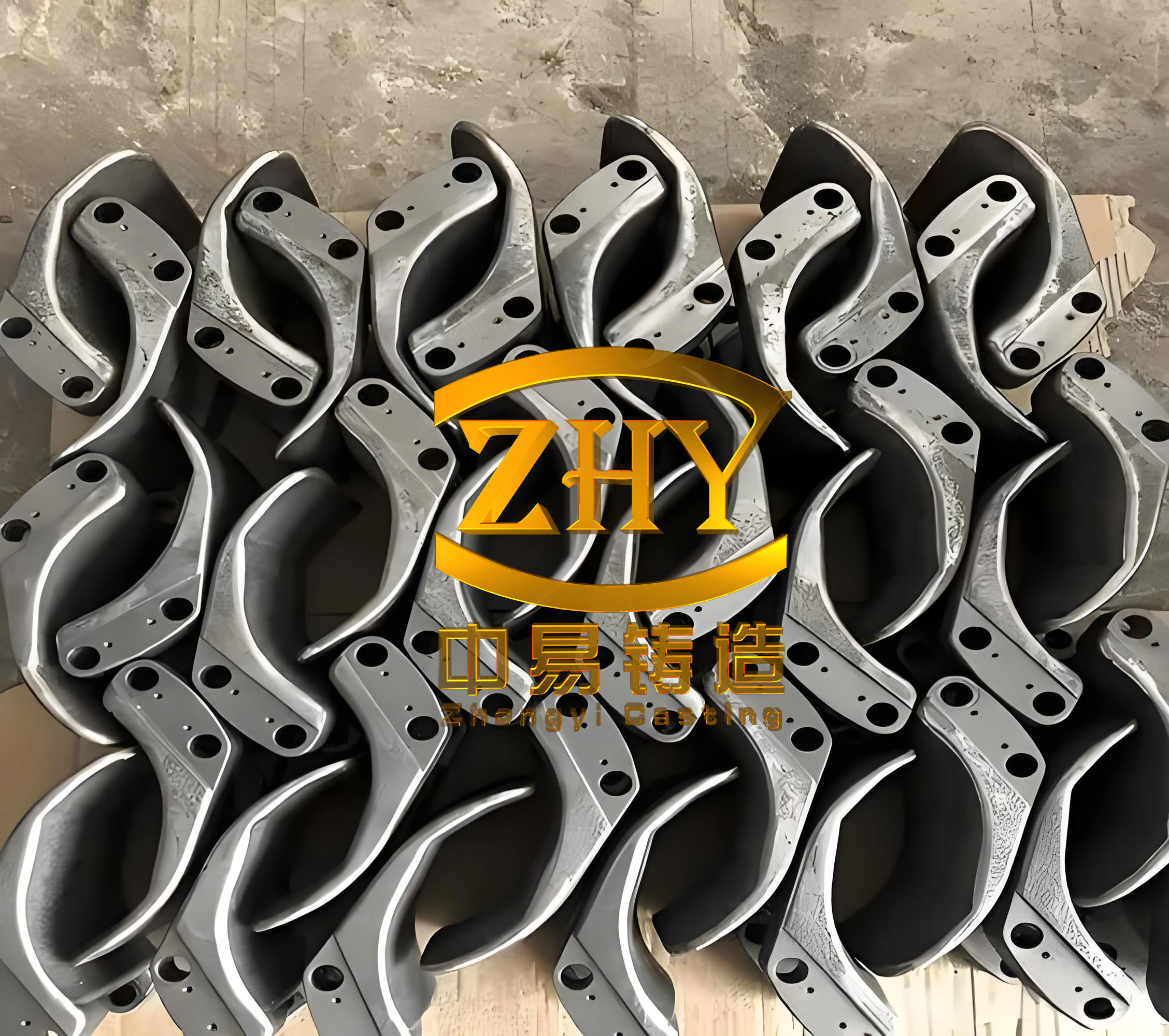
The rail transit shell casting under investigation is a complex component with significant variations in wall thickness, ranging from 9 mm to 58 mm, and a total mass of 36.7 kg. Such geometric complexity poses challenges for both casting integrity and subsequent heat treatment. The structure includes multiple internal cavities and uneven sections, which can lead to defects like shrinkage porosity if not properly addressed. To illustrate the casting’s geometry, a visual representation is provided below. This image highlights the intricate design and wall thickness variations that necessitate careful process planning.
In designing the composition for this ductile iron casting, we prioritized elements that enhance mechanical properties while ensuring good castability and heat treatability. The base iron was formulated with controlled levels of carbon and silicon to achieve a balanced carbon equivalent, which influences graphite formation and matrix structure. Additionally, alloying elements like copper and manganese were added in moderate amounts to improve hardenability and strength, particularly for the austempering process. Phosphorus and sulfur were kept as low as possible to minimize brittleness and segregation. The target chemical composition and mechanical requirements for the ADI rail transit shell are summarized in Tables 1 and 2. These specifications guided our experimental work and ensured that the final ductile iron casting would meet industry standards for high-performance applications.
| Element | Pre-furnace Range | Final Casting Range |
|---|---|---|
| Carbon (C) | 3.85–3.95 | 3.60–3.80 |
| Silicon (Si) | 1.90–2.00 | 2.35–2.55 |
| Manganese (Mn) | 0.30–0.50 | 0.30–0.50 |
| Phosphorus (P) | ≤0.05 | ≤0.05 |
| Sulfur (S) | 0.006–0.018 | 0.006–0.018 |
| Copper (Cu) | 0.40–0.70 | 0.40–0.70 |
| Magnesium (Mg) | – | 0.035–0.055 |
| Property | Minimum Requirement | Typical Range |
|---|---|---|
| Tensile Strength (Rm) | >800 MPa | 800–1000 MPa |
| Yield Strength (Rp0.2) | >500 MPa | 500–700 MPa |
| Elongation (A) | >10% | 10–20% |
| Brinell Hardness (HBW) | – | 260–320 |
| Microstructure | – | Austenite (Austempered Matrix) |
The casting process for this ductile iron component was meticulously designed using MAGMA simulation software to predict and mitigate potential defects. Initial trials employed a traditional gating and risering system with an open-type gating ratio of $F_{\text{直}}:F_{\text{横}}:F_{\text{内}} = 1.00:1.67:1.91$, where $F$ represents the cross-sectional area of the sprue, runner, and ingate, respectively. This ensured rapid mold filling to avoid cold shuts and slag entrapment. Riser dimensions were calculated based on the modulus method, with the riser modulus set at 1.2 times the casting modulus to provide adequate feeding. However, simulation results revealed isolated liquid zones and hot spots within the thick sections, indicating a high risk of shrinkage porosity. This is a common challenge in ductile iron castings, where solidification behavior can lead to internal defects if not properly controlled.
To optimize the process, we introduced chills in strategic locations to enhance cooling rates and promote directional solidification. The chill design was based on the following thermal equation, which relates chill mass to its cooling capacity:
$$ \delta = \frac{G}{\rho \times A} $$
where $\delta$ represents the chill effectiveness parameter, $G$ is the mass of the chill, $\rho$ is the density of the chill material (typically iron or steel), and $A$ is the contact area between the chill and the casting. Two types of chills were employed: Chill 1 (130 mm × 70 mm × 50 mm) and Chill 2 (100 mm × 70 mm × 40 mm), placed in the thicker regions of the mold. The simulation parameters for the MAGMA analysis are detailed in Table 3, which includes material properties and process conditions tailored for this ductile iron casting.
| Parameter | Value |
|---|---|
| Casting Material | QT800 (ADI Grade) |
| Molding Sand Material | Tidal Film Sand |
| Initial Pouring Temperature | 1400°C |
| Pouring Time | 10 s |
| Sand Temperature | 25°C |
| Mesh Nodes | 2,139,766 |
| Mesh Elements | 452,158 |
After incorporating chills, the simulation showed a significant improvement: isolated liquid phases were eliminated, and final hot spots were confined to the risers, indicating a sound casting with minimal shrinkage risk. This optimization underscores the importance of computational tools in designing reliable processes for complex ductile iron castings. The enhanced cooling also refined the graphite structure, which is critical for achieving high ductility in ADI components. By ensuring directional solidification, we improved the integrity and performance of the final ductile iron casting.
Following the casting process, the ductile iron components underwent austempering heat treatment to develop the desired austenitic matrix. The heat treatment cycle involved two key stages: austenitization and isothermal quenching. First, castings were preheated and then held at an austenitizing temperature between 860°C and 920°C for 2–3 hours to ensure complete transformation to austenite. Subsequently, they were rapidly quenched into a salt bath maintained at 350–400°C. The transfer time was minimized to prevent pearlite formation. The castings were held at this isothermal temperature for 1–2 hours, depending on section thickness, to allow for the formation of ausferrite—a mixture of acicular ferrite and stabilized austenite. Finally, they were air-cooled to room temperature. This process is represented by the following simplified thermal curve, which highlights the critical phases:
$$ T(t) = \begin{cases}
T_{\text{austenitize}} & \text{for } t \leq t_{\text{austenitize}} \\
T_{\text{quench}} & \text{for } t_{\text{austenitize}} < t \leq t_{\text{quench}} \\
T_{\text{room}} & \text{for } t > t_{\text{quench}}
\end{cases} $$
where $T(t)$ is the temperature as a function of time, $T_{\text{austenitize}}$ is the austenitizing temperature, $T_{\text{quench}}$ is the salt bath temperature, and $t$ denotes time intervals. Proper control of these parameters is essential for achieving the optimal microstructure and mechanical properties in ductile iron castings.
To evaluate the effects of alloy composition and inoculation on the ductile iron casting, we conducted a series of experiments with varying levels of manganese, copper, and bismuth-containing inoculant. Three distinct compositions were prepared, as detailed in Table 4. Each batch was melted, cast using the optimized process, and subjected to austempering heat treatment. Samples were extracted from designated locations on the casting for metallographic examination, hardness testing, and tensile testing. The results, including mechanical properties and microstructural characteristics, are summarized in Table 5. This comprehensive analysis allowed us to correlate composition with performance in these ductile iron castings.
| Project | Location | C | Si | Mn | Cu | Bi (Inoculant) |
|---|---|---|---|---|---|---|
| 1 | T1 | 3.75 | 2.35 | 0.49 | 0.66 | – |
| T2 | 3.75 | 2.35 | 0.49 | 0.66 | – | |
| 2 | T1 | 3.69 | 2.52 | 0.47 | 0.53 | 0.10 |
| T2 | 3.69 | 2.52 | 0.47 | 0.53 | 0.10 | |
| 3 | T1 | 3.65 | 2.52 | 0.38 | 0.44 | 0.15 |
| T2 | 3.65 | 2.52 | 0.38 | 0.44 | 0.15 |
| Project | Location | Hardness (HBW) | Tensile Strength (MPa) | Yield Strength (MPa) | Elongation (%) | Nodularity (%) | Graphite Count (mm⁻²) | Ausferrite (%) |
|---|---|---|---|---|---|---|---|---|
| 1 | T1 | 318 | 770 | 487 | 6.5 | 80 | 166 | 100 |
| T2 | 321 | 801 | 502 | 6.0 | – | – | – | |
| 2 | T1 | 309 | 897 | 572 | 10.5 | 90 | 307 | 100 |
| T2 | 309 | 918 | 581 | 13.5 | – | – | – | |
| 3 | T1 | 296 | 984 | 610 | 20.0 | 95 | 345 | 100 |
| T2 | 293 | 971 | 602 | 16.5 | – | – | – |
The results clearly demonstrate the impact of composition on the performance of ductile iron castings. In Project 1, with higher manganese and copper but no bismuth inoculant, the graphite nodularity was only 80%, and graphite count was low at 166 mm⁻², leading to inferior tensile strength (770–801 MPa) and elongation (6.0–6.5%). The presence of fragmented graphite further compromised ductility. In Project 2, reducing manganese and copper while adding 0.10% bismuth inoculant improved nodularity to 90% and graphite count to over 300 mm⁻², resulting in better mechanical properties: tensile strength reached 897–918 MPa, yield strength 572–581 MPa, and elongation 10.5–13.5%. This highlights the role of inoculation in refining graphite structure for enhanced ductility in ductile iron castings.
Project 3, with the lowest manganese and copper levels (0.38% Mn and 0.44% Cu) and an increased bismuth inoculant addition of 0.15%, yielded the best outcomes. The nodularity peaked at 95%, graphite count increased to 345 mm⁻², and mechanical properties excelled with tensile strength of 984 MPa, yield strength of 610 MPa, and elongation of 20%. These values surpass the QT800-10 requirements and underscore the importance of balanced alloying and effective inoculation. The microstructure consisted entirely of ausferrite, confirming successful austempering. The relationship between composition and properties can be expressed through a simplified empirical model for ductile iron castings:
$$ P = k_0 + k_1 \cdot [\text{C}] + k_2 \cdot [\text{Si}] – k_3 \cdot [\text{Mn}] – k_4 \cdot [\text{Cu}] + k_5 \cdot [\text{Bi}] $$
where $P$ represents a mechanical property (e.g., tensile strength or elongation), $[X]$ denotes the concentration of element X, and $k_i$ are constants derived from regression analysis. This model emphasizes that reducing manganese and copper while increasing silicon and bismuth enhances both strength and ductility in ductile iron castings.
Beyond composition, the casting process itself plays a critical role. The use of chills not only prevented shrinkage but also contributed to microstructural refinement. By accelerating cooling in thick sections, chills promoted finer graphite formation and more uniform matrix distribution. This is particularly beneficial for ductile iron castings intended for austempering, as a homogeneous microstructure ensures consistent transformation during heat treatment. Additionally, the gating design with filters minimized turbulence and slag inclusion, further improving the quality of the ductile iron casting. We also monitored carbon equivalent (CE) values, calculated as:
$$ \text{CE} = [\text{C}] + \frac{[\text{Si}]}{3} $$
For our optimal composition (3.65% C, 2.52% Si), the CE is approximately 4.48%, which falls within the recommended range of 4.43–4.60% for high-strength ductile iron castings. This balance supports good fluidity during pouring while preventing excessive graphite growth that could reduce mechanical properties.
The successful development of this ADI rail transit shell casting has broader implications for the industry. Lightweight components like this ductile iron casting can reduce vehicle mass by up to 10–15% compared to traditional steel parts, leading to proportional savings in energy consumption and emissions. Moreover, the high strength-to-weight ratio of ADI makes it suitable for other demanding applications, such as automotive suspensions, industrial machinery, and renewable energy systems. Future work could explore further optimization of the ductile iron casting process, perhaps through advanced simulation techniques or the incorporation of other alloying elements like nickel or molybdenum to enhance properties at even lower weights.
In conclusion, our study demonstrates a holistic approach to developing high-performance austempered ductile iron castings for rail transit shells. By integrating MAGMA simulation for process design, optimizing alloy composition with bismuth inoculation, and implementing controlled austempering heat treatment, we achieved a ductile iron casting that meets QT800-10 standards with exceptional tensile strength (984 MPa) and elongation (20%). The addition of chills proved effective in eliminating shrinkage defects and refining microstructure. This work underscores the potential of ADI as a lightweight material for transportation applications and provides a framework for future innovations in ductile iron casting technology. As the demand for efficient, sustainable vehicles grows, such advanced ductile iron castings will play a pivotal role in shaping the future of rail transit and beyond.