
As a practitioner in the field of advanced materials engineering, I have witnessed the remarkable evolution of ductile iron casting, particularly in heavy-section applications, which has become increasingly pivotal in the energy industry. The demand for large-scale energy equipment, driven by global trends toward clean and efficient power generation, has opened vast opportunities for heavy-section ductile iron castings. These components offer a unique combination of high strength, ductility, cost-effectiveness, and manufacturing simplicity, making them ideal for replacing steel castings, forgings, and other materials in critical energy infrastructure. In this article, I will delve into the applications of heavy-section ductile iron castings across thermal power, hydropower, wind power, and nuclear power sectors, highlighting their advantages through technical insights, formulas, and summarized data. The keyword “ductile iron casting” will be emphasized throughout to underscore its significance.
Ductile iron casting, also known as nodular iron, is characterized by its graphite spheroids embedded in a metallic matrix, which imparts superior mechanical properties compared to gray iron. For heavy-section castings, defined by wall thicknesses often exceeding 100 mm and weights up to hundreds of tons, the challenges include controlling graphite degeneration, minimizing shrinkage porosity, and ensuring consistent microstructure. The fundamental advantage lies in its high yield strength-to-cost ratio and excellent castability for complex geometries. The material’s performance can be described by key mechanical properties, such as tensile strength ($\sigma_t$), yield strength ($\sigma_y$), elongation ($\delta$), and impact toughness ($K$), often governed by equations like the Hall-Petch relationship for strength dependency on grain size: $$\sigma_y = \sigma_0 + k_y d^{-1/2}$$ where $\sigma_0$ is the friction stress, $k_y$ is a constant, and $d$ is the grain diameter. In ductile iron casting, the graphite nodule count and matrix structure (ferritic, pearlitic, or austenitic) critically influence these properties, especially for heavy sections where cooling rates are slow.
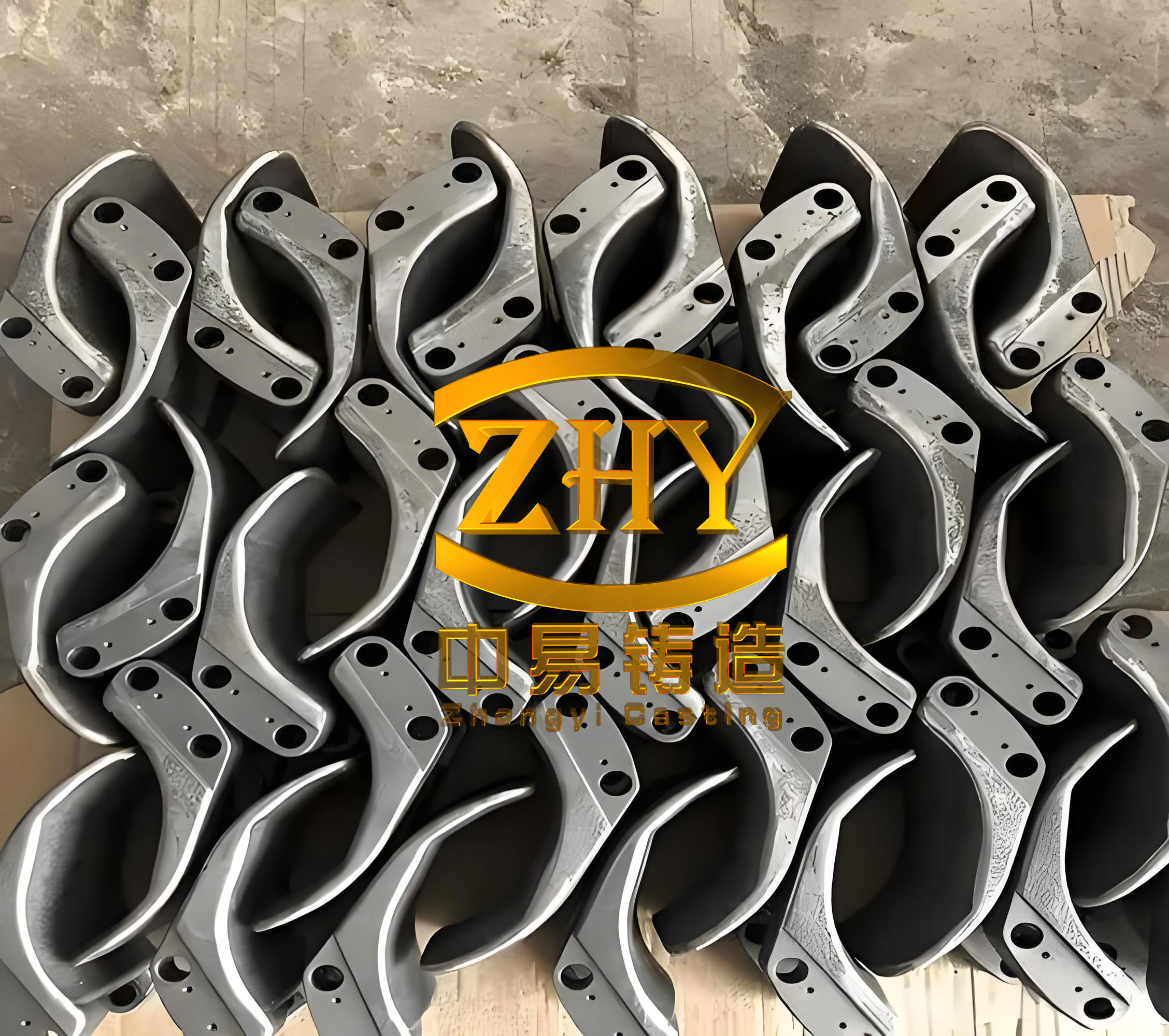
In thermal power generation, which remains a dominant source globally, the shift toward higher efficiency and lower emissions has led to the development of advanced steam turbines. Heavy-section ductile iron castings are integral in components like medium-pressure outer cylinders, bearing housings, and valve bodies. For instance, in a 1000 MW secondary reheat steam turbine, the medium-pressure outer cylinder, weighing up to 84 tons with wall thicknesses ranging from 60 to 320 mm, requires precise metallurgical control. The material specifications often demand a pearlite content below 10%, graphite球化级别不低于 3 级 (球化级别 is spheroidization grade, typically above Grade 3 per Chinese standards), and ultrasonic testing velocities exceeding 5500 m/s. The production of such ductile iron casting involves careful alloying with elements like molybdenum (0.55–0.65%) to enhance strength at elevated temperatures, along with specialized gating systems and feeding mechanisms to mitigate defects. A summary of typical requirements for thermal power ductile iron castings is provided in Table 1.
| Component | Material Grade | Max Weight (tons) | Wall Thickness Range (mm) | Key Properties | Testing Standards |
|---|---|---|---|---|---|
| Medium-Pressure Outer Cylinder | QT400-18 or equivalent | 84 | 60–320 | 球化级别 ≥3, Pearlite ≤10%, Ultrasonic velocity >5500 m/s | EN 12680-3, Magnetic particle inspection |
| Bearing Housing | QT400-18 | 18.5 | Up to 490 | High dimensional stability, Pressure tightness | Ultrasonic and dye penetrant testing |
| Valve Bodies | QT450-10 | 23.2 | Up to 120 | Leak-proof under pressure, Good machinability | EN 1369, EN 12680-3 |
The manufacturing process for these ductile iron castings often employs bottom gating with open systems to ensure smooth filling, and exothermic risers for feeding. The alloy design can be optimized using computational thermodynamics, such as the calculation of carbon equivalent (CE) to predict castability and mechanical properties: $$CE = C + \frac{Si + P}{3}$$ where C, Si, and P are weight percentages. For heavy-section ductile iron casting, CE is typically controlled between 4.3% and 4.6% to balance graphite precipitation and shrinkage. Additionally, inoculation practices with elements like barium or cerium are crucial to enhance graphite nodule count, expressed as nodules per unit area ($N_A$), which impacts toughness: $$K \propto \sqrt{N_A}$$ where higher $N_A$ generally improves impact resistance.
In hydropower, a renewable energy source reliant on water flow, heavy-section ductile iron castings are used in large valves, turbines, and gates. Components like butterfly plates and valve bodies, with diameters exceeding 5 meters and weights up to 24 tons, require excellent pressure integrity and corrosion resistance. The material grade QT450-10 is common, emphasizing a ferritic matrix for ductility. The production challenges include achieving uniform microstructure in sections up to 160 mm thick, which is addressed through controlled cooling and alloy modifications. For example, adding nickel (0.5–1.0%) can stabilize austenite in critical areas, improving low-temperature toughness. The mechanical performance of such ductile iron casting can be modeled using the von Mises yield criterion for multiaxial stress states: $$\sigma_{vm} = \sqrt{\frac{(\sigma_1 – \sigma_2)^2 + (\sigma_2 – \sigma_3)^2 + (\sigma_3 – \sigma_1)^2}{2}} \leq \sigma_y$$ where $\sigma_1, \sigma_2, \sigma_3$ are principal stresses. This ensures structural integrity under hydraulic pressures. Table 2 summarizes key applications in hydropower.
| Application | Typical Dimensions | Material Grade | Critical Requirements | Manufacturing Notes |
|---|---|---|---|---|
| Butterfly Plate | Ø4062 mm × 860 mm height | QT450-10 | Leak-proof at specified pressure, Ultrasonic testing Grade 2-3 | Bottom gating,复合孕育处理 (compound inoculation), No welding allowed |
| Valve Body | Ø5482 mm × 1225 mm height | QT450-10 | Magnetic particle inspection, Dimensional accuracy | Use of优质生铁 (high-purity pig iron),喂丝球化处理 (wire-feeding nodularization) |
| Turbine Casings | Varies by plant capacity | QT400-18 or similar | High fatigue resistance, Erosion resistance | Alloying with Cr or Mo for wear protection |
The significance of ductile iron casting in wind power cannot be overstated, as this sector demands high reliability under cyclic loading and低温 conditions. Heavy-section components like hubs, bedplates, bearing housings, and main shafts for multi-megawatt turbines are predominantly made from ferritic ductile iron grades such as QT400-18AL (equivalent to EN-GJS-400-18U-LT) or QT350-22AL (EN-GJS-350-22ULT). These materials require stringent low-temperature impact toughness, often above 12 J at -40°C, to withstand arctic environments. The production of a 6 MW wind turbine rotor, weighing 47.4 tons with wall thicknesses up to 200 mm, involves advanced metallurgical controls. The graphite morphology is optimized through multi-stage inoculation, and the cooling rate is managed using external chills and spray cooling to refine microstructure. The relationship between impact energy ($E$) and temperature ($T$) for ductile iron casting can be expressed using an Arrhenius-type equation: $$E = E_0 \exp\left(-\frac{Q}{RT}\right)$$ where $E_0$ is a pre-exponential factor, $Q$ is activation energy, and $R$ is the gas constant. This highlights the importance of chemistry control, particularly reducing trace elements like lead and antimony to below 0.06% total. Table 3 outlines typical wind power applications.
| Component | Turbine Capacity | Material Grade | Key Mechanical Properties | Quality Assurance |
|---|---|---|---|---|
| Rotor Hub | 1.25–7 MW | QT400-18AL | Tensile strength ≥400 MPa, Elongation ≥18% at room temperature, Impact toughness ≥12 J at -40°C | 100% ultrasonic testing, Radiographic inspection, Magnetic particle testing |
| Main Shaft | 2 MW | QT400-18AL | Yield strength ≥250 MPa, Good machinability for deep holes | Ultrasonic per DIN EN 12680-3, Dimensional checks |
| Gearbox Housing | Up to 90 tons weight | QT350-22AL | High stiffness, Damping capacity for vibration reduction | Pressure testing, Finite element analysis validation |
For these ductile iron castings, the fatigue life under wind loads is critical, often modeled using the S-N curve: $$N_f = C \sigma_a^{-m}$$ where $N_f$ is cycles to failure, $\sigma_a$ is stress amplitude, and $C$ and $m$ are material constants. The high damping capacity of ductile iron casting, due to graphite interfaces, reduces resonance risks, making it superior to steel for such dynamic applications. Furthermore, the manufacturing process emphasizes low-REM (rare earth magnesium) nodularizers and长效孕育剂 (long-effective inoculants) to ensure graphite球化级别 (spheroidization) even in thick sections.
In nuclear power, a clean and scalable energy source, heavy-section ductile iron castings are gaining traction for spent fuel storage and transport containers. These containers, weighing up to 183 tons with wall thicknesses over 400 mm, require exceptional radiation shielding, mechanical integrity, and fracture toughness at low temperatures. Compared to forged steel or lead-shielded stainless steel alternatives, ductile iron casting offers advantages like higher yield ratio (0.6–0.7 vs. 0.5–0.6 for steel), better impact fatigue resistance, and lower cost (40–50% of steel). The material grade often used is GGG40.3 (equivalent to QT400-18LT), with stringent controls on nitrogen content (80–120 ppm) to avoid defects and maintain properties. The fracture toughness ($K_{IC}$) can be related to the crack tip opening displacement (CTOD) via: $$K_{IC} = \sqrt{E \sigma_y \delta_c}$$ where $E$ is Young’s modulus, $\sigma_y$ is yield strength, and $\delta_c$ is critical CTOD. For heavy-section ductile iron casting, achieving high $K_{IC}$ at -40°C is essential for safety. Table 4 summarizes nuclear applications.
| Container Type | 典型 Weight (tons) | Wall Thickness (mm) | Material Specifications | Performance Metrics |
|---|---|---|---|---|
| TN1300 (German design) | 115 | Up to 500 | GGG40.3, Low REM, Controlled N content | Tensile strength >300 MPa, Impact energy >12 J/cm² at -40°C, Ultrasonic integrity |
| CASTOR series | Up to 183 | 400–500 | Ferritic ductile iron with Ce addition | Shielding efficiency, Drop test compliance, Long-term durability |
| BQH-20 (Chinese design) | 16 | 280 | QT400-18LT | Leak-tightness, Radiation resistance,符合核安全标准 (nuclear safety standards) |
The production of these massive ductile iron castings involves innovative techniques like riserless casting with zircon sand molds of strength >3 MPa, and forced cooling systems to accelerate solidification in thermal centers. The chemical composition is optimized to promote graphite expansion during凝固, reducing shrinkage porosity. For instance, silicon content is kept between 1.8% and 2.3%, and carbon equivalent around 4.3%, to enable feeding without large risers. The cooling rate ($\dot{T}$) in thick sections can be estimated using Fourier’s law: $$\dot{T} = \frac{k}{\rho c_p} \nabla^2 T$$ where $k$ is thermal conductivity, $\rho$ is density, and $c_p$ is specific heat. By controlling $\dot{T}$, the microstructure is refined, enhancing toughness. This ductile iron casting approach has been successfully implemented in Germany and Japan for批量生产 (batch production) of containers.
Looking across all energy sectors, the common thread is the reliance on heavy-section ductile iron casting for its平衡的性能 (balanced performance) and economic viability. The material’s behavior can be further analyzed through constitutive models, such as the Johnson-Cook equation for flow stress under high strain rates: $$\sigma = (A + B \varepsilon^n)(1 + C \ln \dot{\varepsilon}^*)(1 – T^{*m})$$ where $A$, $B$, $C$, $n$, $m$ are constants, $\varepsilon$ is plastic strain, $\dot{\varepsilon}^*$ is dimensionless strain rate, and $T^*$ is homologous temperature. This is relevant for impact scenarios in nuclear containers or wind turbine hubs. Moreover, the quality assurance for ductile iron casting includes non-destructive testing (NDT) methods like ultrasonic velocity measurement, which correlates with density and defect content: $$v = \sqrt{\frac{E(1-\nu)}{\rho(1+\nu)(1-2\nu)}}$$ where $v$ is sound velocity, $E$ is Young’s modulus, $\nu$ is Poisson’s ratio, and $\rho$ is density. Ensuring $v$ > 5500 m/s, as required in thermal power components, indicates high integrity.
In conclusion, as an engineer engaged in this field, I believe heavy-section ductile iron casting will continue to play a crucial role in the energy transition. The ongoing research focuses on improving graphite morphology control through advanced inoculation, optimizing alloy designs for specific service conditions, and integrating digital twins for casting process simulation. For instance, the use of artificial intelligence to predict microstructure based on cooling curves is emerging. The formula for cooling curve analysis might include: $$T(t) = T_0 + \Delta T \exp(-t/\tau) + S(t)$$ where $T(t)$ is temperature over time, $T_0$ is initial temperature, $\Delta T$ is undercooling, $\tau$ is time constant, and $S(t)$ represents latent heat release. By mastering such techniques, the industry can produce even larger and more reliable ductile iron castings for future energy projects, such as offshore wind farms or next-generation nuclear reactors. The keyword “ductile iron casting” encapsulates this synergy of material science and industrial application, driving innovation in the energy sector.
To summarize the technical data, Table 5 provides a comparative overview of heavy-section ductile iron casting properties across energy fields, emphasizing the versatility of this material.
| Energy Sector | Typical Material Grade | Max Section Thickness (mm) | Critical Property Targets | Common Manufacturing Challenges |
|---|---|---|---|---|
| Thermal Power | QT400-18, QT450-10 | 320 | High-temperature strength, Pressure tightness, Ultrasonic velocity >5500 m/s | Graphite flotation in thick zones, Shrinkage control, Alloy segregation |
| Hydropower | QT450-10 | 160 | Leak-proof under pressure, Corrosion resistance, Good machinability | Uniform ferrite formation, Dimensional stability of large diameters |
| Wind Power | QT400-18AL, QT350-22AL | 500+ | Low-temperature impact toughness (>12 J at -40°C), High fatigue strength, Damping capacity | Maintaining nodule count in慢冷 (slow cooling), Trace element control, NDT for internal defects |
| Nuclear Power | GGG40.3, QT400-18LT | 500 | Fracture toughness at -40°C, Radiation shielding, Drop test performance | Nitrogen content management, Riserless casting feasibility, Heavy-weight handling |
The future of heavy-section ductile iron casting lies in embracing these challenges through collaborative research and development. As energy equipment scales up, the demand for cost-effective, high-performance components will only grow, solidifying the position of ductile iron casting as a material of choice. I encourage practitioners to explore fundamental studies on solidification kinetics and microstructure-property relationships, leveraging computational tools to optimize every cast. With continued innovation, ductile iron casting will undoubtedly contribute to a sustainable energy future, enabling larger, more efficient, and safer power generation systems worldwide.