
In the development of marine resources, there is a growing demand for materials that exhibit exceptional corrosion resistance. Ductile iron casting, known for its cost-effectiveness, excellent wear resistance, and superior castability, holds broad application prospects in marine engineering. However, its use is sometimes limited due to inherent corrosion susceptibility. To address this, alloyed ductile iron castings, such as those incorporating nickel and chromium, have been developed. The STQNiCr grade represents a nickel-chromium alloyed ductile iron specifically designed for components like seawater corrosion-resistant valves and industrial equipment. Nickel enhances the formation of a stable, dense passivation layer, improving resistance against various corrosive media, including acidic, alkaline, and chloride-rich environments. Silicon further augments this corrosion resistance while promoting ferrite formation and improving tensile strength, elongation, and yield ratio. This combination makes high-silicon solid solution STQNiCr ductile iron casting a material with vast potential. This study investigates the influence of nickel content on the microstructure and mechanical properties of such ductile iron castings, aiming to optimize composition for marine applications.
The production of high-performance ductile iron casting requires meticulous control over raw materials and melting practices. For this investigation, the charge materials were carefully selected to minimize variability and ensure consistent base iron quality. The charge composition, designed based on extensive foundry experience for ductile iron production, is summarized in Table 1.
| Charge Material | Proportion (wt.%) |
|---|---|
| Pig Iron | 60 |
| Steel Scrap | 15 |
| Returns (Recycled Casting) | 25 |
Melting was conducted to produce 500 kg heats, with castings featuring a primary wall thickness of 40 mm. Y-block samples were poured for standardized testing. The target mechanical properties for the ductile iron casting were as follows: tensile strength (Rm) ≥ 500 MPa, elongation (A) ≥ 3%, and carbide content ≤ 1%. The alloy specification required chromium (Cr) ≥ 0.65 wt.% and nickel (Ni) ≥ 1.0 wt.%, with higher nickel content being desirable for enhanced corrosion performance where mechanically permissible.
Chemical Composition Design and Control
The chemical composition is the cornerstone of achieving the desired microstructure and properties in ductile iron casting. The roles of key elements—silicon, chromium, and nickel—were critically considered in designing the experimental matrix.
Silicon (Si): Silicon is a potent ferrite stabilizer. It dissolves in the iron lattice, altering the crystal structure and electron cloud distribution, thereby destabilizing austenite and promoting ferrite. It also reduces carbon solubility in iron, encouraging graphite precipitation over carbide formation. From a corrosion perspective, silicon facilitates the formation of a protective SiO₂-rich oxide film on the surface of the ductile iron casting, which acts as a barrier against corrosive agents. Furthermore, silicon elevates the electrochemical potential of iron, reducing its anodic activity during corrosion. The relationship between silicon content and ferrite fraction can be conceptually described by its influence on the eutectoid transformation temperature. The shift in the eutectoid temperature due to silicon can be approximated by empirical relations found in metallurgical literature for ductile iron casting:
$$\Delta T_{eutectoid}^{Si} \approx k_{Si} \cdot [wt.\% Si]$$
where $k_{Si}$ is a positive coefficient, indicating silicon raises the ferrite/austenite transformation temperature. For this study, a high silicon range was targeted to leverage these benefits.
Chromium (Cr): Chromium was added primarily to meet the specified minimum for corrosion resistance. At low levels, chromium acts as a pearlite stabilizer by strengthening the bonds within cementite (Fe₃C). However, chromium is a strong carbide promoter. It shifts the eutectic point to the right and narrows the temperature gap between the stable (graphitic) and metastable (carbidic) eutectic reactions, increasing the risk of chill formation (white iron). The tendency for carbide formation increases with chromium content, which can be detrimental to the ductility of the ductile iron casting. Therefore, chromium was maintained at the specified lower limit to minimize carbide risk while providing the intended alloying effect.
Nickel (Ni): Nickel is a strong austenite stabilizer and its effect varies with content. At lower levels, it promotes a mixed pearlite-ferrite matrix. As nickel content increases, it significantly increases the volume fraction of pearlite. Nickel has minimal direct effect on graphite nodule size and distribution but can indirectly maintain nodularity by stabilizing the matrix and reducing graphitic distortions. Importantly, nickel suppresses the precipitation of carbides at grain boundaries. The strengthening contribution from nickel in the ductile iron casting matrix can be considered through solid solution strengthening, often described by a linear relationship:
$$\Delta \sigma_{ss}^{Ni} = K_{Ni} \cdot [wt.\% Ni]$$
where $K_{Ni}$ is the strengthening coefficient for nickel in the iron matrix. Nickel’s most critical role in this context is its ability to enhance the formation and stability of passive films (e.g., mixed Cr₂O₃/NiO layers), drastically improving corrosion resistance in aggressive environments like seawater. Based on these considerations, three distinct nickel levels were chosen for experimentation, as detailed in Table 2.
| Sample ID | C | Si | Mn | P | S | Cr | Ni |
|---|---|---|---|---|---|---|---|
| C1 | 3.45-3.55 | 3.30-3.50 | <0.20 | <0.06 | <0.015 | 0.65 | 1.0 |
| C2 | 3.45-3.55 | 3.30-3.50 | <0.20 | <0.06 | <0.015 | 0.65 | 1.5 |
| C3 | 3.45-3.55 | 3.30-3.50 | <0.20 | <0.06 | <0.015 | 0.65 | 2.0 |
Nodularizing and Inoculation Treatment
The transformation of graphite from flakes to spheroids is fundamental to the superior properties of ductile iron casting. The process involves two key steps: nodularizing (or spheroidizing) and inoculation.
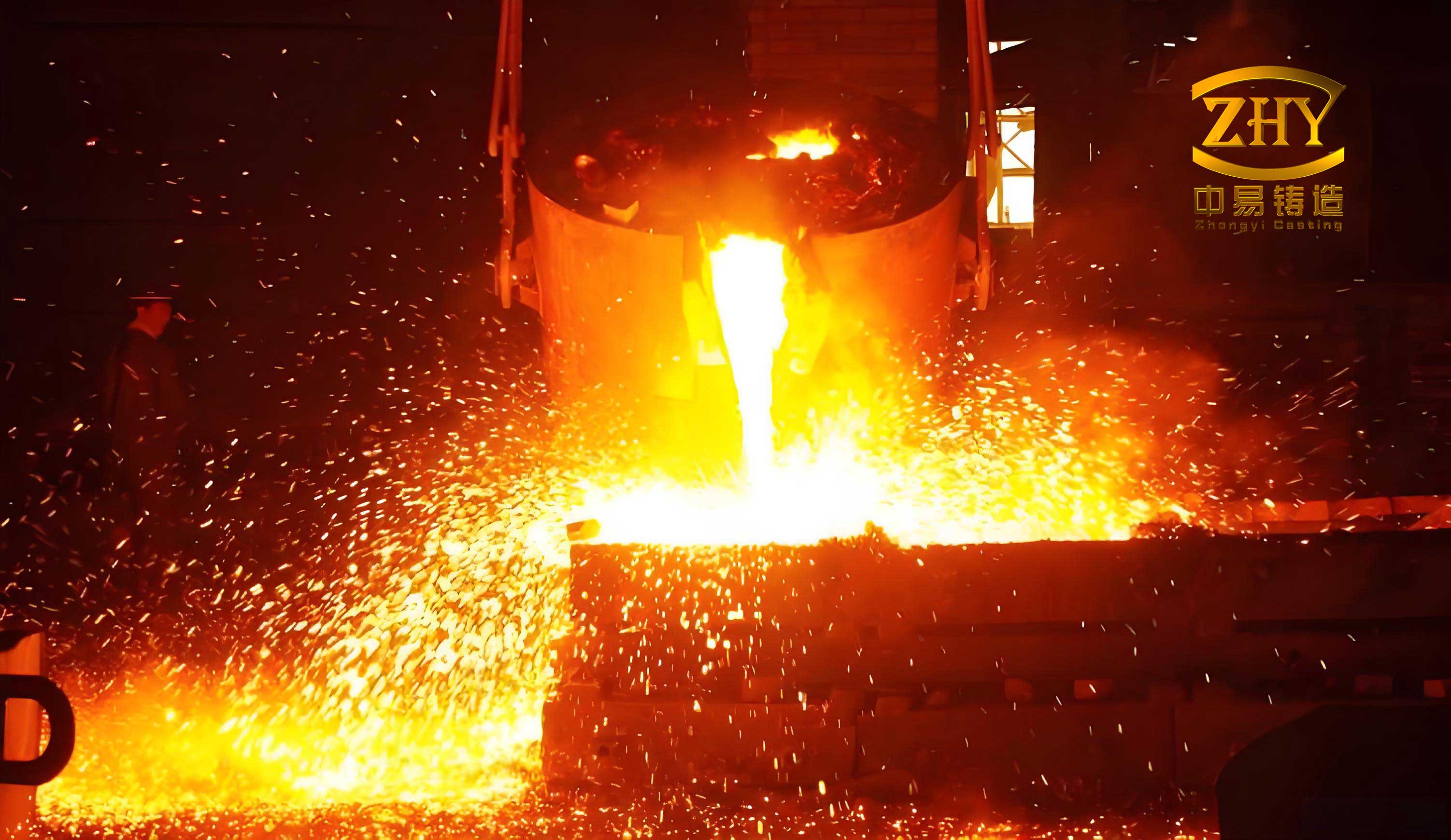
Nodularizing Treatment: A sandwich method (often referred to as the pouring-over or sandwich technique) was employed for nodularization. The treatment aims to introduce magnesium (Mg) or other spheroidizing elements into the melt. Successful treatment converts graphite into a spherical morphology, which drastically reduces the stress concentration and crack initiation sites within the matrix. This is paramount for achieving high elongation in ductile iron casting. The degree of nodularity is quantified by the nodule count and shape factor (roundness). A higher nodularity grade (e.g., ≥ Grade 3 per relevant standards) ensures more uniform stress distribution and improved mechanical reliability. Given that the alloying elements Cr and Ni tend to promote pearlite and potentially carbides—which can reduce ductility—the addition rate of the nodularizing alloy was set higher than for unalloyed ductile iron. In this study, a nodularizer addition of 1.6 wt.% was used to ensure adequate magnesium recovery and effective graphite spheroidization in the alloyed ductile iron casting.
Inoculation Treatment: Inoculation is performed to provide numerous nucleation sites for graphite precipitation during solidification. This ensures a fully graphitic structure, prevents chill (carbide) formation, refines graphite nodules, and increases nodule count. A finer and more uniform distribution of graphite nodules further enhances the strength, toughness, and machinability of the ductile iron casting. It also improves microstructural homogeneity, reducing microsegregation and the associated corrosion potential differences. For this research, a total inoculant addition of 1.25 wt.% was applied. The inoculant was added in-stream during pouring for immediate inoculation. A silicon-bismuth (Si-Bi) inoculant was specifically chosen for the late-stage addition due to its recognized efficacy in increasing graphite nodule count and promoting ferrite formation in the matrix of ductile iron casting. The addition rate of the Si-Bi inoculant was 0.15 wt.%.
Microstructural Analysis
Samples from the three different nickel-content ductile iron castings (C1, C2, C3) were prepared following standard metallographic procedures: sectioning, mounting, grinding, polishing, and etching (typically with nital). The microstructures were then examined using optical microscopy at appropriate magnifications. The key microstructural features assessed were graphite morphology (nodularity, size), matrix constituents (pearlite, ferrite), and the presence of carbides.
All three grades of ductile iron casting exhibited a nodular graphite structure with a nodularity grade ≥ 3 and a nodule size primarily in the range of 6 to 7 (according to standard size charts). The matrix structure, however, showed a significant variation with nickel content. The quantitative analysis of the matrix phases is summarized in Table 3.
| Sample ID | Nickel Content (wt.%) | Pearlite Fraction (%) | Carbide/Ledeburite Presence |
|---|---|---|---|
| C1 | 1.0 | ~60 | <1% (Negligible) |
| C2 | 1.5 | ~70 | <1% (Negligible) |
| C3 | 2.0 | ~90 | ~8% (Ledeburite observed) |
The micrographs revealed that with increasing nickel content, the area fraction of pearlite (the dark-etching lamellar mixture of ferrite and cementite) in the matrix increased systematically from approximately 60% in C1 to about 90% in C3. This is a direct consequence of nickel’s austenite-stabilizing power, which suppresses the transformation of austenite to ferrite during cooling, favoring the formation of pearlite. In sample C3, with 2.0 wt.% Ni, the microstructure revealed the presence of ledeburite, a eutectic mixture of austenite and cementite that forms during solidification under conditions favoring the metastable system. The appearance of ledeburite indicates that the combined effect of nickel and chromium, at this level, pushed the solidification path sufficiently to promote carbide formation from the liquid, despite the high silicon content and inoculation. This is a critical transition point for the ductile iron casting, as ledeburite is extremely hard and brittle.
The mechanism behind nickel’s effect on pearlite fraction can be linked to its influence on the critical transformation temperatures. Nickel lowers the eutectoid temperature ($A_1$), expanding the temperature range for pearlite formation upon cooling. The degree of undercooling ($\Delta T$) below the equilibrium eutectoid temperature affects the driving force for pearlite vs. ferrite formation. Nickel’s role can be incorporated into models estimating the pearlite start temperature, $T_P$:
$$T_P \approx T_{eutectoid}^0 – \sum (m_i \cdot [wt.\% i])$$
where $T_{eutectoid}^0$ is the eutectoid temperature for pure Fe-C, $[wt.\% i]$ is the concentration of alloying element i, and $m_i$ is its coefficient. For nickel, $m_{Ni}$ is negative, meaning $T_P$ decreases, but the overall effect is to increase the pearlite fraction by altering the kinetics and thermodynamics of the transformation in the ductile iron casting matrix.
Mechanical Properties Evaluation
Tensile test specimens were machined from the Y-blocks according to international standards. The tests provided data on tensile strength (Rm), yield strength (Rp0.2), and elongation (A). Brinell hardness (HBW) measurements were also conducted. The results, presented as the average of three tests per condition in Table 4, show a clear trend correlating mechanical properties with nickel content in these ductile iron castings.
| Sample ID | Ni (wt.%) | Tensile Strength, Rm (MPa) | Yield Strength, Rp0.2 (MPa) | Elongation, A (%) | Brinell Hardness, HBW |
|---|---|---|---|---|---|
| C1 | 1.0 | 665 | 510 | 7.0 | 223 |
| 657 | 500 | 7.5 | 221 | ||
| 663 | 508 | 7.0 | 229 | ||
| C2 | 1.5 | 691 | 583 | 5.0 | 258 |
| 694 | 579 | 5.5 | 257 | ||
| 682 | 581 | 5.0 | 251 | ||
| C3 | 2.0 | 716 | 620 | 2.0 | 270 |
| 701 | 627 | 2.5 | 276 | ||
| 717 | 631 | 2.5 | 274 |
The data unequivocally demonstrates that increasing nickel content in the high-silicon solid solution STQNiCr ductile iron casting leads to a monotonic increase in tensile strength, yield strength, and hardness. For instance, the average tensile strength rose from approximately 662 MPa for C1 (1.0% Ni) to about 711 MPa for C3 (2.0% Ni). This strengthening is attributed to two primary mechanisms: solid solution strengthening by nickel atoms in the ferrite/pearlite matrix, and the increased volume fraction of the stronger pearlite phase. The relationship between yield strength and microstructure can be approximated by a rule-of-mixtures for the ductile iron casting matrix, considering the strengths of the constituent phases:
$$R_{p0.2} \approx f_{\alpha} \cdot \sigma_{\alpha} + f_{P} \cdot \sigma_{P}$$
where $f_{\alpha}$ and $f_{P}$ are the volume fractions of ferrite and pearlite, respectively, and $\sigma_{\alpha}$ and $\sigma_{P}$ are their intrinsic yield strengths. As nickel increases $f_{P}$, the overall $R_{p0.2}$ increases.
However, this gain in strength comes at a significant cost to ductility. The elongation dropped from an average of about 7.2% for C1 to 5.2% for C2, and then plummeted to approximately 2.3% for C3. The drastic reduction in elongation for the C3 ductile iron casting is directly correlated with the appearance of ledeburite in the microstructure. Ledeburite, being a brittle, carbide-rich phase, acts as a potent site for crack initiation and propagation under tensile stress, severely limiting plastic deformation. Consequently, while the C3 ductile iron casting met the strength and hardness criteria, it failed to satisfy the minimum elongation requirement of 3%, rendering it unsuitable for applications where toughness is critical.
The hardness trend follows the strength trend closely, as expected. The increase in hardness with nickel content is a combined result of pearlite strengthening and, in the case of C3, the contribution from hard carbides within the ledeburite. The presence of carbides significantly increases the wear resistance of the ductile iron casting but at the expense of machinability and fracture toughness.
Discussion on the Role of Nickel in Ductile Iron Casting
The findings of this study highlight the dual and competing roles of nickel in high-silicon alloyed ductile iron casting. On one hand, nickel is highly beneficial for enhancing strength and, crucially, corrosion resistance—a key property for marine-grade ductile iron casting. On the other hand, beyond a certain threshold, it can induce undesirable microstructural constituents that catastrophically reduce ductility.
The optimal nickel content for this specific STQNiCr ductile iron casting, balancing strength, ductility, and the absence of harmful carbides, was found to be 1.5 wt.% (Sample C2). At this level, the microstructure consisted of approximately 70% pearlite and 30% ferrite (estimated balance), with no significant carbides. This structure provided a tensile strength near 690 MPa, a yield strength around 580 MPa, and an elongation of 5%, alongside a hardness of about 255 HB. This combination successfully meets the target mechanical property set.
The transition to a carbide-containing structure at 2.0 wt.% Ni underscores the complex interplay between alloying elements in ductile iron casting. While silicon strongly promotes graphite formation, chromium and nickel favor carbide stability. The combined alloying effect can be evaluated using carbon equivalents adjusted for alloying elements. A modified carbon equivalent (CEm) that accounts for the graphitizing and anti-graphitizing effects might be expressed as:
$$CE_{m} = [wt.\% C] + \frac{1}{3}[wt.\% Si] – \frac{1}{2}[wt.\% Cr] – \frac{1}{4}[wt.\% Ni]$$
This is a simplified illustrative form; actual coefficients vary. For the C3 composition, the negative contributions from Cr and Ni likely result in a lower effective graphitizing potential, pushing the solidification toward the metastable system and leading to ledeburite formation in the ductile iron casting. This highlights the necessity of carefully balancing alloy additions to avoid compromising the fundamental graphitic structure that defines ductile iron.
Furthermore, the effect of nickel on the solidification path and phase transformation temperatures is critical. Nickel expands the austenite phase field and lowers the martensite start (Ms) temperature, although martensite is not expected in these slowly cooled castings. Its primary effect is on the pearlite transformation. The continuous cooling transformation (CCT) diagram for the ductile iron casting shifts to longer times with increasing nickel, allowing pearlite to form over a wider range of cooling rates. This contributes to the increased pearlite fraction observed.
Implications for Industrial Production of Corrosion-Resistant Ductile Iron Casting
The production of reliable, high-performance STQNiCr ductile iron casting for marine applications requires strict process control. Based on this investigation, the following guidelines are proposed for foundries:
- Charge Make-up: Use a charge composed of 60% pig iron, 15% steel scrap, and 25% returns to ensure a clean, low-tramp element base iron suitable for high-quality ductile iron casting production.
- Composition Targets: Aim for a final composition within these ranges for optimal properties: Carbon: 3.45-3.55 wt.%, Silicon: 3.30-3.50 wt.%, Manganese: <0.20 wt.%, Phosphorus: <0.06 wt.%, Sulfur: <0.015 wt.% (before treatment), Chromium: 0.65 wt.%, Nickel: 1.5 wt.%. This nickel level maximizes strength and corrosion benefits without triggering carbide formation in this specific high-silicon ductile iron casting.
- Treatment Practice: Employ a robust nodularizing treatment with an addition rate slightly higher than for unalloyed ductile iron (e.g., 1.6 wt.% nodularizer) to ensure full spheroidization in the presence of pearlite-stabilizing elements. Follow with effective inoculation, including a late-stream addition of a potent inoculant like silicon-bismuth (e.g., 0.15 wt.%), to guarantee a high nodule count, suppress chill, and promote a desirable matrix structure in the final ductile iron casting.
- Quality Verification: Implement routine microstructural examination to monitor nodularity, nodule count, pearlite/ferrite ratio, and the absence of carbides. Mechanical testing of separately cast samples should confirm that tensile strength exceeds 500 MPa and elongation remains above 3% for the specified ductile iron casting grade.
The successful application of this ductile iron casting material in corrosive environments like seawater also depends on the stability of the passive film. The synergy between nickel and chromium in promoting a protective layer is well-established. The high silicon content further contributes to this layer’s integrity. Therefore, the optimized composition derived here is expected to exhibit superior long-term corrosion performance, making it a strong candidate for valves, pumps, and fittings in marine engineering systems.
Conclusion
This study systematically investigated the influence of nickel content on the microstructure and mechanical properties of a high-silicon solid solution STQNiCr grade ductile iron casting. The following key conclusions were drawn:
- A ductile iron casting with a composition of 3.45-3.55 wt.% C, 3.30-3.50 wt.% Si, 0.65 wt.% Cr, and 1.5 wt.% Ni, produced from a charge of 60% pig iron, 15% steel scrap, and 25% returns, and treated with appropriate nodularizing and inoculation practices, yields an optimal combination of mechanical properties meeting the requirements for demanding applications.
- Increasing the nickel content in this high-silicon ductile iron casting consistently increases the pearlite fraction in the matrix. However, when the nickel content reaches 2.0 wt.%, the thermodynamic balance shifts sufficiently to cause the formation of ledeburite (eutectic carbides) during solidification.
- The mechanical properties of the ductile iron casting show a strong dependence on nickel content. Tensile strength, yield strength, and hardness increase monotonically with increasing nickel. In contrast, elongation decreases progressively. The ductile iron casting with 2.0 wt.% Ni exhibits a dramatic drop in elongation to below 3% due to the embrittling effect of ledeburite, failing to meet the specified toughness criterion.
- Therefore, for this specific STQNiCr ductile iron casting formulation, a nickel content of 1.5 wt.% represents the optimal balance, providing high strength (Rm ~690 MPa, Rp0.2 ~580 MPa), adequate ductility (A ~5%), and a fully graphitic, carbide-free microstructure essential for good toughness and machinability. This optimized ductile iron casting composition is recommended for producing components where enhanced corrosion resistance and good mechanical properties are paramount.
The findings contribute to a deeper understanding of the alloy design principles for specialized ductile iron castings, emphasizing the need for a holistic approach that considers the synergistic and antagonistic interactions between multiple alloying elements to achieve the desired performance envelope in the final ductile iron casting product.