
In my extensive experience within the foundry industry, particularly focusing on high-performance materials, ductile iron casting has been a cornerstone for applications demanding superior thermal and mechanical properties. One such material, silicon-molybdenum (Si-Mo) heat-resistant ductile iron, is prized for its exceptional resistance to thermal fatigue, thermal shock, and adequate hot strength, enabling service temperatures of 700–800 °C. This makes it indispensable for components like automotive turbocharger housings. However, producing these ductile iron castings presents unique challenges. The complex geometries, varying wall thicknesses, and stringent customer specifications necessitate rigorous control over raw materials and process parameters, including chemical composition, melting, spheroidization, inoculation, and pouring temperatures. Often, low-magnesium spheroidizers and silicon-barium inoculants are employed. Despite these precautions, a persistent defect known as fragmentary graphite frequently leads to batch rejections, causing significant economic losses and production delays. Currently, there is no unified global consensus on the root causes and solutions for fragmentary graphite in ductile iron casting. Therefore, based on my firsthand investigations and production trials, this article delves into the factors influencing this defect—such as molten iron activity, composition, spheroidization and inoculation practices, and cooling rates in heavy sections—and presents effective countermeasures that have successfully mitigated fragmentary graphite in Si-Mo heat-resistant ductile iron castings.
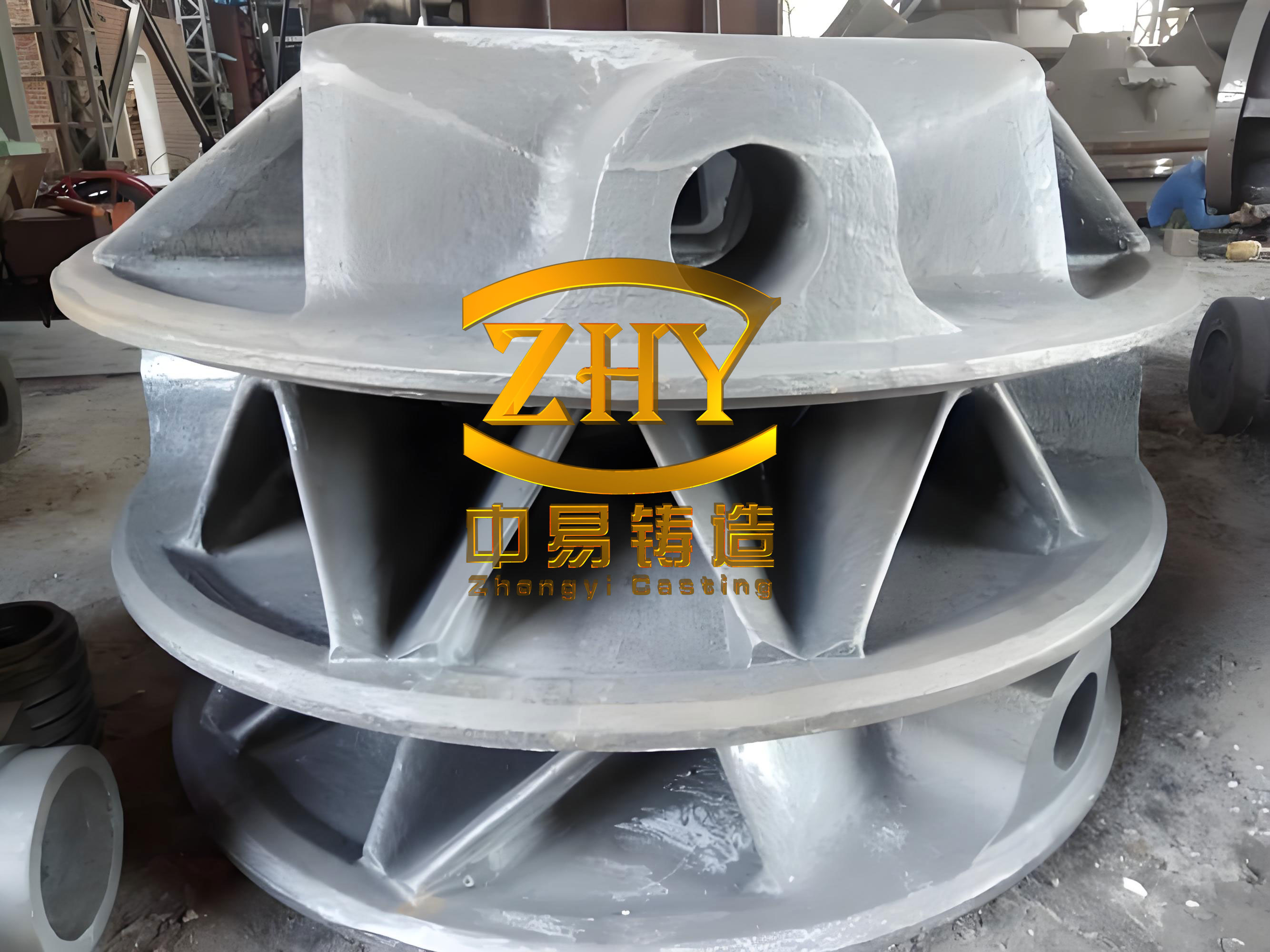
The quest for high-integrity ductile iron casting begins with precise chemical control. For Si-Mo heat-resistant grades, the composition is tailored to maximize ferrite matrix content and enhance high-temperature stability. Silicon, a potent graphitizer, raises the austenite transformation temperature, while molybdenum boosts hot tensile strength, creep resistance, and thermal fatigue performance. However, excessive silicon can promote graphite flotation and segregation, and molybdenum may form carbides at grain boundaries, potentially reducing elongation. Hence, elements like manganese, phosphorus, and sulfur are strictly limited. The typical chemical ranges for these ductile iron castings are summarized in Table 1.
| Grade | C | Si | Mn | P | S | Mo | Ni | Mg |
|---|---|---|---|---|---|---|---|---|
| Medium Si-Mo | 3.0–3.4 | 3.75–4.25 | ≤0.6 | ≤0.07 | ≤0.02 | 0.5–0.7 | ≤0.5 | ≤0.06 |
| High Si-Mo | 3.0–3.4 | 4.4–4.9 | ≤0.6 | ≤0.07 | ≤0.02 | 0.5–0.7 | ≤0.5 | ≤0.06 |
To achieve these specifications and ensure sound ductile iron casting, the melting practice is critical. In our operations, we use a 2-ton medium-frequency induction furnace charged with 45 carbon steel and high-purity Q10 pig iron. Alloying elements are added via FeMo55, FeSi75, and low-sulfur carburizers. To minimize shrinkage tendencies common in ductile iron casting, carbon content is slightly elevated to improve fluidity, and melting and pouring temperatures are increased by approximately 40°C compared to standard nodular iron—targeting 1500–1530°C for melting and 1410–1430°C for pouring. Spheroidization is performed using a covered ladle process. Despite this controlled setup, fragmentary graphite defects persistently emerged in thermal hotspots like feeder necks and thick sections of turbocharger housings.
Upon microstructural examination, fragmentary graphite in these ductile iron castings appears as finely dispersed graphite chunks within the matrix, resembling type D graphite in gray iron. However, within a eutectic cell, these fragments are interconnected. They often distribute intergranularly or form clusters surrounded by spheroidal graphite, as illustrated in the micrographs. This morphology suggests a strong correlation with austenite dendrites. Two key observations support this: first, fragmentary graphite predominantly occurs in regions with well-developed austenite; second, it aligns along austenite dendrites and is locally distributed alongside a few spheroidal graphite nodules. The short distances between these graphite fragments facilitate carbon diffusion, promoting ferrite formation between them, while molybdenum carbides and pearlite tend to reside at grain boundaries away from the fragmentary graphite zones. This defect severely compromises the mechanical properties, particularly elongation and fatigue resistance, of the ductile iron casting.
Through systematic analysis of multiple production batches, I identified several key factors contributing to fragmentary graphite formation in Si-Mo ductile iron casting. These factors interact complexly, but each can be a primary culprit under certain conditions.
1. Excessive Melting Temperature and Prolonged Holding: When molten iron for ductile iron casting is superheated to 1620–1630°C and held for over 30 minutes, the effective nucleation sites diminish, reducing nucleation potency. This leads to undercooling and promotes the growth of fragmentary graphite. The relationship between holding time at high temperature and nucleation site density can be modeled. The rate of nucleation site loss might be approximated by an exponential decay function:
$$ N(t) = N_0 e^{-kt} $$
where \( N(t) \) is the number of active nucleation sites at time \( t \), \( N_0 \) is the initial number, and \( k \) is a rate constant dependent on temperature. Higher temperatures increase \( k \), accelerating site depletion and raising the risk of fragmentary graphite in the final ductile iron casting.
2. Excessively Low Sulfur Content in Base Iron: Sulfur plays a paradoxical role in ductile iron casting. While high sulfur hinders spheroidization, very low sulfur (<0.008%) impairs nucleation. Using high-purity charge materials and high melting temperatures often drops sulfur to 0.005–0.007%. This results in poor spheroidization and fragmentary graphite, especially in hot spots. Experimentally, adding ferrosulfur to adjust base iron sulfur to 0.011–0.016% significantly improved graphite nodule count and roundness, virtually eliminating fragmentary graphite. This underscores sulfur’s role as a crucial nucleation agent in ductile iron casting. The effect can be summarized as: optimal sulfur range maximizes graphite nodule count \( N_g \), which inversely correlates with fragmentary graphite occurrence. A simplified relationship is:
$$ N_g \propto [S]^{\alpha} \quad \text{for } [S] \text{ in optimal range} $$
where \( [S] \) is sulfur content and \( \alpha \) is a positive exponent.
3. High Carbon Equivalent (CE) and Elevated Silicon: Carbon equivalent, a measure of graphitization potential, is critical for ductile iron casting. For Si-Mo grades, CE is calculated as:
$$ CE = C + \frac{Si + P}{3} $$
where C, Si, and P are in mass percent. When CE exceeds 4.7% (typically with Si > 4.6%), fragmentary graphite becomes pronounced in thermal centers. High silicon increases fluidity but also enhances graphite flotation and segregation, creating favorable conditions for fragmentary graphite formation. The tendency for fragmentary graphite \( F \) can be empirically related to CE:
$$ F \propto e^{\beta \cdot (CE – CE_{\text{crit}})} $$
where \( \beta \) is a material constant and \( CE_{\text{crit}} \) is a threshold value around 4.6% for these ductile iron castings.
4. Use of High-Rare Earth (RE) Spheroidizers: Rare earth elements are common in spheroidizers for ductile iron casting to counteract tramp elements. However, in Si-Mo grades, RE sensitivity is heightened. RE elements like cerium and lanthanum have low melting points (e.g., Fe-Ce eutectic at 1060°C, Fe-La at 880°C). During solidification, they cause local constitutional undercooling in the eutectic liquid, potentially remelting parts of the austenite shell surrounding graphite nodules. This creates open austenite dendrite channels where carbon diffuses, leading to dendritically distributed fragmentary graphite. Comparative trials using spheroidizers with different RE contents on the same heat of ductile iron casting demonstrated clear differences. Table 2 shows the spheroidizer compositions, and Table 3 presents the resulting casting chemistries.
| Spheroidizer | Mg | Si | RE | Ca |
|---|---|---|---|---|
| Type A (High-RE) | 5.8 | 44.5 | 1.8 | 2.4 |
| Type B (Low-RE) | 5.5 | 44.6 | 0.7 | 2.3 |
| Sample | C | Si | Mn | P | S | Mo | Ni | Mg | Ce |
|---|---|---|---|---|---|---|---|---|---|
| From Type A | 3.12 | 4.05 | 0.12 | 0.021 | 0.007 | 0.54 | 0.03 | 0.035 | 0.016 |
| From Type B | 3.10 | 4.04 | 0.12 | 0.021 | 0.008 | 0.54 | 0.03 | 0.036 | 0.008 |
Microstructural analysis revealed that the low-RE spheroidizer yielded more uniform spheroidal graphite with fewer fragments, confirming that for clean-base ductile iron casting (low in S, Sn, Pb, Ti), low-RE or RE-free spheroidizers are preferable to avoid fragmentary graphite.
5. Slow Cooling Rates in Heavy Sections: Ductile iron casting solidification is highly sensitive to cooling rate. In thick sections or hot spots like turbocharger tongues and feeder junctions, prolonged solidification times reduce undercooling, leading to a loose coupling between graphite and austenite. This allows liquid pockets to persist around graphite, facilitating branched growth and fragmentary graphite formation. The local solidification time \( t_f \) is a key parameter, often estimated using Chvorinov’s rule:
$$ t_f = B \left( \frac{V}{A} \right)^n $$
where \( V \) is volume, \( A \) is surface area, \( B \) is a mold constant, and \( n \) is an exponent (typically ~2). Higher \( t_f \) values correlate strongly with increased fragmentary graphite severity in ductile iron casting.
Based on these insights, I developed and implemented a multi-pronged strategy to combat fragmentary graphite in Si-Mo ductile iron casting. The success of these measures hinges on a holistic approach addressing nucleation, composition, and thermal management.
Countermeasure 1: Enhancing Molten Iron Activity for Ductile Iron Casting. Active iron with abundant nucleation sites is fundamental. We increased the proportion of high-quality pig iron in the charge, limited returns to avoid impurity buildup, and avoided prolonged holding at high temperatures. Crucially, maintaining base iron sulfur in the 0.011–0.016% range proved essential. Additionally, pre-conditioning the melt with high-purity silicon carbide (SiC) was adopted. SiC dissociates, providing nascent carbon and silicon that act as substrates for graphite nucleation, enhancing nucleation potential for ductile iron casting. The effectiveness can be conceptualized by a nucleation parameter \( \eta \):
$$ \eta = f([S], [\text{SiC}], T_{\text{hold}}) $$
where higher \( \eta \) reduces fragmentary graphite incidence.
Countermeasure 2: Optimizing Chemical Composition for Ductile Iron Casting. Tight control of CE and trace elements is vital. We target a CE of 4.5–4.6%, keeping silicon at the lower end of the specification (e.g., ~3.8% for medium Si-Mo). In stubborn cases, minute additions of antimony (Sb ~0.003%) or tin (Sn) were evaluated. These low-melting-point elements segregate at the graphite-austenite interface during solidification, hindering carbon diffusion and suppressing fragmentary graphite in ductile iron casting. However, they increase pearlite content and shrinkage tendency, requiring careful balancing. The trade-off can be expressed as:
$$ \Delta F_{\text{graphite}} = -a[\text{Sb}] + b[\text{Sb}]^2 + \text{(shrinkage term)} $$
where \( a, b \) are coefficients. Furthermore, RE content from all sources (spheroidizer, inoculant) is minimized, especially for high-silicon or chromium-containing ductile iron casting grades.
Countermeasure 3: Selecting Effective Inoculants and Treatment Methods for Ductile Iron Casting. Inoculation is perhaps the most powerful tool to prevent fragmentary graphite in ductile iron casting. While silicon-barium inoculants are common, they sometimes underperform in hot spots. Through trials, zirconium-bearing inoculants (e.g., silicon-strontium-zirconium or sulfur-oxygen-zirconium types) demonstrated superior efficacy in suppressing fragmentary graphite. Zirconium forms stable carbides and nitrides that serve as excellent heterogeneous nucleation sites. Conversely, bismuth-containing or RE-bearing inoculants, though beneficial for thin sections, perform poorly in slow-cooling regions of ductile iron casting and were avoided. The choice of inoculant significantly impacts the final graphite nodule count \( N_g \), which is inversely related to fragmentary graphite area fraction \( A_f \):
$$ A_f \approx \frac{\kappa}{N_g} $$
where \( \kappa \) is a constant. Multiple inoculation, particularly late stream inoculation during pouring, is highly recommended for ductile iron casting. The inoculant grain size must be fine (0.2–0.7 mm) to prevent slag defects, given the relatively lower fluidity of Si-Mo ductile iron casting.
Countermeasure 4: Accelerating Cooling in Heavy Sections of Ductile Iron Casting. Any measure that increases local cooling rate or reduces thermal mass helps. We redesigned gating systems to distribute metal flow and avoid localized overheating. Strategic use of chills, chromite sand in molds, and attached cooling fins on patterns were implemented to extract heat faster from critical areas. This reduces the local solidification time \( t_f \), pushing the solidification mode away from the conditions favoring fragmentary graphite in ductile iron casting. The improvement can be quantified by the reduction in the modulus \( (V/A) \) of the hot spot:
$$ \Delta \left( \frac{V}{A} \right) \downarrow \quad \Rightarrow \quad t_f \downarrow \quad \Rightarrow \quad A_f \downarrow $$
Implementing these countermeasures systematically in our ductile iron casting production led to a dramatic reduction in fragmentary graphite defects. The scrap rate for turbocharger housings due to this defect fell to negligible levels. Microstructural uniformity improved significantly, ensuring consistent mechanical properties across the casting, even in complex, thick-walled ductile iron casting components.
In conclusion, fragmentary graphite in Si-Mo heat-resistant ductile iron casting is a multifactorial defect primarily stemming from inadequate nucleation, suboptimal composition, inappropriate spheroidization/inoculation, and slow cooling in heavy sections. From my practical journey in refining ductile iron casting processes, the following key takeaways emerge. First, maintaining high molten iron activity through controlled sulfur and pre-conditioning is foundational for sound ductile iron casting. Second, meticulous chemical control, targeting a CE around 4.5–4.6% and considering trace additions like Sb, is crucial, though the side effects must be managed. Third, the selection of metallurgical treatments is paramount: low-RE or RE-free spheroidizers combined with Zr-bearing inoculants applied via stream inoculation yield the best graphite morphology in ductile iron casting. Finally, enhancing cooling in thermal centers through design and tooling modifications is an effective mechanical solution. The interplay of these factors can be summarized in a holistic quality function for ductile iron casting:
$$ Q_{\text{DI}} = \int \left( \alpha \cdot \eta_{\text{nucleation}} + \beta \cdot \frac{1}{|CE – CE_{\text{opt}}|} + \gamma \cdot N_g + \delta \cdot \frac{1}{t_f} \right) dt $$
where \( Q_{\text{DI}} \) represents the overall quality metric for ductile iron casting free from fragmentary graphite, and \( \alpha, \beta, \gamma, \delta \) are weighting coefficients. This integrated approach, born from rigorous analysis and shop-floor validation, provides a reliable framework for producing high-integrity Si-Mo heat-resistant ductile iron castings. The knowledge gained is transferable to other premium-grade ductile iron casting applications where thermal and mechanical demands push the boundaries of conventional foundry practice. Continuous monitoring and adaptation remain essential, as each ductile iron casting project may present unique challenges, but the core principles of nucleation control, compositional balance, and thermal management stand firm.