
Based on extensive research and practical experience in the field, I aim to delve deeply into the advanced technology required for producing high-performance ductile iron casting suitable for low-temperature applications, particularly down to -60°C. The demand for such materials has surged in sectors like rail transit, wind power, nuclear energy, and polar exploration, where components must withstand extreme environmental stresses without compromising mechanical integrity. This article will systematically explore every critical aspect of the process, from chemical composition design to final heat treatment, emphasizing control measures that ensure consistent quality. Throughout this discussion, the term “ductile iron casting” will be frequently highlighted to underscore its centrality in modern manufacturing.
The foundation of any successful ductile iron casting lies in its chemical composition. Achieving the desired low-temperature toughness—specifically, a tensile strength ≥425 MPa, impact energy between 12-14 J, and elongation ≥22% at -60°C—requires meticulous balancing of elements. Carbon, for instance, must be maintained within a narrow range to prevent defects like graphite floating or chill formation while ensuring complete graphitization. Silicon, though a potent graphitizer, adversely affects impact toughness; every 0.1% increase in Si can raise the ductile-to-brittle transition temperature by approximately 5.5–6.0°C. Thus, lowering silicon content is essential, but this must be compensated by adding trace nickel to maintain strength. Manganese is even more detrimental, with a 0.1% increment potentially increasing the transition temperature by 10–12°C, mandating strict limits. Phosphorus and sulfur, as harmful impurities, must be minimized to avoid embrittling phases and poor nodularization. The optimal composition for QT400-18AL (-60°C) grade ductile iron casting is summarized in Table 1.
| Element | Control Range (wt%) | Primary Effect and Rationale |
|---|---|---|
| Carbon (C) | 3.50 – 3.80 | Prevents graphite floating and chill; ensures full graphitization. Higher carbon improves fluidity but must avoid excessive buoyancy. |
| Silicon (Si) | 1.90 – 2.25 | Promotes ferrite formation but reduces low-temperature impact toughness. Lower limits are preferred, with Ni addition for strength compensation. |
| Magnesium (Mg) | 0.030 – 0.050 | Essential for spheroidization; residual Mg must be controlled to avoid shrinkage defects and ensure nodule count. |
| Manganese (Mn) | ≤ 0.20 | Severely raises ductile-to-brittle transition temperature; kept minimal to preserve toughness. |
| Phosphorus (P) | ≤ 0.03 | Forms brittle phosphide eutectics; low levels are critical for elongation and impact resistance. |
| Sulfur (S) | ≤ 0.015 | Interferes with Mg treatment; low sulfur ensures effective nodularization and reduces slag inclusion. |
| Nickel (Ni) | Trace (as needed) | Enhances strength without compromising low-temperature properties; allows for lower Si content. |
| Other Trace Elements | Minimized | Elements like Cr, Sn, Sb, and Pb should be avoided as they stabilize pearlite or cause intergranular segregation. |
To achieve this composition, raw material selection is paramount. High-purity pig iron is the cornerstone, chosen for its elevated carbon content and minimal impurities. Scrap steel should be low-alloy to avoid introducing unwanted elements. Carbon raisers, essential for adjusting carbon levels, must be low-sulfur varieties with high absorption rates (C ≥ 90%, S ≤ 0.25%). The relationship between raw material purity and final properties can be expressed via a quality factor Q, where:
$$ Q = \frac{[C] \cdot [Si]}{[Mn] + [P] + [S] + \sum [Trace]} $$
Here, [ ] denotes concentration in weight percent. A higher Q value correlates with better low-temperature performance in ductile iron casting. During melting, charge calculations must be precise, favoring high-purity pig iron over scrap and returns to maintain a clean base iron.
Melting control is the next critical phase. The process begins with accurate weighing of charges to avoid segregation. Rapid melting is encouraged to prevent oxidation and element loss, with careful monitoring to avoid bridging. Once the bath reaches 1420°C, a preliminary sample is taken for carbon equivalent analysis, followed by spectroscopic analysis at 1450°C to fine-tune composition. The final tapping temperature is rigorously maintained between 1530–1550°C; this high temperature ensures adequate fluidity for treatment and reduces viscosity-related defects. The thermal history during melting influences nucleation potential, which can be modeled using an Arrhenius-type equation for nucleation rate N:
$$ N = A \exp\left(-\frac{E_a}{RT}\right) $$
where \( A \) is a pre-exponential factor, \( E_a \) is activation energy for graphite nucleation, \( R \) is the gas constant, and \( T \) is temperature in Kelvin. Higher tapping temperatures can enhance nucleation sites if managed correctly. After skimming slag, the molten iron is ready for treatment.
Spheroidization is the heart of ductile iron casting, transforming graphite into spheroids for superior mechanical properties. A low-magnesium, low-rare earth alloy (with MgO ≤ 0.7%) is preferred to minimize dross and fading effects. The alloy size (3–20 mm) ensures gradual reaction, and addition rates of 1.15–1.25% are typical. The treatment ladle is designed with a concave bottom pit, with a height-to-diameter ratio >2, to maximize reaction efficiency and magnesium recovery. During tapping, iron is poured to avoid direct impingement on the alloy, using a fast-then-slow sequence over about 90 seconds. Residual magnesium should be controlled at 0.036–0.050%; too low leads to poor nodularity, while too high increases shrinkage tendency. The reaction kinetics can be approximated by:
$$ [Mg]_{residual} = [Mg]_{added} \cdot e^{-k t} $$
where \( k \) is a rate constant dependent on temperature and slag conditions. After treatment, pouring must be completed within 15 minutes to prevent fading.
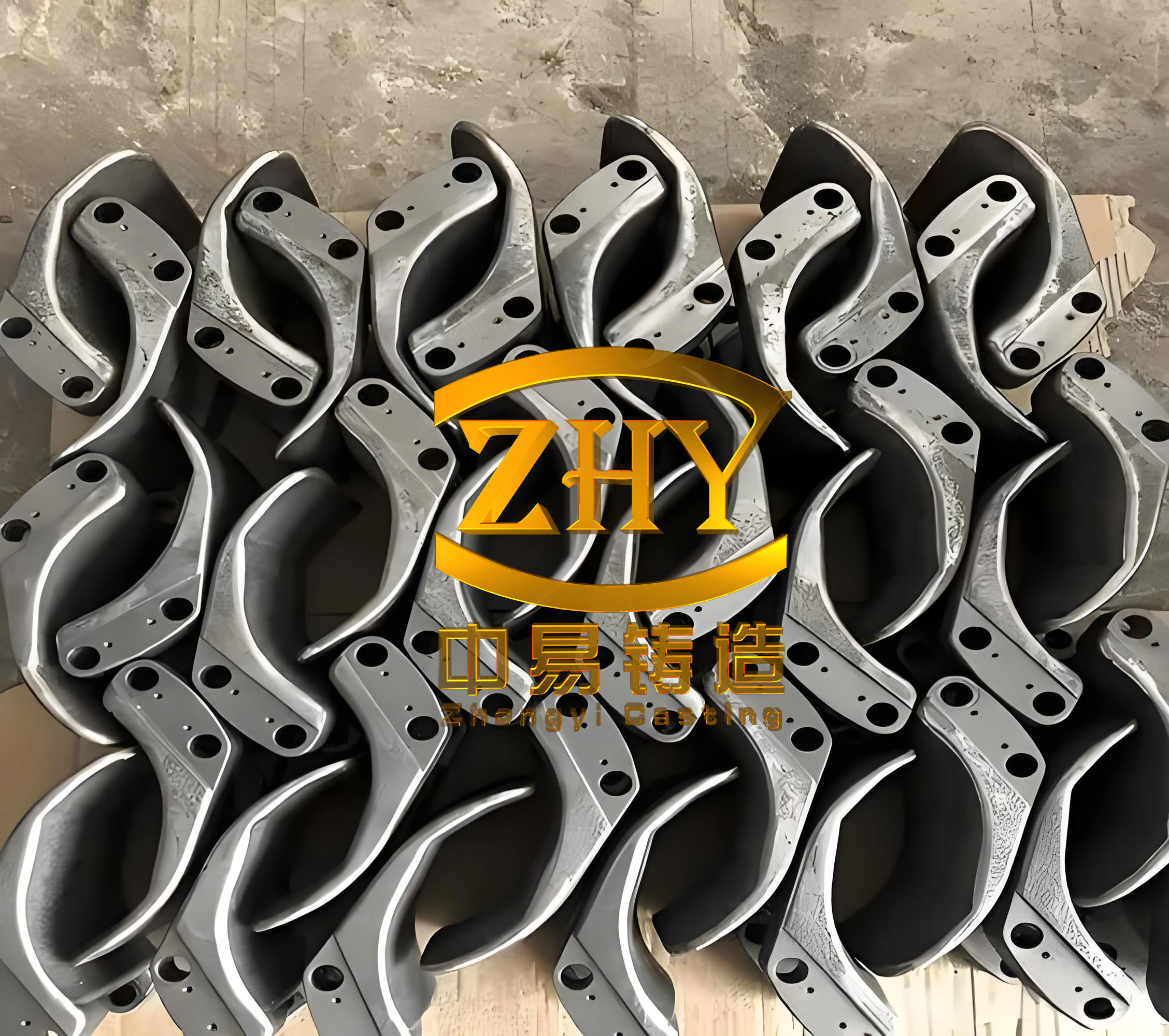
Inoculation immediately follows to enhance graphite nucleation and prevent undercooling. A complex inoculant based on ferrosilicon, with additions of calcium, barium, and trace bismuth, is employed. The total inoculation addition ranges from 1.10–1.20%, supplemented by a late stream inoculation of 0.10–0.20% to counteract fading. This dual approach increases graphite count, refines matrix structure, and improves homogeneity. The effectiveness of inoculation in ductile iron casting can be quantified by the nodule count per unit area (NA), which correlates with impact energy. Empirically, for low-temperature grades:
$$ N_A = B \cdot [Si]_{effective} \cdot [Inoculant]^{0.5} $$
where \( B \) is a material constant, and [Si]effective includes both base and inoculated silicon. Higher NA values (typically >150 nodules/mm²) are associated with better toughness at sub-zero temperatures.
Casting practices must complement these treatments. Gating systems are designed to minimize turbulence and reoxidation, with filters often used to trap inclusions. Pouring temperatures are kept moderate (around 1350–1400°C) to reduce shrinkage porosity while ensuring fill. Solidification modeling helps optimize feeder placement, as soundness is critical for the demanding properties of ductile iron casting. After shakeout, castings are inspected non-destructively before proceeding to heat treatment.
Heat treatment is indispensable for achieving 100% ferritic matrix in low-temperature ductile iron casting. As-cast microstructures often contain minor pearlite, which degrades toughness. A high-temperature annealing at 900–920°C is employed, followed by controlled cooling. This process dissolves carbides, transforms pearlite to ferrite, and allows carbon to diffuse to graphite nodules. The annealing time depends on section thickness, typically 1–2 hours per inch, plus soaking. The transformation kinetics can be described using the Avrami equation for ferrite formation fraction X:
$$ X = 1 – \exp(-k t^n) $$
where \( k \) and \( n \) are temperature-dependent constants. At 910°C, complete ferritization is achieved efficiently. After holding, slow furnace cooling to 600°C prevents thermal stresses, followed by air cooling. This regimen yields the target mechanical properties: tensile strength ≥425 MPa, elongation ≥22%, and impact energy of 12–14 J at -60°C. Table 2 summarizes the key process parameters for producing QT400-18AL (-60°C) ductile iron casting.
| Process Stage | Key Parameters | Control Limits | Objective |
|---|---|---|---|
| Melting | Tapping Temperature | 1530 – 1550 °C | Ensure fluidity and reduce oxide inclusion |
| Spheroidization | Mg Alloy Addition | 1.15 – 1.25 % | Achieve residual Mg of 0.036–0.050% |
| Inoculation | Total Inoculant | 1.10 – 1.20 % | Increase graphite nodule count |
| Stream Inoculation | Late Addition | 0.10 – 0.20 % | Counteract fading and refine eutectic cells |
| Heat Treatment | Annealing Temperature | 900 – 920 °C | Convert pearlite to ferrite fully |
| Cooling Rate | Furnace Cooling | ≤ 50 °C/h to 600°C | Avoid stress and preserve ductility |
Quality verification is integral. Tensile and impact tests are conducted at room and low temperatures, with microstructural examination to ensure nodularity >80% and ferrite content >95%. Advanced techniques like electron microscopy help identify any deleterious phases. The success of this ductile iron casting technology is evident in its application to critical components such as gearboxes, motor housings, and axle boxes for high-speed trains operating in extreme cold.
In conclusion, mastering low-temperature ductile iron casting requires a holistic approach. Starting with high-purity raw materials, precise chemical control—particularly minimizing Si and Mn while adding trace Ni—sets the foundation. Rigorous melting and tapping protocols ensure a clean, homogeneous melt. Effective spheroidization and inoculation are vital for achieving high nodule count and matrix refinement. Finally, a tailored high-temperature heat treatment guarantees a fully ferritic structure, unlocking the required toughness at -60°C. Each step interlocks, and deviations can compromise performance. Through diligent application of these principles, manufacturers can reliably produce ductile iron casting that meets the stringent demands of modern infrastructure, pushing the boundaries of material science in harsh environments. The continuous evolution of this technology will further expand the horizons for ductile iron casting in emerging fields like space exploration and deep-sea engineering.