
In my extensive experience with ductile iron casting, particularly in automotive applications, I have frequently encountered the challenge of inverse chill defects. These defects, characterized by the formation of white iron structures in the core regions of castings, significantly compromise the machinability, impact toughness, and overall structural integrity of components. The investigation into the root causes of inverse chill is paramount for advancing the quality and reliability of ductile iron casting processes. This article delves deeply into a comprehensive analysis of inverse chill defects observed in QT500-7 ductile iron castings used for automobile brake calipers and brackets, employing a multifaceted approach to unravel the underlying metallurgical phenomena.
The widespread adoption of ductile iron casting for critical automotive parts, such as brake calipers and brackets, is driven by its exceptional combination of mechanical properties, castability, and cost-effectiveness compared to steel or aluminum alloys. The grade QT500-7, with its specified tensile strength of 500 MPa and 7% elongation, is a common choice. However, the solidification process in ductile iron casting is complex, involving metastable transformations that can lead to undesirable microstructural features. Inverse chill represents one such defect where, under specific conditions, the metastable cementite phase forms preferentially in the last-to-solidify areas, typically the thermal center of a casting section. This defect not only increases tool wear during machining but also acts as a stress concentrator and crack initiation site, potentially leading to premature failure in service. Therefore, a profound understanding of its genesis is crucial for process optimization in ductile iron casting.
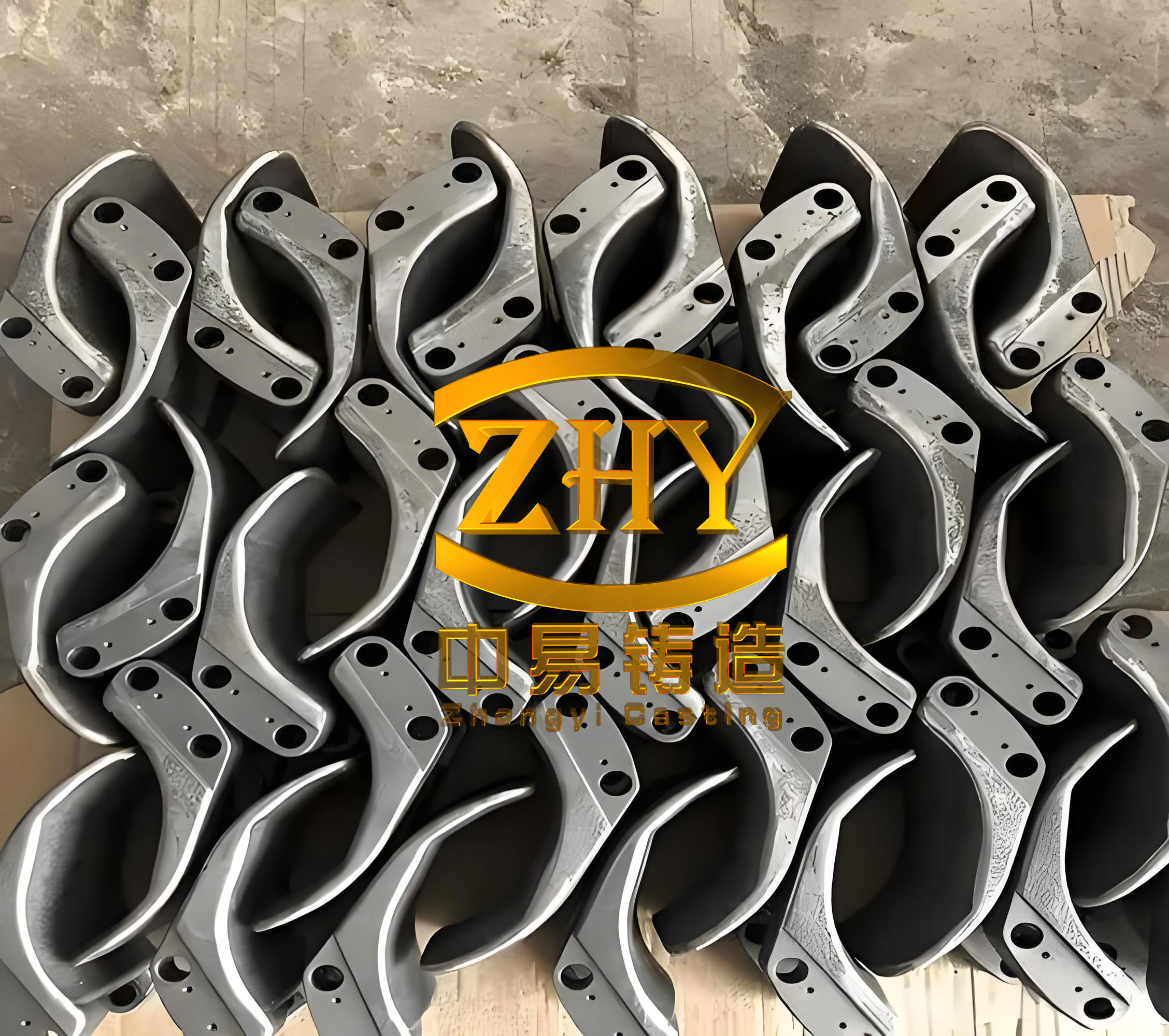
My investigation commenced with the systematic examination of two distinct inverse chill defects found during routine quality inspections of production castings. The defects manifested in the ear section of the brake caliper and the beam section of the bracket. To ensure a thorough analysis, I adopted a suite of characterization techniques, each chosen to elucidate specific aspects of the defect formation.
The initial step involved macro-observation of the defect zones. Samples were sectioned from the identified inverse chill areas, ground, polished, and etched with a 4% nital solution. The macroscopic features were strikingly different. The defect in the brake caliper sample presented as a large, dark, elliptical patch with a considerably darker hue than the surrounding matrix, covering a significant area. In contrast, the defect in the bracket sample appeared as numerous small, dark, punctate spots scattered within the core region. This visual disparity hinted at potentially different mechanistic origins for the inverse chill in these two ductile iron casting components.
Chemical composition analysis was performed on samples taken from the bulk material of both castings. It is important to note that standard spark spectrometry on non-chilled samples provides an average composition, which may not reflect local variations. The results are summarized in Table 1.
| Sample | C (wt%) | Si (wt%) | Mn (wt%) | P (wt%) | S (wt%) |
|---|---|---|---|---|---|
| Brake Caliper | 3.76 | 2.28 | 0.72 | 0.028 | 0.016 |
| Bracket | 3.38 | 2.96 | 0.36 | 0.035 | 0.018 |
| QT500-7 Specification | 3.6-5.0 | 2.5-2.9 | ≤0.6 | ≤0.08 | ≤0.025 |
While the brake caliper’s silicon content was below the specification range, and the manganese was above, the bracket showed a lower carbon and higher silicon content. These average values, however, merely set the stage; the real story lies in microsegregation. The solidification of ductile iron casting involves a prolonged mushy zone for hypereutectic compositions, which is a primary driver for solute redistribution. The segregation coefficient, $k$, defined as the ratio of solute concentration in the solid to that in the liquid at the interface ($k = C_s / C_l$), governs this process. For elements like manganese (an austenite stabilizer and anti-graphitizer), $k < 1$, leading to positive segregation where they are enriched in the last-solidifying liquid. Conversely, for silicon (a strong graphitizer), $k > 1$, leading to negative segregation in the final solid. This can be described by the Scheil-Gulliver equation for non-equilibrium solidification:
$$C_s = k C_0 (1 – f_s)^{k-1}$$
where $C_s$ is the solute concentration in the solid, $C_0$ is the initial alloy concentration, and $f_s$ is the solid fraction. This equation predicts significant enrichment of manganese in the residual liquid, increasing the chilling tendency locally.
Metallographic examination was conducted on both the inverse chill zones and adjacent sound areas. Unetched samples were analyzed for graphite morphology, and etched samples were used to reveal the matrix structure. The graphite characteristics were evaluated according to relevant standards, and the data is compiled in Table 2.
| Location | Nodularity (%) | Nodule Count (mm⁻²) | Predominant Graphite Size |
|---|---|---|---|
| Brake Caliper Inverse Chill Zone | 92 | 204 | Size 7 (55%) |
| Brake Caliper Sound Zone | 93 | 216 | Size 7 (67%) |
| Bracket Inverse Chill Zone | 77 | 196 | Size 7 (59%) |
| Bracket Sound Zone | 83 | 216 | Size 7 (72%) |
The graphite structure in the brake caliper sample was relatively uniform between the defect and sound zones, with high nodularity and similar nodule counts. However, the bracket sample showed a clear deterioration in the inverse chill zone: lower nodularity and a reduced nodule count, particularly in the very center of the defect where graphite appeared scarce. This is a classic signature of inoculation fading or recession. In ductile iron casting, effective inoculation provides numerous substrates for graphite nucleation. In heavy sections or slow-cooling regions, these nuclei can dissolve over time due to Ostwald ripening or diffusion, described by the Lifshitz-Slyozov-Wagner theory for particle coarsening:
$$\bar{r}^3 – \bar{r}_0^3 = \frac{8 \gamma D C_{\infty} V_m}{9 R T} t$$
where $\bar{r}$ is the average particle radius, $\gamma$ is the interfacial energy, $D$ is the diffusion coefficient, $C_{\infty}$ is the solubility in the matrix, $V_m$ is the molar volume, $R$ is the gas constant, $T$ is temperature, and $t$ is time. This dissolution reduces the number of effective graphite nuclei, increasing the undercooling required for graphite precipitation and pushing the system towards the metastable cementite formation.
The matrix microstructure in the etched condition revealed the fundamental nature of the inverse chill. In the brake caliper defect zone, the structure consisted of a ledeburitic-type eutectic—a fine, dispersed mixture of cementite and austenite decomposition products (now transformed to pearlite), appearing in a cellular or honeycomb pattern interspersed with blocky segments. This morphology is indicative of a relatively high undercooling event. In contrast, the bracket defect zone exhibited massive, coarse, plate-like and needle-like primary cementite aggregates, often interconnected. This is characteristic of a more severe suppression of the stable eutectic reaction. The increased hardness of these zones, as confirmed by Vickers microhardness testing (see Table 3), directly correlates with the high volume fraction of hard cementite and pearlite.
| Location | Average Microhardness (HV) |
|---|---|
| Brake Caliper Inverse Chill Zone | 293 |
| Brake Caliper Sound Zone | 199 |
| Bracket Inverse Chill Zone | 425 |
| Bracket Sound Zone | 240 |
To probe the local chemistry, scanning electron microscopy (SEM) coupled with energy-dispersive X-ray spectroscopy (EDS) was employed on the inverse chill areas. Elemental mapping and point analysis provided clear evidence of microsegregation. While silicon mapping sometimes showed apparent “rich” zones due to its association with the last solidifying interdendritic liquid (which is also silicon-rich in ductile iron), comparative point analysis between the chill zone and the adjacent sound matrix was more revealing. Consistently, the manganese content was measurably higher in the inverse chill zones for both samples, while the silicon content was relatively lower. This localized enrichment of anti-graphitizing elements like manganese critically alters the metastable equilibrium. The driving force for the graphite eutectic reaction versus the cementite eutectic reaction can be framed in terms of Gibbs free energy change, $\Delta G$. The undercooling, $\Delta T$, below the stable eutectic temperature $T_{st}$ influences which phase forms. The presence of segregants like Mn increases the thermodynamic driving force for cementite formation, effectively depressing the metastable eutectic temperature less than the stable one. A simplified criterion for the formation of inverse chill can be related to a critical local concentration of chill-promoting elements, $C_{crit}$, which shifts the solidification path into the white iron region of the phase diagram. This local concentration is a result of segregation amplified by the solidification parameters.
Synthesizing all evidence, I conclude that the primary cause of inverse chill in the brake caliper ductile iron casting was pronounced microsegregation of anti-graphitizing elements, particularly manganese. The relatively high average Mn content (0.72%) and low Si (2.28%) in this casting created a baseline composition with increased chilling tendency. During solidification, the positive segregation of Mn and possible negative segregation of Si in the thermal center reached a threshold that significantly elevated the local undercooling required for graphite nucleation. This pushed the system past the critical undercooling for the metastable reaction, resulting in the formation of the dispersed ledeburitic structure. The graphite morphology remained largely unaffected because the nucleation event for graphite nodules occurred earlier in solidification, before the segregating liquid pool became critically enriched.
For the bracket ductile iron casting, the situation was more complex and severe. Here, two synergistic factors were at play: microsegregation and inoculation fading. The average composition showed a lower carbon equivalent, which can extend the solidification range and increase segregation potential. More importantly, the slower cooling in the thicker section of the bracket, or perhaps a delay between inoculation and solidification of the core, allowed for the dissolution of graphite nuclei. The reduction in effective nuclei count, as quantified by the lower nodule count in the chill zone, dramatically increased the undercooling for graphite precipitation. Concurrently, the segregation of Mn (even from a lower base level of 0.36%) in the last liquid, now devoid of sufficient nucleation sites, created a perfect storm. The system underwent a massive undercooling, leading to the direct precipitation of coarse primary cementite, manifesting as the severe, aggregated inverse chill structure. This interplay can be modeled by considering the combined effect on the total undercooling, $\Delta T_{total}$:
$$\Delta T_{total} = \Delta T_{comp} + \Delta T_{nucl}$$
where $\Delta T_{comp}$ is the undercooling increment due to local composition changes from segregation, and $\Delta T_{nucl}$ is the undercooling increment required due to a deficiency of nucleation sites. When $\Delta T_{total}$ exceeds the critical value for the metastable eutectic, inverse chill forms.
To mitigate inverse chill defects in ductile iron casting, a multi-pronged approach is essential. Firstly, strict control of base chemistry is crucial. Manganese should be kept at the lower end of the specification, and a balanced carbon equivalent should be maintained to optimize fluidity and graphitization potential. Secondly, inoculation practice must be robust. Using effective inoculants with elements like Sr, Ca, or rare earths that form stable, refractory nuclei can resist fading. The inoculation should be performed as late as possible in the process stream, and for heavy sections, consider using mold or stream inoculation to ensure fresh nuclei reach the thermal center. Thirdly, modifying solidification conditions can help. Techniques such as controlled cooling, the use of chills to directionalize solidification, or even the strategic addition of minor elements like titanium have been reported to interfere with the segregation pattern of manganese, reducing its detrimental effect. Finally, for castings already afflicted with inverse chill, a sub-critical or full annealing heat treatment can be applied to decompose the cementite. For example, a normalization treatment at 950°C for 2 hours, followed by controlled cooling, promotes the graphitization of the metastable carbides, restoring ductility and machinability to the ductile iron casting.
The journey of analyzing these defects reinforces the intricate balance required in ductile iron casting. It is a process where thermodynamics, kinetics, and process engineering intersect. Every parameter—from charge makeup and melting practice to inoculation, pouring temperature, and mold design—casts a vote on the final microstructure. Inverse chill, while a formidable defect, is not an insurmountable one. Through diligent application of metallurgical principles, continuous process monitoring, and adaptive control strategies, the incidence of such defects can be minimized, ensuring that ductile iron casting continues to be a robust and reliable manufacturing route for high-performance automotive components. The lessons learned from this investigation are broadly applicable to a wide range of ductile iron casting applications where soundness and consistency are paramount.
Further research could quantitatively model the segregation profiles using computational thermodynamics coupled with solidification simulation software specific for ductile iron casting. This would allow for predictive casting design, identifying potential hot spots for inverse chill before tooling is even manufactured. Additionally, advanced in-situ characterization techniques could be employed to observe the nucleation and growth events in real-time, providing unprecedented insight into the precise moment where the solidification path diverges towards the metastable phase in a ductile iron casting. The pursuit of such knowledge is not merely academic; it is the foundation for the next generation of high-integrity, defect-free ductile iron castings that will meet the ever-increasing demands of the automotive industry and beyond.