
In my experience, manufacturing cylinder blocks for compressors presents significant challenges due to their complex geometry, stringent dimensional accuracy, and high-performance requirements in low-temperature environments. The ductile iron casting process must be meticulously controlled to achieve the desired mechanical properties, such as strength, ductility, and impact resistance at temperatures as low as -40°C. This article delves into the comprehensive production process control strategies we employ, focusing on raw material selection, chemical composition optimization, inoculation practices, and casting工艺 design. The goal is to minimize defect rates and ensure consistent quality in ductile iron casting for heavy-section components like cylinder blocks, which weigh approximately 4 tons with varying wall thicknesses from 55 mm to 170 mm.
The success of ductile iron casting hinges on understanding the interplay between metallurgy and processing. We begin by selecting appropriate铸造工艺. Given our production facilities, we opt for furan resin sand molding combined with horizontal造型 and vertical pouring. This approach facilitates good mold stability and feeding characteristics. To validate the工艺, we utilize casting simulation software, such as Huazhu CAE, to analyze solidification patterns and predict potential shrinkage or porosity. This proactive simulation helps in optimizing gating and riser systems, ensuring sound castings. The complexity of the cylinder block structure necessitates such advanced tools to visualize metal flow and temperature gradients during solidification.
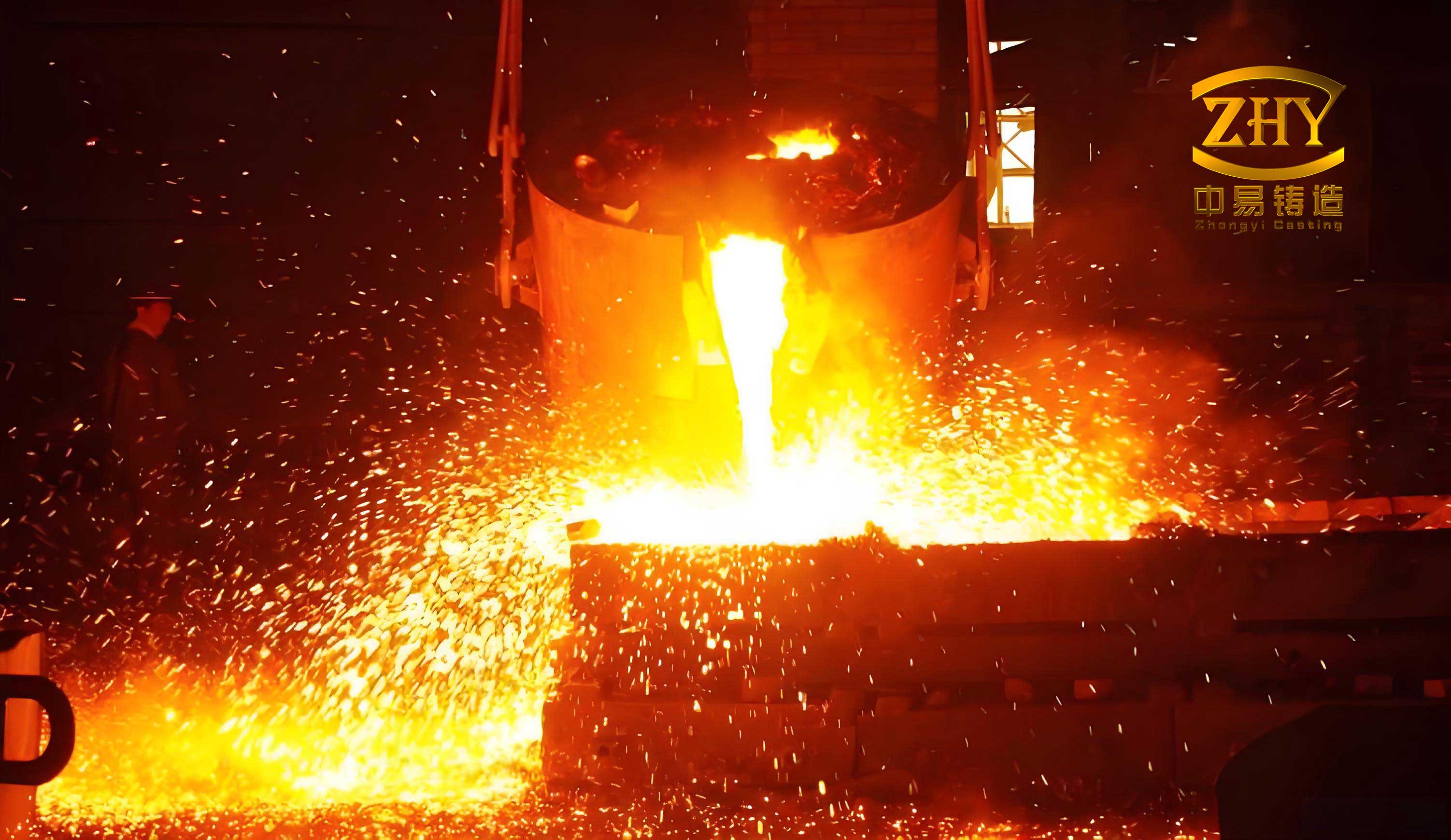
Control over the production process starts with炉料配比. We exclusively use high-quality No. 10 carbon steel scrap as the primary charge material to minimize impurities. Its chemical composition is critical, as detailed in Table 1. This choice ensures low levels of trace elements like Ti and Cr, which can adversely affect ductility and low-temperature toughness in ductile iron casting.
| Element | C | Si | Mn | P | S | Ti | Cr | V | Fe |
|---|---|---|---|---|---|---|---|---|---|
| Content (wt.%) | 0.09 | 0.12 | 0.16 | 0.08 | 0.017 | 0.02 | 0.071 | 0.001 | Balance |
To achieve the desired carbon content in the ductile iron casting, we employ high-temperature graphitized carburizers. These additives promote graphite formation and reduce chilling tendencies. The specifications are summarized in Table 2. The carburizer’s low sulfur and nitrogen content is vital to prevent defects and ensure proper graphite nodularity.
| Parameter | Fixed Carbon | Ash | Moisture | S | N | Particle Size |
|---|---|---|---|---|---|---|
| Content | ≥98.5 | ≤1 | ≤1 | <0.1 | ≤0.0150 | 1–5 mm |
The heart of ductile iron casting control lies in铁水化学成分 selection. Each element plays a pivotal role in determining the final microstructure and properties. We target a carbon equivalent (CE) range of 4.4% to 4.6% to balance fluidity and shrinkage. The carbon equivalent is calculated using the formula:
$$CE = C + \frac{1}{3}(Si + P)$$
For our ductile iron casting, carbon content is maintained between 3.65% and 3.75%. Higher carbon increases graphite nodule count and improves density, but excess can lead to graphite flotation. Silicon, a strong graphitizer, is controlled at 1.80% to 2.00% in the final iron, with base iron silicon kept at 0.80% to 1.00% to allow for multiple inoculations. Manganese, which stabilizes carbides and reduces toughness, is restricted to below 0.30%. Phosphorus and sulfur are harmful impurities; we limit P to under 0.10% and S to below 0.03% in the base iron. Titanium interference with球化 is controlled by keeping Ti ≤ 0.04%. Additionally, nickel is added at 0.6% to 0.8% via冲入法 to enhance strength without compromising low-temperature impact properties. The interplay of these elements can be modeled using empirical relationships for strength, such as:
$$\sigma_u = A + B \cdot (C) – C \cdot (Mn) + D \cdot (Si)$$
where $\sigma_u$ is the ultimate tensile strength, and A, B, C, D are constants derived from historical data for ductile iron casting.
球化剂 and孕育剂 selection are crucial for achieving spherical graphite morphology. We use T-1 type球化剂 with 1.4% addition. Its composition, given in Table 3, ensures magnesium levels of 0.04% to 0.06% and rare earth (RE) content of 0.02% to 0.03%. This combination minimizes白口倾向 and promotes round graphite nodules. The球化处理 employs the冲入法 with a reaction time of 60–90 seconds.
| Element | Mg | RE | Ba | Ca | Si | Fe |
|---|---|---|---|---|---|---|
| Content (wt.%) | 6.5–7.5 | 1.8–2.5 | 1.8–2.5 | Balanced | 43–45 | Remainder |
For孕育, BS-3 type孕育剂 is applied at 1.0% total, distributed as 0.4% ladle cover, 0.45% ladle addition, and 0.15%随流孕育 (floating silicon method). This multi-stage inoculation enhances graphite nucleation, leading to fine, uniformly distributed graphite spheres in the ductile iron casting. The effectiveness of inoculation can be quantified by the nodule count per unit area, which correlates with improved mechanical properties. We monitor this through metallographic analysis.
Process parameters are tightly controlled. Melting is conducted in a 5-ton medium-frequency induction furnace. The tapping temperature is set at 1,500–1,530°C to ensure proper dissolution of alloys. After球化 and孕育, the pouring temperature is maintained at 1,350–1,380°C with a pouring time of 120–150 seconds to avoid turbulence and oxide formation. Post-casting, the cylinder blocks undergo a prolonged annealing cycle of 72 hours to achieve a predominantly ferritic matrix, which is essential for high ductility and low-temperature impact resistance in ductile iron casting. The hardness is targeted below 140 HB to meet specifications.
The results from trial production validate our process control. Table 4 compares the chemical compositions of base and treated iron, demonstrating successful adjustment within desired ranges.
| Iron Type | C | Si | Mn | P | S | Mg | RE | Ti | Cr | V | Cu | Ni | Fe |
|---|---|---|---|---|---|---|---|---|---|---|---|---|---|
| Base Iron | 3.95 | 0.85 | 0.246 | 0.018 | 0.023 | – | – | 0.0038 | 0.047 | <0.0010 | 0.013 | 0.036 | Balance |
| Treated Iron | 3.77 | 1.82 | 0.254 | 0.019 | 0.016 | 0.030 | 0.015 | 0.0063 | 0.048 | <0.0010 | 0.014 | 0.728 | Balance |
Mechanical properties and microstructure evaluated on separately cast试棒, heat-treated alongside the castings, are summarized in Table 5. All values meet the requirements for QT350-22L grade ductile iron casting, including -40°C Charpy V-notch impact energy.
| Property | Ultimate Tensile Strength (MPa) | Yield Strength (MPa) | Elongation (%) | Hardness (HB) | Impact Energy at -40°C (J) | Graphite Nodularity | Nodule Size | Matrix Structure |
|---|---|---|---|---|---|---|---|---|
| Value | 410 | 240 | 24 | 120 | 16, 18, 20 | Grade 3 | Grade 6 | 95% Ferrite |
The impact energy values, averaging above 12 J, confirm the efficacy of our process in achieving low-temperature toughness. The microstructure exhibits well-formed graphite spheres (Grade 3 nodularity) in a ferritic matrix, which is optimal for ductile iron casting intended for cryogenic service. We attribute this to the precise control over inoculation and chemical composition, particularly low Mn and proper Ni addition.
To further optimize ductile iron casting, we consider mathematical models for solidification. The cooling rate in thick sections can be approximated using Fourier’s law, influencing graphite nucleation. The nodule count N_v can be related to undercooling ΔT by:
$$N_v = k \cdot (\Delta T)^n$$
where k and n are material constants. By controlling pouring temperature and inoculation, we maximize N_v for improved properties. Additionally, the relationship between tensile strength and hardness for ferritic ductile iron can be expressed as:
$$\sigma_u \approx 3.45 \times HB \text{ (in MPa)}$$
for typical ranges, aiding in non-destructive quality checks.
In conclusion, producing high-quality low-temperature ductile iron casting for cylinder blocks demands an integrated approach. From炉料配比 to final heat treatment, every step must be calibrated based on metallurgical principles and practical experience. Our process emphasizes raw material purity, targeted chemical composition, effective球化 and孕育, and rigorous thermal management. This systematic control reduces defects like shrinkage, porosity, and poor graphite structure, ensuring that the ductile iron casting meets stringent mechanical and low-temperature performance criteria. Continuous improvement through simulation and data analysis further enhances the reliability and economy of ductile iron casting for complex, heavy-section components. The success of this methodology underscores the importance of holistic process control in advanced foundry operations.