
In the production of critical automotive components, the drive frame housing for a reduction gearbox represents a significant technical challenge. This part, a key element in减速 systems, is typically specified in material grade QT600-3. My task involved optimizing the manufacturing process for this specific ductile iron casting to resolve persistent quality issues, reduce weight, and lower overall production costs. The casting weighs approximately 54 kg with overall dimensions of φ385 mm x 270 mm, featuring a complex geometry with varying wall thicknesses ranging from 11 mm to 45 mm. The primary technical requirements included a tensile strength of ≥600 MPa, elongation ≥3%, a hardness range of 190-250 HB, and stringent microstructural specifications including a minimum nodularity rating and limits on carbides and phosphides.
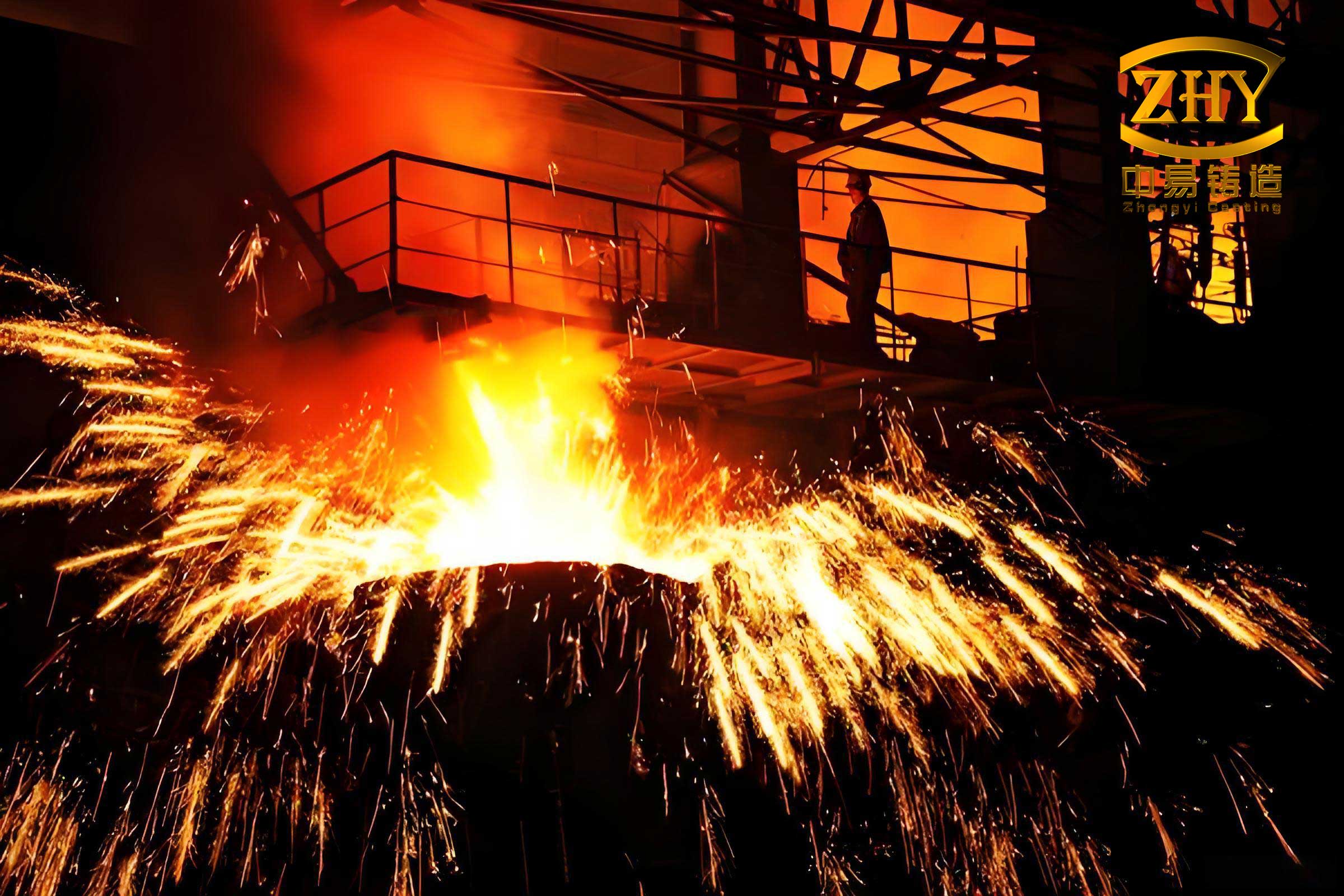
The initial production process for these ductile iron castings followed conventional methods. The charge makeup consisted of 40% pig iron and 60% steel scrap, melted to a target composition. Nodularization was achieved using a traditional sandwich (or冲入法) method with 0.3% REMgSiFe alloy and subsequent inoculation with 0.2% FeSi. Casting was performed at temperatures between 1350-1380°C. This approach, however, led to several critical problems. Shrinkage porosity, particularly in heavier sections, was a recurring defect leading to scrap. Furthermore, the冲入法 process was inherently unstable, highly dependent on operator skill, and posed environmental and safety hazards due to violent magnesium flare-ups, fuming, and metal splashing.
The identification of these problems formed the basis for a comprehensive optimization strategy. The goals were clear: eliminate shrinkage defects to improve the integrity of the ductile iron castings, implement a more stable and safer nodularization process, explore weight reduction opportunities for light-weighting, and reduce raw material costs without compromising the required mechanical properties.
1. Advanced Two-Step Spheroidizing and Eutectic Control
The core of the quality improvement was the development and implementation of a Two-Step Spheroidizing Treatment. This innovative approach leveraged technology from the production of compacted graphite iron, specifically an Intelligent On-line Measurement and Control System, and adapted it for high-quality ductile iron castings.
Step 1: Pre-treatment via Modified Sandwich Method. Instead of adding the full spheroidizing agent in one go, a precise amount of a “vermiculizing” agent (0.3%) was placed in the well of a treatment ladle. This agent had a specific composition designed for a controlled reaction. It was covered with a mixture of 0.2% FeSi inoculant and 0.7% steel punchings, compacted firmly. The base iron was tapped into the ladle, carefully avoiding direct impingement on the alloy pocket. After the reaction subsided, slag was thoroughly removed. This step preconditioned the iron without achieving full spheroidization.
Step 2: Wire-Feeding Compensation for Precision Control. The pre-treated iron was then transferred to a station equipped with a喂丝机 (wire-feeding unit) and a sealing lid. A sample was taken for immediate thermal analysis by the on-line system. The key parameter calculated from this analysis is the Eutectic Saturation (SC) or Carbon Equivalent (CE). For ductile iron castings, controlling this value is critical for minimizing shrinkage tendency. The target is to keep the iron slightly hypereutectic. The formula for Eutectic Saturation is:
$$SC = \frac{C}{4.26 – 0.31 \times Si}$$
Where C and Si are the percentages of carbon and silicon, respectively. An SC value between 0.9 and 1.1 is often targeted to optimize graphite expansion and feeding. Based on the real-time measurement of temperature and derived SC value, the control system calculated the exact length of Mg-bearing cored wire needed. The wire-feeding machine then automatically injected this precise amount into the sealed ladle, achieving a final residual magnesium content of 0.038% ± 0.006%. This closed, automated process ensures exceptional consistency.
The mechanism for shrinkage reduction is twofold. First, the precise control of residual Mg minimizes excess magnesium, which is known to increase shrinkage tendency. Second, and more importantly, by actively controlling the eutectic saturation (SC) to an optimal range, the solidification characteristics of the iron are improved. A properly balanced composition promotes maximal graphite expansion during the eutectic reaction, effectively counteracting the volumetric contraction of the iron matrix, thereby reducing or eliminating internal shrinkage in the final ductile iron castings. The process parameters before and after optimization are summarized below:
| Parameter | Original Process | Optimized Two-Step Process |
|---|---|---|
| Method | Conventional Sandwich (冲入法) | Pre-treatment + Automated Wire-Feeding |
| Key Agent | 0.3% REMgSiFe | Step1: 0.3% “Vermiculizer” | Step2: Mg-Cored Wire |
| Control | Visual/Operator Skill | On-line Thermal Analysis & Automated Feedback |
| Target [Mgres] | ~0.04-0.06% (Variable) | 0.038% ± 0.006% (Precise) |
| Eutectic Control | Not actively controlled | Active control of SC ~ 0.9-1.1 |
| Environment/Safety | Significant fume/flare/splash | Clean, sealed process; High safety |
| Shrinkage Result | Persistent porosity in thick sections | Effectively eliminated |
2. Lightweighting through Structural and Foundry Optimization
Lightweighting of ductile iron castings is a crucial strategy for enhancing performance and reducing cost. The goal is to reduce weight while fully maintaining functional integrity and staying within all dimensional tolerances.
2.1 Casting Wall Thickness Optimization. A systematic analysis was conducted on multiple production batches. Statistical data on actual casting dimensions, mold measurements, and design allowances were collected. Using 3D CAD software (like Pro/ENGINEER), mass calculations and simulations were performed to identify non-critical areas where wall thickness could be safely reduced. The guiding principle was to maintain all dimensions at the lower safe limit of the specified casting tolerance grade (CT9). The primary modifications were applied to external diameters, rib thickness, and excessive machining allowances. For instance, reducing a wall from 17.2 mm to 16.2 mm, or trimming an oversized machining pad, contributed significantly to overall weight savings. The detailed lightweighting plan is shown in the following table:
| Target Area (Color Code Ref.) | Original Dimension / Feature | Modified Dimension / Feature | Material Removed | Calculated Weight Saving |
|---|---|---|---|---|
| Primary Outer Wall (Red) | Ø383 mm, ~17.2 mm thick | Ø381 mm, ~16.2 mm thick | 1.0 mm radially | 1.323 kg |
| Secondary Flange (Yellow) | Ø360 mm | Ø358.6 mm | 0.7 mm radially | 0.250 kg |
| Support Column Side (Grey) | As-cast surface | Surface machined/cored back | 1.0 mm | 0.270 kg |
| Internal Web (Blue) | 14.5 mm thick | 13.0 mm thick | 1.5 mm | 0.300 kg |
| Bottom Machining Pad (Green) | 4.93 mm allowance | 3.0 mm allowance | 1.93 mm | 0.820 kg |
| Total Weight Reduction: | 2.963 kg | |||
| % of Original Mass (54.99 kg): | ≈ 5.4% | |||
2.2 Core Weight Reduction. Lightweighting extends beyond the metal casting itself. The sand cores used to form internal cavities also present an opportunity for savings. Analysis of the core assembly (typically 3 cores for this part) revealed non-functional extensions, particularly on the #3 core used for feeder placement. These excessive “core prints” were redesigned and removed. This modification reduced the mass of the #3 sand core from 19.3 kg to 16.5 kg, saving 2.8 kg of core sand and binder per casting. This not only reduces material cost but also lowers the handling burden for foundry personnel and decreases gas generation during pouring.
3. Cost-Effective Adjustment of Melting Charge and Alloying
Material cost constitutes a major portion of the expense for producing ductile iron castings. The optimization reviewed the charge makeup and alloying strategy to achieve the required mechanical properties more economically.
3.1 Charge Makeup. The original charge of 40% pig iron and 60% steel scrap was re-evaluated. Given the market price parity between the two materials, the ratio was inverted to 80% pig iron and 20% steel scrap. Pig iron has a higher and more consistent carbon content. This shift significantly reduced the demand for recarburizers to reach the target carbon equivalent (CE), leading to direct cost savings and more stable melt chemistry.
3.2 Alloying Strategy for Strength. Copper (Cu) is a common and effective alloying element in ductile iron castings to promote pearlite formation, thereby increasing strength and hardness. However, Cu is a relatively expensive material. Tin (Sn) is a potent pearlite stabilizer; its effect on increasing pearlite content can be an order of magnitude greater than that of copper on a weight-percent basis. The new strategy leveraged this by substantially reducing the Cu addition and introducing a small, controlled amount of Sn. The typical target ranges were adjusted as follows:
| Element | Original Addition Range | Optimized Addition Range | Rationale & Effect |
|---|---|---|---|
| Copper (Cu) | 0.65% – 0.70% | 0.28% – 0.32% | Major cost reduction. Base strength maintained by Sn. |
| Tin (Sn) | 0% | 0.035% – 0.045% | Potent pearlite promoter. Compensates for reduced Cu, ensuring hardness & strength targets are met. Must be carefully controlled to avoid embrittlement. |
| Charge Carburizer | Higher demand | Significantly reduced | Due to higher pig iron ratio, less carbon needs to be added artificially. |
| FeSi (for Si adjustment) | Standard amount | Reduced | Pig iron typically carries more Si than steel scrap, reducing the need for subsequent Si correction. |
The final target chemical composition for the optimized ductile iron castings was maintained within a tight window to ensure consistent properties: C: 3.7-3.9%, Si: 2.1-2.3%, Mn: 0.4-0.45%, P≤0.04%, S≤0.015%, along with the adjusted Cu and Sn ranges.
4. Integrated Results and Validation
The implementation of this multi-faceted optimization program yielded significant, measurable benefits across quality, weight, and cost metrics for these high-performance ductile iron castings.
Quality: The two-step spheroidizing process with eutectic control completely eliminated the shrinkage porosity defects that plagued the original process. The microstructure of the produced castings consistently met specifications, showing well-nodularized graphite (size ≤6) in a matrix of predominantly pearlite with some ferrite, free of excessive carbides or phosphides. This is represented by the equation for successful solidification, where expansion (E) counteracts shrinkage (S):
$$ E_{graphite} \approx k \cdot C_{eq} \geq S_{matrix} $$
where $k$ is a factor related to nucleation and growth conditions, and $C_{eq}$ is the carbon equivalent effectively controlled by the process.
Lightweighting: Through careful dimensional analysis and redesign, the casting weight was reduced by approximately 2.96 kg, equating to a 5.4% reduction from the original mass. An additional 2.8 kg reduction in sand core weight per casting contributed to further resource savings. All modified dimensions remained well within the CT9 tolerance band, passing all customer fit-and-function checks.
Cost: The adjusted charge makeup (80% pig iron) reduced consumption of costly recarburizer and FeSi for silicon adjustment. The strategic substitution of a portion of the copper addition with tin resulted in substantial savings on alloy costs, as Sn, while potent, is used in very small quantities. The cumulative effect was a significant reduction in the direct material input cost per ton of poured ductile iron castings.
Process Stability & Safety: Replacing the erratic and hazardous冲入法 with an automated, sealed wire-feeding process created a much safer working environment, eliminated magnesium flares and fumes, and made the process independent of operator skill variations, ensuring consistent day-to-day quality.
In conclusion, the systematic optimization of the drive frame housing production demonstrates a holistic approach to improving ductile iron castings. By integrating advanced process control technology (two-step treatment), implementing design-for-manufacturing principles (lightweighting), and executing a smart metallurgical strategy (cost-effective alloying), it is possible to simultaneously achieve superior casting integrity, reduced component weight, and lower production costs. This case study provides a validated framework that can be adapted and applied to other demanding ductile iron castings in the automotive and heavy machinery sectors.