
In my experience with ductile iron castings, volume defects such as shrinkage porosity and shrinkage cavities are among the most common causes of scrap and rejection. These defects severely compromise the mechanical properties of the parts, leading to potential failures and significant economic losses. The solidification behavior of ductile iron is uniquely complex, characterized by a mushy or pasty solidification mode over a wide temperature range. This results from the precipitation of graphite spheroids and dendritic structures while the metal is still in a liquid state. Understanding this solidification process is therefore paramount for designing effective casting processes that minimize defects. This article, from my perspective as a practitioner, delves into the intricacies of ductile iron solidification and its profound implications for casting工艺, aiming to provide insights that enhance the quality and yield of ductile iron castings.
The production of high-integrity ductile iron castings is consistently challenged by the formation of internal and external shrinkage defects. I have observed and categorized numerous types of these defects, which fundamentally arise from the volumetric changes during cooling and solidification. Unlike many other casting alloys, the solidification of ductile iron involves not just contraction but also a significant expansion phase due to graphite precipitation. This interplay between contraction and expansion defines the mushy solidification zone and is the root cause of feeding difficulties. A deep comprehension of these phenomena—liquid contraction, initial graphitization expansion, solidification contraction, and eutectic expansion—is essential. By mastering this knowledge, we can tailor our casting工艺, from gating and risering to mold design, to effectively counteract the natural tendency for shrinkage formation in ductile iron castings.
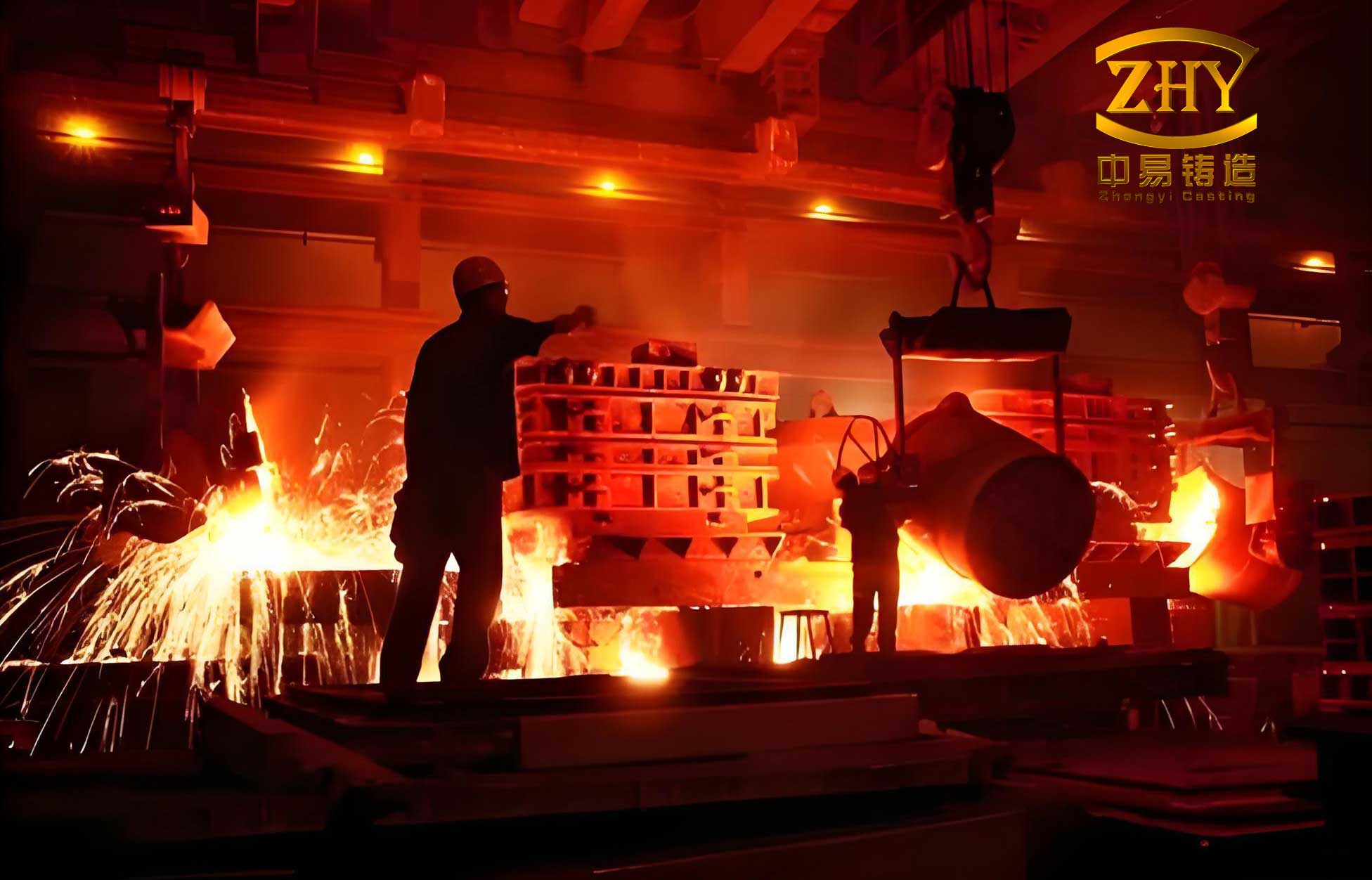
The family of defects in ductile iron castings related to shrinkage is extensive. Based on my work, I often classify them based on their location and morphology. The table below summarizes some of the most prevalent shrinkage defects encountered in the production of ductile iron castings.
| Defect Type | Typical Location | Description |
|---|---|---|
| External Shrinkage Porosity/Cavity | Near gates, riser necks, or top surfaces | Visible depressions or holes on the casting surface, often at the last points to solidify. |
| Internal Microshrinkage (Dispersed) | Throughout the casting section, especially in thermal centers | A network of tiny, interconnected pores that can significantly reduce density and strength. |
| Sponge Porosity | In heavy sections or hot spots | A coarse, sponge-like structure of voids often associated with severe graphite flotation. |
| Axial Shrinkage | Along the central axis of cylindrical or long castings | Porosity concentrated in the central region due to inadequate feeding from the ends. |
| Leakage Path Porosity | In thin sections or pressure-boundary walls | Interconnected porosity that causes the casting to fail pressure tightness tests. |
To effectively combat these issues in ductile iron castings, we must first model the volumetric changes during solidification. The overall volume change, $\Delta V_{total}$, is not a simple linear contraction but a dynamic sum of several distinct phases. This can be expressed as:
$$ \Delta V_{total} = \sum \Delta V_{liquid} + \sum \Delta V_{initial-graphite} + \sum \Delta V_{solidification} + \sum \Delta V_{eutectic} + \sum \Delta V_{solid} $$
Each of these terms represents a specific stage in the cooling and solidification of ductile iron castings, and their magnitudes determine the final soundness of the casting.
Liquid Contraction
The journey of ductile iron castings begins with liquid metal. As the molten iron cools from the pouring temperature down to the liquidus temperature, it undergoes liquid contraction. This is a purely thermal contraction where the kinetic energy of atoms decreases, reducing their average spacing. Macroscopically, this is observed as a drop in the liquid surface level in a pouring basin or runner. The volume of liquid contraction, $\Delta V_{SL}$, for a given volume $V_0$ over a temperature drop can be calculated using the coefficient of liquid contraction, $\alpha_{SL}$:
$$ \Delta V_{SL} = \alpha_{SL} (T_t – T_{t+\Delta t}) V_0 $$
Here, $T_t$ and $T_{t+\Delta t}$ are the temperatures at the start and end of a time interval $\Delta t$. For typical ductile iron castings, $\alpha_{SL}$ is such that a temperature drop of 100°C results in approximately 1.5% volume contraction. Therefore, the total liquid contraction is highly dependent on the superheat, i.e., the difference between pouring temperature and liquidus. The table below illustrates this relationship for ductile iron castings.
| Pouring Temperature (°C) | Temperature Drop to Liquidus (°C) | Approximate Liquid Contraction (%) |
|---|---|---|
| 1450 | 300 | 4.5 |
| 1400 | 250 | 3.75 |
| 1350 | 200 | 3.00 |
| 1300 | 150 | 2.25 |
This data clearly shows why a lower pouring temperature, whenever feasible without risking mistruns, is beneficial for reducing the initial volumetric deficit that the feeding system must compensate for in ductile iron castings.
Initial Graphitization Expansion
For hypereutectic ductile iron castings (where the carbon equivalent, CE, is above the eutectic point), the first solid phase to form is primary graphite. As the temperature falls below the graphite liquidus, carbon atoms precipitate directly from the melt to form graphite spheroids. Since graphite has a much lower density (approximately 2.25 g/cm³) than the liquid iron, this precipitation causes a volumetric expansion. This is the initial graphitization expansion. The condition for this to occur is $CE_X – CE_0 > 0$, where $CE_0$ is the eutectic carbon equivalent and $CE_X$ is the actual composition of the iron.
The amount of primary graphite precipitated, $G_{primary}$, can be estimated if we know the carbon content:
$$ G_{primary} = \frac{C_X – C_C}{100 – C_C} \times 100\% $$
Here, $C_X$ is the total carbon content of the iron and $C_C$ is the carbon content at the eutectic point. The associated volume expansion is significant; each 1% of graphite precipitated leads to a volume increase of roughly 2.05% to 3.4%. This expansion can partially offset the liquid contraction. However, in heavy-section ductile iron castings, this primary graphite has time to float upwards, leading to graphite flotation defects. Therefore, controlling the CE value and enhancing cooling rates in thick sections are critical strategies for managing this phase in ductile iron castings.
Solidification Contraction (Austenite Formation)
As the temperature reaches the eutectic range, the remaining liquid undergoes the eutectic transformation, simultaneously precipitating austenite and graphite. The crystallization of austenite, a face-centered cubic structure with high packing density, involves a considerable volumetric contraction. Typically, the solidification contraction associated with austenite formation is taken as about 3.5% by volume. The magnitude of this contraction depends on the amount of austenite formed during the eutectic reaction. If $V_{aust}$ is the volume of austenite precipitated, the contraction $\Delta V_{solidification}$ is proportional to it. This is a critical period for ductile iron castings because it creates a demand for liquid feed metal to prevent shrinkage voids.
Eutectic Expansion
Concurrent with austenite formation, the eutectic graphite grows. This is the main graphitization stage and is responsible for the characteristic eutectic expansion in ductile iron castings. The growth of graphite spheroids within the austenite shells exerts pressure on the surrounding semi-solid matrix. The expansion from eutectic graphitization is again substantial, with each 1% of carbon precipitating as graphite causing 2.05%-3.4% volume increase. The net volume change during the eutectic plateau is the algebraic sum of the austenite contraction and the graphite expansion. In many cases, for well-inoculated irons with a high graphite count, the expansion can overcome the contraction, leading to a net expansion. This is the foundation for the “no-riser” or “feederless” casting of ductile iron castings, provided the mold is rigid enough to contain this pressure.
Solid State Contraction
After complete solidification, the ductile iron casting continues to cool from the solidus temperature down to room temperature. This phase involves solid-state thermal contraction, governed by the linear coefficient of thermal expansion. While important for determining final dimensions and residual stresses, this phase is less directly implicated in the formation of shrinkage porosity compared to the events during solidification itself.
The Integrated Solidification Model for Ductile Iron Castings
Putting all these stages together, we can visualize the solidification of ductile iron castings as a curve of volume versus time or temperature. Initially, liquid contraction dominates, causing a drop in volume. For hypereutectic irons, initial graphite expansion may cause a slight rise or plateau. Then, during the main eutectic reaction, the curve typically shows a rapid contraction dip followed by a significant expansion hump due to eutectic graphitization. Finally, solid-state contraction takes over. The precise shape of this curve determines whether shrinkage forms. If the net volume change after accounting for feeding is negative (more contraction than expansion), porosity will likely occur. The key factors influencing this balance in ductile iron castings are:
- Chemical composition (Carbon Equivalent, C/Si ratio, alloying elements).
- Pouring temperature.
- Cooling rate / Section size.
- Mold rigidity.
- Effectiveness of inoculation and nodule count.
Mathematically, we can represent the critical condition for soundness. A casting will be free of shrinkage if the available expansion pressure from graphitization, $P_{exp}$, exceeds the pressure required to compensate for the net contraction, $P_{req}$, which is a function of the sum of contractions and the resistance to fluid flow in the mushy zone. While complex simulation software solves this in detail, the principle guides our工艺 decisions for ductile iron castings.
Practical Guidelines Derived from Solidification Understanding
Based on the above analysis of ductile iron solidification, I have derived several practical measures to improve the quality of ductile iron castings and reduce shrinkage defects.
1. Optimizing Melt Chemistry and Quality
The foundation for sound ductile iron castings lies in the melt. A suitable carbon equivalent (CE) is crucial. I generally aim for a CE between 4.3% and 4.4%, which is often slightly hypereutectic, providing some beneficial initial expansion but not so high as to promote excessive graphite flotation in thick sections. Furthermore, a higher carbon-to-silicon ratio is often desirable as it can reduce the shrinkage tendency. The presence of alloying elements like copper, tin, or manganese affects the austenite solidification range and stability, thereby influencing the contraction/expansion balance. Finally, controlling residual magnesium and inoculation practice to ensure a high, uniform nodule count is vital. A fine, uniform graphite structure promotes earlier and more uniform eutectic expansion, which aids in self-feeding for ductile iron castings.
2. Controlling Pouring Temperature
As shown in the liquid contraction table, a lower pouring temperature directly reduces the initial volumetric deficit. Therefore, for ductile iron castings, I always use the lowest practical pouring temperature that ensures complete mold filling and good surface quality. This simple adjustment can significantly lessen the demand on the feeding system.
3. Ensuring Adequate Mold Rigidity
The eutectic expansion is only useful for compensating shrinkage if the mold wall does not yield. If the mold wall moves outward (e.g., in a soft green sand mold), the expansion pressure is relieved, and no internal feeding occurs. Therefore, achieving high mold rigidity is a cornerstone for producing sound ductile iron castings, especially when aiming for riserless designs. Techniques include:
– Using high-pressure molding for green sand molds.
– Employing rigid mold materials like chemically bonded sands (resin sand).
– Strategic use of mold reinforcements such as internal chills (graphite, iron, or steel), refractory bricks, or reinforcing rods within the mold itself.
These elements increase the mold’s resistance to wall movement, forcing the expansion pressure to act inward, thereby compacting the mushy zone and eliminating porosity in ductile iron castings.
4. Designing Gating and Riser Systems Appropriately
The unique expansion phase necessitates special design rules for gating and risering in ductile iron castings, different from those for steel or gray iron.
– Gating Design: Ingates should be designed to freeze quickly after filling. A common practice is to use thin, wide ingates (with a width-to-thickness ratio greater than 3:1). This rapid solidification seals off the casting from the gating system early, preventing the expanding metal during the eutectic stage from being pushed back into the sprue or runners, which would create suction and draw in air or cause internal shrinkage.
– Risering and Riser Necks: The same principle applies to riser necks. The neck must be designed with a sufficiently small modulus (ratio of volume to cooling surface area) so that it solidifies before the casting enters the main eutectic expansion phase. This prevents the expansion pressure from forcing metal back into the riser, a phenomenon known as “back-suction,” which can create shrinkage at the neck junction (a “neck shrink” defect). The riser itself, if used, often serves more as a pressure relief or a source for liquid during the initial contraction phases rather than as a classical feeding source during late solidification for ductile iron castings.
5. Modulus Considerations and Chilling
For feederless casting of ductile iron castings, a general rule is that the casting modulus (thickness) should be above a critical value, often cited as 2.5 cm. Thinner sections cool too quickly, not allowing sufficient graphitization expansion pressure to build up before the entire section becomes rigid. For sections with lower modulus or isolated hot spots, strategic use of external or internal chills is highly effective. Chills accelerate local cooling, promoting directional solidification towards a riser or simply ensuring that the section solidifies quickly and uniformly before significant expansion occurs elsewhere, which could isolate it from feed metal.
Advanced Process Control and Simulation
Modern foundries producing high-quality ductile iron castings increasingly rely on computational solidification simulation. These software packages implement the physical models of contraction and expansion discussed here. By simulating the entire process, engineers can visualize the sequence of solidification, identify potential shrinkage zones, and virtually test different工艺方案s—like adjusting riser placement, chill size, or pouring temperature—before making any physical patterns. This not only saves time and cost but also dramatically improves the first-pass yield of complex ductile iron castings. The simulation output, showing temperature fields, solid fraction, and predicted shrinkage, is an invaluable tool for validating our understanding of the solidification characteristics specific to each ductile iron casting.
Conclusion
The pursuit of sound, high-performance ductile iron castings is fundamentally tied to a deep understanding of their unique solidification behavior. The mushy solidification, driven by the dynamic competition between metallic contraction and graphite expansion, presents both a challenge and an opportunity. By viewing the casting process through this lens, we can implement targeted strategies: careful control of chemistry and pouring parameters, design of rigid mold systems, and intelligent gating/risering that works in harmony with the expansion phase. Mastering these principles allows us to harness the natural graphitization expansion to achieve self-feeding, thereby minimizing shrinkage defects. Continuous learning and application of this knowledge, combined with modern simulation tools, are key to advancing the reliability and efficiency of producing ductile iron castings for demanding applications across industries. Every successful casting reinforces the critical importance of respecting and leveraging the complex solidification story of ductile iron.