
In my extensive experience with foundry engineering, I have encountered numerous challenges in producing high-quality ductile iron castings, particularly for large and complex components like machine tool stands. Ductile iron castings are renowned for their superior mechanical properties, such as high strength and ductility, due to the spheroidal graphite microstructure. However, the production of thick-section ductile iron castings is fraught with difficulties, primarily because of their prolonged solidification times and increased propensity for shrinkage defects like porosity and cavities. These issues arise from the unique solidification behavior of ductile iron, which exhibits a mushy or pasty freezing pattern, making it less amenable to traditional feeding methods using risers. In this comprehensive analysis, I delve into the casting process optimization for a specific ductile iron stand, focusing on eliminating defects and enhancing efficiency through riser-free casting techniques. The insights shared here are based on hands-on production trials, numerical simulations, and practical refinements, all aimed at advancing the manufacturing of reliable ductile iron castings.
The machine tool stand in question is a critical component made from QT400-18 ductile iron, with an approximate weight of 2,483 kg and overall dimensions of 2,230 mm × 1,750 mm × 550 mm. This ductile iron casting features a complex internal cavity structure, varying wall thicknesses ranging from 20 mm to 80 mm, and prominent thick-section areas around the bearing hole support frames at the top. Such geometrical complexity necessitates meticulous casting process design to ensure soundness and meet stringent quality standards, including EN 12890 H2 grade and DIN ISO 8062-CT12 accuracy level. The functional surfaces require a roughness of Ra 12.5 μm or better, achievable through subsequent machining, but the as-cast integrity must be free from defects like sand inclusions, shrinkage porosity, or voids. My initial assessment highlighted that the uneven wall thickness and the bulky bearing support regions posed significant solidification challenges, often leading to shrinkage in ductile iron castings if not properly addressed.
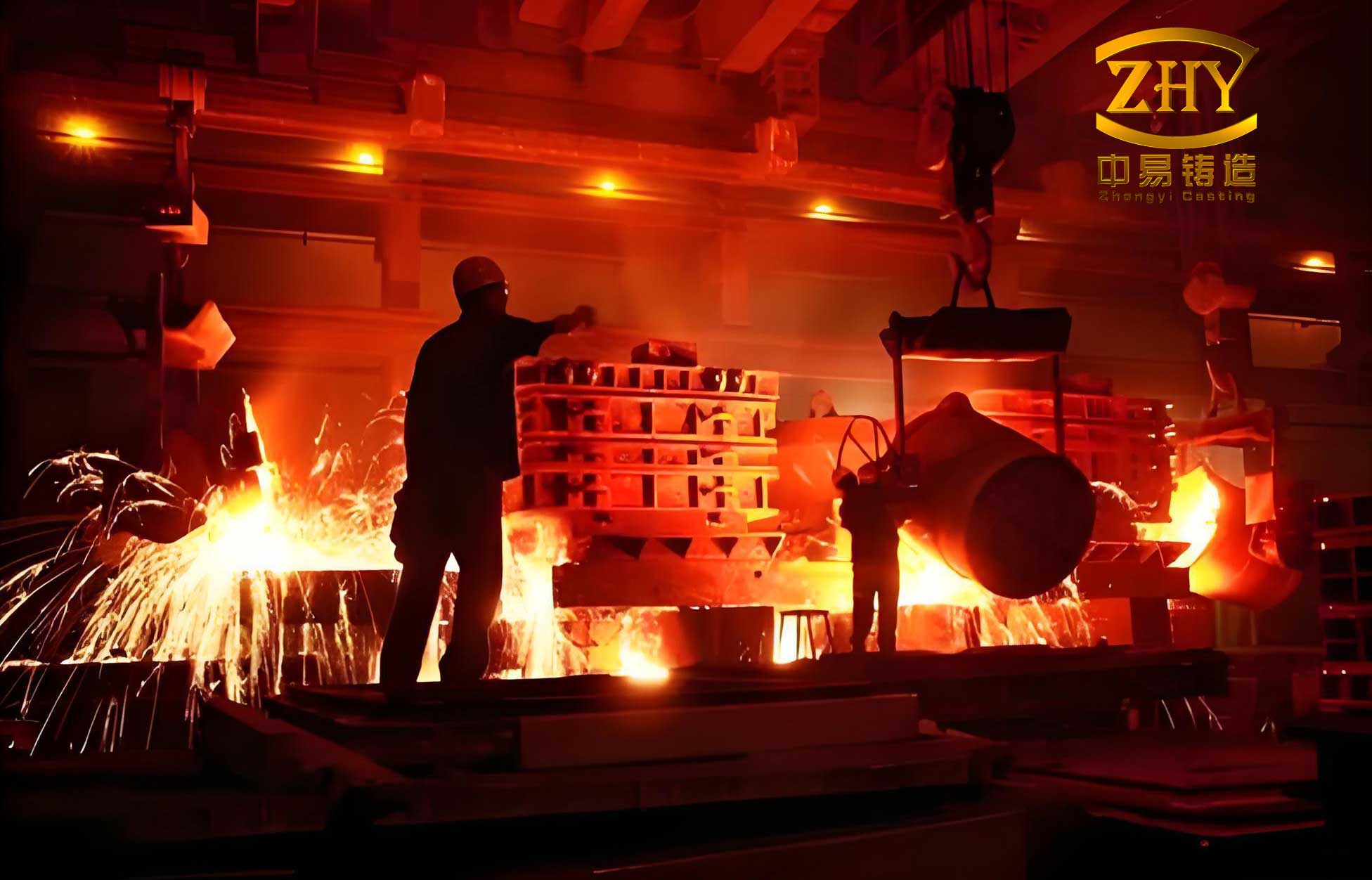
Originally, the casting process employed a manual molding approach using furan resin-bonded self-hardening sand, which offers high dimensional accuracy and good surface finish for ductile iron castings. The gating system was designed as an open-type stepped configuration with multiple ingates to promote balanced filling and solidification. The chemical composition of the molten iron was tightly controlled: for the base iron, carbon ranged from 3.6% to 4.0%, silicon from 1.3% to 1.6%, with manganese, sulfur, and phosphorus kept low; after spheroidization with a calcium-containing rare earth magnesium alloy (added at about 1.4% of iron weight), the target composition included 3.5%–3.9% C, 2.2%–2.5% Si, and residual magnesium below 0.05%. The pouring temperature was maintained between 1,310°C and 1,330°C, with a tapping temperature around 1,450°C. To address shrinkage in the thick bearing support areas, two large risers were initially placed atop these regions, intended to feed liquid metal during solidification. However, production outcomes revealed minor shrinkage porosities at the riser roots, leading to rejection of ductile iron castings. This prompted a thorough investigation into the underlying causes and alternative methods.
Through numerical simulation using AnyCasting software, I analyzed the solidification behavior of the ductile iron stand. The temperature field evolution indicated that the last areas to solidify were indeed the thick bearing hole support frames, as visualized in the solidification time contours. This aligns with the typical issue in ductile iron castings where thermal gradients and cooling rates influence defect formation. The simulation also showed that the risers solidified prematurely relative to the casting hotspots, rendering them ineffective for feeding. This can be explained by the mushy solidification characteristic of ductile iron, where interdendritic feeding is limited, and riser efficiency diminishes. To quantify this, I considered the solidification shrinkage and graphite expansion effects. The net volume change during solidification of ductile iron can be expressed as:
$$ \Delta V_{net} = V_l \cdot (\alpha_l \cdot \Delta T_l + \beta_s) – V_g \cdot \gamma_g $$
where \( \Delta V_{net} \) is the net volume change, \( V_l \) is the liquid volume, \( \alpha_l \) is the liquid thermal contraction coefficient, \( \Delta T_l \) is the temperature drop during cooling, \( \beta_s \) is the solidification shrinkage rate (typically 4–6% for ductile iron), \( V_g \) is the volume of graphite precipitated, and \( \gamma_g \) is the expansion coefficient due to graphite formation (approx. 2–3%). In ductile iron castings, the graphite expansion can partially compensate for shrinkage, but only if the mold is rigid enough to contain the pressure and promote inward feeding.
Based on these insights, I explored a riser-free casting approach for the ductile iron stand. The rationale hinges on leveraging the graphite expansion in ductile iron castings to counteract shrinkage, provided the mold cavity is sealed early during solidification. My optimized process involved several key modifications: First, the original risers were replaced with wedge-shaped vent holes at the top to allow gas escape without acting as feeders. Second, the ingate thickness was reduced to 18 mm in a flat rectangular shape, ensuring they solidify before the casting to create an early seal. Third, external or internal chills were applied near the bearing hole areas to enhance cooling rates and refine the microstructure in these critical zones. Additionally, I evaluated whether to cast the bearing holes or leave them for machining, with both options tested in production. The gating system retained the stepped design but with adjusted parameters to ensure rapid and uniform filling. A summary of the process changes is presented in Table 1.
| Parameter | Original Process | Optimized Riser-Free Process |
|---|---|---|
| Risers | Two large risers on bearing supports | Replaced with wedge-shaped vent holes |
| Ingate Thickness | Variable, typically thicker | Uniform 18 mm flat rectangular |
| Cooling Aids | None | External or internal chills near bearing holes |
| Bearing Hole Formation | Casted out | Options: casted out or machined later |
| Pouring Temperature | 1,310–1,330°C | 1,310–1,330°C (unchanged) |
| Mold Rigidity | Furan resin sand with metal flask | Enhanced by flask clamping and high-strength sand |
| Simulated Solidification Time | Longer in hotspots, risers solidify early | More uniform, vents and ingates solidify first |
The effectiveness of this riser-free method for ductile iron castings was validated through further numerical simulations. The solidification time fields demonstrated that the vent holes and thin ingates solidified prior to the casting body, effectively sealing the mold cavity. This early seal, combined with the high rigidity of the furan resin sand mold and the secured metal flask, confines the graphite expansion pressure to act inward, compensating for liquid and solidification shrinkage. The use of chills accelerated cooling in the bearing support regions, as shown by reduced solidification times in those areas. The mathematical representation of this equilibrium can be derived from pressure balance in the mold cavity:
$$ P_{exp} = \frac{V_g \cdot \gamma_g \cdot E}{A_m} \geq P_{sh} = \frac{\Delta V_{net} \cdot K}{A_c} $$
where \( P_{exp} \) is the pressure due to graphite expansion, \( E \) is the modulus of elasticity of the mold material, \( A_m \) is the mold surface area, \( P_{sh} \) is the pressure required to counteract shrinkage, \( K \) is a material constant, and \( A_c \) is the casting cross-sectional area. For successful riser-free casting of ductile iron castings, the condition \( P_{exp} \geq P_{sh} \) must be satisfied, which my optimized process achieved through controlled cooling and mold constraints.
In production trials, I implemented multiple variants of the optimized process to assess robustness. For instance, in one scenario, external chills were placed on both sides of the bearing support frames while the holes were cast; in another, internal chills were used with the holes left unmachined; and in a third, external chills were applied with holes to be machined later. All variants produced sound ductile iron castings without shrinkage defects, confirming the feasibility of riser-free casting for such components. The ductile iron castings exhibited improved microstructural uniformity in the thickened sections, attributed to the chilling effect that promoted finer graphite nodules and pearlite formation. The elimination of risers not only simplified molding operations but also increased the casting yield significantly—from approximately 75% in the original process to over 90% in the optimized one. This yield improvement is crucial for cost-effectiveness in producing large ductile iron castings. Table 2 summarizes the production outcomes and key metrics.
| Variant | Chill Type | Bearing Hole Treatment | Defect Status | Casting Yield | Microstructure Quality |
|---|---|---|---|---|---|
| 1 | External chills | Casted out | No shrinkage | 91% | Refined graphite in supports |
| 2 | Internal chills | Machined later | No shrinkage | 92% | Enhanced nodule count |
| 3 | External chills | Machined later | No shrinkage | 90% | Uniform matrix |
The success of this riser-free approach for ductile iron castings can be further elaborated through the principles of solidification control. In ductile iron, the graphite expansion occurs during the eutectic reaction, and if the mold is sufficiently rigid, it can generate internal pressure to feed shrinkage. The key parameters influencing this include the cooling rate, mold stiffness, and pouring temperature. I derived a simplified model to predict the feasibility of riser-free casting for ductile iron castings based on geometric and thermal factors:
$$ Feasibility Index (FI) = \frac{R_m \cdot C_r \cdot T_g}{S_f \cdot V_t} $$
where \( R_m \) is the mold rigidity factor (higher for resin-bonded sand with clamping), \( C_r \) is the cooling rate influenced by chills, \( T_g \) is the graphite expansion potential (related to composition and inoculation), \( S_f \) is the solidification shrinkage factor, and \( V_t \) is the volume-to-surface area ratio of the casting. For the machine tool stand, with high \( R_m \) from the furan sand and metal flask, enhanced \( C_r \) from chills, and controlled \( T_g \), the FI value exceeded the threshold for defect-free solidification, justifying the riser-free design.
Moreover, the economic and operational benefits of this optimized process for ductile iron castings are substantial. By removing risers, we reduced material waste and shortened molding time, leading to lower production costs. The simplified gating system also minimized turbulence during pouring, decreasing the risk of oxide inclusions in ductile iron castings. The consistent quality achieved across multiple casts underscores the reliability of riser-free methods for thick-section ductile iron components, provided that process parameters are meticulously controlled. In my practice, I have extended similar principles to other ductile iron castings, such as engine blocks and heavy-duty frames, with comparable success rates.
In conclusion, my analysis and optimization efforts demonstrate that riser-free casting is a viable and advantageous technique for producing large, complex ductile iron castings like machine tool stands. The traditional reliance on risers for feeding often proves ineffective due to the mushy solidification nature of ductile iron, leading to defects and low yield. Through numerical simulation and practical trials, I showed that by replacing risers with vent holes, thinning ingates to ensure early solidification, and incorporating chills to regulate cooling, sound ductile iron castings can be achieved. The graphite expansion inherent in ductile iron, when harnessed within a rigid mold environment, compensates for shrinkage without external feeders. This approach not only enhances the integrity of ductile iron castings but also streamlines manufacturing processes and boosts economic efficiency. Future work could focus on refining chill designs and exploring automated pouring systems to further optimize the production of high-performance ductile iron castings for industrial applications.
The journey from defect-prone to defect-free ductile iron castings underscores the importance of adaptive process design. As foundry technologies evolve, the principles outlined here—emphasizing mold rigidity, controlled cooling, and graphite expansion utilization—will remain pivotal for advancing the quality and sustainability of ductile iron castings. I encourage foundry engineers to embrace simulation tools and innovative techniques to push the boundaries of what is achievable with ductile iron, ensuring that these versatile materials continue to meet the demanding standards of modern machinery and infrastructure.