
Since the year 2000, the rapid development of the domestic cement market has led to a flourishing trend in the manufacturing of vertical roller mills (hereinafter referred to as VRMs) in China. However, many companies have faced challenges in product design competitiveness, and in material selection, they have often failed to achieve cost reduction, efficiency improvement, energy savings, and consumption reduction. In recent years, as domestic manufacturing has expanded globally, many enterprises have found their products lacking advantages when competing with international counterparts. Our products, while technically feasible, have shown deficiencies in material usage, environmental protection, energy efficiency, serialization, and standardization, resulting in higher costs. Additionally, there are significant gaps in reliability, durability, and maintainability compared to competitors. Therefore, the rational selection of materials to enhance product reliability and competitiveness has become particularly crucial. This article will analyze the application of ductile iron castings in VRMs, providing insights for VRM design.
In recent years, VRM technology for material grinding has matured worldwide. VRMs have not only completely replaced tube mills in grinding cement raw materials and coal but have also seen increasingly widespread application in grinding cement clinker, with growing adoption in emerging cement markets such as India and Vietnam. As energy-saving grinding equipment, VRMs are widely used not only in the cement industry but also in thermal power generation and non-metallic mineral sectors, gradually gaining recognition from users. The structure of a VRM includes three main categories: castings, structural components, and purchased finished parts. Among these, castings primarily consist of the grinding table, rocker arms, and grinding rollers, accounting for 35% to 45% of the equipment weight, a relatively high proportion. Thus, selecting appropriate casting materials, optimizing casting structures, improving casting processes, enhancing casting performance, and extending casting service life are extremely important. This also aligns with the requirements of energy saving, emission reduction, and green manufacturing by enabling reasonable weight reduction and cost reduction.
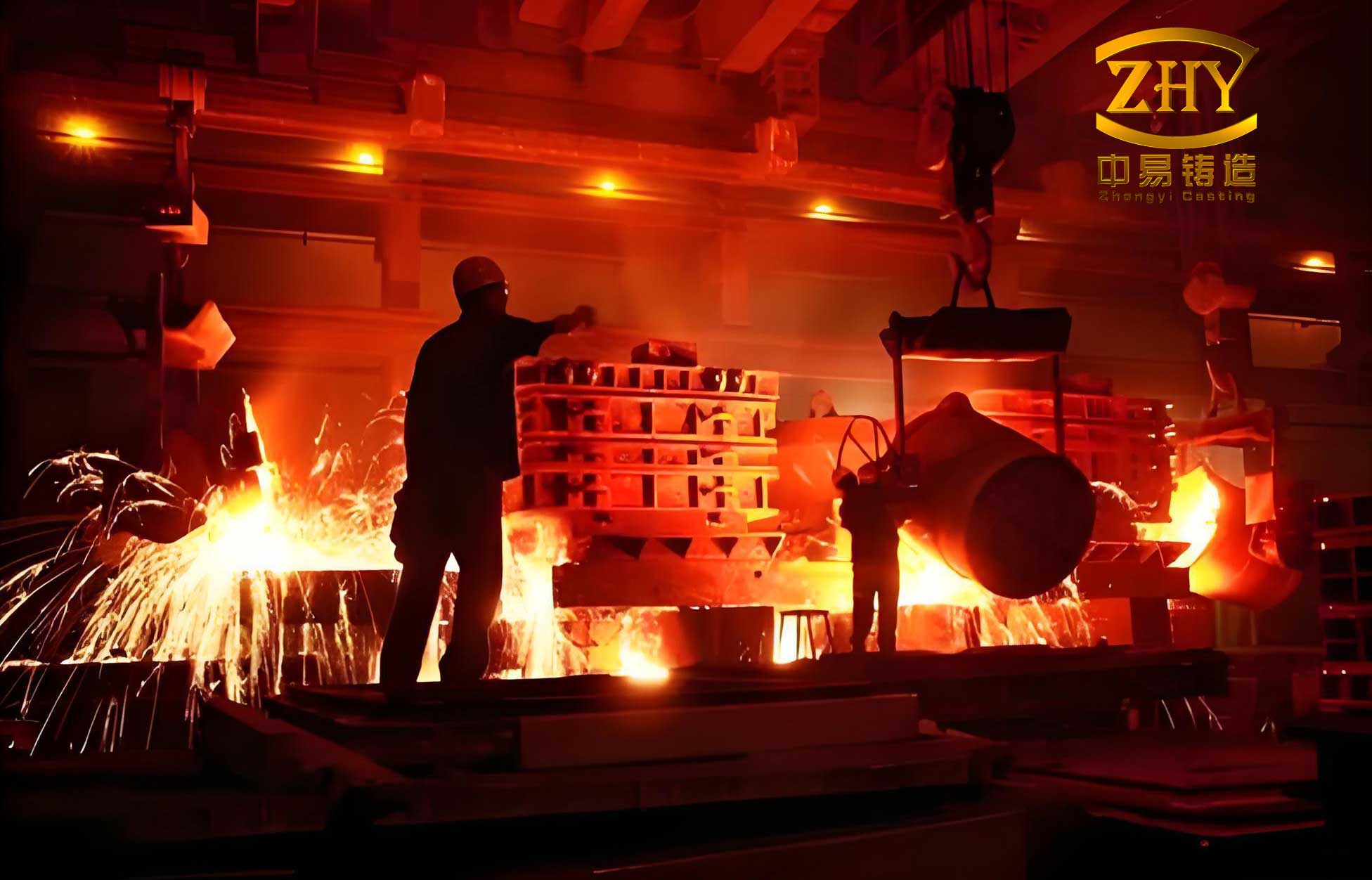
The grinding table is a critical component of a VRM, as it transmits the motor torque and transfers the grinding force generated by roller pressure to the foundation. Therefore, the casting quality of the grinding table plays a vital role in the normal operation of the entire VRM. In this analysis, I will use the grinding table assembly as an example to compare different casting materials—specifically, cast steel ZG270-500 and ductile iron—from perspectives such as casting process and difficulty, casting quality, and manufacturing cost.
Casting Process and Manufacturing Technology Comparison
Taking the TRMS32.2 slag mill as an example, I analyze the casting materials for cast steel ZG270-500 and ductile iron. For the cast steel grinding table, the maximum outer diameter is 3,520 mm, height is 1,820 mm, with a maximum hot spot of 355 mm and a single weight of 37 tons. The required molten steel for pouring is 65 tons, which is 1.75 times the finished weight, with a pouring temperature of 1,540–1,560 °C. After pouring, annealing treatment is necessary at (560 ± 10) °C. The finished table must meet ultrasonic testing (UT) Grade III per GB 7233 on upper and lower surfaces, and magnetic particle testing (MT) Grade III per GB 9444 in the R-area. The casting shrinkage rate for ZG270-500 cast steel is typically 2%. Machining allowances are 23 mm for the upper plane and 18 mm for the lower plane and sides. The casting uses manual resin sand core assembly with one mold per box, featuring sequential solidification, where shrinkage cavities and porosity may occur at hot spots. Riser design based on modulus method results in four risers of Φ800 mm × 1,200 mm, with external chills placed at hot spots, yielding a casting yield of 66.5%.
For the ductile iron grinding table, with a diameter of 3.4 meters, the material is QT400-18A ductile iron. The net weight of the casting is 28 tons, requiring 37 tons of molten iron, with a pouring temperature of 1,310–1,330 °C, which is 1.32 times the finished weight. A bottom-pouring system is used, with chills to accelerate contraction at hot spots. The shrinkage rate for ductile iron castings is lower, at 0.7% to 1%, due to graphite expansion during solidification offsetting some contraction. However, graphite expansion can increase expansion pressure on the mold, requiring high mold rigidity to prevent shrinkage porosity. Machining allowances are 15 mm for the upper plane and 10 mm for others, with raw surfaces at 4–5 mm. By ensuring strict process parameters, mold rigidity, and chill placement, sound ductile iron castings can be consistently produced.
Key data from the casting processes are summarized in Table 1. The ductile iron casting shows advantages in reduced molten metal requirement, lower pouring temperature, and higher casting yield. Additionally, ductile iron castings can undergo in-mold insulation instead of heat treatment, further saving energy.
| Parameter | Cast Steel Grinding Table | Ductile Iron Casting Grinding Table |
|---|---|---|
| Molten Metal to Finished Weight Ratio | 1.75 | 1.32 |
| Pouring Temperature (°C) | 1,560 | 1,330 |
| Chemical Composition Control | Relatively Loose | Strict |
| Pattern Quality Requirements | Moderate | High |
| Shrinkage Rate (%) | 2 | 1 |
| Heat Treatment | Annealing at 560 °C | In-mold insulation for 5–7 days |
| Machining Allowance (mm) | 23 | 15 |
| Casting Quality | Generally UT Grade III | Main working surfaces achieve UT Grade II |
| Scrap Steel Utilization | High | Moderate |
Casting Quality and Performance Comparison
From a quality perspective, ductile iron castings exhibit superior surface finish and internal soundness compared to cast steel counterparts. The ductile iron grinding table typically achieves UT Grade II, indicating fewer defects, while cast steel often only reaches UT Grade III. This is attributed to the better castability of ductile iron, which reduces issues like shrinkage and porosity. Moreover, the yield ratio—defined as the ratio of yield strength to tensile strength—is an important mechanical property indicator. For the cast steel grinding table, the yield strength is 300 MPa, tensile strength is 542 MPa, giving a yield ratio of approximately 0.55. In contrast, the ductile iron casting shows a yield strength of 270 MPa and tensile strength of 395 MPa, with a yield ratio of about 0.68. This higher yield ratio for ductile iron castings suggests better deformation resistance under load, which can enhance durability in service.
The yield ratio can be expressed mathematically as:
$$ \text{Yield Ratio} = \frac{\sigma_y}{\sigma_t} $$
where \(\sigma_y\) is the yield strength and \(\sigma_t\) is the tensile strength. For ductile iron castings like QT400-18A, typical values range from 0.65 to 0.70, whereas for cast steel ZG270-500, it is around 0.55–0.60. This difference highlights the advantageous mechanical behavior of ductile iron castings in applications requiring stiffness and stability.
Additionally, the shrinkage behavior during solidification can be modeled using the following formula for volumetric shrinkage:
$$ \Delta V = V_0 \cdot \beta \cdot \Delta T $$
where \(\Delta V\) is the volume change, \(V_0\) is the initial volume, \(\beta\) is the coefficient of thermal contraction, and \(\Delta T\) is the temperature drop. For ductile iron, the graphite expansion effect reduces net shrinkage, which can be approximated as:
$$ \Delta V_{\text{net}} = \Delta V_{\text{thermal}} – \Delta V_{\text{graphite}} $$
This results in lower residual stresses and fewer defects in ductile iron castings, contributing to their higher quality.
Cost Analysis and Economic Benefits
When evaluating manufacturing costs, ductile iron castings offer significant savings over cast steel. First, for the same specification, ductile iron has a lower density (approximately 7.1–7.2 g/cm³ for ductile iron vs. 7.8 g/cm³ for cast steel), leading to weight reduction. This not only reduces material usage but also eases handling and machining. Second, the molten metal requirement for ductile iron is lower—in the TRMS32.2 example, ductile iron requires 43% less molten metal than cast steel. This directly lowers energy consumption for melting, as pouring temperature is about 200 °C lower for ductile iron. The energy savings can be estimated using the specific heat capacity formula:
$$ Q = m \cdot c \cdot \Delta T $$
where \(Q\) is the heat energy, \(m\) is the mass, \(c\) is the specific heat capacity (around 0.46 kJ/kg·°C for iron-based alloys), and \(\Delta T\) is the temperature rise. For instance, producing 37 tons of ductile iron at 1,330 °C compared to 65 tons of cast steel at 1,560 °C results in substantial energy reduction.
Moreover, ductile iron castings eliminate the need for post-casting annealing, as in-mold insulation suffices, further cutting heat treatment costs. Machinability is another cost factor; ductile iron is easier to machine than cast steel due to graphite lubrication, reducing tool wear and machining time. Table 2 summarizes the cost-related advantages of ductile iron castings.
| Cost Factor | Ductile Iron Castings | Cast Steel |
|---|---|---|
| Material Cost per Ton (Approx.) | $5,000–$6,000 lower | Higher base cost |
| Energy Consumption for Melting | Lower due to reduced mass and temperature | Higher |
| Heat Treatment | Not required (in-mold insulation) | Required (annealing) |
| Machining Costs | Reduced due to better machinability | Higher |
| Weight Reduction Potential | Up to 10–15% for same component | Limited |
| Overall Cost Savings | 20–30% per component | Baseline |
The economic benefits extend beyond initial manufacturing. In the cement equipment industry, where ductile iron castings are increasingly adopted internationally, their use in VRM components like grinding tables, rocker arms, and roller hubs has proven cost-effective. For example, in a typical VRM, ductile iron castings constitute about 40% of grinding tables, 35% of rocker arms, and 25% of grinding rollers by weight. Replacing cast steel with ductile iron in these parts can save approximately 20 tons of molten metal per component, translating to significant cost reductions for cement plants.
Proportion and Lifespan of Ductile Iron Castings in Cement Equipment
Since 2000, the expansion of cement production capacity has driven rapid growth in China’s cement equipment sector, with annual output reaching 946,000 tons by 2014. While manufacturing capabilities have advanced to support large-scale equipment production, design and processing levels still lag behind developed countries. In cement main equipment, castings account for 20% to 30% of total machine weight, but historically, most castings have been steel castings, with minimal use of ductile iron castings. This is partly due to legacy designs from pre-2000 eras when large-section ductile iron casting technology was underdeveloped in China, and partly due to insufficient design updates during the rapid growth period.
However, in international markets, leading VRM manufacturers like FLSmidth and Loesche have extensively adopted ductile iron castings for key components. For instance, ductile iron is used not only for grinding tables but also for roller hubs and rocker arms, demonstrating satisfactory performance over years of operation. The shift towards ductile iron castings is driven by their excellent properties: high stiffness, minimal deformation, good thermal stability, and wear resistance due to graphite’s lubricating effect. These attributes contribute to extended service life, reducing downtime and maintenance costs.
The lifespan of ductile iron castings in abrasive environments can be modeled using wear rate equations. For example, the Archard wear law states:
$$ V = K \cdot \frac{F \cdot s}{H} $$
where \(V\) is the wear volume, \(K\) is the wear coefficient, \(F\) is the normal load, \(s\) is the sliding distance, and \(H\) is the material hardness. Ductile iron, with its graphite nodules, often exhibits a lower wear coefficient than cast steel in grinding applications, leading to longer component life. Empirical data from field applications show that ductile iron castings in VRMs can last 10–20% longer than cast steel counterparts under similar conditions.
Furthermore, the application proportion of ductile iron castings in cement equipment is increasing globally. In developed countries, large-section ductile iron castings have been produced since the late 20th century, such as a 195-ton cement VRM grinding table made in 1991. China has caught up in recent decades, with advancements enabling the production of heavy ductile iron castings. This progress supports the broader adoption of ductile iron castings in domestic and international markets.
Technical Advantages and Future Trends
The technical superiority of ductile iron castings lies in their unique microstructure, which combines the ductility of ferrite with the strength of pearlite or other matrix phases. The spherical graphite nodules act as crack arrestors, enhancing toughness and fatigue resistance. This can be quantified using fracture mechanics parameters, such as the stress intensity factor \(K_{IC}\). For ductile iron, \(K_{IC}\) values are typically higher than for cast steel, indicating better resistance to crack propagation. The relationship between graphite nodule count and mechanical properties can be expressed as:
$$ \sigma_t = \sigma_0 + k \cdot N^{1/2} $$
where \(\sigma_t\) is tensile strength, \(\sigma_0\) is a base strength, \(k\) is a constant, and \(N\) is the nodule count per unit area. Higher nodule counts, achieved through proper inoculation and cooling, improve the performance of ductile iron castings.
In VRM applications, these properties translate to reduced failure rates and lower maintenance needs. For example, grinding tables made from ductile iron castings show less cracking and deformation under cyclic loading, ensuring stable operation over longer periods. Additionally, the environmental benefits of ductile iron castings align with green manufacturing goals. The lower energy consumption and material usage contribute to a smaller carbon footprint, which is increasingly important in sustainable industrial practices.
Looking ahead, the trend towards larger and more efficient VRMs will further drive the adoption of ductile iron castings. Innovations in casting technology, such as simulation-driven design and advanced cooling techniques, will enhance the quality and consistency of these castings. Moreover, the integration of ductile iron castings with other materials, like composite wear surfaces, could open new possibilities for performance optimization.
Conclusion
In summary, ductile iron castings offer compelling advantages over cast steel in vertical roller mill manufacturing. From casting process efficiency and quality to cost savings and extended lifespan, ductile iron castings demonstrate superior performance across multiple dimensions. The comparative analysis highlights key benefits: lower molten metal requirements, reduced energy consumption, easier machinability, and higher yield ratios. These factors collectively enhance the competitiveness of VRMs in global markets, supporting the industry’s move towards energy-efficient and sustainable solutions. As technology advances, the role of ductile iron castings in cement equipment is poised to expand, driving innovation and value for manufacturers and users alike. Therefore, I strongly recommend the increased adoption of ductile iron castings in VRM design to achieve better economic and technical outcomes.