
In the realm of modern manufacturing, ductile iron castings have become indispensable due to their exceptional strength, toughness, and cost-effectiveness. They are widely employed in critical sectors such as automotive, agricultural machinery, shipbuilding, pipelines, and hydraulic equipment. However, the persistent issue of shrinkage porosity and cavities in these castings poses a significant challenge to production quality and efficiency. As a practitioner deeply involved in casting process research and application, I have explored various methodologies to mitigate these defects, particularly within the context of sand-lined metal mold casting—a technology that combines the advantages of metal mold and shell mold casting. This article delves into the solidification characteristics of ductile iron, the principles of sand-lined metal mold casting, and effective strategies for preventing shrinkage defects, supported by numerical simulations, formulas, and tabular summaries.
The sand-lined metal mold casting process involves a metal mold (iron type) coated with a thin layer of resin sand, creating a mold with high rigidity and rapid cooling capabilities. This configuration enhances dimensional accuracy, reduces machining allowances, improves surface finish, and ensures consistent internal microstructure. For ductile iron castings, the mold’s rigidity is crucial as it leverages the self-feeding characteristics of graphitization expansion. Nonetheless, contrary to some beliefs, this does not imply that shrinkage defects are entirely eliminated. Based on the solidification behavior of ductile iron, I argue that feeding remains necessary even in this process. Through years of experimentation and simulation, I have identified several approaches—ranging from no-riser techniques to chilling methods—that effectively address shrinkage in ductile iron castings.
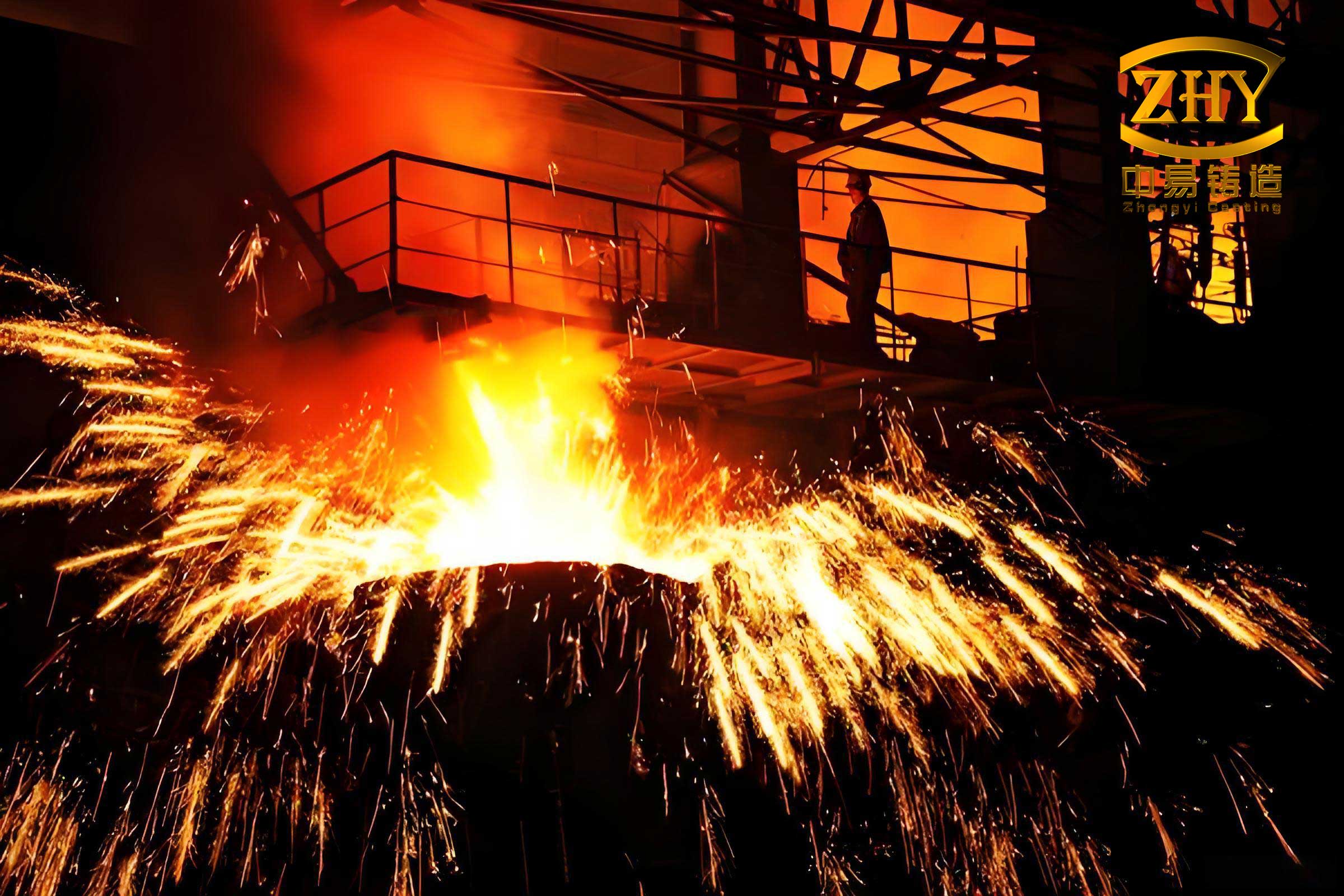
To understand the prevention strategies, one must first grasp the unique solidification traits of ductile iron. Unlike other alloys, ductile iron exhibits a broad eutectic solidification range, leading to a mushy freezing mode where liquid and solid phases coexist across wide sections. This complicates feeding. Additionally, the numerous graphite nuclei from spheroidization and inoculation result in fine eutectic cells, while the graphitization expansion force during eutectic solidification is substantial—approximately five times that of gray iron. If the mold lacks sufficient rigidity, this expansion can cause mold wall movement, releasing pressure and increasing shrinkage tendency. The volume changes during solidification occur in three stages: liquid contraction from pouring to eutectic temperature, expansion due to graphite precipitation, and solid contraction after complete freezing.
Quantifying these volume changes is essential for designing effective feeding systems. For instance, consider a ductile iron with 3.8% C and 2.5% Si. The graphite precipitation can be estimated as: $$ w(C)_{graphite} = w(C)_{total} – w(C)_{austenite} $$ where $w(C)_{austenite}$ ranges from 1.54% to 1.6%. Thus, $$ w(C)_{graphite} \approx 3.8\% – 1.57\% = 2.23\% $$ The expansion volume per 1% graphite precipitation is about 2%, so the total expansion $ \Delta V_g $ is: $$ \Delta V_g = 2 \times w(C)_{graphite} \times V_0 \approx 4.46\% V_0 $$ Liquid contraction $ \Delta V_l $ depends on superheat; for a superheat of 150°C and a liquid contraction coefficient of 0.017%/°C, $$ \Delta V_l = 0.00017 \times 150 \times V_0 = 2.55\% V_0 $$ Solid contraction $ \Delta V_s $ is typically around 3% $ V_0 $. The net volume change $ \Delta V_{net} $ is: $$ \Delta V_{net} = \Delta V_l + \Delta V_s – \Delta V_g = 2.55\% + 3\% – 4.46\% = 1.09\% V_0 $$ This positive value indicates residual shrinkage, underscoring the need for feeding in ductile iron castings, regardless of mold rigidity. The following table summarizes key solidification parameters for ductile iron:
| Parameter | Symbol | Typical Value | Description |
|---|---|---|---|
| Liquid Contraction Coefficient | $\alpha_l$ | 0.00016–0.00018 /°C | Volume change per degree during cooling |
| Graphite Expansion Coefficient | $\beta_g$ | 2% per 1% C precipitated | Expansion due to graphite formation |
| Solid Contraction Coefficient | $\alpha_s$ | 3% of initial volume | Shrinkage after solidification |
| Eutectic Temperature Range | $\Delta T_e$ | 30–50°C | Width of eutectic solidification |
| Graphite Nuclei Density | $N_g$ | 10^5–10^6 /cm³ | Number of graphite particles per unit volume |
Numerical simulation technology, or casting CAE, plays a pivotal role in optimizing processes for ductile iron castings. It enables the visualization of mold filling and solidification sequences, predicting defects such as shrinkage porosity. For sand-lined metal mold casting, the heat transfer involves multiple layers: casting-sand layer-metal mold-atmosphere. After validation through experiments, simulations have become reliable tools. The governing heat transfer equation can be expressed as: $$ \rho C_p \frac{\partial T}{\partial t} = \nabla \cdot (k \nabla T) + Q $$ where $\rho$ is density, $C_p$ is specific heat, $k$ is thermal conductivity, $T$ is temperature, $t$ is time, and $Q$ represents latent heat release during phase change. By solving this numerically, one can identify hot spots and optimize riser placement and cooling conditions.
In practice, I have applied various feeding methods to prevent shrinkage in ductile iron castings produced via sand-lined metal molds. Each method leverages the mold’s rigidity and controlled cooling. Below, I detail these approaches with examples and formulas.
The no-riser method relies on the gating system for liquid feeding and maximizes self-feeding via graphitization expansion. It is suitable for ductile iron castings with a modulus exceeding 2.5 cm, requiring high metallurgical quality, low pouring temperatures, and multiple thin gates. The modulus $M$ is defined as the volume-to-surface area ratio: $$ M = \frac{V}{A} $$ For instance, in crankshaft production, gates solidify early, and the central sections form a large liquid zone that self-feeds through expansion. The condition for no-riser feasibility is that the graphite expansion must compensate for the net shrinkage: $$ \Delta V_g \geq \Delta V_l + \Delta V_s $$ However, as calculations show, this is not always achievable, necessitating careful design.
Sequential solidification directs solidification from remote sections toward the riser, which solidifies last. This is ideal for thick-walled ductile iron castings. The temperature gradient $G$ and solidification rate $R$ govern the process: $$ G \cdot R \geq K $$ where $K$ is a material constant. In a traction wheel casting, simulation shows that at 70% solidification, the center remains liquid, progressing toward the riser, ensuring feeding until complete solidification.
Direct practical riser method feeds only the liquid shrinkage, with the riser neck solidifying before graphitization expansion begins. This suits ductile iron castings with modulus below 2.5 cm, offering high yield and easy removal. The riser size can be determined using Chvorinov’s rule: $$ t_s = B \left( \frac{V}{A} \right)^2 $$ where $t_s$ is solidification time, and $B$ is a mold constant. For a bearing cover casting, the riser neck solidifies at 60% casting solidification, disconnecting liquid metal and allowing expansion to compensate for residual shrinkage.
Balanced solidification theory posits that risers feed the difference between expansion and contraction, avoiding late riser solidification. Risers are placed near but not on hot spots to reduce thermal interference. For a rotor casting, risers are set beside cylindrical hubs, with flat gates directed inward, preventing direct impingement on hot spots. The feeding requirement $F$ is: $$ F = \Delta V_l + \Delta V_s – \Delta V_g $$ and riser volume $V_r$ is designed to satisfy $V_r \geq F \cdot V_c$, where $V_c$ is casting volume.
Cold riser method addresses isolated hot spots by using risers with higher thermal capacity that solidify later than the hot spot. The condition is: $$ M_{riser} > M_{hotspot} $$ where $M$ is modulus. For an elevator base casting, cold risers connected to three hot spots remain liquid until 97% casting solidification, providing adequate feeding.
Chilling method accelerates cooling at isolated hot spots via thin sand layers, sand-lined iron cores, or chills. It avoids multiple risers, improving yield. The heat extraction rate $q$ is: $$ q = h \cdot A \cdot (T_c – T_m) $$ where $h$ is heat transfer coefficient, $A$ is area, $T_c$ is casting temperature, and $T_m$ is mold temperature. In a motor end cover, varying sand layer thickness—3 mm at thick sections and 9 mm at thin sections—ensures uniform solidification, eliminating shrinkage.
The following table compares these feeding methods for ductile iron castings in sand-lined metal mold casting:
| Method | Principle | Application Criteria | Advantages | Limitations |
|---|---|---|---|---|
| No-Riser | Gating system feeds liquid; self-feeding via expansion | Modulus >2.5 cm; high-quality iron | High yield; no riser removal | Risk of shrinkage if expansion insufficient |
| Sequential Solidification | Directional solidification toward riser | Thick sections; simple geometries | Reliable feeding; predictable solidification | Requires temperature control |
| Direct Practical Riser | Feeds liquid shrinkage only; neck solidifies early | Modulus <2.5 cm; small castings | High yield; easy riser removal | Neck design critical |
| Balanced Solidification | Feeds shrinkage difference; riser near hot spot | Complex shapes; multiple hot spots | Reduces thermal interference; efficient feeding | Complex design calculations |
| Cold Riser | Riser with higher thermal capacity feeds hot spot | Isolated hot spots; moderate modulus | Effective for local shrinkage; versatile | Increases riser volume; lower yield |
| Chilling | Increases cooling rate at hot spots | Thin sections; localized hot spots | Improves microstructure; no riser needed | Requires precise chill placement |
In conclusion, the prevention of shrinkage defects in ductile iron castings through sand-lined metal mold casting is a multifaceted endeavor. While the mold’s rigidity enhances self-feeding via graphitization expansion, feeding remains essential due to the net volume shrinkage calculated from liquid contraction, expansion, and solid contraction. Numerical simulations provide invaluable insights for optimizing processes. By applying methods such as no-riser, sequential solidification, direct practical riser, balanced solidification, cold riser, and chilling—each tailored to specific casting geometries and requirements—one can effectively mitigate shrinkage porosity and cavities. These strategies underscore the importance of a holistic approach, combining theoretical understanding with practical experimentation to ensure high-quality ductile iron castings for demanding applications. As technology advances, further integration of simulation and innovative feeding techniques will continue to elevate the reliability and efficiency of producing ductile iron castings.
Throughout this discussion, the term ductile iron castings has been emphasized repeatedly, highlighting its centrality in industrial contexts. The sand-lined metal mold process, with its unique attributes, offers a robust platform for manufacturing these castings, but success hinges on meticulous process design that accounts for solidification dynamics. Future work may explore advanced alloys, real-time monitoring, and machine learning-enhanced simulations to further refine shrinkage prevention in ductile iron castings, pushing the boundaries of what is achievable in modern foundry practice.