
The relentless drive towards larger, more powerful, and efficient mining and mineral processing equipment presents unique challenges for component manufacturers. Critical structural parts for machines like grinding mills, rotary kilns, and sintering plants are becoming increasingly massive, with wall sections often exceeding 200mm and weights climbing into the tens, even hundreds, of tonnes. For decades, steel castings and forgings were the default choice for such demanding applications. However, the evolution of metallurgical science and foundry practice has firmly established ductile iron (nodular iron) as a superior, cost-effective alternative for a wide range of these heavy-section components. As a metallurgical engineer specializing in heavy casting production, I have witnessed and contributed to this shift. Ductile iron castings offer an exceptional combination of high strength, good ductility, excellent castability, vibration damping, and machinability, all at a lower raw material and manufacturing cost compared to equivalent steel components. This article delves into the application, production challenges, and technical nuances of utilizing ductile iron for thick-walled mining machinery parts, consolidating knowledge from various industrial practices.
The defining characteristic of these components is their “heavy-section” or “thick-walled” nature. This presents a significant metallurgical challenge distinct from producing thin-walled ductile iron castings. The prolonged solidification and cooling times in heavy sections create an environment conducive to several detrimental phenomena:
- Graphite Degeneration: The extended time in the critical solidification range allows magnesium (the key nodulizing element) to fade, leading to the formation of flake or vermicular graphite at the core of the casting, severely degrading mechanical properties.
- Chunk Graphite Formation: In the thermal center of very thick sections, graphite can aggregate into large, irregular clusters or “chunks,” which act as stress raisers and reduce ductility and fatigue strength.
- Carbide Precipitation: The slow cooling through the eutectoid transformation range can promote the formation of pearlite. However, if certain alloying elements are present or the composition is not balanced, hard, brittle iron carbides can also form, impairing machinability and toughness.
- Shrinkage Porosity: Designing an effective feeding system to compensate for the significant volume contraction during solidification is extraordinarily difficult in complex, thick geometries.
Overcoming these challenges requires a holistic approach encompassing meticulous alloy design, advanced melting and treatment practices, and carefully engineered casting methodology.
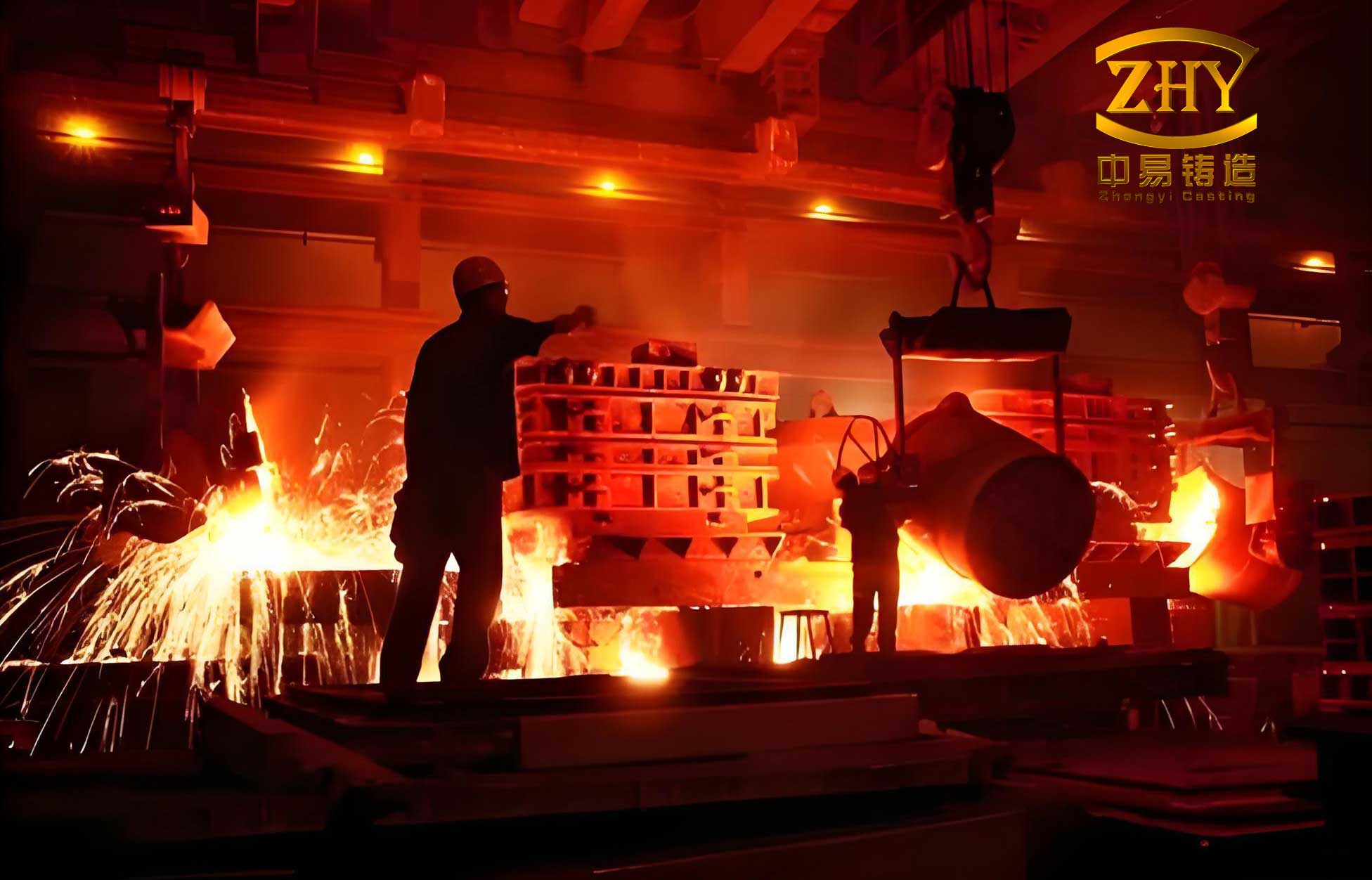
Key Application Examples of Heavy-Section Ductile Iron Castings
The versatility of ductile iron is demonstrated by its adoption across numerous fundamental mining machine components. The following table summarizes several prominent examples, highlighting their demanding service conditions and the specific grade of ductile iron typically specified.
| Component | Machine | Primary Function & Stresses | Typical Ductile Iron Grade | Key Challenges |
|---|---|---|---|---|
| Grinding Table/Plate | Vertical Roller Mill | Supports grinding rollers, transmits high torque, abrasive wear. | QT400-15A / EN-GJS-400-15U | Extreme thickness (>500mm), 100% non-destructive testing (NDT) requirements. |
| Mill End Cap / Head | Ball Mill, SAG Mill | Closes the mill cylinder, withstands cyclical loading and impact. | QT500-7 | Complex geometry with ribs, heavy and varying wall sections, full NDT. |
| Bearing Housing / Pedestal | Various (Mills, Kilns) | Supports main rotating shaft, absorbs dynamic loads and vibrations. | EN-GJS-400-18U | High integrity requirements, often no weld repair permitted. |
| Riding Wheel / Tyre | Rotary Kiln, Dryer | Supports the rotating kiln shell,承受 enormous static and dynamic pressures. | QT700-2 | Very thick section (>400mm), high strength requirement, full NDT. |
| Slag Pot / Ladle | Steel Plant | Transports molten slag, thermal cycling, abrasion, impact. | QT500-7 | Thermal fatigue resistance, combination of strength and ductility. |
| Blast Furnace Cooling Stave | Blast Furnace | Forms furnace wall, removes heat, resists abrasion and thermal stress. | QT400-18 | Deep section integrity, high ferrite content requirement at the core. |
1. Grinding Table for Vertical Roller Mills
This is a quintessential heavy-section ductile iron casting. The table rotates at high torque and supports the grinding rollers, processing hundreds of tonnes of abrasive material daily. A single casting can weigh over 100 tonnes with thermal hot spots exceeding 500mm in diameter. The specification often calls for a ferritic grade like EN-GJS-400-15U, demanding high elongation (>15%) alongside good strength to withstand internal stresses and occasional impacts. Production of such a massive ductile iron casting involves several critical steps. The melt is prepared from high-purity pig iron, low-sulfur steel scrap, and returns. To combat graphite degeneration, a robust nodulizing treatment is essential. The wire-feeding inoculation process has proven highly effective for these large masses. Here, a magnesium-bearing wire is continuously fed into the molten stream in the treatment ladle, ensuring a consistent and deep treatment with minimal temperature loss and magnesium fade.
The reaction can be simplified as:
$$ \text{FeSiMg (wire)} \rightarrow \text{Mg}_{(vapor)} + \text{FeSi} $$
$$ \text{Mg} + \text{S} \rightarrow \text{MgS} \quad \text{(Desulfurization)} $$
$$ \text{Mg} + \text{O} \rightarrow \text{MgO} \quad \text{(Deoxidation)} $$
$$ \text{[Mg]}_{(in melt)} \rightarrow \text{Nucleation of Spheroidal Graphite} $$
A combination of inoculation methods—late stream inoculation during treatment followed by in-mold or pouring cup inoculation—is employed to ensure a high nodule count, which is crucial for maintaining properties in the thickest sections. The feeding system is typically bottom-gated to ensure calm filling and relies on large, insulated top risers, often assisted by exothermic sleeves, to feed the massive thermal centers. Numerical simulation is indispensable for optimizing riser placement and size to eliminate shrinkage defects in these critical zones.
2. Mill End Caps and Bearing Housings
End caps for large ball and SAG mills are complex geometries with thick flanges and thinner, reinforced cylindrical sections. They are subject to high cyclical stresses from the rotating charge inside the mill. A grade like QT500-7 provides an optimal balance of strength and moderate ductility. The casting process must ensure soundness in the heavy flange regions where the cap bolts to the mill shell. This is often achieved through a combination of directional solidification towards top risers and strategic use of chilling in isolated hot spots. Bearing housings, acting as the foundation for the mill’s main shaft, demand exceptional integrity. Grades with enhanced low-temperature impact properties or higher elongation (like EN-GJS-400-18U) are common. The prohibition of weld repairs underscores the need for a flawless casting process, from mold strength (to prevent mold wall movement) to precise temperature control during pouring.
3. High-Strength Components: Riding Wheels and Special Parts
For applications requiring higher yield strength, such as rotary kiln riding wheels, pearlitic-ferritic or fully pearlitic grades like QT700-2 are used. Achieving a consistent, carbide-free matrix with a high nodule count in sections over 400mm thick is challenging. Alloying with small additions of copper (Cu) and/or tin (Sn) is common to promote pearlite formation without excessive chilling tendency. The solidification time for such a section can be estimated using Chvorinov’s rule:
$$ t_s = B \left( \frac{V}{A} \right)^n $$
where \( t_s \) is the solidification time, \( V \) is the volume, \( A \) is the surface area, \( B \) is the mold constant, and \( n \) is an exponent (typically ~2). For a 400mm thick plate, the (\(V/A\)) modulus is high, leading to a very long \( t_s \), which exacerbates fading and segregation issues. Therefore, the chemical composition and treatment must be designed to remain stable over this extended period.
Production Methodology and Metallurgical Control
The successful production of heavy-section ductile iron castings hinges on a tightly controlled sequence of steps. The following table outlines the critical parameters and their targets throughout the process.
| Process Stage | Control Parameter | Target / Rationale |
|---|---|---|
| Charge & Melting | Raw Material Purity | Low S (<0.015%), low trace elements (Ti, Sb, Pb, Bi etc.). |
| Carbon Equivalent (CE) | CE = %C + 0.33(%Si) typically 4.2-4.4%. Ensures good fluidity, reduces shrinkage tendency. | |
| Superheating | ~1500-1520°C for grain refinement and impurity removal, followed by a controlled holding time. | |
| Treatment | Nodulizing Method | Wire-feeding or Tundish Cover for large ladles; promotes Mg recovery and reproducibility. |
| Inoculation Strategy | Multiple-stage: Pre-inoculation, Post-inoculation, Late-stream inoculation. Maximizes nodule count. | |
| Treatment Temperature | 1360-1390°C. High enough for fluidity, low enough to minimize Mg loss and fading. | |
| Casting | Pouring Temperature | 1330-1360°C. Optimized to prevent mistuns and minimize shrinkage porosity. |
| Feeding System Design | Bottom gating, large insulated/exothermic risers, use of chills and padding. Validated via simulation. | |
| Alloying | Specific Additions | Ni (0.4-0.8%): stabilizes pearlite, improves uniformity in thick sections. Mo: for increased strength/hardenability. |
Beyond the parameters in the table, the fundamental metallurgical equation governing the final microstructure involves the competition between stable (graphite) and metastable (carbide) eutectic solidification, influenced by cooling rate and composition. The tendency for carbide formation can be approximated by the Carbide Factor (CF):
$$
CF = \%C + 0.33\%Si + 0.25\%P – 0.033\%Mn – 0.33\%S \quad \text{(One of several empirical formulas)}
$$
For heavy sections with slow cooling, a higher, positive CF value is aimed for to avoid carbides. Conversely, the nodulizing potential must be maintained. This is where elements like Cerium (Ce) or other rare earths (RE) come into play, often added via the inoculant or as part of the nodulizer. They counteract the deleterious effects of trace elements like Pb and Bi that promote degenerate graphite forms. The synergy between Mg and RE is crucial for thick-section integrity. The final as-cast microstructure in the thermal center of a well-made heavy-section ferritic ductile iron casting should consist of >90% ferrite, with well-dispersed, small, and perfectly spheroidal graphite nodules (Type I, size 5-6 per ASTM A247). Achieving this requires the cooling curve in the critical region to avoid the “carbide nose” of the TTT diagram.
Quality Assurance and Non-Destructive Testing
Given the safety-critical and costly nature of mining machinery, heavy-section ductile iron castings are subjected to rigorous inspection. Standard practice involves 100% non-destructive testing (NDT) of all machined critical surfaces. Ultrasonic Testing (UT) per standards like EN 12680-3 is used to detect internal discontinuities such as shrinkage, porosity, or inclusions. Magnetic Particle Inspection (MPI) or Dye Penetrant Inspection (DPI) per EN 1369 and EN 1371-1 is employed to reveal surface and near-surface defects. The acceptance criteria are often stringent, typically Level 2 or better. Furthermore, mechanical test coupons are cast either attached to the main casting (e.g., on a riser neck) or from separately cast keel blocks designed to represent the cooling rate of the thickest section. These are tested for tensile strength, yield strength, elongation, and often impact energy at specified temperatures.
Future Directions and Concluding Remarks
The application of ductile iron castings in heavy-duty mining machinery is a mature yet continuously evolving field. The future lies in pushing the boundaries further:
- Development of New Grades: Tailoring alloys for even thicker sections (>600mm) or for combined properties, such as high strength (UTS > 800 MPa) with maintained ductility and toughness in low-temperature environments.
- Process Digitalization and Simulation: Advanced numerical modeling integrating fluid flow, solidification, microstructure prediction, and stress analysis will become standard for first-time-right production of these complex, high-value castings.
- Lightweighting and Integration: Optimizing designs to reduce weight without compromising performance, and integrating multiple functional parts into a single, complex ductile iron casting to reduce assembly work and cost.
- Sustainability: Increasing the use of recycled steel scrap in charges, optimizing energy consumption during melting, and extending component life through superior metallurgy contribute to more sustainable mining operations.
In conclusion, ductile iron has decisively proven its worth as a premier material for the thick-walled, high-integrity components that form the backbone of modern mining equipment. By mastering the interplay between chemistry, treatment, and solidification control, foundries can reliably produce ductile iron castings that meet the extreme demands of strength, durability, and reliability. The ongoing innovation in this sector ensures that ductile iron will remain a critical material in building the ever-larger machines that drive global resource extraction, offering a compelling combination of performance and economic efficiency. The journey of these massive ductile iron castings, from molten metal to the heart of a grinding mill or rotary kiln, stands as a testament to advanced manufacturing capabilities.