
In the field of metal casting, the pursuit of materials with tailored, location-specific properties represents a significant engineering challenge. My extensive research has been dedicated to developing and understanding a surface modification technique that achieves precisely this goal for one of the most common engineering materials: gray cast iron. The core innovation lies in the application of specialized rare-earth (RE) based coatings to the mold cavity, which, upon contact with the molten gray cast iron, induce a profound transformation in the graphite morphology exclusively within the surface layer of the final casting.
The fundamental principle driving this work is the recognition that many engineering components, such as cylinder liners, brake discs, rolls, and particularly large ingot molds, experience vastly different service conditions at their surface compared to their core. The surface often demands high wear resistance, thermal fatigue resistance, and strength, while the interior benefits from good thermal conductivity, vibration damping, and overall toughness to withstand internal stresses. Traditional monolithic materials, including standard gray cast iron with its characteristic flake graphite, represent a compromise. My investigation proposes a solution: creating a composite structure within a single casting, where the surface layer possesses spheroidal graphite (akin to ductile iron) for superior surface properties, and the core retains the flake graphite of gray cast iron for its advantageous bulk characteristics. This approach eliminates the complexity and cost associated with bimetallic casting or extensive post-casting heat treatments.
The genesis of this work stemmed from two critical observations in industrial practice. First, the exceptional service life of certain ingot molds was correlated with an accidental, naturally occurring high nodularity in their surface layer, while the core remained highly vermicular. Second, and conversely, the detrimental formation of a surface flake graphite layer (“inverse chill”) in some ductile iron castings, such as crankshafts, was a known cause of premature failure. These contrasting cases highlighted the immense potential and necessity of deliberately controlling the surface graphite structure. My research, therefore, focused on developing a reliable, foundry-friendly process to achieve controlled surface nodularization on gray cast iron castings using mold coatings.
Fundamentals of Graphite Formation and the Role of Rare Earths
To appreciate the mechanism of surface modification, one must first understand graphite formation in gray cast iron. In its conventional state, the carbon in hypereutectic iron-carbon alloys precipitates during the eutectic reaction as interconnected flakes within an austenitic matrix. This flake morphology is responsible for the material’s excellent castability, machinability, and damping capacity but limits its tensile strength and ductility.
The transformation from flake to spheroidal graphite is primarily achieved through the addition of specific elements, known as nodularizers, with magnesium and cerium (a key component of rare-earth alloys) being the most prominent. These elements act by adsorbing onto the growing graphite crystals, altering the interfacial energy between the graphite and the melt. This change in energy favors isotropic growth, leading to the formation of spheres. The reaction is highly sensitive to interference, particularly from sulfur. The reactive nodularizing elements first desulfurize the melt according to a reaction like:
$$ [RE] + [S] \rightarrow (RE_xS_y) $$
Only after the sulfur content is reduced below a critical threshold (typically < 0.02 wt.% for consistent bulk treatment) can the remaining “active” RE effectively promote graphite spheroidization. The role of inoculation, often with ferrosilicon (75% Si), is to provide abundant heterogeneous nucleation sites for graphite, refining the matrix and preventing carbide formation.
The central hypothesis of my work is that this metallurgical reaction can be localized. By incorporating RE alloys into a mold coating, the nodularizing and inoculating elements are supplied in a highly controlled, gradient manner only from the surface inwards. The molten gray cast iron in contact with the coating is enriched with RE and Si, creating a localized zone where conditions for spheroidal graphite formation are met. As one moves inward from the casting surface, the concentration of these active elements diffuses and decays, leading to a transition zone of vermicular (compacted) graphite and finally to the unmodified flake graphite structure of the base iron.
Design and Optimization of the RE-Based Coating System
The coating is not a simple mixture; it is a functional composite system designed to perform several critical tasks simultaneously: deliver alloying elements, protect them from premature oxidation, adhere to the mold, and interact effectively with the molten metal. My research involved systematic experimentation to optimize each component. The primary constituents can be categorized as follows:
| Component Category | Specific Materials Used | Primary Function | Key Considerations |
|---|---|---|---|
| Nodularizing Agent | 1# Ferro-Silico-Rare Earth (Fe-Si-RE) Alloy | Supplies Cerium (Ce) and other RE elements to promote spheroidal graphite formation. | Particle size (0.2-0.6 mm), weight percentage in coating is critical (≥80%). |
| Inoculating Agent | 75% Ferrosilicon (FeSi75) | Provides silicon and creates nucleation sites for graphite, refines structure, supports nodularization. | Synergistic with RE alloy. Ratio to RE alloy significantly affects modified layer depth. |
| Fluxing Agents | Borax (Na₂B₄O₇), Sodium Fluoride (NaF) | Lower melting point, form a protective slag layer, improve wettability between coating and metal, prevent oxidation of alloy particles. | Added in small percentages (~2.5% of RE alloy weight). |
| Binder System | Waterglass (Sodium Silicate) or Silica Sol, Polyvinyl Butyral (PVB) | Provide green strength and adhesion of coating to sand mold. PVB enhances thermal plasticity and metal-coating contact. | |
| Carrier/Filler | Graphite Powder (in initial trials), Solvent (Water) | Adjust viscosity, facilitate application. Graphite may act as a mild inoculant. | Ensures uniform coating thickness (~5 mm). |
My initial exploratory tests utilized an L9 (3^4) orthogonal array to evaluate the main effects. The analysis conclusively identified the content of the 1# Fe-Si-RE alloy as the most significant factor for initiating surface nodularization. A subsequent, more detailed comparative study, stabilizing the binder and flux, investigated the interplay between coating composition and base iron chemistry. This study revealed that the inoculant (FeSi75) content had a profound effect on the depth of the nodularized layer, while the base iron’s carbon equivalent (CE) and sulfur content were prerequisites for success.
| Influencing Factor | Optimal/Favorable Condition | Effect of Deviation | Rationale |
|---|---|---|---|
| Coating RE Alloy Content | High (≥ 80% of alloy powder) | Below threshold: No surface nodularization, only flake or vermicular graphite. | Sufficient [RE] concentration at interface is mandatory to overcome sulfur and initiate spheroidal growth. |
| Coating Inoculant (FeSi75) Content | Optimized ratio to RE (e.g., ~9:91) | Insufficient: Shallow modified layer. Excessive: May dilute RE effect or alter matrix. | Enhances nucleation potential, supporting the growth of numerous small nodules and aiding RE diffusion. |
| Base Iron Carbon Equivalent (CE) | Hypereutectic (CE > 4.3%) | Hypoeutectic: Leads to vermicular graphite or surface flake layer, even with coating. | Hypereutectic composition provides abundant carbon for graphite precipitation, favoring the formation of discrete nodules over interconnected structures when modified. |
| Base Iron Sulfur Content | Low (< 0.04 wt.%) | High S (>0.06%): Consumes RE, prevents nodularization, may cause surface flake layer. | High sulfur acts as a potent poison for nodularizers. The reaction $$[RE] + [S] \rightarrow (RES)$$ must not deplete all available RE before graphite growth begins. |
From this body of work, an optimized coating formulation was derived: 91 parts 1# Fe-Si-RE alloy, 9 parts FeSi75 inoculant, with additions of 2.5 parts each of borax and NaF (relative to the RE weight), bound with 10 wt.% waterglass and 0.4 wt.% PVB (relative to total powder weight). This composition consistently yielded the target composite structure.
Experimental Methodology and Characterization of the Gradient Structure
The experiments were conducted using variable-thickness wedge-shaped castings. This design allowed for the simultaneous study of the effect of section modulus (casting thickness) on the modified layer. The coating was applied to a localized area of the mold wall. Standard greensand and resin-bonded sand molds were employed. The base gray cast iron was melted in medium-frequency induction furnaces, with its chemistry carefully adjusted for different experimental batches.
Metallographic examination of successfully treated castings reveals a distinct, reproducible gradient structure. From the surface inwards, three consecutive zones are observed:
- Surface Nodular Zone: A layer of well-formed, spheroidal graphite with a nodularity equivalent to grade 2-3 according to relevant standards. The depth of this zone can exceed 2.5 mm in favorable conditions.
- Intermediate Transition Zone: A region dominated by vermicular (compacted) graphite. The boundary between the nodular and vermicular zones is often quite sharp.
- Core Matrix Zone: The unmodified base metal, exhibiting the typical flake graphite structure of the original gray cast iron melt.
This gradient in graphite morphology is accompanied by a corresponding gradient in the metallic matrix. The core, representing the unmodified iron, is primarily pearlitic. The surface nodular zone shows a mixed pearlite-ferrite structure. Intriguingly, the immediate subsurface transition zone often exhibits a predominantly ferritic matrix. This can be explained by the diffusion dynamics: the influx of potent inoculants from the coating creates an extreme number of graphite nucleation sites at the surface. The rapid precipitation and growth of this carbon as graphite nodules creates a localized carbon-depleted region in the adjacent liquid, which, upon transformation, results in a ferritic halo around the nodules and a broader ferritic band in the high-nucleation transition region.
Microprobe analysis (WDS/EDS) confirmed the metallurgical mechanism. Rare earth elements were found to be preferentially segregated at the graphite-matrix interface and within non-metallic inclusions encapsulated inside the graphite spheroids. Line scans across graphite nodules clearly showed peaks of Ce and S coinciding at inclusion sites, visually confirming the prior desulfurization reaction: $$[Ce] + [S] \rightarrow CeS$$. The residual active cerium then facilitates spheroidal growth.
The Influence of Casting Geometry and Solidification Dynamics
The casting’s section thickness (or modulus) is not a passive variable but an active process parameter. My measurements show a clear correlation: increased section thickness leads to a greater depth of the nodularized layer. This is rationalized by the slower solidification rate in thicker sections. A longer local solidification time provides a more extended period for the diffusion of RE and Si elements from the coating into the molten metal, allowing the nodularizing conditions to penetrate deeper.
However, this benefit comes with a trade-off. While the nodular layer is deeper, the graphite nodules within it tend to be larger and fewer in number compared to those formed in a thinner, faster-cooling section. This aligns with established solidification theory, where slower cooling favors the growth of fewer, larger grains (or nodules). In very thin sections, the extremely high cooling rate can sometimes hinder the diffusion process, limiting layer depth, but can also suppress the formation of a surface flake layer, making it a favorable condition for achieving a sound, fully nodular surface skin.
Thermal analysis during solidification provided profound insights. Cooling curves recorded near the coated surface versus an uncoated surface of the same casting showed marked differences:
- Reduced Cooling Rate: The coated surface cooled approximately 8°C/min slower initially, likely due to the insulating effect of the coating layer.
- Elevated Eutectic Temperature: The recalescence associated with the eutectic reaction was about 20°C higher on the coated side.
- Shortened Eutectic Duration: The eutectic plateau was condensed by roughly 1.7 minutes.
- Pre-Eutectic Austenite Formation: A distinct arrest, indicative of austenite dendrite formation, was visible on the cooling curve from the coated side before the eutectic reaction began.
These thermal signatures can be interpreted as follows. The higher eutectic temperature ($T_{Eut}^{Coated}$) is a direct result of the powerful inoculation, which reduces the undercooling needed for graphite nucleation. The relationship can be conceptually framed as:
$$\Delta T_{N} = T_{Eq} – T_{Nuc}$$
where $\Delta T_{N}$ is the nucleation undercooling, $T_{Eq}$ is the equilibrium eutectic temperature, and $T_{Nuc}$ is the actual nucleation temperature. The coating dramatically increases $T_{Nuc}$. The shortened eutectic time reflects the extremely high number of nucleation events, allowing the transformation to complete rapidly. The presence of a pre-eutectic austenite arrest indicates that the rare earth elements from the coating have altered the solidification sequence, promoting the primary crystallization of austenite dendrites before the onset of the graphite-austenite eutectic. This is a characteristic feature of the solidification of treated irons that form spheroidal or vermicular graphite.
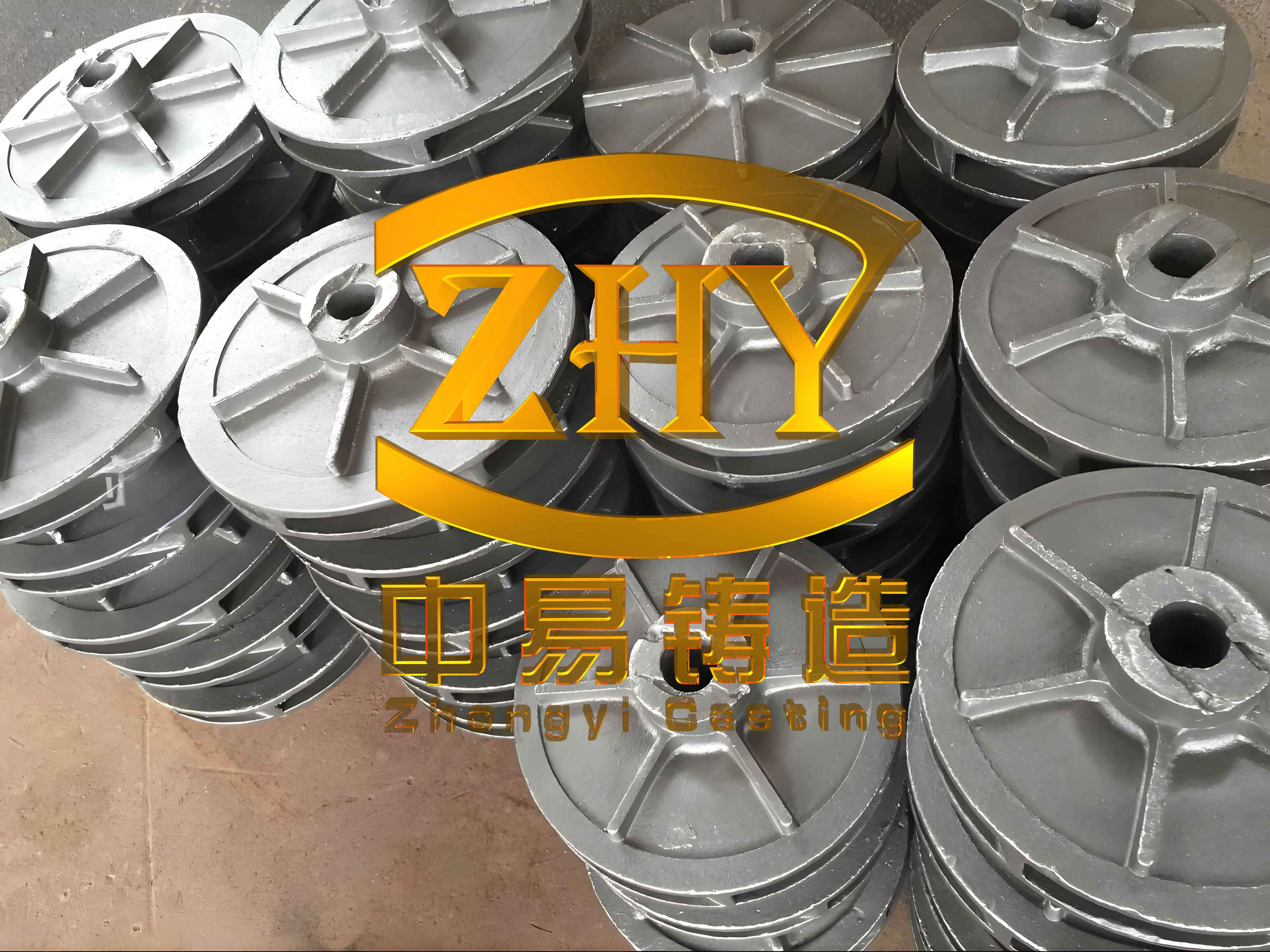
The technical advantages of this process are significant when considering the performance of components like the one depicted. By generating a hard, wear-resistant, and fatigue-resistant spheroidal graphite surface on a tough, thermally conductive, and easily castable gray iron body, components can achieve performance metrics typically associated with more expensive or complex manufacturing routes. This makes the technology highly attractive for a wide range of industrial applications where surface and core requirements are divergent.
Process Advantages, Applications, and Industrial Implications
The surface nodularization technique via RE-based coatings offers a compelling set of advantages for the foundry industry:
- Material Efficiency: It uses expensive nodularizing elements (RE) only where they are needed—at the surface—drastically reducing total alloy consumption compared to producing a full-section ductile iron casting.
- Design Flexibility: It allows engineers to design with a “composite” material in mind, specifying surface hardness and core properties independently within a single casting.
- Process Simplicity: It integrates seamlessly into standard sand-casting workflows. The application of a coating is a routine foundry operation, requiring no major changes in melting or pouring practice for the base gray cast iron.
- Reduced Defect Risk: By avoiding the bulk treatment of iron with magnesium or heavy RE additions, issues like dross formation, slag defects, and porosity tendencies often associated with ductile iron processing are minimized.
- Performance Enhancement: It directly addresses failure modes like surface-initiated cracking in wear parts or the detrimental “inverse chill” in critical ductile iron castings.
Potential applications are vast and align with components suffering from surface degradation:
Wear Parts: Mill rolls, camshafts, brake rotors, and agricultural tool edges benefit from a hard, nodular surface on a tough core.
Thermally Cycled Components: Ingot molds, glass mold dies, and engine blocks can leverage the crack-resistant spheroidal surface and the high thermal conductivity of the gray iron interior.
Pressure-Sensitive Parts: Hydraulic valve bodies or manifolds could use a pressure-tight, strong surface layer.
Conclusion and Future Perspectives
My research comprehensively demonstrates the feasibility and controllability of producing a surface-nodularized composite structure on gray cast iron castings using a rare-earth-based mold coating. The process is governed by a well-defined interaction between a specifically formulated coating—rich in RE nodularizer and inoculant—and a base iron chemistry that must be hypereutectic and low in sulfur. The resulting casting exhibits a deliberate gradient: a spheroidal graphite surface layer for performance, a vermicular graphite transition, and a flake graphite core for bulk properties.
The depth and quality of this modified layer are influenced by coating composition, base iron chemistry, and the casting’s geometry through its effect on solidification kinetics. Thermal analysis confirms that the coating fundamentally alters the solidification sequence, promoting austenite dendrite formation and a high-temperature, rapidly progressing eutectic reaction characteristic of inoculated, RE-treated irons.
This technique stands as a powerful tool for the design of high-performance, cost-effective cast components. Future work may explore the use of different RE sources or magnesium-containing coatings, the application via core or chill surfaces in complex castings, quantitative modeling of the element diffusion profiles, and extensive tribological and mechanical testing of the gradient structure under simulated service conditions. The ability to engineer graphite morphology layer-by-layer within a casting opens a new chapter in the sophisticated application of that most traditional of foundry materials, gray cast iron.