
In the realm of metal casting, particularly for grey cast iron components, the accurate assessment of mechanical properties is paramount for ensuring structural integrity and performance in service. For decades, foundries and purchasers have relied on separately cast test specimens to evaluate material properties. However, a growing consensus within the industry recognizes that attached test blocks, which solidify under conditions more closely mirroring the actual casting, provide a superior representation of the component’s inherent characteristics. Throughout my extensive experience in foundry engineering and quality control, I have observed that the mechanical properties indicated by these attached blocks are not absolute but are significantly influenced by their specific location on the casting. This article presents a comprehensive investigation into this phenomenon, detailing how local cooling conditions, dictated by section thickness, govern the microstructure and, consequently, the tensile strength and hardness of grey cast iron. The core thesis is that for a single grey cast iron casting, the performance of an attached test block is a function of its position, primarily due to variations in cooling rate and the resulting undercooling, which directly control the pearlite content in the matrix.
The foundation of this study lies in the metallurgy of grey cast iron. Grey cast iron is characterized by its graphite flakes embedded in a metallic matrix, which is typically pearlitic, ferritic, or a mixture thereof. The mechanical properties, notably tensile strength and hardness, are predominantly determined by the matrix structure and the graphite morphology. Pearlite, a lamellar mixture of ferrite and cementite, contributes to higher strength and hardness, whereas ferrite offers greater ductility but lower strength. The formation of these phases is critically dependent on the cooling rate during solidification and subsequent solid-state transformation. A higher cooling rate, often associated with thinner sections, promotes undercooling, which increases the driving force for the nucleation and growth of pearlite. Conversely, slower cooling in thicker sections allows for more stable, diffusion-controlled transformation, potentially leading to higher ferrite content. This relationship can be conceptually framed using the concept of undercooling, $\Delta T$, and its influence on nucleation rate, $I$, often approximated by classical nucleation theory:
$$ I = I_0 \exp\left(-\frac{\Delta G^*}{k_B T}\right) $$
where $\Delta G^*$ is the critical free energy barrier for nucleation, which is inversely proportional to the square of the undercooling: $\Delta G^* \propto \frac{1}{(\Delta T)^2}$. For the pearlite transformation in grey cast iron, a simplified empirical relationship between cooling rate ($\dot{T}$), final pearlite fraction ($f_P$), and tensile strength ($\sigma_u$) is often sought. While exact universal formulas are complex due to numerous interacting factors, a linear correlation between pearlite content and tensile strength is widely accepted for many grades of grey cast iron. This forms the theoretical backbone for understanding the positional dependence of test block properties.
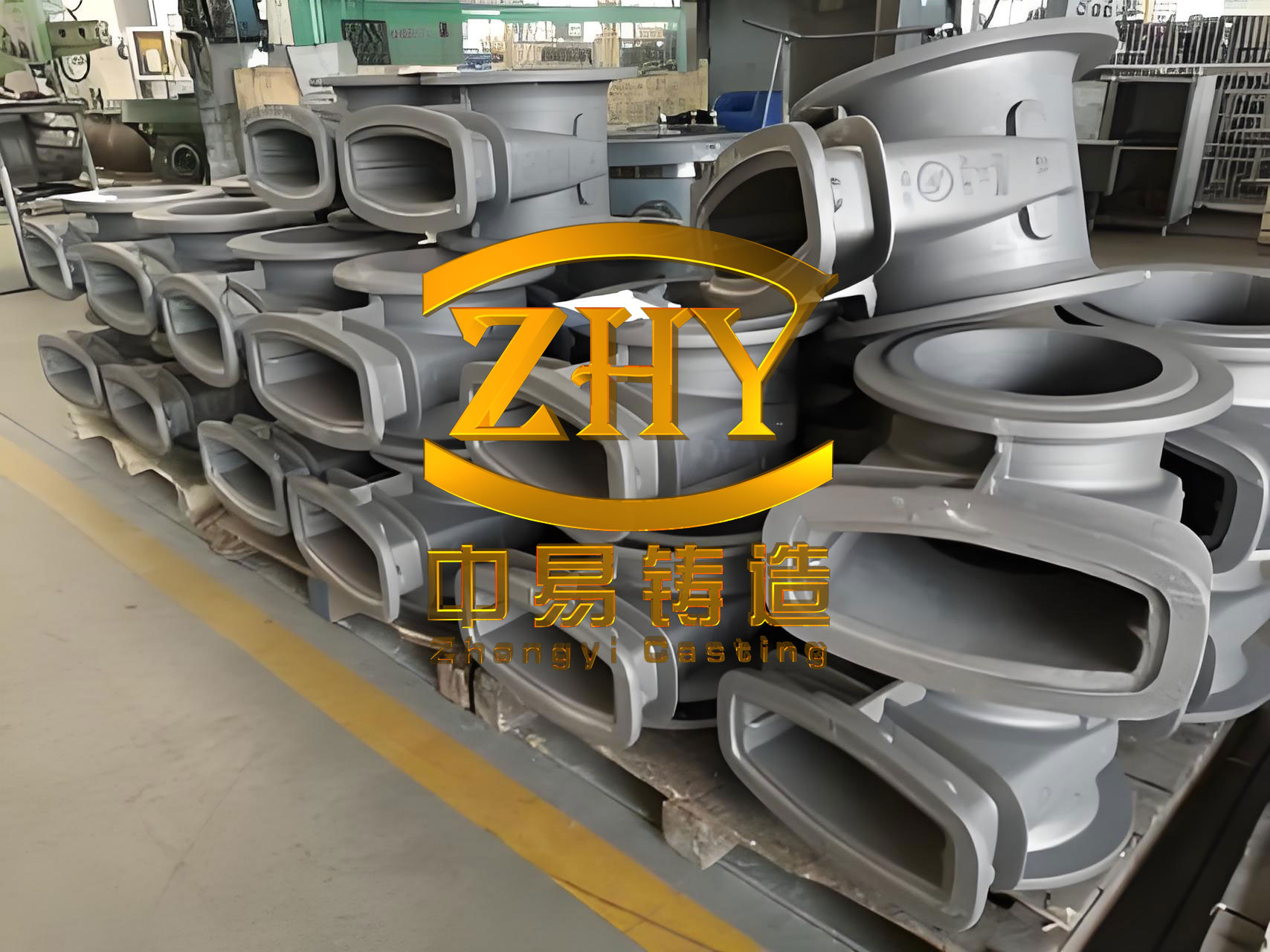
To investigate this positional effect systematically, a detailed experimental program was designed and executed. The subject was a series of large, critical components: compressor bodies manufactured from grade HT250 grey cast iron, each weighing approximately 10 metric tons. These castings exhibited significant variation in wall thickness, making them ideal for this study. Three identical castings from the same production batch were selected. On each casting, two attached test blocks were integrally cast at three distinct nominal wall thickness locations: 45 mm (representing a relatively thin section), 80 mm (an intermediate section), and 150 mm (a thick, massive section). This resulted in a total of 18 test blocks (3 locations × 2 blocks per location × 3 castings). For clarity in data presentation, a consolidated identification system is used, as shown in Table 1.
| Castings Series | Nominal Wall Thickness (mm) | Test Block Group Designation | Number of Blocks per Casting |
|---|---|---|---|
| I, II, III | 45 | Group A | 2 |
| 80 | Group B | 2 | |
| 150 | Group C | 2 |
The entire manufacturing process was rigorously controlled to isolate the variable of test block position. The chemical composition of the grey cast iron melt was meticulously maintained to be within a narrow range, as verified by spectrometric analysis. The target composition was designed to achieve HT250 grade properties while minimizing the risk of graphite flotation and shrinkage porosity in the thick sections. The average chemical composition from the heats used for these three castings is presented in Table 2.
| Element | Carbon (C) | Silicon (Si) | Manganese (Mn) | Phosphorus (P) | Sulfur (S) |
|---|---|---|---|---|---|
| Content | 3.10 | 1.80 | 0.85 | 0.035 | 0.073 |
Melting was conducted in a medium-frequency induction furnace, which allows for excellent temperature control and homogeneity. A key process parameter is pouring temperature. To balance fluidity for mold filling with the need to control shrinkage and grain growth, a strategy of “high temperature tapping, low temperature pouring” was employed. The molten grey cast iron was tapped from the furnace at approximately 1430°C and poured into the molds at a carefully controlled temperature of 1360-1370°C. Inoculation is a critical step for grey cast iron, as it promotes the formation of fine, type A graphite and reduces the chill tendency. In this case, post-inoculation was performed using a conventional 75% ferrosilicon alloy added via a stream inoculation method at the spout during tapping, with an addition rate of 0.4% by weight of the molten metal.
After shakeout and cleaning, the test blocks were removed from the castings. Each block was then subjected to standard metallographic preparation and mechanical testing. Metallographic examination involved sectioning, mounting, polishing, and etching (typically with 2% nital) to reveal the microstructure. The volume fraction of pearlite was estimated using standard comparative charts according to relevant international standards. Mechanical testing consisted of tensile tests on machined specimens taken from the test blocks and Brinell hardness measurements. The results, aggregated from the multiple blocks in each group to provide statistically significant averages, are compiled in Table 3.
| Test Block Group (Wall Thickness) | Average Pearlite Content (%) | Average Tensile Strength, Rm (MPa) | Average Brinell Hardness (HBW) | Estimated Cooling Rate Index* |
|---|---|---|---|---|
| Group A (45 mm) | 60 ± 5 | 239 | 182 | High |
| Group B (80 mm) | 45 ± 5 | 196 | 162 | Medium |
| Group C (150 mm) | 30 ± 5 | 150 | 132 | Low |
* Qualitative index based on section modulus and thermal analysis.
The data in Table 3 reveals a clear and strong trend. The test blocks attached to the 45 mm wall (Group A) exhibited the highest pearlite content, approximately 60%, which corresponded to the highest tensile strength (239 MPa) and hardness (182 HBW). The properties progressively decreased for the blocks from the 80 mm section (Group B: ~45% pearlite, 196 MPa, 162 HBW) and further for the 150 mm section (Group C: ~30% pearlite, 150 MPa, 132 HBW). This unequivocally demonstrates that the position of the attached test block on a grey cast iron casting has a profound impact on its measured mechanical properties.
The underlying mechanism is rooted in the differential solidification and cooling kinetics across the casting. The local cooling rate, $\dot{T}_{local}$, for a given point in a sand-cast component can be approximated by considering it as a one-dimensional heat transfer problem through a wall of thickness $d$. A first-order estimate is given by:
$$ \dot{T}_{local} \approx \frac{T_{pour} – T_{solidus}}{t_{solid}} \quad \text{where} \quad t_{solid} \propto d^n $$
Here, $T_{pour}$ is the pouring temperature, $T_{solidus}$ is the solidus temperature, $t_{solid}$ is the local solidification time, and $n$ is an exponent typically between 1.5 and 2 for sand castings (Chvorinov’s rule: $t_{solid} = B \cdot (V/A)^2$, where $V/A$ is the volume-to-surface area ratio, proportional to wall thickness for simple shapes). Therefore, $\dot{T}_{local} \propto 1/d^n$. The thinner the section, the faster the cooling. This rapid cooling increases the undercooling ($\Delta T$) below the eutectoid temperature before the austenite-to-pearlite transformation. Higher undercooling shifts the transformation kinetics towards finer pearlite interlamellar spacing and a greater fraction of pearlite, as the driving force for diffusion-controlled ferrite formation is reduced. The relationship between pearlite fraction ($f_P$) and an effective cooling parameter can be modeled for many grey cast iron grades. A simplified linear form for a fixed composition is:
$$ f_P = \alpha + \beta \cdot \log(\dot{T}_{local}) $$
where $\alpha$ and $\beta$ are material constants. Subsequently, the tensile strength of grey cast iron, $\sigma_u$, has a well-established, nearly linear dependence on the pearlite content, often expressed as:
$$ \sigma_u (\text{MPa}) = \sigma_0 + K \cdot f_P $$
Here, $\sigma_0$ represents the base strength contribution from the graphite matrix and ferrite, and $K$ is a strengthening coefficient per unit percent of pearlite. Combining these relationships explains the observed data: Position (via thickness $d$) → Cooling Rate ($\dot{T}$) → Undercooling ($\Delta T$) → Pearlite Fraction ($f_P$) → Tensile Strength ($\sigma_u$) and Hardness. This chain of causation is the fundamental reason why a single specification for grey cast iron properties must be interpreted in the context of the section size from which the test sample originates.
The implications of this finding are substantial for quality assurance protocols in the grey cast iron industry. When a procurement specification calls for mechanical properties based on attached test blocks, it is insufficient to merely state the grade (e.g., HT250). The exact location from which the test block is to be taken must be explicitly defined. Ideally, this location should be representative of a critical or highly stressed section of the casting. Alternatively, if the casting has a wide range of section sizes, multiple test block locations might be specified to characterize the property gradient. Failure to define this can lead to disputes between foundries and purchasers, as a block from a thick, non-critical section may not meet the minimum strength values expected from the grade, even though the material in thinner, load-bearing walls is fully compliant. This positional sensitivity is particularly crucial for heavy-section grey cast iron castings used in applications like compressor bodies, engine blocks, machine tool bases, and wind turbine hubs.
Beyond the basic thickness effect, other factors can modulate the positional dependence. The geometry of the test block itself (its size and connection to the casting), the proximity to gates or risers, and local mold material properties can influence its thermal history. However, in a well-designed casting with judiciously placed test blocks that are representative of the adjacent casting wall, the dominant factor remains the wall thickness. Furthermore, the chemical composition of the grey cast iron plays a role. Higher alloying elements like manganese, chromium, or copper can increase hardenability and promote pearlite formation even in slower-cooling sections, thereby reducing the property gradient. The inoculation practice also affects graphite nucleation and can influence the sensitivity to cooling rate. These interactive effects can be explored through response surface methodology or other statistical design of experiments. A generalized model incorporating these variables for predicting local properties in complex grey cast iron castings remains an active area of research, with potential applications in simulation software.
To further elaborate on the quantitative aspects, let’s consider a more detailed analysis of the cooling process. The heat transfer during solidification of grey cast iron in a sand mold involves transient conduction. The temperature field $T(x,t)$ can be described by the heat equation:
$$ \frac{\partial T}{\partial t} = \alpha_{th} \frac{\partial^2 T}{\partial x^2} + \frac{\dot{q}_{latent}}{\rho c_p} $$
where $\alpha_{th}$ is the thermal diffusivity, $\dot{q}_{latent}$ is the latent heat release rate due to solidification, $\rho$ is density, and $c_p$ is specific heat. Solving this for different boundary conditions corresponding to different wall thicknesses ($d$) shows that the centerline cooling curve after solidification decays exponentially. The time constant $\tau$ for this cooling is proportional to $d^2$. Therefore, the cooling rate in the critical eutectoid range (approx. 700-750°C) scales inversely with $d^2$. This supports the strong dependence observed. One can define a non-dimensional parameter, the Fourier number $Fo = \alpha_{th} t / d^2$, to compare thermal histories. Similar $Fo$ values imply similar thermal states. For our test blocks, the solidification time ratio between the 150mm and 45mm sections would be approximately $(150/45)^2 \approx 11$, meaning the thick section cools about 11 times slower, dramatically altering the transformation kinetics.
The practical application of this knowledge extends to non-destructive testing and quality prediction. If the relationship between hardness, position, and tensile strength is well-characterized for a specific grey cast iron grade and casting geometry, then hardness mappings on the casting itself can be used to infer property distributions. This is less destructive than removing multiple test blocks. However, the attached test block remains the standard for contractual certification because it provides a material sample for destructive tensile testing, which is the definitive measure of strength.
In conclusion, the mechanical properties of grey cast iron, as determined by attached test blocks, are not intrinsic constants but are profoundly sensitive to the test block’s location on the casting. This sensitivity stems from variations in local cooling conditions, primarily governed by section thickness. Faster cooling in thinner sections leads to greater undercooling, promoting a higher volume fraction of pearlite in the matrix, which in turn yields higher tensile strength and hardness. This work, based on systematic investigation of heavy-section grey cast iron compressor bodies, clearly demonstrates a gradient in properties: test blocks from 45 mm walls showed approximately 60% pearlite and 239 MPa strength, while those from 150 mm walls showed only 30% pearlite and 150 MPa strength. Therefore, it is imperative for material specifications and purchase agreements for grey cast iron castings to explicitly define the location from which certification test blocks are to be taken. This practice ensures that the tested properties are representative of the critical areas of the component, thereby avoiding technical disputes and enhancing the reliability of grey cast iron components in service. The fundamental metallurgical principles outlined here—linking cooling rate, undercooling, pearlite formation, and final properties—provide a robust framework for understanding and managing property variations in all grey cast iron production.