
In our production of grey cast iron components, we encountered significant challenges with defects such as shrinkage porosity and gas holes, leading to high scrap rates. Specifically, for a coupling sleeve part made of HT20-40 grey cast iron, the scrap rate reached up to 50% in raw castings and 30% after machining, when using traditional sequential solidification principles. This prompted us to explore alternative methodologies based on equilibrium solidification and limited feeding, which revolutionized our approach to riser design for grey cast iron.
Grey cast iron is distinct from steels due to its graphite precipitation during solidification, which induces expansion and self-feeding capabilities. This characteristic necessitates a departure from classical sequential solidification theories, which assume that risers must remain liquid longer than the casting to compensate for liquid and solidification shrinkage. For grey cast iron, the process involves initial cooling with primary austenite formation causing contraction, followed by eutectic stage where graphite precipitation generates expansion. If this expansion balances the contraction in other regions, the casting enters equilibrium solidification, and riser feeding ceases. Thus, risers for grey cast iron need not solidify last; instead, they provide limited feeding until equilibrium is achieved. This principle underpins our redesign of riser systems using finned risers, which enhanced casting integrity and reduced scrap.
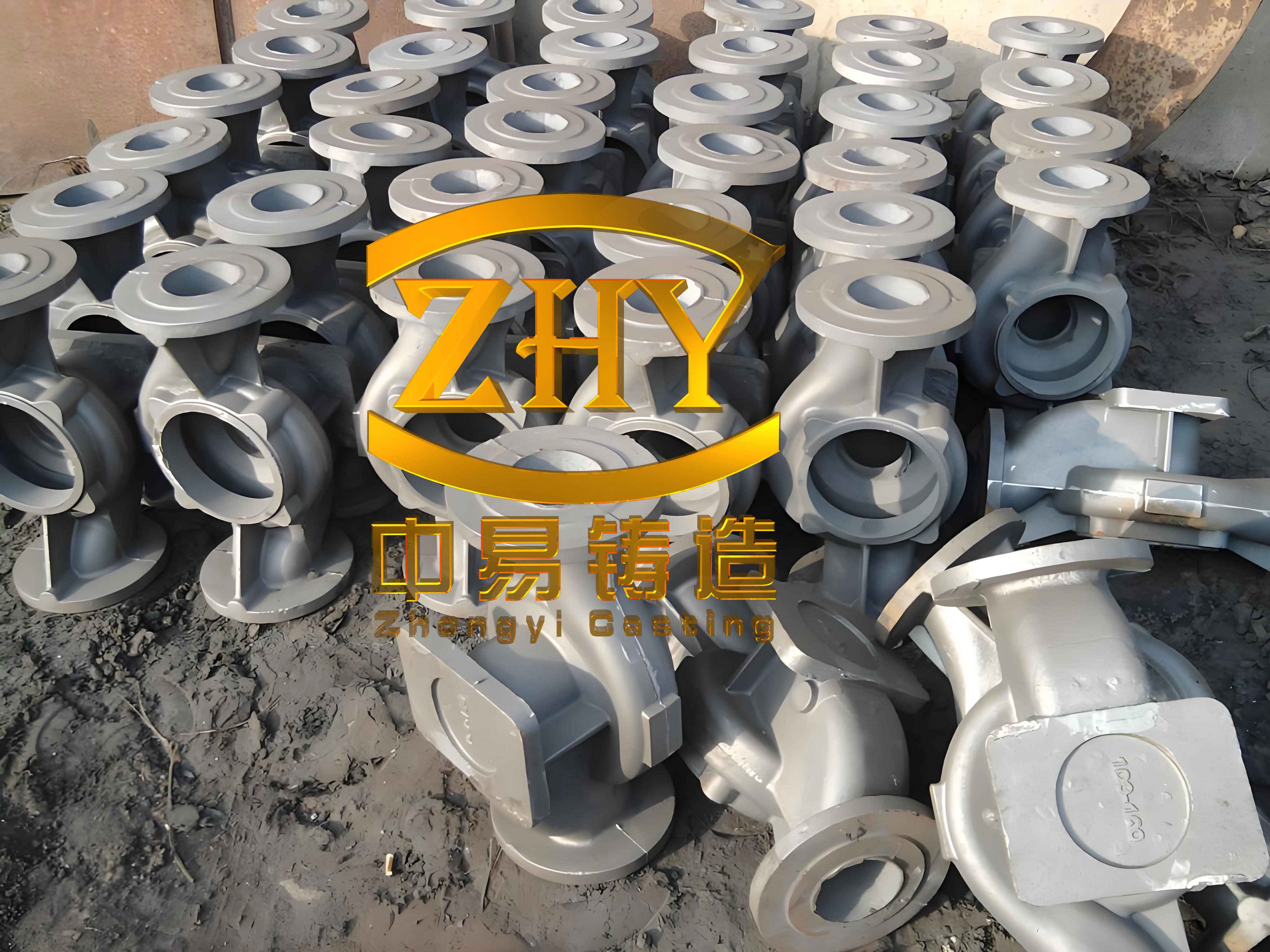
The fundamental difference between grey cast iron and steel lies in the solidification mechanism. Grey cast iron exhibits graphitization expansion, which can be quantified using the following relationship for volume change during solidification:
$$ \Delta V = V_{\text{contraction}} – V_{\text{expansion}} $$
where \( \Delta V \) is the net volume change, \( V_{\text{contraction}} \) is the volume reduction due to liquid and solidification shrinkage, and \( V_{\text{expansion}} \) is the volume increase from graphite precipitation. For grey cast iron, the expansion often offsets part of the contraction, reducing the reliance on external feeding. The self-feeding capacity can be expressed as:
$$ S_{\text{self}} = \alpha \cdot C_{\text{eq}} \cdot V_{\text{casting}} $$
where \( S_{\text{self}} \) is the self-feeding volume, \( \alpha \) is a coefficient dependent on cooling rate and alloy composition, \( C_{\text{eq}} \) is the carbon equivalent, and \( V_{\text{casting}} \) is the casting volume. This equation highlights how grey cast iron’s composition influences its ability to mitigate shrinkage.
Traditional sequential solidification assumes that risers must compensate for all shrinkage, leading to oversized risers placed directly on geometric hot spots. However, for grey cast iron, this can exacerbate thermal interference, increasing the effective hot spot size. The contact hot spot diameter \( D_c \) when a riser of diameter \( D_r \) is placed on a casting section of thickness \( T \) can be approximated by:
$$ D_c = T + k \cdot D_r $$
where \( k \) is a thermal interference factor typically ranging from 0.5 to 1.2. In our case, for the coupling sleeve with a wall thickness of 20 mm and a riser diameter of 60 mm, \( D_c \) exceeded 30 mm, creating a larger last-solidifying zone that risers could not feed effectively after solidification, resulting in shrinkage cavities.
To address this, we adopted the equilibrium solidification theory, which emphasizes limited feeding and riser placement near but not on hot spots. The key principles include: risers need not solidify after the casting; gates and risers should avoid geometric hot spots; and mold rigidity should be maximized to enhance self-feeding. Below is a table comparing sequential and equilibrium solidification for grey cast iron:
| Aspect | Sequential Solidification | Equilibrium Solidification |
|---|---|---|
| Feeding Mechanism | Risers provide full liquid feeding until casting solidifies. | Risers provide limited feeding until graphite expansion balances contraction. |
| Riser Placement | Directly on geometric hot spots. | Near hot spots, avoiding direct contact to reduce thermal interference. |
| Solidification Order | Casting solidifies first, then riser. | Riser may solidify before or with casting. |
| Applicability | Steels and alloys without expansion during solidification. | Grey cast iron and other alloys with graphitization or expansion phases. |
| Self-Feeding Utilization | Low, relies on external feeding. | High, leverages graphite expansion for internal feeding. |
The defects in our grey cast iron coupling sleeve were analyzed systematically. Shrinkage cavities formed under riser necks due to enlarged contact hot spots, while gas holes arose from poor mold ventilation and sand quality. Using equilibrium solidification principles, we identified that risers on hot spots increased thermal gradients, delaying solidification in those regions. Moreover, the low rigidity of pit molding reduced the effectiveness of graphite expansion, as the mold could deform, allowing microporosity formation. The following table summarizes the defect causes and solutions based on grey cast iron behavior:
| Defect Type | Primary Cause | Solution with Equilibrium Solidification |
|---|---|---|
| Shrinkage Cavities | Risers on geometric hot spots causing enlarged contact hot spots. | Place finned risers near hot spots; use limited feeding to allow self-feeding. |
| Gas Holes | Poor mold permeability and sand quality in pit molding. | Improve sand system; use finned risers for slag trapping and gas venting. |
| Microporosity | Low mold rigidity reducing graphite expansion utilization. | Increase mold rigidity with flask molding; optimize riser design. |
| Riser Removal Damage | Large risers difficult to remove without damaging casting. | Use small finned risers with thin fins for easy removal. |
We redesigned the riser system using finned risers, also known as hot-side dark risers, which feature thin fins for feeding and slag trapping. The finned riser design involves a main riser body with extended fins that connect to the casting through thin sections, typically 2-4 mm thick. This allows rapid solidification of the feed path, preventing back-feeding or “inverse segregation” where liquid metal is sucked back into the riser during graphite expansion. The riser design calculations were based on modulus method and feeding requirements for grey cast iron.
For the coupling sleeve, with a weight of approximately 5 kg and dimensions as specified, we calculated the riser modulus \( M_r \) using:
$$ M_r = \frac{V_r}{A_r} $$
where \( V_r \) is the riser volume and \( A_r \) is the riser surface area. Based on empirical data for grey cast iron, the riser modulus should be 1.2 to 1.5 times the casting modulus \( M_c \) at the feeding region. The casting modulus for the thick section was computed as:
$$ M_c = \frac{V_{\text{section}}}{A_{\text{section}}} $$
Given a section thickness of 20 mm for the sleeve, \( M_c \approx 10 \, \text{mm} \). Thus, \( M_r \) was set to 12 mm. Using standard riser design tables for grey cast iron, we selected a riser diameter of 40 mm and height of 60 mm, with fin thickness of 3 mm and fin length of 15 mm. The gating system was designed with a sprue diameter of 20 mm and runner cross-section of 25 mm × 30 mm to ensure proper filling and feeding. The pouring temperature was maintained at 1350°C to optimize fluidity and graphite formation.
The feeding capacity of the finned riser was evaluated using the feeding distance formula for grey cast iron:
$$ L_f = k_f \cdot \sqrt{T} $$
where \( L_f \) is the feeding distance, \( T \) is the section thickness, and \( k_f \) is a coefficient ranging from 15 to 25 for grey cast iron depending on carbon equivalent and cooling conditions. For our casting, with \( T = 20 \, \text{mm} \) and \( k_f = 20 \), \( L_f \approx 89 \, \text{mm} \), sufficient to cover the entire casting geometry. The riser weight was calculated as 1.2 kg, giving a casting yield of:
$$ \text{Yield} = \frac{W_{\text{casting}}}{W_{\text{casting}} + W_{\text{riser}} + W_{\text{gating}}} \times 100\% $$
where \( W_{\text{casting}} = 5 \, \text{kg} \), \( W_{\text{riser}} = 1.2 \, \text{kg} \), and \( W_{\text{gating}} = 0.8 \, \text{kg} \), resulting in a yield of approximately 71%, an improvement from 60% with traditional risers.
The performance of finned risers was validated through five production batches of grey cast iron couplings. The scrap rate dropped to below 5% for raw castings and 2% after machining, with one batch achieving 100% sound castings and 98% after machining. The finned risers demonstrated superior slag trapping and gas venting, as the thin fins solidified quickly, isolating impurities in the riser. Moreover, the risers were easily removed without damaging the casting due to their small size and fin design. Below is a table summarizing the production results with finned risers for grey cast iron:
| Batch Number | Number of Castings | Raw Casting Scrap Rate (%) | Machined Part Scrap Rate (%) | Remarks |
|---|---|---|---|---|
| 1 | 50 | 4 | 1 | Minor gas holes in few parts. |
| 2 | 50 | 2 | 0 | All castings sound; perfect machining. |
| 3 | 50 | 6 | 3 | Slight shrinkage in one casting. |
| 4 | 50 | 3 | 1 | Improved sand quality reduced gas holes. |
| 5 | 50 | 1 | 1 | Best batch with finned risers optimized. |
The effectiveness of finned risers hinges on the principles of equilibrium solidification for grey cast iron. By allowing limited feeding and leveraging graphite expansion, these risers minimize thermal interference and enhance casting integrity. The design parameters can be generalized for similar grey cast iron components using the following formulas and tables. For cylindrical risers with fins, the modulus correction factor \( f_m \) accounts for fin effects:
$$ M_{r,\text{eff}} = f_m \cdot M_r $$
where \( f_m \) is typically 0.8 to 0.9 for finned risers, as the fins increase surface area and reduce modulus slightly. The feeding requirement \( F_r \) for grey cast iron during the eutectic stage is given by:
$$ F_r = \beta \cdot (1 – e^{-t/\tau}) \cdot V_{\text{casting}} $$
where \( \beta \) is a feeding factor dependent on carbon equivalent, \( t \) is time, and \( \tau \) is the solidification time constant. This equation models the gradual cessation of feeding as equilibrium is approached.
In practice, for grey cast iron castings with weights up to 10 kg and section thicknesses of 10-30 mm, finned risers with fin thickness of 2-4 mm and fin length of 10-20 mm are recommended. The riser diameter can be determined from:
$$ D_r = 2 \cdot M_{r,\text{eff}} + \delta $$
where \( \delta \) is a safety margin of 5-10 mm. The table below provides guidelines for finned riser design based on casting weight for grey cast iron:
| Casting Weight (kg) | Riser Diameter (mm) | Fin Thickness (mm) | Fin Length (mm) | Estimated Feeding Distance (mm) |
|---|---|---|---|---|
| ≤2 | 20-30 | 2 | 10 | 50-70 |
| 2-5 | 30-40 | 3 | 15 | 70-100 |
| 5-10 | 40-50 | 4 | 20 | 100-130 |
| 10-20 | 50-60 | 4 | 25 | 130-160 |
Our experience confirms that grey cast iron responds well to equilibrium solidification principles. The finned riser design not only improved quality but also reduced costs by minimizing riser size and easing removal. However, challenges like gas porosity persisted due to mold sand issues, underscoring the need for comprehensive process control. We recommend updating sand systems regularly and using flask molding instead of pit molding to enhance rigidity for grey cast iron castings.
In conclusion, the key to eliminating shrinkage defects in grey cast iron lies in riser placement and design rather than size. Finned risers, placed near but not on hot spots, align with equilibrium solidification and limited feeding, harnessing the self-feeding capacity of grey cast iron. This approach has proven effective in our foundry, transforming scrap rates and reinforcing the importance of material-specific solidification theories. Future work should focus on optimizing fin geometry and integrating simulation tools for grey cast iron casting processes.
The principles discussed here are broadly applicable to grey cast iron components in various industries. By embracing equilibrium solidification, foundries can achieve higher yields and better quality for grey cast iron castings, leveraging the unique properties of this versatile material. Continuous improvement in mold materials and process parameters will further enhance the benefits of finned riser systems for grey cast iron.