
As a researcher in the field of advanced manufacturing, I have extensively studied the integration of simulation technologies into traditional casting processes. The sand coated iron mold casting method, a semi-precision technique developed to address specific industrial needs, represents a significant innovation in foundry practices. In this article, I will delve into the principles, characteristics, and particularly the simulation-based design applications of sand coated iron mold casting. The adoption of computer-aided simulation software has revolutionized how we approach casting design, allowing for more scientific, efficient, and cost-effective production. My goal is to provide a comprehensive overview that highlights the transformative potential of simulation in optimizing sand coated iron mold casting processes, thereby enhancing product quality and competitive advantage for foundries.
The sand coated iron mold casting process combines the benefits of both sand casting and metal mold casting. Essentially, it involves using a metal mold—typically made of cast iron—as a flask, with a thin layer of resin-coated sand shot onto the inner cavity surface. This sand layer is then heated and cured, creating a precise mold that interfaces directly with the molten metal. The metal mold, or iron type, is separated from the casting by this sand coating, which regulates heat transfer and solidification conditions. This setup allows for controlled cooling rates, reducing defects and improving mechanical properties. The key advantage of sand coated iron mold casting lies in its ability to adjust the thickness of the sand layer; if too thick, it behaves like conventional sand casting, and if too thin, it mimics metal mold casting. This flexibility makes sand coated iron mold casting highly adaptable for producing complex castings with enhanced performance.
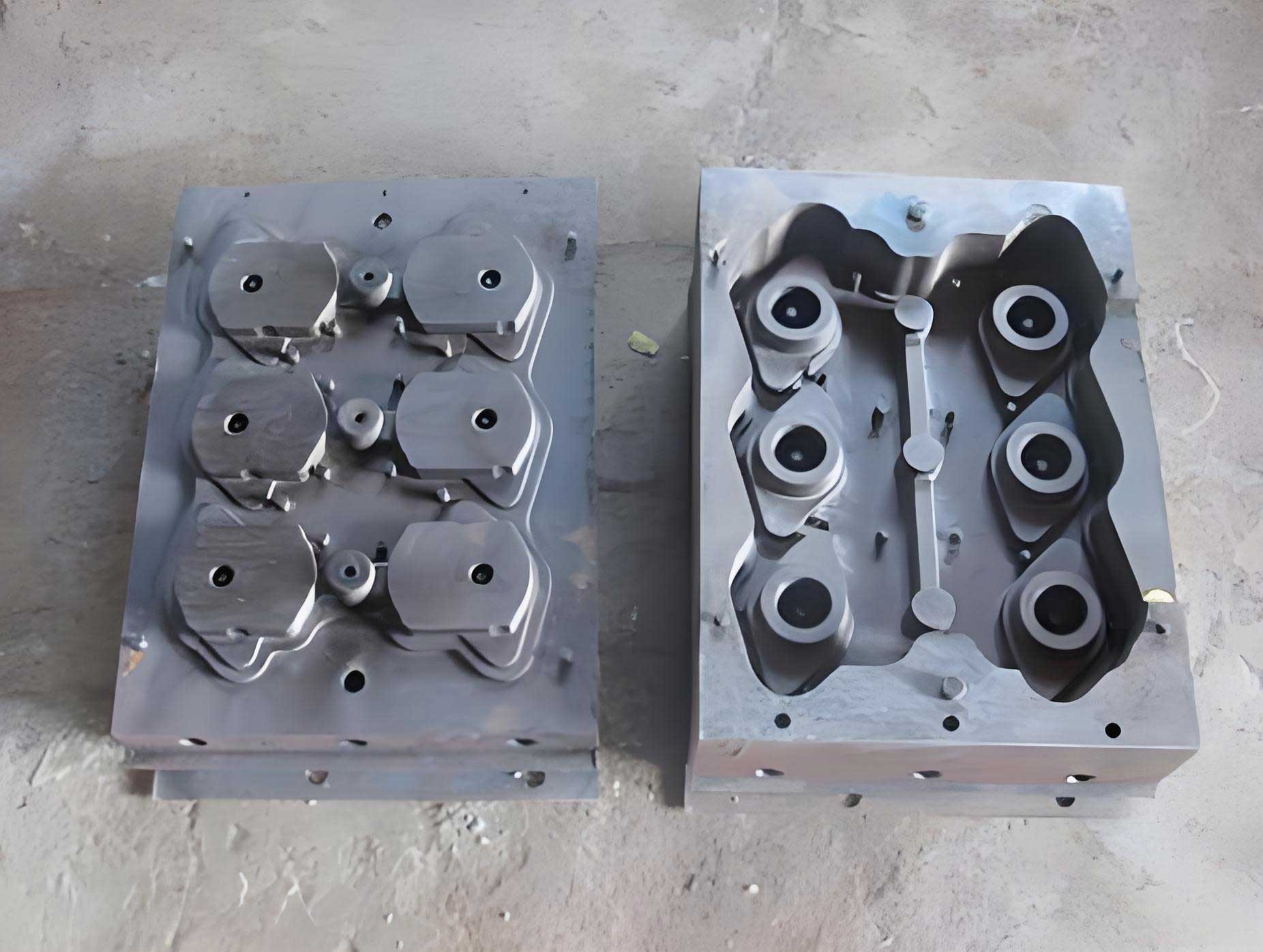
From my experience, the main characteristics of sand coated iron mold casting can be summarized as follows. Firstly, the cooling rate in sand coated iron mold casting is faster than in traditional sand casting but slower than in full metal mold casting. This intermediate rate helps achieve a fine microstructure, improving tensile strength and wear resistance without inducing undesirable white iron formations. Secondly, sand coated iron mold casting facilitates mechanization and automation, leading to higher production efficiency and consistency. Thirdly, it offers substantial cost savings—typically 20% to 30% lower than conventional sand casting—by reducing sand usage by over 80% and minimizing metal liquid waste due to better dimensional accuracy. Fourthly, the sand coating protects the iron mold from direct thermal shock, extending its service life. Lastly, sand coated iron mold casting significantly enhances casting quality by mitigating defects like shrinkage porosity and hot tearing, which are common in other methods.
To better illustrate these characteristics, I have compiled a comparative table that highlights how sand coated iron mold casting stands against other casting techniques:
| Feature | Sand Casting | Metal Mold Casting | Sand Coated Iron Mold Casting |
|---|---|---|---|
| Cooling Rate | Slow | Fast | Moderate |
| Defect Tendency | High (e.g., shrinkage) | Medium (e.g., cold shuts) | Low |
| Production Efficiency | Low | High | High |
| Cost per Unit | High | Medium | Low |
| Mold Life | Short (single use) | Long | Very Long |
| Applicability | Wide range | Limited to simple shapes | Complex geometries |
Transitioning to simulation design, the use of casting simulation software has become indispensable in modern foundries. In my work, I rely on tools like ProCAST, MAGMAsoft, and others to model the sand coated iron mold casting process. The general workflow involves several stages: pre-processing, process simulation, and post-processing, followed by iterative optimization. The simulation design flow for sand coated iron mold casting can be encapsulated in a step-by-step process, as shown in the table below:
| Step | Description | Key Activities |
|---|---|---|
| 1. Initial Design | Develop a preliminary casting process plan based on experience. | Define gating system, risers, and cooling channels. |
| 2. 3D Modeling | Create a digital model of the casting and mold assembly. | Use CAD software (e.g., SolidWorks) and export in compatible formats. |
| 3. Pre-processing | Import the model into simulation software and set up the analysis. | Mesh generation, material assignment, and boundary condition definition. |
| 4. Simulation Run | Execute the numerical simulation to predict casting behavior. | Solve for fluid flow, heat transfer, and stress-strain equations. |
| 5. Post-processing | Analyze the results to identify potential defects. | Visualize temperature gradients, solidification sequences, and porosity. |
| 6. Optimization | Refine the design based on simulation insights. | Adjust parameters (e.g., sand thickness) and re-simulate until criteria are met. |
In the context of sand coated iron mold casting, the pre-processing phase is critical. I focus on geometry modeling and mesh generation. For complex castings, such as engine blocks produced via sand coated iron mold casting, I typically use tetrahedral or hexahedral meshes depending on the software. The mesh size must balance accuracy and computational cost; a rule of thumb is that the smallest wall thickness should be at least three times the mesh element length. For instance, in a sand coated iron mold casting simulation for a piston, I might choose a triangular mesh to capture intricate corners effectively. The governing equation for heat transfer during solidification in sand coated iron mold casting can be expressed as:
$$ \rho C_p \frac{\partial T}{\partial t} = \nabla \cdot (k \nabla T) + Q $$
where \( \rho \) is density, \( C_p \) is specific heat, \( T \) is temperature, \( t \) is time, \( k \) is thermal conductivity, and \( Q \) represents latent heat release. This equation helps model the cooling behavior in the sand coated iron mold casting process, where the sand layer acts as an insulator.
Moving to process treatment, material data acquisition is paramount for accurate simulation of sand coated iron mold casting. I often employ a combination of experimental and computational methods. For new alloys used in sand coated iron mold casting, I conduct tests to measure thermal properties like conductivity and enthalpy. Alternatively, software-built databases can be leveraged, but they require validation. A common challenge in sand coated iron mold casting simulation is the lack of standardized material data; to address this, I use interpolation techniques or third-party tools to fill gaps. Parameter setting varies by software: for example, in simulations of sand coated iron mold casting with ProCAST, I define boundary conditions such as heat transfer coefficients between the iron mold and sand, which typically range from 500 to 1000 W/m²·K. The table below summarizes key parameters for sand coated iron mold casting simulation:
| Parameter | Typical Value for Sand Coated Iron Mold Casting | Influence on Simulation |
|---|---|---|
| Sand Layer Thickness | 3–10 mm | Controls cooling rate and defect formation. |
| Iron Mold Temperature | 200–300°C | Affects initial heat flux and solidification pattern. |
| Pouring Temperature | 1350–1450°C (for steel) | Impacts fluidity and thermal stresses. |
| Heat Transfer Coefficient | 600 W/m²·K (sand-iron interface) | Determines thermal exchange efficiency. |
Post-processing in sand coated iron mold casting simulation involves analyzing results to predict and mitigate defects. I closely examine the filling process, where metal flow dynamics are visualized. Key metrics include filling velocity, temperature distribution, and pressure fields. For sand coated iron mold casting, a steady filling velocity of 0.5–1.0 m/s is desirable to avoid turbulence. The solidification process is equally important; I use criteria like the Niyama criterion to assess shrinkage porosity risk. In sand coated iron mold casting, the Niyama value \( G/\sqrt{\dot{T}} \) should be above 1.0 °C·min¹/²/mm to ensure soundness, where \( G \) is temperature gradient and \( \dot{T} \) is cooling rate. Another useful formula for predicting solidification time in sand coated iron mold casting is Chvorinov’s rule:
$$ t_s = B \left( \frac{V}{A} \right)^n $$
where \( t_s \) is solidification time, \( V \) is volume, \( A \) is surface area, \( B \) is a mold constant, and \( n \) is an exponent (typically 2 for sand molds). For sand coated iron mold casting, \( B \) is adjusted due to the sand layer’s insulating effect.
Finally, process improvement through simulation is where sand coated iron mold casting truly benefits. I employ optimization techniques like Design of Experiments (DOE) to refine parameters. For instance, in a sand coated iron mold casting project for gear hubs, I used orthogonal arrays to test variables such as sand thickness, pouring speed, and mold temperature. The response surface methodology helped identify optimal settings that minimized defects. Additionally, production tuning involves real-world adjustments based on simulation feedback. In sand coated iron mold casting, this might include modifying the sand coating composition or iron mold preheating protocols. The iterative nature of simulation allows for continuous enhancement, ensuring that sand coated iron mold casting processes achieve peak performance.
In conclusion, the integration of simulation design into sand coated iron mold casting has proven to be a game-changer. From my perspective, it not only shortens development cycles but also elevates casting quality to new heights. By leveraging advanced software, we can predict and eliminate defects early, optimize material usage, and tailor the sand coated iron mold casting process for diverse applications. As foundries embrace digital transformation, sand coated iron mold casting will continue to evolve, driven by data-driven insights and innovative simulation approaches. I am confident that further research in this area will unlock even greater efficiencies, solidifying sand coated iron mold casting as a cornerstone of modern manufacturing.