
In my experience as a materials engineer specializing in foundry processes, the development of high-strength ductile iron components, particularly camshafts for automotive applications, has been a focal point of innovation. Ductile iron offers a compelling combination of mechanical properties, rivaling some structural steels, making it an ideal candidate for demanding applications like camshafts. The key challenge lies in achieving a precise microstructure—primarily pearlite with minimal ferrite and carbides, along with well-formed spheroidal graphite—to meet stringent performance criteria. This article delves into my first-hand account of utilizing sand coated iron mold casting, coupled with tailored heat treatments, to produce ductile iron camshafts with tensile strengths exceeding 900 MPa and elongations over 4%. I will elaborate on the entire production chain, from melting to final heat treatment, incorporating tables and formulas to synthesize critical data, and emphasize the pivotal role of sand coated iron mold casting throughout.
The cornerstone of this manufacturing approach is the sand coated iron mold casting process. This method involves using an iron mold with a thin layer of sand coating, which provides excellent dimensional accuracy, rapid cooling rates, and reduced shrinkage defects compared to conventional sand casting. The sand coated iron mold casting technique ensures a fine and uniform microstructure from the outset, which is crucial for subsequent heat treatments. In our setup, the molds are pre-coated with a resin-bonded sand layer, typically 3-5 mm thick, to enhance thermal management and surface finish. The rapid heat dissipation inherent to sand coated iron mold casting promotes finer graphite nodules and a denser matrix, laying the foundation for high strength. Below is a summary of the core production stages, highlighting how sand coated iron mold casting integrates into each step.
| Stage | Process Details | Key Parameters | Role of Sand Coated Iron Mold Casting |
|---|---|---|---|
| Melting | Conducted in a GW medium-frequency induction furnace with a 500 kg capacity. | Tap temperature: 1650-1750°C; Charge composition: C: 3.6-3.9%, Si: 2.0-2.5%, Mn: 0.3-0.5%, P<0.05%, S<0.02%. | Provides consistent iron chemistry essential for mold filling and solidification in sand coated iron mold casting. |
| Nodularization & Inoculation | Using RE-Si-Mg-Ca alloy as nodularizer; post-inoculation with FeSi75. | Nodularization temperature: 1600°C; Time: ~4 min; Inoculant addition: 0.4-0.6 wt%. | Ensures high nodularity (>80%) critical for withstanding thermal stresses during cooling in sand coated iron mold casting. |
| Pouring | Gravity pouring into preheated sand coated iron molds. | Pouring temperature: 1400°C; Mold preheat: 150-200°C. | The sand coating minimizes metal-mold reaction and controls cooling rate, defining the as-cast structure in sand coated iron mold casting. |
| Solidification & Demolding | Rapid solidification due to iron mold; immediate demolding after complete freezing. | Solidification time: ~15-20 minutes per casting; Demolding temperature: ~800°C. | Sand coated iron mold casting enables fast extraction, reducing cycle time and preventing pearlite decomposition. |
| Heat Treatment | Normalizing and tempering in a box-type resistance furnace. | Details provided in Table 2; Batch size: 200-300 camshafts per cycle. | Builds upon the fine as-cast structure from sand coated iron mold casting to achieve target microstructure. |
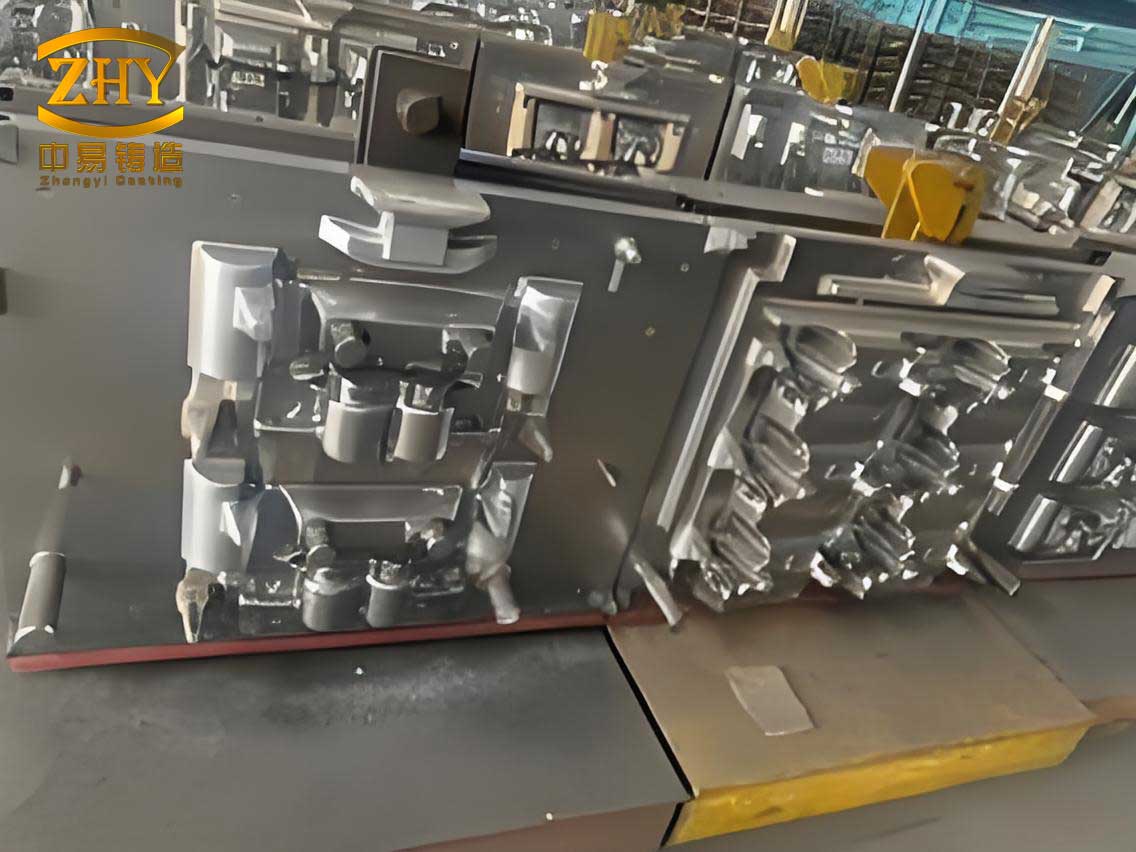
The sand coated iron mold casting process is not merely a molding technique but a system that influences the entire metallurgical trajectory. The cooling rate, $V_c$, during solidification can be approximated using Fourier’s law of heat conduction, where the sand layer acts as a thermal barrier. For a sand coated iron mold casting, the effective heat transfer coefficient, $h_{eff}$, is a composite of the sand and iron mold contributions:
$$ h_{eff} = \frac{1}{\frac{\delta_s}{k_s} + \frac{\delta_m}{k_m}} $$
where $\delta_s$ and $k_s$ are the thickness and thermal conductivity of the sand coating, and $\delta_m$ and $k_m$ are those of the iron mold. A typical value for $h_{eff}$ in sand coated iron mold casting ranges from 500 to 1000 W/m²K, leading to cooling rates of 10-50°C/s in the critical solidification range. This rapid cooling suppresses carbide precipitation and encourages fine graphite formation, which I have consistently observed in microstructural analyses. The as-cast microstructure from sand coated iron mold casting typically shows a pearlite matrix (85-90%) with surrounding ferrite (5-10%) and spheroidal graphite with nodularity above 90% and graphite size below 0.08 mm. However, to meet the stringent camshaft specifications—pearlite >95%, ferrite <5%, carbides <5%, and tensile strength ≥700 MPa—heat treatment is indispensable. We employed two normalizing and tempering regimes, as detailed below, to refine the matrix further.
| Process Step | Process 1 (Dispersed Air Cooling) | Process 2 (Intensive Mist Cooling) | Objective |
|---|---|---|---|
| Normalizing | Austenitizing at 900°C for 60 min, followed by dispersed air cooling (≈5-10°C/s). | Austenitizing at 900°C for 60 min, followed by intensive mist cooling (≈20-30°C/s). | To transform austenite into fine pearlite and eliminate free ferrite. |
| Tempering | Heating at 550°C for 120 min, then air cooling. | Heating at 550°C for 120 min, then air cooling. | To relieve internal stresses and stabilize the microstructure. |
The microstructural evolution during heat treatment is governed by diffusion-controlled transformations. Upon austenitizing, the as-cast structure from sand coated iron mold casting dissolves into austenite ($\gamma$) and graphite ($G$). The dissolution kinetics can be described by the Avrami equation for phase transformation:
$$ f = 1 – \exp(-k t^n) $$
where $f$ is the fraction transformed, $k$ is a rate constant dependent on temperature and composition, $t$ is time, and $n$ is an exponent. For pearlite dissolution in ductile iron, $n$ typically ranges from 1 to 1.5. During cooling, the transformation from austenite to pearlite depends on the cooling rate. The mist cooling in Process 2 achieves a higher undercooling, $\Delta T$, leading to a finer interlamellar spacing, $\lambda$, in pearlite, as per the Zener-Hillert relation:
$$ \lambda = \frac{2\sigma_{\alpha\theta} V_m}{\Delta G_v} \propto \frac{1}{\Delta T} $$
where $\sigma_{\alpha\theta}$ is the interfacial energy, $V_m$ is the molar volume, and $\Delta G_v$ is the driving force. Finer $\lambda$ enhances strength according to the Hall-Petch-type relationship for pearlitic steels:
$$ \sigma_y = \sigma_0 + k_y \lambda^{-1/2} $$
where $\sigma_y$ is the yield strength, $\sigma_0$ is the friction stress, and $k_y$ is a constant. In my observations, Process 2 yielded pearlite with $\lambda$ approximately 0.1-0.2 µm, compared to 0.2-0.3 µm for Process 1, directly impacting mechanical properties. The tempering stage then allows carbon diffusion from pearlite to graphite, marginally increasing ferrite at graphite interfaces but relieving stresses. The overall mechanical properties from both processes are summarized below, demonstrating the efficacy of combining sand coated iron mold casting with optimized heat treatment.
| Condition | Hardness (HB) | Tensile Strength, $\sigma_b$ (MPa) | Elongation, $\delta$ (%) | Impact Toughness, $K_{IC}$ (MPa√m) |
|---|---|---|---|---|
| As-Cast (via Sand Coated Iron Mold Casting) | 284 ± 10 | 781 ± 25 | 4.00 ± 0.5 | 40 ± 5 |
| Process 1: Normalized (Air Cooled) | 309 ± 8 | 964 ± 20 | 3.90 ± 0.4 | 38 ± 4 |
| Process 1: Normalized + Tempered | 291 ± 7 | 953 ± 18 | 4.70 ± 0.6 | 45 ± 5 |
| Process 2: Normalized (Mist Cooled) | 329 ± 9 | 984 ± 22 | 5.20 ± 0.5 | 42 ± 4 |
| Process 2: Normalized + Tempered | 286 ± 8 | 932 ± 19 | 4.06 ± 0.5 | 44 ± 5 |
The data underscores that sand coated iron mold casting provides an excellent starting point, but heat treatment is crucial for property enhancement. Process 1, involving dispersed air cooling, results in a more balanced combination of strength and ductility after tempering, with $\sigma_b$ around 953 MPa and $\delta$ of 4.7%. In contrast, Process 2, with intensive mist cooling, shows higher as-normalized strength but a more pronounced drop after tempering, though still above 900 MPa. The difference stems from the stability of the microstructure. The faster cooling in sand coated iron mold casting and subsequent mist cooling produces a metastable, fine pearlite with high dislocation density. During tempering, carbon diffusion is accelerated, leading to quicker softening and ferrite formation near graphite. This can be modeled using the diffusion equation:
$$ \frac{\partial C}{\partial t} = D \nabla^2 C $$
where $C$ is carbon concentration and $D$ is the diffusion coefficient, which follows an Arrhenius relationship: $D = D_0 \exp(-Q/RT)$, with $D_0$ as the pre-exponential factor, $Q$ activation energy, $R$ gas constant, and $T$ temperature. For Process 2, the finer structure has more grain boundaries, increasing $D$ and facilitating carbon migration. Thus, while sand coated iron mold casting enables fine structures, the heat treatment must be tailored to control these kinetic processes.
Beyond the core process, I have explored the implications of sand coated iron mold casting for mass production. The repeatability of the sand coated iron mold casting process is high, with dimensional tolerances within ±0.2 mm and minimal scrap rates (<2%). This consistency is vital for automotive components like camshafts, where batch-to-batch uniformity is paramount. Furthermore, the environmental benefits of sand coated iron mold casting are notable: the sand coating reduces iron mold wear, extending mold life to over 50,000 cycles, and the rapid cooling minimizes energy consumption during subsequent heat treatment. In terms of alloy design, the composition used—3.7% C, 2.2% Si, 0.4% Mn, 0.04% Mg—is optimized for sand coated iron mold casting, ensuring fluidity for thin sections and nodularity retention. The silicon content, in particular, influences the matrix; higher silicon promotes ferrite, so we balance it to favor pearlite after heat treatment. This can be quantified using the carbon equivalent, $CE$, for ductile iron:
$$ CE = \%C + \frac{\%Si + \%P}{3} $$
Our alloy has a CE of approximately 4.4, which is ideal for sand coated iron mold casting to avoid excessive carbides while maintaining castability. The success of this approach is evident in the final camshafts, which meet or exceed industry standards, such as hardness of 230-302 HB, pearlite content >95%, and graphite nodularity >80% with average diameter below 0.04 mm. These metrics validate sand coated iron mold casting as a robust foundation.
Looking forward, the integration of sand coated iron mold casting with advanced heat treatment opens avenues for further innovation. For instance, austempering could be applied to produce austempered ductile iron (ADI) camshafts with even higher strength and wear resistance. The baseline from sand coated iron mold casting—fine graphite and uniform matrix—would enhance austempering kinetics. Additionally, simulation tools like finite element analysis (FEA) can model thermal profiles in sand coated iron mold casting, optimizing sand layer thickness and cooling rates. A simplified heat transfer model during solidification in sand coated iron mold casting can be expressed as:
$$ \rho c_p \frac{\partial T}{\partial t} = \nabla \cdot (k \nabla T) + L_f \frac{\partial f_s}{\partial t} $$
where $\rho$ is density, $c_p$ specific heat, $k$ thermal conductivity, $L_f$ latent heat, and $f_s$ solid fraction. By calibrating such models with experimental data from sand coated iron mold casting, we can predict microstructure and properties virtually, reducing trial-and-error. In production, I have also implemented statistical process control (SPC) for sand coated iron mold casting parameters, monitoring variables like pouring temperature and sand coating integrity to ensure consistency. The table below summarizes key control parameters and their effects, emphasizing the centrality of sand coated iron mold casting.
| Parameter | Target Range | Influence on Microstructure | Impact on Final Properties |
|---|---|---|---|
| Sand Coating Thickness | 3.0-5.0 mm | Thinner coating increases cooling rate, refining graphite and matrix; thicker coating reduces chilling risk. | Optimal at 4 mm for balance of fine structure and minimal stress in sand coated iron mold casting. |
| Pouring Temperature | 1380-1420°C | Higher temperature improves fluidity but may coarsen graphite; lower temperature risks mistruns. | 1400°C ideal for sand coated iron mold casting to achieve fine graphite (<0.08 mm). |
| Mold Preheat Temperature | 150-200°C | Reduces thermal shock, ensuring even solidification in sand coated iron mold casting. | Prevents cracks and enhances nodularity consistency. |
| Cooling Rate Post-Casting | 10-30°C/s (in mold) | Directly sets as-cast pearlite fraction and graphite size. | Higher rates from sand coated iron mold casting yield stronger as-cast blanks for heat treatment. |
In conclusion, my work demonstrates that sand coated iron mold casting is a pivotal technology for producing high-strength ductile iron camshafts. By leveraging the rapid, controlled cooling of sand coated iron mold casting, we achieve an as-cast structure amenable to property enhancement through normalizing and tempering. Between the two heat treatment processes, Process 1—dispersed air cooling followed by tempering—emerges as the optimal choice, delivering a tensile strength above 950 MPa and elongation near 5%, satisfying rigorous automotive demands. The sand coated iron mold casting process not only ensures microstructural precision but also offers production efficiency and sustainability. As industries push for lighter, stronger components, the synergy of sand coated iron mold casting with tailored heat treatments will remain a cornerstone in advanced cast iron manufacturing, enabling components like camshafts to perform reliably under high-stress conditions. Future explorations may integrate in-situ monitoring during sand coated iron mold casting or alloy modifications to push strength beyond 1000 MPa, but the foundation laid by sand coated iron mold casting is indisputable.