
The pursuit of manufacturing excellence in foundry engineering continuously drives the adoption and refinement of specialized casting techniques. Among these, sand coated iron mold casting stands out as a particularly effective method for producing high-integrity ferrous castings, especially ductile iron components. This process uniquely combines the benefits of permanent mold casting and sand casting, utilizing a rigid iron mold whose cavity is lined with a thin, thermally insulating layer of resin-bonded sand. The inherent characteristics of sand coated iron mold casting offer distinct advantages: significant mold rigidity, which counteracts shrinkage tendencies; rapid cooling rates that refine the microstructure and enhance mechanical properties; excellent surface finish; and high yield due to the feasibility of minimal or no risering. This article delves into a detailed, first-person investigation into optimizing this process for a critical automotive component—the steering axle—leveraging advanced numerical simulation to guide and validate technological improvements.
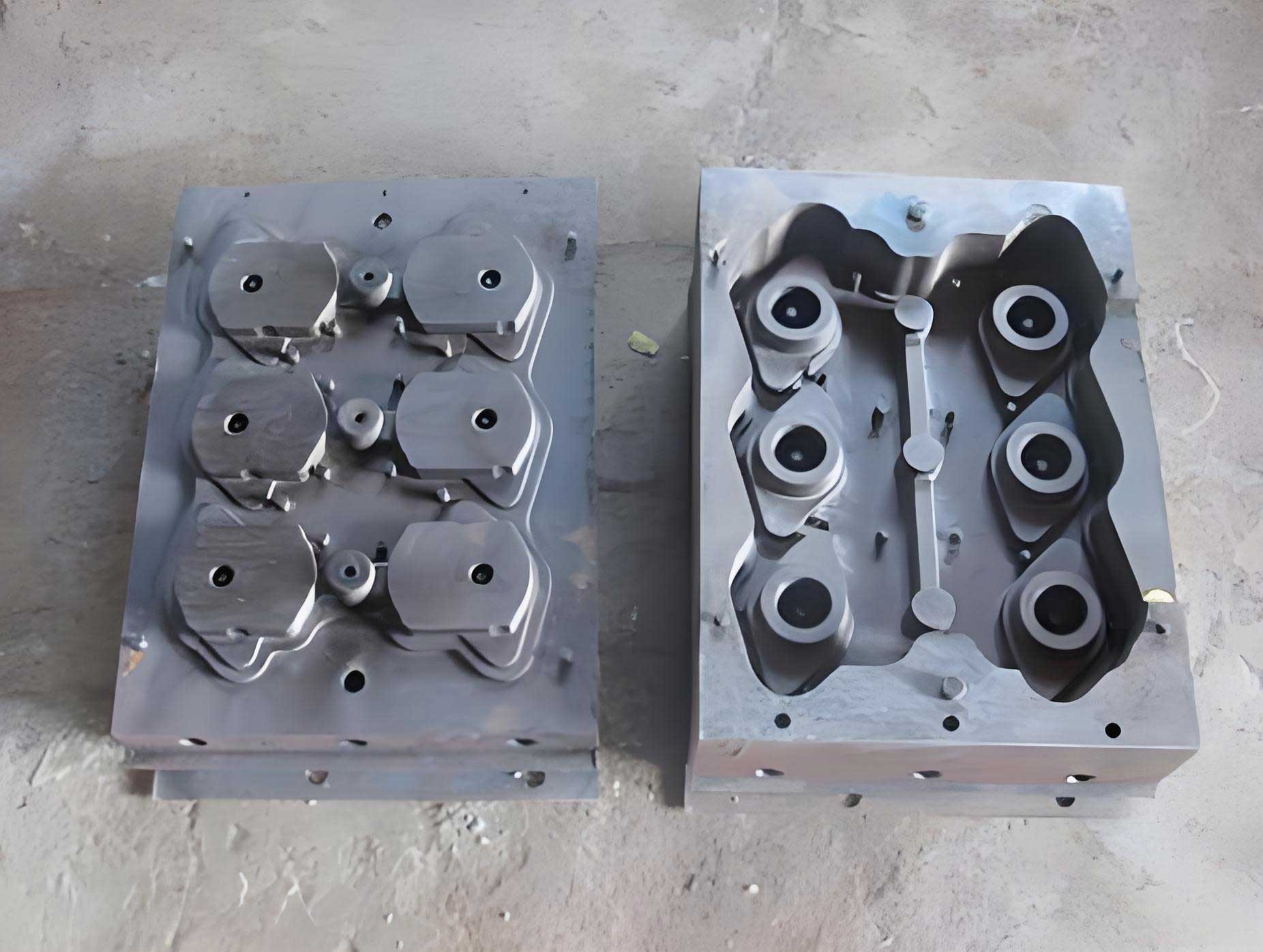
The core mechanism of sand coated iron mold casting that makes it so suitable for ductile iron lies in the interaction between mold rigidity and the graphite expansion phase. During the solidification of ductile iron, the precipitation of graphite nodules causes a volumetric expansion. In a rigid mold system like sand coated iron mold casting, this expansion is constrained, generating internal pressures that can effectively feed adjacent sections still undergoing solidification, thereby minimizing shrinkage porosity. This self-feeding capability can be described by considering the pressure generated, $P$, which is a function of the volumetric expansion due to graphite, $\Delta V_g$, the rigidity of the mold system, $K_m$, and the ability of the mold wall to move (if at all). In an ideal, perfectly rigid mold, the pressure counteracts the solidification shrinkage, $\Delta V_s$:
$$ P \propto K_m \cdot (\Delta V_g – \Delta V_s) $$
However, in practice, the system’s effectiveness depends on carefully balanced process parameters. The cooling rate, governed by the heat transfer through the sand coating and the iron mold, is crucial. The temperature field, $T(\mathbf{x}, t)$, during solidification is solved from the transient heat conduction equation:
$$ \rho c_p \frac{\partial T}{\partial t} = \nabla \cdot (k \nabla T) + \dot{Q}_{latent} $$
where $\rho$ is density, $c_p$ is specific heat, $k$ is thermal conductivity, and $\dot{Q}_{latent}$ is the latent heat release rate during phase change. The thickness of the sand coating, $\delta_{sand}$, directly modulates $k_{eff}$ at the metal-mold interface, making it a powerful variable for controlling local solidification times.
Numerical Simulation Framework for Process Optimization
To systematically optimize the sand coated iron mold casting process for the steering axle, a numerical simulation study using ProCAST software was undertaken. The steering axle is a structurally demanding component where internal soundness in high-stress areas is paramount. The primary objective was to design a gating system and determine optimal process parameters that would eliminate shrinkage defects without resorting to traditional risers, thereby maximizing yield.
The first step involved constructing a detailed 3D geometric model of the steering axle and the proposed gating system. A horizontal parting, two-cavity mold layout was adopted to improve productivity. The initial gating design featured a single sprue, two runners, and four ingates to fill both cavities. The finite element mesh was generated with non-uniform tetrahedral elements, applying a finer mesh to the casting and gating (ensuring at least 2-3 elements across thin sections) and a coarser mesh to the mold to balance computational accuracy and efficiency.
Key boundary conditions and material properties were defined as follows. The mold material was set as iron with a heat transfer coefficient (HTC) of 500 W/m²·K at the metal-mold interface. The sand coating’s insulating effect was implicitly modeled by adjusting the interface conditions and material properties of the mold surface layer. The initial temperatures were set at 1400°C for the ductile iron melt and 100°C for the mold. Air cooling was applied to external surfaces with an HTC of 10 W/m²·K.
Simulation Results, Analysis, and Iterative Optimization
The simulation analysis progressed through three distinct stages, each revealing critical insights and leading to targeted process modifications.
Stage 1: Preliminary Simulation and Defect Identification
The initial simulation assumed a uniform sand coating thickness ($\delta_{sand}$) of 8 mm across the entire casting surface. The Niyama criterion, often used to predict shrinkage porosity, was a key output. The results clearly indicated a significant concentration of predicted shrinkage porosity at the upper thermal junction of the central section of the axle. This area, characterized by a thicker geometry and connection ribs, acted as a last-freezing hot spot. The self-feeding pressure from the sand coated iron mold casting system was insufficient to compensate for shrinkage in this isolated region under the given conditions. The yield for this preliminary design was calculated at 85%.
| Parameter | Stage 1: Preliminary |
|---|---|
| Sand Coating Thickness | Uniform 8 mm |
| Gating Design | 1 Sprue, 2 Runners, 4 Ingates |
| Cavities per Mold | 2 |
| Filling Time | 14 s |
| Key Defect Location | Upper Central Hot Spot |
| Predicted Yield | 85% |
Stage 2: Targeted Cooling Modification
To address the hot spot issue, the principle of differential cooling was applied—a strategic advantage of the sand coated iron mold casting process. The sand coating thickness at the identified hot spot was selectively reduced from 8 mm to 4 mm, while maintaining the 8 mm thickness elsewhere. This modification increased the local effective heat transfer coefficient, accelerating the solidification rate at the problematic junction. The governing heat flux, $q$, across the coating can be approximated by:
$$ q = \frac{T_{melt} – T_{mold}}{(\delta_{sand}/k_{sand}) + R_{contact}} $$
where $R_{contact}$ is the interfacial resistance. Reducing $\delta_{sand}$ directly reduces the thermal resistance, increasing $q$ and thus the local cooling rate. The simulation of this modified setup showed a marked reduction in the volume and severity of predicted shrinkage at the hot spot. However, a non-trivial amount of microporosity was still predicted, indicating that merely accelerating cooling was not a complete solution. The yield remained at 85%.
| Parameter | Stage 2: Improved |
|---|---|
| Sand Coating Thickness | 4 mm at Hot Spot; 8 mm elsewhere |
| Gating Design | 1 Sprue, 2 Runners, 4 Ingates |
| Cavities per Mold | 2 |
| Filling Time | 14 s |
| Defect Status | Significantly Reduced, but Present |
| Predicted Yield | 85% |
Stage 3: Holistic Process Parameter Optimization
The final optimization step involved a multiparameter adjustment based on a deeper understanding of the sand coated iron mold casting mechanics. Three key changes were implemented simultaneously in the simulation:
- Filling Time: Extended from 14 s to 28 s to reduce flow turbulence and potential gas entrapment.
- Mold Rigidity ($K_m$) and Graphitization Rate: The numerical parameters controlling the mold’s mechanical response (its effective rigidity) and the kinetics of carbon’s graphitization expansion were adjusted to more accurately reflect the real-world behavior of a robust sand coated iron mold casting system. This essentially tuned the simulation to better model the self-feeding pressure $P$ generated by the constrained expansion.
- Sand Coating Profile: The differential thickness profile from Stage 2 was retained.
The results were definitive. The simulated solidification pattern showed a clear directional progression from the thin sections towards the now-faster-cooling hot spot, and more critically, the internal pressure from the constrained graphite expansion was effectively transmitted to feed the final solidifying regions. The predicted shrinkage porosity was virtually eliminated. The yield for this optimized setup was calculated at 83.4%, a marginal decrease from previous designs due to the slightly longer filling time potentially affecting thermal losses, but this was a worthwhile trade-off for achieving defect-free internal quality.
| Parameter | Stage 3: Optimized |
|---|---|
| Sand Coating Thickness | 4 mm at Hot Spot; 8 mm elsewhere |
| Gating Design | 1 Sprue, 2 Runners, 4 Ingates |
| Cavities per Mold | 2 |
| Filling Time | 28 s |
| Key Modifications | Adjusted Mold Rigidity & Graphitization Model Parameters |
| Defect Status | Effectively Eliminated |
| Predicted Yield | 83.4% |
Discussion and Synthesis of Findings
This systematic investigation underscores that successful sand coated iron mold casting is not merely about using a rigid mold with a sand lining; it is about orchestrating a complex interplay of thermal and mechanical phenomena. The optimization pathway revealed several critical insights:
- Thermal Management is Local: The ability to vary the sand coating thickness ($\delta_{sand}$) provides exquisite control over the local solidification time, $t_f$, which can be estimated from Chvorinov’s rule modified for a coating: $t_f \propto (\delta_{sand} / k_{sand})^2$. Strategic thinning at hot spots can enforce a more favorable temperature gradient.
- The Criticality of the Pressure Balance: The elimination of defects in the final stage was primarily attributed to correctly leveraging the self-feeding mechanism. The pressure required to suppress pore formation, $P_{crit}$, must be satisfied:
$$ P_{feeding} = f(K_m, \Delta V_g) \ge P_{crit} $$
The simulation adjustments in Stage 3 effectively ensured this condition was met throughout the solidification sequence. - Filling Dynamics Matter: While not the primary factor for shrinkage, extending the filling time is a prudent measure in sand coated iron mold casting to promote laminar flow and reduce the probability of surface defects or mold erosion, which could compromise the sand layer’s integrity.
The final, optimized process for the steering axle via sand coated iron mold casting integrates a robust, two-cavity gating design, a strategically varied sand coating profile, controlled filling, and relies fundamentally on the calibrated rigidity of the mold to harness graphite expansion. This combination ensures high metallurgical quality and excellent dimensional accuracy while maintaining a very high yield, demonstrating the powerful synergy between numerical simulation and practical foundry engineering in advancing the sand coated iron mold casting technique.
Future work could involve further sensitivity analysis on the precise values of mold rigidity and graphitization kinetics, experimental validation of the simulated pressure fields, and extending this optimization framework to other complex geometries to fully exploit the potential of the sand coated iron mold casting process across the automotive and heavy machinery sectors.