
In recent years, the domestic automotive industry has experienced rapid development, with production and quality steadily increasing, and the localization rate of core components significantly improving. As a key component of engines, the camshaft plays a crucial role in engine performance. Currently, major Chinese automotive brands such as Geely, BYD, and Chery have gradually adopted high-strength ductile iron camshafts for batch installation, with their excellent performance being widely recognized. This trend is considered the main direction for the production of automotive and internal combustion engine camshafts. In this context, I have focused on the sand coated iron mold casting process, which combines the advantages of metal mold casting and shell mold casting, offering enhanced control over casting quality and microstructure. This study aims to explore the application of sand coated iron mold casting for producing QT600-3 ductile iron camshafts, with a focus on body acceptance testing—where mechanical properties are directly sampled from the casting itself, rather than from separately cast test bars. This approach ensures that the performance truly reflects that of the camshaft, addressing discrepancies often seen in single-cast specimen testing. Through this research, I seek to provide a reliable theoretical basis and practical foundation for optimizing the sand coated iron mold casting process in industrial settings.
The sand coated iron mold casting process is characterized by its unique combination of a metal mold and a coated sand layer, which regulates cooling rates and improves casting integrity. In my investigation, I applied this method to the Chery 371VVT ductile iron camshaft, a small camshaft with a total length of 282 mm, journal diameter of 20 mm, cam base circle diameter of 26 mm, and large end diameter of 41 mm. The varying cross-sections and sudden changes in diameter pose challenges for achieving consistent mechanical properties, necessitating precise control over the casting process. For body acceptance, samples were taken at a specific location 190 mm from one end, as illustrated in the structural diagram. The tensile specimens were prepared according to GB/T1348-2009, and testing was conducted using a WEW-type 30-ton universal tensile testing machine. Metallographic examination followed the GB/T9441-2009 standard for ductile iron. The core of this study lies in the detailed design of the sand coated iron mold casting process, which I will elaborate on in the following sections, incorporating tables and formulas to summarize key aspects.
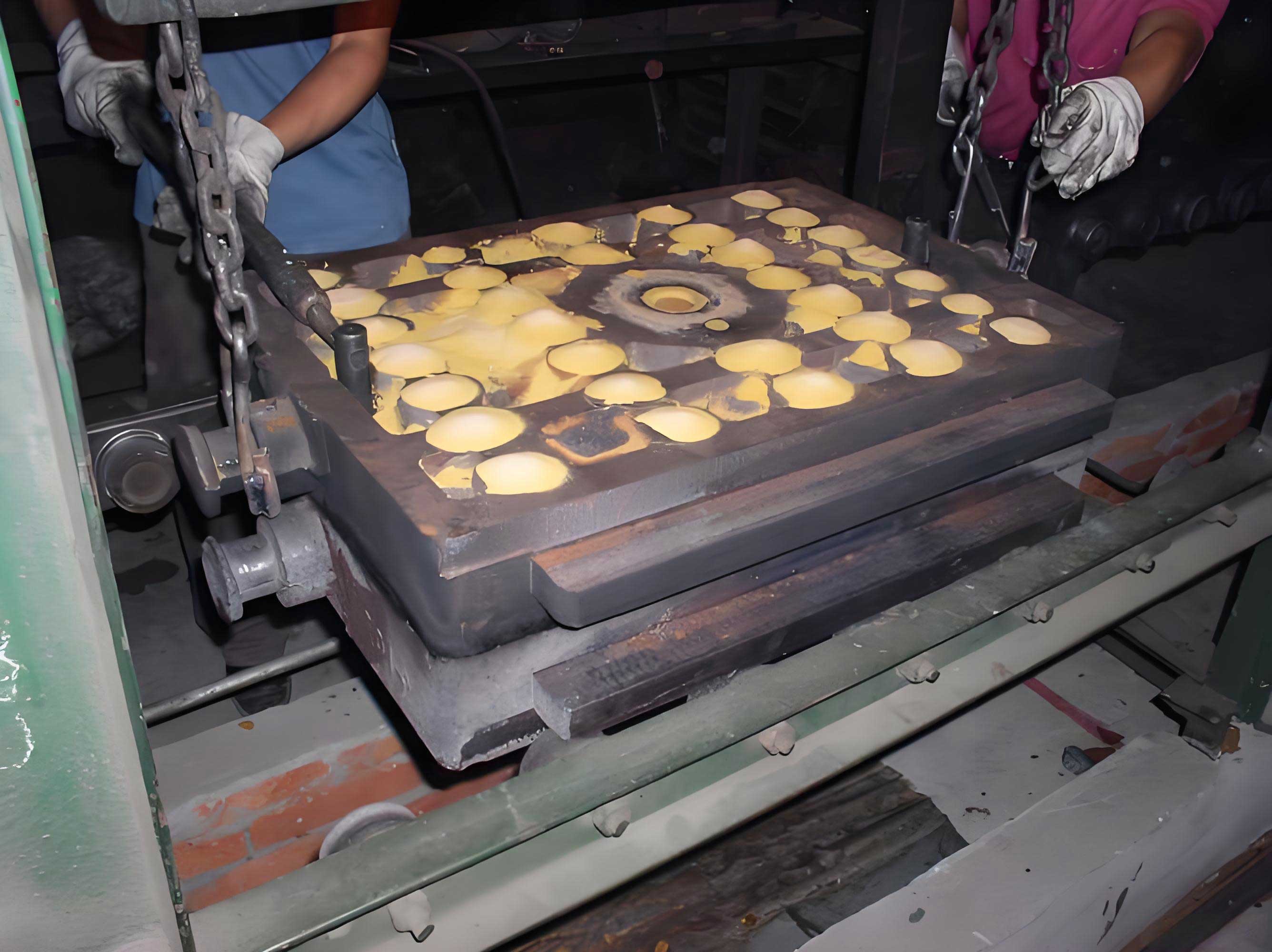
The design of the sand coated iron mold casting process requires careful consideration of multiple factors, including the casting material, structural shape, gating system, and solidification sequence. The sand coated iron mold casting technique leverages a metal mold thickness and a coated sand layer thickness to optimize cooling rates. For the 371VVT camshaft, I set the iron mold thickness at 20 mm, with the mold temperature controlled between 160°C and 200°C during sand shooting. The coated sand layer directly contacts the molten metal, forming the main cavity of the casting; thus, its properties critically influence quality. The coated sand used in this study had specific performance values, as shown in Table 1. The thickness of the coated sand layer significantly affects the cooling rate: within a certain range, increasing the thickness reduces the cooling speed. Therefore, I designed variable thicknesses based on the casting wall thickness—8–10 mm for thin sections and 4–6 mm for thick sections—to promote balanced solidification and minimize defects like shrinkage porosity. This adaptive approach is a key advantage of the sand coated iron mold casting method, allowing for tailored cooling conditions that enhance microstructure and mechanical properties.
| Property | Value |
|---|---|
| Grain Size | 70/140 |
| Room Temperature Strength (MPa) | 4–6 |
| Hot Strength (MPa) | ≥2.5 |
| Gas Evolution at 850°C (mL/g) | ≤15 |
| Thermal Expansion at 1000°C (%) | ≤0.7 |
In terms of gating system design, I employed a choke semi-closed system with the choke section at the ingate and the largest cross-sectional area at the runner. The ingates were located at the smallest end of the camshaft, and an exhaust and slag-collecting riser was set at the large end of each shaft. This configuration reduces the filling speed at the ingate, improves slag trapping, and facilitates self-feeding through graphitization expansion. The sand coated iron mold casting process enables rapid cooling, which, combined with the high rigidity of the iron mold, allows the casting to utilize its own graphite expansion to compensate for liquid and solidification shrinkage, thereby eliminating shrinkage defects. To enhance production efficiency and yield, I designed the mold to produce 16 castings per cycle. The mathematical relationship for cooling rate in sand coated iron mold casting can be expressed as:
$$ \frac{dT}{dt} = k \cdot \frac{(T_m – T_0)}{d^2} $$
where \( \frac{dT}{dt} \) is the cooling rate, \( k \) is a thermal conductivity constant, \( T_m \) is the metal temperature, \( T_0 \) is the mold temperature, and \( d \) is the effective thickness combining iron mold and coated sand layer. For the sand coated iron mold casting process, adjusting \( d \) through variable coated sand thickness helps achieve optimal solidification conditions.
The melting process was another critical aspect of this study. I designed two distinct charge compositions: Scheme A used scrap steel as the primary charge material, with graphite-type carburizer to adjust carbon content, while Scheme B relied on Q10 ductile iron pig iron. The chemical composition was carefully controlled within the ranges specified in Table 2 to ensure a mixed matrix of pearlite and ferrite, with pearlite content exceeding ferrite, as required for QT600-3. The sand coated iron mold casting process benefits from precise chemistry control, as it influences fluidity, solidification behavior, and final microstructure. The use of scrap steel in Scheme A, termed synthetic ductile iron, is particularly advantageous for sand coated iron mold casting due to lower interference elements and finer graphite nucleation.
| Element | Content (wt%) |
|---|---|
| C | 3.7–3.9 |
| Si | 2.6–2.8 |
| Mn | ≤0.20 |
| Cu | 0.30–0.50 |
| P | ≤0.06 |
| S | ≤0.05 |
Melting was conducted in a 500 kg medium-frequency induction furnace. The molten iron was heated to 1600°C and held for 5–8 minutes, with treatment temperatures between 1520°C and 1560°C. Nodulization was performed using the traditional sandwich method with rare earth magnesium ferrosilicon as the nodulizing agent (1.3%–1.5%), and inoculation was done with silicon-calcium-barium alloy (1.0%–1.3%) in three stages: in-ladle (40%), in-stream before pouring (40%), and during pouring (20%). The pouring temperature ranged from 1370°C to 1420°C. These parameters were optimized for the sand coated iron mold casting process to ensure high nodule count and fine microstructure. The kinetics of graphite nucleation in synthetic ductile iron can be described by:
$$ N = N_0 \cdot e^{-E_a/(RT)} $$
where \( N \) is the number of graphite nodules, \( N_0 \) is a pre-exponential factor, \( E_a \) is the activation energy for nucleation, \( R \) is the gas constant, and \( T \) is the temperature. The sand coated iron mold casting process promotes higher \( N \) due to faster cooling and increased heterogeneous nucleation sites from carburizer additions.
The results from body acceptance testing revealed significant differences between the two charge schemes. As summarized in Table 3, the synthetic ductile iron camshafts (Scheme A) produced via sand coated iron mold casting exhibited superior mechanical properties, exceeding the QT600-3 requirements, while the non-synthetic ones (Scheme B) fell short. The synthetic iron showed higher tensile strength, greater elongation, and better graphite spheroidization grade. This can be attributed to the lower impurity content in scrap steel, which reduces interference elements, and the carburization process that enhances nucleation. The sand coated iron mold casting process further amplifies these benefits by providing a rapid cooling environment that refines the matrix structure. Specifically, the cooling rate in sand coated iron mold casting can be approximated as:
$$ v_c = \frac{\alpha \cdot (T_p – T_m)}{\rho \cdot c_p \cdot L} $$
where \( v_c \) is the solidification front velocity, \( \alpha \) is the heat transfer coefficient, \( T_p \) is the pouring temperature, \( T_m \) is the mold temperature, \( \rho \) is density, \( c_p \) is specific heat, and \( L \) is latent heat. The sand coated iron mold casting process typically yields higher \( \alpha \) values compared to conventional sand casting, leading to faster solidification and finer grains.
| Sample Type | Sample ID | Tensile Strength (MPa) | Elongation (%) | Ferrite Content (%) | Pearlite Content (%) | Graphite Grade |
|---|---|---|---|---|---|---|
| Synthetic Ductile Iron (Scheme A) | 1 | 765 | 3.5 | 25 | 75 | 2-1 |
| 2 | 754 | 3.7 | 25 | 75 | 2-1 | |
| Non-Synthetic Ductile Iron (Scheme B) | 1 | 618 | 1.55 | 25 | 75 | 3-2 |
| 2 | 621 | 1.51 | 25 | 75 | 3-2 |
Hardness measurements were also conducted on cam lobes and the base material. As shown in Table 4, the sand coated iron mold casting process produced higher hardness values compared to shell mold casting, which is beneficial for wear resistance and service life. The increased hardness is a direct result of the denser microstructure and finer pearlite achieved through rapid cooling in sand coated iron mold casting. The relationship between hardness and cooling rate can be modeled as:
$$ HV = HV_0 + m \cdot \log(v_c) $$
where \( HV \) is the Vickers hardness, \( HV_0 \) is a base hardness, \( m \) is a material constant, and \( v_c \) is the cooling rate. The sand coated iron mold casting process typically yields higher \( v_c \), leading to enhanced hardness.
| Hardness Measurement Point | Sand Coated Iron Mold Casting (HRC at 4 mm depth, HB for base) | Shell Mold Casting (HRC at 4 mm depth, HB for base) |
|---|---|---|
| Point 1 (Cam Lobe) | 31 | 27 |
| Point 2 | 31 | 26 |
| Point 3 | 31 | 26 |
| Point 4 | 32 | 26.5 |
| Point 5 | 31 | 27.5 |
| Point 6 | 30 | 28 |
| Point 7 | 31.5 | 28 |
| Base Material (HBW) | 276 | 265 |
Metallographic examination of the journal section revealed a microstructure consisting of spheroidal graphite, fine lamellar pearlite, and bull’s-eye ferrite, with no free cementite present. The graphite spheroidization grade was above level 2, with a nodule count over 90%, and graphite ball diameters ranging from 15 to 25 μm (size grades 6–7). The pearlite content exceeded 75%, meeting the Chery 371VVT standards. The sand coated iron mold casting process facilitated this refined structure due to the combined effects of rapid cooling and copper addition, which strengthens and refines pearlite. The growth kinetics of graphite nodules in sand coated iron mold casting can be described by the diffusion-controlled equation:
$$ r = \sqrt{D \cdot t} $$
where \( r \) is the nodule radius, \( D \) is the diffusion coefficient of carbon in austenite, and \( t \) is time. The sand coated iron mold casting process reduces \( t \) by accelerating solidification, leading to smaller \( r \) and finer graphite.
Furthermore, I analyzed the thermal behavior of the sand coated iron mold casting process using finite element simulations to optimize parameters. The heat transfer during solidification can be expressed by the Fourier equation:
$$ \frac{\partial T}{\partial t} = \nabla \cdot (k \nabla T) $$
where \( T \) is temperature, \( t \) is time, and \( k \) is thermal conductivity. For sand coated iron mold casting, \( k \) varies across the iron mold and coated sand layers, influencing temperature gradients and solidification patterns. By adjusting the coated sand thickness, I could control these gradients to minimize thermal stresses and defects. This computational approach complements experimental findings, providing a deeper understanding of the sand coated iron mold casting process.
In addition to mechanical properties, I evaluated the impact of sand coated iron mold casting on dimensional accuracy and surface quality. The iron mold provides high rigidity, reducing mold wall movement and ensuring consistent casting dimensions. The coated sand layer, with its low thermal expansion, further enhances accuracy. The relationship between dimensional deviation and process parameters can be approximated as:
$$ \Delta L = \alpha_T \cdot L_0 \cdot \Delta T + \epsilon $$
where \( \Delta L \) is the dimensional change, \( \alpha_T \) is the thermal expansion coefficient, \( L_0 \) is the initial dimension, \( \Delta T \) is the temperature change, and \( \epsilon \) is a error term from mold deformation. The sand coated iron mold casting process minimizes \( \epsilon \) through the sturdy iron mold, resulting in superior dimensional stability compared to conventional sand casting.
To further explore the efficiency of sand coated iron mold casting, I conducted a productivity analysis. The process allows for high mold reuse rates and rapid cycle times due to the durability of the iron mold. The production rate \( P \) can be modeled as:
$$ P = \frac{N \cdot f}{t_c} $$
where \( N \) is the number of castings per mold (16 in this study), \( f \) is the mold filling frequency, and \( t_c \) is the cycle time including cooling and ejection. The sand coated iron mold casting process typically achieves lower \( t_c \) than sand casting, leading to higher \( P \). This makes it economically viable for mass production of components like camshafts.
Environmental considerations were also addressed in this study. The sand coated iron mold casting process reduces sand waste compared to traditional green sand casting, as the coated sand can be partially reclaimed. Additionally, the use of scrap steel in synthetic ductile iron promotes resource recycling. The carbon footprint \( C_f \) of the process can be estimated as:
$$ C_f = E_m \cdot e_c + E_p \cdot e_p $$
where \( E_m \) is the energy for melting, \( e_c \) is the emission factor for energy, \( E_p \) is the energy for mold preparation, and \( e_p \) is the associated emission factor. The sand coated iron mold casting process often has lower \( E_p \) due to mold reuse, contributing to sustainability.
In conclusion, my research demonstrates that the sand coated iron mold casting process is highly effective for producing QT600-3 ductile iron camshafts with body acceptance performance. Key findings include: (1) Using scrap steel-based synthetic ductile iron with optimized chemistry and multiple inoculation stages enables superior mechanical properties in sand coated iron mold casting. (2) Variable coated sand thickness—8–10 mm for thin sections and 4–6 mm for thick sections—ensures balanced solidification and defect reduction in sand coated iron mold casting. (3) The choke semi-closed gating system with ingates at the smallest end facilitates self-feeding through graphitization expansion, a core advantage of sand coated iron mold casting. (4) The process yields higher hardness and refined microstructure compared to shell mold casting, enhancing camshaft durability. These insights underscore the potential of sand coated iron mold casting as an advanced manufacturing technique for automotive components, offering a blend of quality, efficiency, and sustainability. Future work could focus on automating parameter control and expanding the application to other high-performance castings, further leveraging the benefits of sand coated iron mold casting.