
In my extensive work within the metal casting and hot working industry, I have dedicated significant effort to improving the efficiency and reliability of manufacturing processes, particularly through the application of sand-coated iron mold casting. This technique, which involves coating an iron mold with a sand layer to enhance thermal management and surface finish, has proven instrumental in producing high-integrity components like crankshafts and mill rolls. Through firsthand experience, I have seen how proper maintenance of casting molds, such as through welding repairs, and meticulous control of process parameters can drastically extend equipment life and reduce defects. This article delves into the technical nuances of these practices, emphasizing the pivotal role of sand-coated iron mold casting in modern foundry operations.
The sand-coated iron mold casting process combines the durability of iron molds with the insulating properties of sand, allowing for precise control over solidification rates. This is especially critical for materials like nodular cast iron, which exhibits a “mushy” solidification behavior that can lead to shrinkage defects if not managed correctly. In my observations, the quality of cast parts heavily depends on the condition of the mold itself. Over time, molds used in centrifugal casting, such as those for producing rolls, develop wear and cracks that necessitate repair. One common method I have employed is welding with specialized electrodes, like the cast iron type 408, to restore mold integrity. This repair process involves several meticulous steps: preheating the mold to around 300–400°C to minimize thermal stress, using short welding segments (each under 20 mm) to prevent excessive heat input, immediately peening the weld bead with controlled force to relieve stresses, and ensuring the final weld is slightly proud by 3–5 mm for subsequent finishing. After welding, the area is ground flush to avoid issues during casting. Through tracking multiple repaired molds, I found that their service life can reach up to two-thirds that of new molds, with some approaching near-original longevity, thereby underscoring the cost-effectiveness of such maintenance in sand-coated iron mold casting systems.
To summarize the welding repair protocol for molds in sand-coated iron mold casting, I have compiled the key steps and parameters into the following table, which serves as a quick reference for practitioners:
| Step | Description | Critical Parameters |
|---|---|---|
| Preheating | Heat the damaged mold area uniformly to reduce thermal shock. | Temperature: 300–400°C; Time: Until stabilized. |
| Welding | Use cast iron electrode (e.g., Type 408) with short, controlled passes. | Weld length ≤ 20 mm per pass; Current: As per electrode specs. |
| Peening | Light hammering immediately after welding to relieve stress. | Force: Moderate to avoid cracking; Coverage: Entire weld bead. |
| Finishing | Grind the weld to be flush with the mold surface. | Height tolerance: ±0 mm relative to mold surface. |
| Inspection | Check for cracks or undercuts; re-weld if necessary. | Visual and dye penetrant testing recommended. |
Beyond mold maintenance, the heart of quality in sand-coated iron mold casting lies in understanding and mitigating defects, particularly shrinkage issues in nodular cast iron components like crankshafts. These defects, including macro-porosity and micro-shrinkage, often originate in thermal centers or at junctions such as between journal necks and counterweights. In my analysis, the root causes are multifaceted, tied to the inherent solidification characteristics of ductile iron and process variables. For instance, excessive residual magnesium (Mg) and rare earth (RE) elements, which inhibit graphite formation, can promote carbide formation and increase shrinkage tendencies. This relationship can be expressed through a formula for the combined effect: $$ \text{Shrinkage propensity} \propto (\text{Mg}_{\text{res}} + \text{RE}_{\text{res}}) $$ where lower values generally reduce defects. Ideally, I aim for Mgres + REres = 0.08%–0.10% with a ratio Mgres/REres ≥ 1 in sand-coated iron mold casting. Additionally, carbon equivalent (CE) plays a crucial role; if too low (below 4.2%), graphite expansion during solidification is insufficient to compensate for liquid and solidification shrinkage. The carbon equivalent is calculated as: $$ \text{CE} = \%\text{C} + \frac{1}{3}\%\text{Si} $$ For sand-coated iron mold casting, I recommend a CE range of 4.4%–4.7% to optimize feeding while avoiding graphite flotation. Other factors like high pouring temperatures (above 1360°C) and premature mold unlocking can exacerbate shrinkage by increasing liquid contraction or disrupting the pressure seal during graphite expansion.
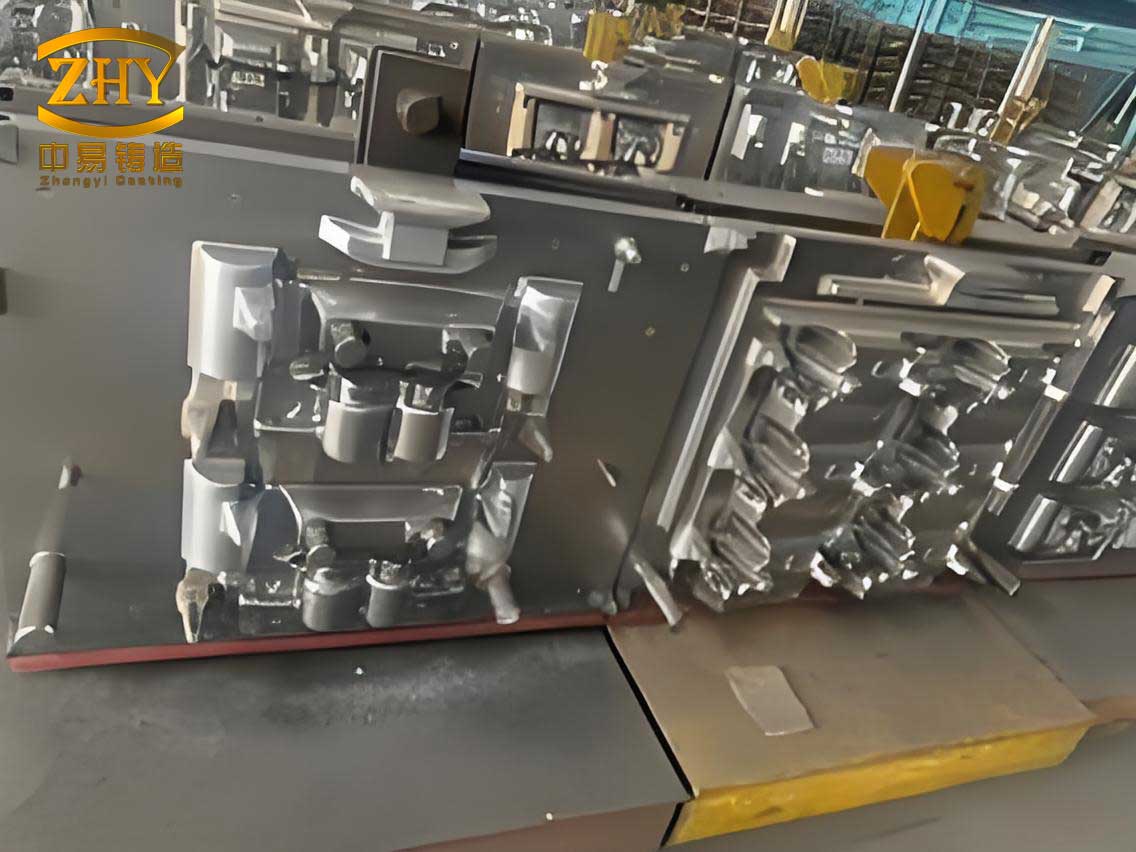
The image above illustrates a typical setup in sand-coated iron mold casting, highlighting the integration of the sand layer with the iron mold to achieve uniform cooling. This visual reinforces the importance of mold design in defect prevention. To systematically address shrinkage in sand-coated iron mold casting, I have developed preventive measures based on causal analysis. For example, controlling melt chemistry is paramount: besides managing Mg and RE residues, phosphorus (P) should be minimized to ≤0.07% to reduce segregation and phosphide eutectic formation. Pouring practices also matter; I advocate for “high-temperature melting, low-temperature pouring,” with molten iron tapped at 1440–1500°C but poured at or below 1360°C to balance fluidity and contraction. Furthermore, in automated lines using sand-coated iron mold casting, the timing of loosening mold clamps is critical—waiting until complete solidification ensures that graphite expansion compensates for shrinkage. The interplay of these factors can be modeled using a solidification time equation: $$ t_s = k \cdot V^{2/3} $$ where \( t_s \) is solidification time, \( V \) is volume, and \( k \) is a mold constant dependent on the sand coating’s insulating properties in sand-coated iron mold casting. By optimizing \( k \) through coating thickness and sand type, I can tailor cooling rates to minimize shrinkage.
In practice, implementing these measures requires a holistic approach. I often use tables to correlate defect types with corrective actions in sand-coated iron mold casting. Below is a comprehensive table summarizing shrinkage defects in nodular cast iron crankshafts, their causes, and targeted solutions:
| Defect Type | Typical Location | Primary Causes | Preventive Measures in Sand-Coated Iron Mold Casting |
|---|---|---|---|
| Macro-shrinkage (Gross porosity) | Thermal centers, journal junctions | Low CE, high Mg/RE, high pouring temp | Increase CE to 4.4–4.7%; control Mgres+REres ≤0.10%; pour ≤1360°C. |
| Micro-shrinkage (Dispersed porosity) | Centerline of sections | Premature mold unlocking, high P content | Delay mold opening until full solidification; reduce P to ≤0.07%. |
| Surface shrinkage cavities | Near mold walls at hot spots | Inadequate feeding due to sand coating issues | Optimize sand layer thickness (e.g., 3–5 mm) for uniform thermal gradient. |
| Subsurface shrinkage linked to cracks | Balance block connections | Thermal stresses from rapid cooling | Use controlled peening post-welding; preheat molds to 300°C. |
Expanding on these principles, I have also explored mathematical models to predict shrinkage formation in sand-coated iron mold casting. One useful formula relates the shrinkage volume \( V_s \) to process variables: $$ V_s = \alpha \cdot V_l \cdot \Delta T + \beta \cdot V_s’ $$ where \( \alpha \) is the liquid contraction coefficient, \( V_l \) is the liquid volume, \( \Delta T \) is the temperature drop during pouring, and \( \beta \) accounts for solidification shrinkage influenced by graphite expansion. In sand-coated iron mold casting, the sand layer’s insulation reduces \( \Delta T \), thereby lowering \( V_s \). Additionally, the efficiency of feeding can be expressed as: $$ \eta_f = \frac{G}{R} $$ where \( \eta_f \) is feeding efficiency, \( G \) is the graphite expansion pressure, and \( R \) is the resistance from mold rigidity. By enhancing \( G \) through higher CE and reducing \( R \) via proper sand coating, I can achieve \( \eta_f > 1 \), indicating adequate compensation for shrinkage. These equations guide my adjustments in real-time production, ensuring that sand-coated iron mold casting remains a robust method for high-quality parts.
Another critical aspect I have encountered is the integration of welding repairs with sand-coated iron mold casting workflows. When molds degrade, the welding techniques described earlier become essential to maintain dimensional accuracy and thermal properties of the sand coating. For instance, after repairing a crack in an iron mold used for sand-coated iron mold casting, I verify that the sand layer application remains consistent to avoid hot spots. This synergy between maintenance and process control is vital for economic sustainability. Data from my tracking studies show that repaired molds in sand-coated iron mold casting systems can achieve 65–70% of the lifecycle of new molds, with cost savings exceeding 30% in roll production. This underscores why sand-coated iron mold casting is not just a casting method but a comprehensive approach involving continuous mold care.
To further elucidate the chemical interactions in sand-coated iron mold casting, I often refer to phase diagrams and empirical rules. For nodular cast iron, the role of inoculation is crucial; I use a formula to estimate the required inoculant addition based on section thickness \( d \) (in mm): $$ I = k_i \cdot e^{-0.05d} $$ where \( I \) is the inoculant weight percentage, and \( k_i \) is a constant depending on the base iron composition. In sand-coated iron mold casting, the chilled effect of the iron mold is mitigated by the sand layer, allowing for lower \( k_i \) values and reducing slag inclusions. Moreover, the dynamics of solidification in sand-coated iron mold casting can be captured by the Chvorinov’s rule modified for coated molds: $$ t = B \left( \frac{V}{A} \right)^n $$ where \( t \) is solidification time, \( V/A \) is the volume-to-surface-area ratio, \( B \) is a mold constant influenced by sand coating properties, and \( n \) is an exponent typically near 2. By calibrating \( B \) through trials, I optimize pouring schedules to minimize shrinkage.
In conclusion, my journey with sand-coated iron mold casting has revealed that excellence in metal casting hinges on a blend of robust maintenance practices like welding repairs and precise control over metallurgical and thermal parameters. The sand-coated iron mold casting process, with its unique ability to balance cooling rates through the sand layer, is indispensable for producing defect-sensitive components such as crankshafts and mill rolls. By adhering to guidelines on chemistry, temperature, and timing, and by employing mathematical models for prediction, I have consistently reduced shrinkage defects and extended mold life. As the industry evolves, innovations like automated forging robots—mentioned in passing for context—complement these casting methods, but the core principles of sand-coated iron mold casting remain foundational. I am confident that through continued refinement and sharing of such insights, sand-coated iron mold casting will keep driving advancements in hot working technologies, ensuring safer, more efficient manufacturing across the globe.