
Reflecting on the evolution of the machine tool industry since the late 20th century, the relentless drive towards higher speeds, heavier cuts, and greater automation and precision has fundamentally transformed the technological landscape of our foundry floors. The era where production relied heavily on artisanal skill and accumulated experience is steadily giving way to a new paradigm defined by scientific rigor, superior materials, and advanced processes and equipment. Today, the core markers of modern casting are efficiency, low consumption, and environmentally conscious production of high-quality castings. In this context, the role of machine tool castings as the foundational bedrock of machine tool integrity cannot be overstated. Their quality directly dictates the static and dynamic stiffness, damping characteristics, and long-term precision stability of the final product.
The pursuit of excellence in machine tool castings begins with the material itself. For decades, cast iron has been the dominant material, constituting a significant portion of a machine tool’s total weight. A comparative look at the weight ratios in different countries highlights its enduring importance.
| Country | Weight of Castings in General Machine Tools (%) | Weight of Machine Tool Castings in Total National Foundry Output (%) |
|---|---|---|
| Japan | ~70-80 | ~6-8 |
| Soviet Union | ~70-80 | ~6-8 |
Within this, grey iron castings for machine tools make up a substantial share of the total national grey iron output, while ductile iron finds specific, critical applications. The selection of cast iron grade is not arbitrary; it is a calculated decision to achieve desired mechanical and physical properties. Japanese standards, for instance, specify distinct grades for different casting types to ensure performance.
| Type of Casting | Japanese Standard Designation | Approx. Tensile Strength (MPa) |
|---|---|---|
| Bed Type | FC300 | 300 |
| Table Type | FC250-FC300 | 250-300 |
| Headstock Type | FC250 | 250 |
| Saddle/Slide Type | FC200-FC250 | 200-250 |
The shift towards机电一体化 (Mechatronics) and ultra-high precision demanded more from these foundational components. The paramount requirement became high stiffness, which in turn depends critically on the material’s modulus of elasticity (E) under working stress. There exists a functional relationship between elastic modulus and tensile strength; only high-grade cast irons possess a high E value. This can be conceptually represented as:
$$ E = f(\sigma_{TS}) $$
where a higher tensile strength $ \sigma_{TS} $ generally correlates with a higher $ E $, leading to improved rigidity.
Furthermore, the long-term dimensional stability of machine tool castings is threatened by the gradual relaxation of internal residual stresses over time, leading to autonomous deformation. It is well-established that the presence and subsequent relaxation of these stresses are primary causes of distortion. High-strength cast irons exhibit a lower stress relaxation coefficient, meaning they resist creep deformation more effectively. Therefore, using high-grade cast iron inherently enhances the precision-holding capability of the casting. This drove nations like the UK, USA, and France to adopt premium grades such as Mechanite, with specifications calling for tensile strengths of 250-350 MPa and elastic moduli exceeding 130 GPa. A comparison of premium cast iron properties illustrates the global benchmarks.
| Country / Material | Tensile Strength (MPa) | Elastic Modulus (GPa) | Relative Hardness | Key Characteristics |
|---|---|---|---|---|
| Japan (High Grade) | 250-350 | 130-145 | ≤ 1.0 | High rigidity, stability |
| UK/USA (Mechanite) | 250-350 | 135-140 | N/A | Consistent properties, good machinability |
| France (CETF Recommendation) | 250-350 | ≥ 130 | N/A | High performance for critical parts |
| High-Strength Low-Stress Iron (Developed) | ≥ 250 | ≥ 130 | < 1.0 | Low residual stress (~30% reduction), good anti-creep |
From my experience, the development and adoption of high-strength, low-stress cast iron have been pivotal. This material not only meets the mechanical property benchmarks but also significantly reduces the residual casting stresses, in some cases obviating the need for thermal stress relief while maintaining superior precision stability. This advancement directly contributes to an increase in the static stiffness of machine tool structures.
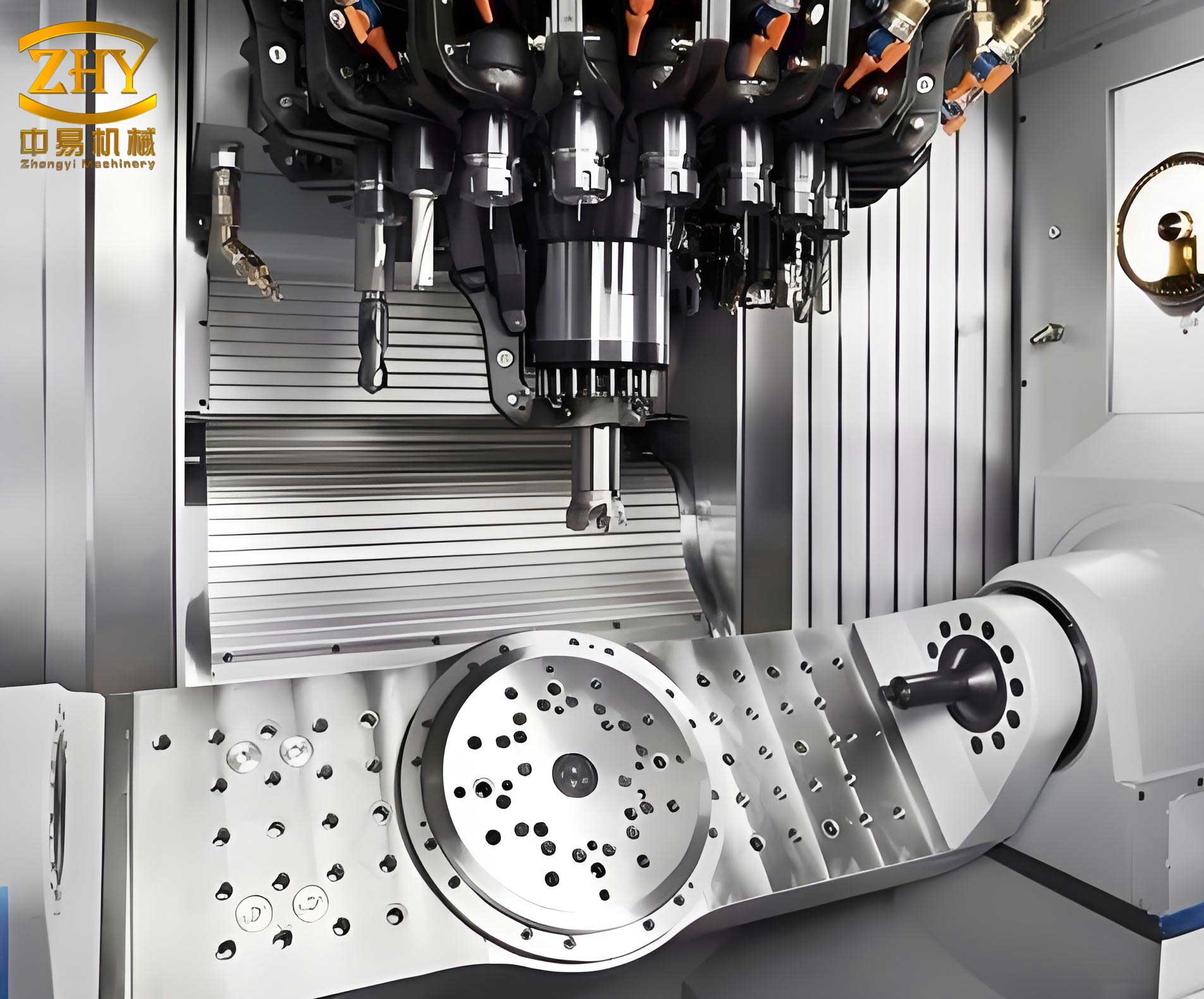
While cast iron reigns supreme, the quest for optimal performance has spurred exploration into alternative materials for machine tool castings. Welded steel fabrications offer high stiffness and strength for specific geometries. Polymer concrete (or epoxy granite) provides exceptional damping properties, thermal stability, and design freedom at a competitive cost. Natural granite is prized for its stability and damping. High-nickel cast irons with a coefficient of thermal expansion about 30% lower than grey iron are used for ultra-precision applications. Ceramic materials are making inroads for components like spindles and bearings due to their wear resistance, thermal stability, and low thermal expansion. The future material landscape for key machine tool structures is dynamic and promising.
| Component | Traditional Material | Potential New Material | Driving Benefit |
|---|---|---|---|
| Bed, Base | Cast Iron, Welded Steel | Polymer Concrete, Ceramic | Damping, Thermal Stability, High Stiffness |
| Spindle | Alloy Steel | Advanced Ceramic | High Rigidity, Wear Resistance, Lightweight |
| Bearing, Guideway | Steel, Bronze | Ceramic, Engineering Plastic | Wear Resistance, Low Friction, Thermal Properties |
| Structural Frames | Cast Iron | Carbon Fiber Composites | Extreme Lightweighting, High Damping |
The overarching trend is clear: future materials for machine tool castings and structures must offer a superior combination of high mechanical strength, favorable physical properties (like damping and thermal stability), exceptional precision retention, and high stiffness, all while enabling design flexibility and lean manufacturing.
The journey from raw charge to molten metal is where the inherent quality of machine tool castings is fundamentally established. For many years, the cupola furnace has been the workhorse of iron melting, favored for its operational simplicity and efficiency in melting solid charge. However, environmental pressures—a cupola can emit 5-10 kg of dust per ton of molten iron—and rising coke costs have accelerated the adoption of electric furnaces, primarily induction furnaces. Electric melting provides precise temperature control, consistent chemistry, lower environmental impact, and superior working conditions. The “duplex” melting process, combining a cupola for efficient melting with an induction furnace for superheating and holding, leverages the strengths of both technologies and has seen rapid growth.
In my observation, the trajectory of melting technology varies globally. While advanced economies are shifting towards electric-based melting, regions with cost and energy constraints still rely heavily on cupolas, albeit increasingly sophisticated ones equipped with computer control systems for optimized charge calculation, blast control, and process monitoring. The key objective everywhere is to achieve high, consistent tapping temperatures (consistently above 1450°C is now a benchmark) with minimal elemental oxidation loss (aiming for Si loss < 10%, Mn loss < 15%) and stable, high-quality molten iron. The mastery of inoculation practices using specialized inoculants is equally critical in this stage to control microstructure and final properties.
If melting defines the internal quality, then molding defines the external form and dimensional accuracy of machine tool castings. It is often cited that a significant percentage of casting defects originate from molding and core-making processes. The evolution of molding materials in our industry tells a story of continuous improvement: from conventional green sand (clay-bonded) to chemically-bonded sands like sodium silicate (water glass) and cement, and ultimately to the widespread adoption of resin-bonded sands since the 1970s.
The transition to resin sand, particularly furan no-bake systems, has been a game-changer. It offers exceptional dimensional accuracy, excellent surface finish, high productivity from simplified processes, and the ability to produce complex cores without the need for baking. The economic impact is tangible, as evidenced by case studies showing reductions in man-hours per ton, lower scrap rates, and increased yield. Modern precision machine tool castings demand surface flatness tolerances as tight as 0.5 mm over a 1000 mm length, a standard far more stringent than past industrial norms and readily achievable with resin sand processes. While clay sand remains in use for certain applications, the trend toward resin-bonded and other cold-box processes for producing high-integrity, near-net-shape machine tool castings is unmistakable and necessary to meet global quality standards.
The final, crucial frontier in the advancement of machine tool castings is refinement and lightweighting. In an era focused on resource efficiency and energy savings, producing castings that are “right-weighted”—possessing optimal strength and stiffness with minimal material—is imperative. The historical trend shows a clear reduction in the average weight per machine tool unit, from several tens of tons decades ago to much lower figures today, driven partly by design optimization and partly by material and process improvements. This involves strategic ribbing, finite element analysis (FEA)-led design, and the confidence to reduce nominal wall thicknesses. While traditional designs might have featured walls of 25-30 mm, modern practices allow for walls of 15-20 mm, or even 10-12 mm for smaller, precision machines, without compromising performance.
The potential savings are enormous. Lightweighting existing casting designs by even 10-15% translates to thousands of tons of saved metal annually on an industrial scale. The formula for mass saving is straightforward:
$$ \Delta M = \rho \cdot \Delta V $$
where $ \Delta M $ is the mass reduction, $ \rho $ is the density of cast iron, and $ \Delta V $ is the reduction in volume achieved through design refinement. Achieving this requires a holistic approach: high-strength materials that allow thinner sections, precise molding processes that ensure dimensional fidelity of thin walls, and rigorous finishing operations like grinding of parting lines and shot blasting to remove stress raisers and improve fatigue life. The move towards near-net-shape casting minimizes machining allowance, further conserving material and energy.
Looking ahead, the path for producing superior machine tool castings is multifaceted. It demands a sustained commitment to material science, exploring not only enhanced cast irons but also the judicious integration of polymer composites and advanced ceramics where their unique properties offer system-level advantages. Process digitization—from automated molding lines with real-time sand property control to AI-driven melting optimization—will be key to achieving consistent quality at scale. Furthermore, the entire philosophy must embrace sustainability, focusing on closed-loop sand reclamation, energy-efficient melting, and lightweight designs that reduce the carbon footprint across the lifecycle of the machine tool. The casting is not merely a component; it is the foundation upon which precision, productivity, and innovation in manufacturing are built. Its continued evolution remains absolutely critical to the future of the machine tool industry.