
The evolution of manufacturing technology continuously drives the demand for higher performance and reliability in cast components. Within sectors such as automotive and heavy machinery, aluminum-silicon (Al-Si) alloy shell castings are critical due to their requirements for structural integrity, pressure tightness, and dimensional accuracy. This article details the application and optimization of sand mold low-pressure casting (LPC) technology for producing complex, high-quality Al-Si shell castings, based on extensive practical experience in overcoming the limitations of traditional gravity casting methods.
Gravity pouring of Al-Si shell castings, particularly for intricate, thick-walled components like engine or gearbox housings, often leads to inherent defects that compromise part performance. The turbulent flow of molten metal during pouring promotes oxide film entrapment and gas pickup. Furthermore, the natural feeding mechanism in gravity casting struggles to effectively compensate for shrinkage in sections with varying wall thicknesses, leading to porosity and shrinkage defects that are detrimental to pressure tightness. These challenges necessitated a shift to a more controlled casting process.
Low-pressure casting presents a compelling solution. In this process, a sealed furnace holds the molten aluminum. A riser tube extends from the furnace into the mold cavity situated above. By applying a controlled gas pressure (typically inert gas like argon or dry air) to the surface of the molten metal in the furnace, the metal is forced upward through the riser tube to fill the mold cavity in a laminar, bottom-up fashion. The pressure is maintained during solidification to enhance feeding. The core advantages for shell castings include:
- Laminar Filling: Reduces turbulence, minimizing oxide formation and gas entrainment.
- Directional Solidification: Promoted from the top (farthest from the gate) towards the bottom (gate), improving feed metal efficiency.
- Superior Mechanical Properties: The applied pressure during solidification reduces microporosity, yielding denser material with enhanced tensile strength and elongation.
- High Yield: The integrated filling and feeding system (the riser tube) eliminates extensive gating and risering needed in gravity casting, significantly improving metal yield.
Challenges with Gravity Casting for Complex Shell Castings
The initial production attempts for a specific engineering vehicle housing, a prime example of a demanding Al-Si shell casting, highlighted the shortcomings of gravity sand casting. The component, with a complex geometry, compact structure, and significant variation in wall thickness (from 14mm nominal sections to 60mm thick hubs), was specified in ZL111 (A357 equivalent) alloy. Key quality requirements are summarized below:
| Parameter | Requirement/Specification |
|---|---|
| Material | ZL111 (Al-Si7Mg) |
| Dimensions | ~450 mm x 585 mm x 315 mm |
| Weight | Approx. 50 kg |
| Pressure Test | 0.3 MPa hydraulic pressure for 15 minutes, zero leakage |
| Defect Standard | Free of shrinkage porosity, gas holes, inclusions, and cracks |
Despite employing chills, extensive risers, and vents in the gravity casting process, defect rates remained unacceptably high. The predominant issues were:
Oxide Inclusions: Turbulent filling folded surface oxides into the melt.
Gas Porosity & Pinholes: Resulting from air entrapment and reaction with moisture in the sand mold.
Shrinkage Porosity: Inadequate feeding in isolated heavy sections, such as mounting bosses and rib intersections.
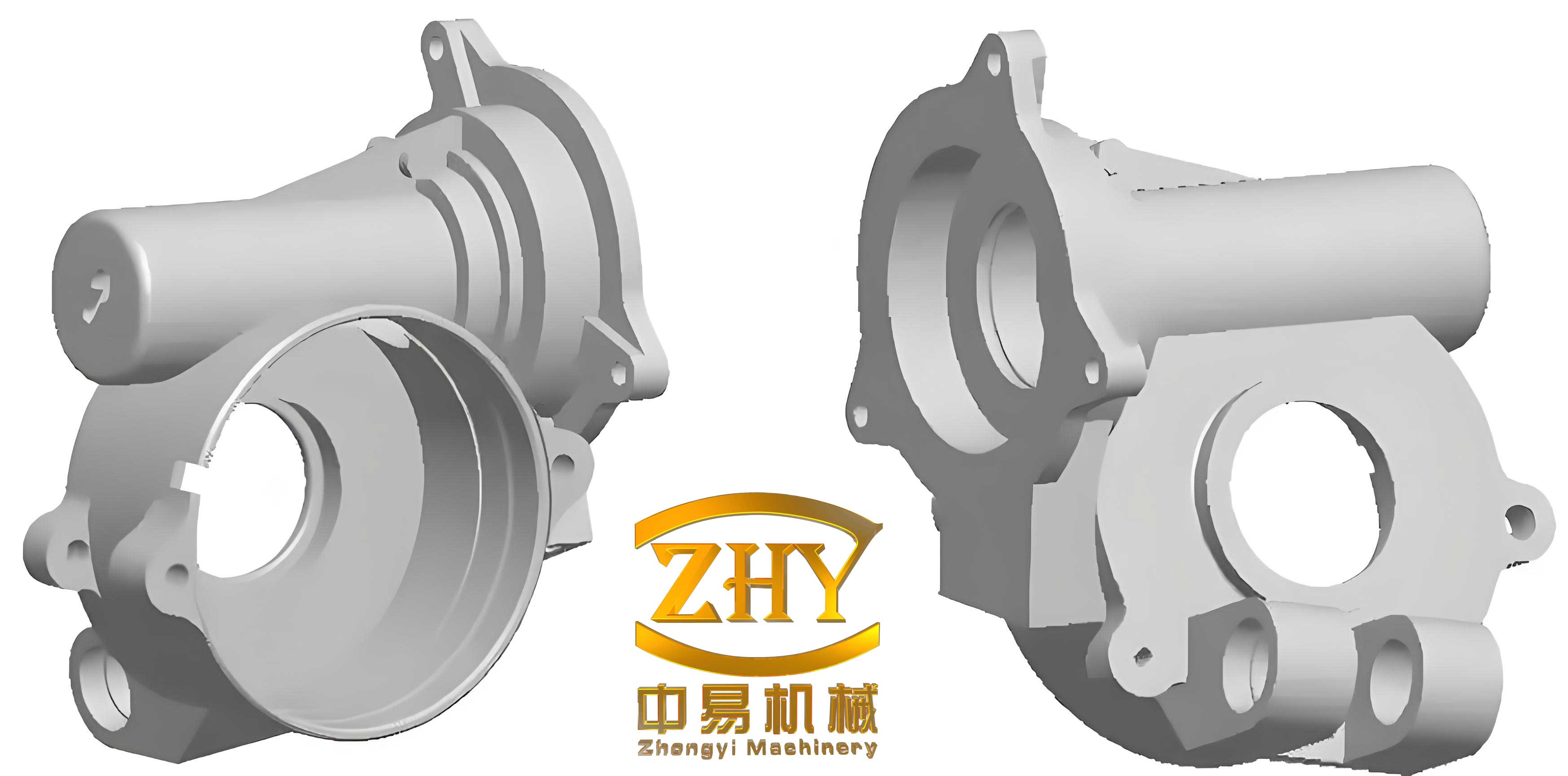
Low-Pressure Casting Process Design for Shell Castings
The transition to low-pressure casting required a holistic redesign of the foundry practice. The adopted methodology for these Al-Si shell castings is a “pressure-controlled solidification” process, characterized by a slow lift phase, a faster but controlled filling phase, and the application of a modest, sustained pressure during solidification.
Gating System & Mold Design
A two-part furan resin sand mold was utilized for its good collapsibility and dimensional stability. The gating system was designed as an open type with bottom filling. A single, enlarged downsprue/riser tube connection at the base of the casting serves as both the filling channel and the primary feeding source. This central location is typically chosen under a thick section of the shell casting to establish a strong thermal gradient. Strategic placement of chills (cast iron) on critical thick sections external to the mold cavity is essential to accelerate local cooling and establish directional solidification towards the pressure source. Numerous small-diameter (approx. 3 mm) vent pins are installed at the highest points and isolated pockets within the mold core assembly to allow air to escape during filling.
Key Process Parameters and Their Determination
The success of low-pressure casting for integrity-critical shell castings hinges on the precise control of several interlinked parameters.
1. Pouring Temperature:
A lower pouring temperature is preferred to reduce shrinkage volume, gas solubility, and metal-mold reaction. For ZL111 alloy shell castings, the optimal range was found to be 680°C to 710°C. Temperatures at the higher end may be used for very complex, thin-walled sections to ensure complete filling.
2. Filling Pressure & Speed:
The pressure required to lift the metal to the top of the mold cavity ($P_{fill}$) is derived from the fundamental hydrostatic equation:
$$ P_{fill} = H \rho g $$
where $H$ is the total height from the metal level in the furnace to the top of the mold cavity (in meters), $\rho$ is the density of the molten aluminum (~2500 kg/m³), and $g$ is acceleration due to gravity (9.81 m/s²). Accounting for system resistance and ensuring a controlled fill, the applied pressure is slightly higher. The practical range for the subject shell castings was 0.12 MPa to 0.16 MPa.
Filling speed, controlled by the pressure ramp rate, is critical. Too fast causes turbulence; too slow leads to mistruns. The fill time for these components was optimized between 15 and 30 seconds. The relationship between pressure increase ($dP/dt$) and fill speed is complex and system-dependent, requiring empirical tuning.
3. Solidification (Boost) Pressure and Rate:
After mold filling, the pressure is increased to a higher level to improve feeding efficiency. This boost pressure ($P_{solid}$) compresses any forming gas pores and forces more metal into interdendritic regions. However, excessive pressure can cause mold wall movement or penetration. For sand molds producing Al-Si shell castings, a boost pressure 10-30% higher than the fill pressure is effective:
$$ P_{solid} = k \cdot P_{fill} \quad \text{where} \quad k \approx 1.1 \text{ to } 1.3 $$
A boost pressure range of 0.13 MPa to 0.16 MPa with a slow ramp rate of 0.003 MPa/s to 0.006 MPa/s proved successful.
4. Pressure Hold Time:
Pressure must be maintained until the casting, especially the gate region, is completely solidified. Insufficient hold time can cause suck-back porosity. The hold time ($t_{hold}$) is a function of the casting modulus (Volume/Surface Area). A practical rule is to hold until the gate has solidified to a depth of 30-50 mm. For these 50 kg shell castings, a hold time of 10 to 15 minutes was standard.
| Process Stage | Parameter | Optimal Range | Function & Rationale |
|---|---|---|---|
| Metal Preparation | Alloy | ZL111 (A357) | Excellent castability, good strength, and pressure tightness. |
| Pouring Temperature | 680°C – 710°C | Minimizes shrinkage and gas pickup while ensuring fluidity. | |
| Filling Stage | Filling Pressure ($P_{fill}$) | 0.12 MPa – 0.16 MPa | Overcomes metallostatic head and system resistance for controlled fill. |
| Filling Time | 15 s – 30 s | Balances laminar flow and prevention of premature freezing. | |
| Solidification Stage | Boost Pressure ($P_{solid}$) | 0.13 MPa – 0.16 MPa | Enhances interdendritic feeding, reduces microporosity. |
| Pressure Hold Time ($t_{hold}$) | 10 min – 15 min | Ensures complete solidification under pressure, prevents suck-back. |
Solidification Simulation & Process Validation
Numerical simulation is an indispensable tool for validating and refining the LPC process for complex shell castings. Using casting simulation software (e.g., HuaZhu CAE), the thermal field and solidification sequence can be predicted. The simulation model for the housing confirmed that with the designed placement of the gate and chills, directional solidification progressed smoothly from the extremities of the casting back towards the pressurized gate. Isolated liquid pools (hot spots) were eliminated, validating the efficacy of the chill design. The simulation output, showing the progressive solidification fronts, provides confidence in the process before costly prototyping.
Critical Operational Practices
Beyond parameter control, stringent foundry practices are paramount for consistently sound shell castings:
- Mold & Core Coating: All mold and core surfaces must be coated with a refractory wash (e.g., zircon-based) to prevent metal penetration and sand burn-on. Applying two coats after allowing the mold to dry for several hours is critical.
- Chill Preparation: All chills must be clean, dry, and preheated before placement to prevent gas evolution at the metal-chill interface. They are coated with a thin layer of wash and dried.
- Mold Closure & Pressurization: The mold should be poured soon after closing to minimize moisture pick-up. The pressure cycle must be automated and repeatable, with precise control over each ramp and plateau.
- Melt Quality: Rigorous degassing (using rotary impellers with argon or nitrogen) and careful slag removal before transferring to the LPC furnace are non-negotiable to ensure low hydrogen content and clean metal.
Results and Benefits Realized
The implementation of the sand mold low-pressure casting process fundamentally transformed the production outcome for these Al-Si shell castings. The consistent achievement of leak-tight castings that pass the 0.3 MPa hydraulic test is the primary success metric. The internal soundness was confirmed by radiographic inspection, showing a marked reduction in scattered porosity and the elimination of gross shrinkage cavities.
The mechanical properties of the low-pressure cast components met or exceeded the specifications required for the demanding application, with typical values for ZL111 showing improvement over gravity-cast equivalents due to the denser microstructure. The process enabled high-volume, stable production, successfully substituting imported parts and even allowing for export, delivering significant economic benefit.
In conclusion, the low-pressure casting technique, when properly designed and controlled, is exceptionally well-suited for manufacturing high-integrity Al-Si alloy shell castings. The transition from gravity casting resolves chronic issues of oxide inclusions, gas porosity, and shrinkage. The key lies in the synergistic application of a laminar bottom-filling gating system, a pressure profile that ensures filling and feeding, strategic use of chills to control solidification, and uncompromising melt and mold hygiene. For foundries facing quality challenges with complex, pressure-tight aluminum components, the investment in low-pressure casting technology for shell castings offers a robust path to superior, reliable, and cost-effective production.