
In the field of heavy machinery, cone crushers are extensively used for material crushing, and their壳体 (shell castings) represent a critical application of large-scale steel castings. The CH660 cone crusher bottom shell, with a total weight of 16,000 kg for the upper and lower assemblies, is a典型 example of such shell castings. This component was manufactured domestically for an international client, adhering to stringent global standards and technical specifications. The shell castings house various wear-resistant liners, crushing cones, motors, and transmission gears, operating under conditions of severe vibration, high dust, and恶劣 environments. Consequently, high demands are placed on the surface quality and dimensional accuracy of these shell castings. Failure due to casting defects can lead to significant production downtime and economic losses, making the development of a rational casting工艺 essential for organized production, enhanced economic效益, and ensured product quality.
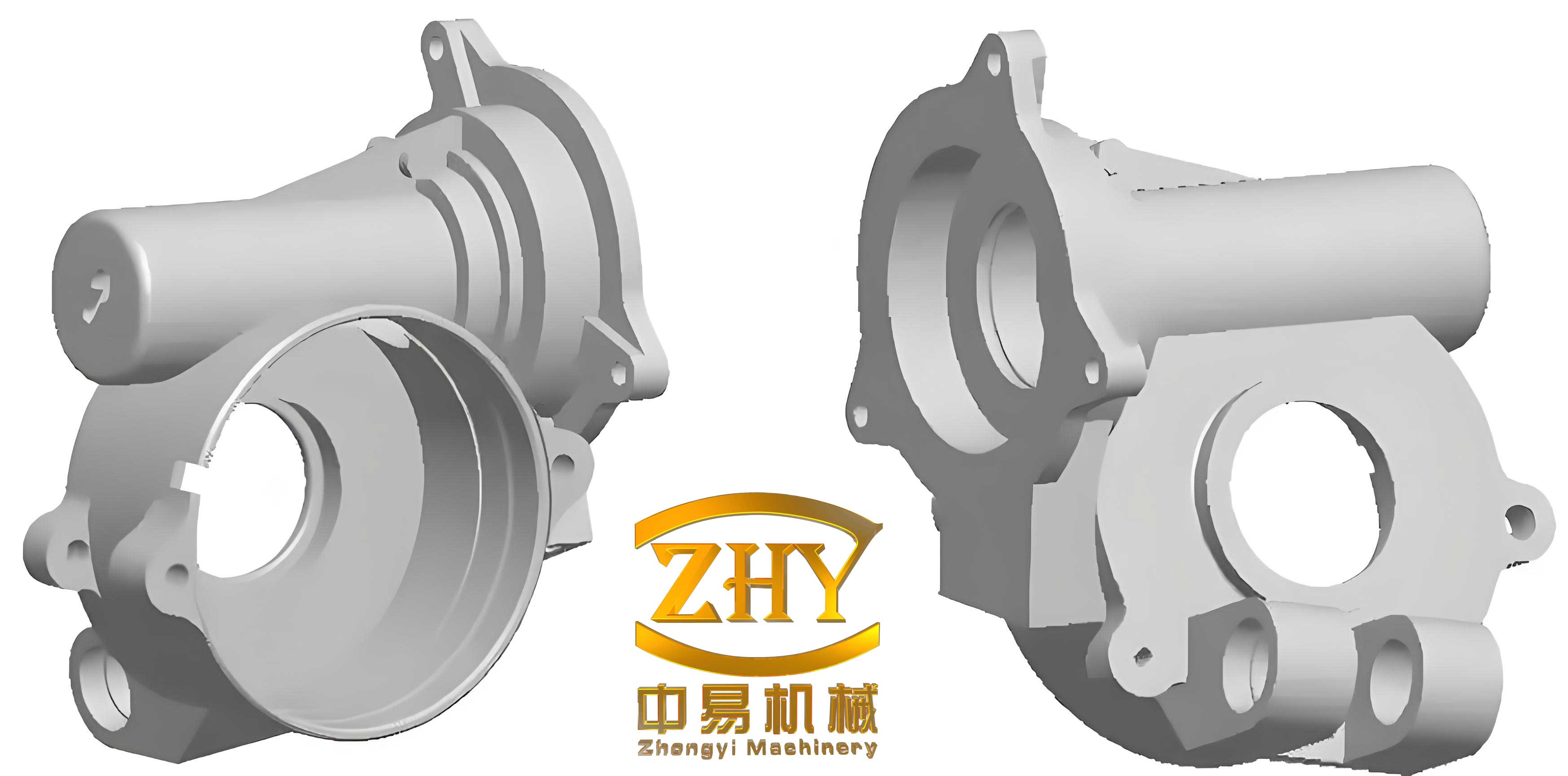
From a first-person perspective, our team undertook the challenge of producing these complex shell castings. The铸件 (casting) has a maximum diameter of Φ2,200 mm, a height of 1,095 mm, a rough weight of 8,200 kg, with wall thicknesses ranging from 55 mm to 150 mm. It features a complex geometry with four ribs and a motor working孔 connecting the central and outer cylindrical壳体, upper and lower flanges, and a central凹槽. This part is for批量 production, with an annual demand exceeding上百 pieces. The material specification is K1 (internal standard) GS200+N, with chemical composition and mechanical properties outlined below. The shell castings require surface and non-destructive testing as per standards, dimensional accuracy at ISO806 table ICT12 level, and a heat treatment of normalizing plus tempering.
The chemical composition of the steel used for these shell castings is critical to achieving the desired properties. Based on internal control standards to ensure quality, the composition is as follows:
| Element | Internal Control Standard (wB/%) |
|---|---|
| C | 0.12–0.17 |
| Si | 0.38–0.57 |
| Mn | 0.82–0.92 |
| P | ≤0.025 |
| S | ≤0.020 |
| Cu | ≤0.20 |
| Ni | – |
| Cr | – |
| Mo | – |
| Al | – |
The mechanical properties required for these shell castings are equally important to withstand operational stresses. The specifications and typical实测 values from batch production are summarized below:
| Property | Specification Requirement | Measured Value (Sample 1) | Measured Value (Sample 2) | Measured Value (Sample 3) |
|---|---|---|---|---|
| Yield Strength (MPa) | ≥200 | 252 | 267 | 280 |
| Tensile Strength, Rm (MPa) | >400 | 457 | 424 | 445 |
| Elongation, A (%) | >25 | 30.0 | 31.3 | 34.6 |
| Impact Energy, AKV (J) | ≥35 | 62 | 58 | 75 |
The casting process design for these shell castings began with a thorough analysis. The carbon content is below 0.18%, classifying it as low-carbon steel, which leads to high pouring temperatures and susceptibility to secondary oxidation. The significant variation in wall thickness, from 55 mm to 150 mm, results in dispersed hot spots and non-smooth feeding channels, making the shell castings prone to defects like shrinkage cavities, sand sticking, misruns, dimensional deviations, and cracks. To address these challenges, we formulated a comprehensive casting方案.
First, the parting surface was selected to minimize core数量, reduce flask尺寸, save molding sand, and facilitate molding and feeding. A three-part flask was adopted, which, although增加了一个砂箱, eliminated one large core and allowed for pattern plate molding in the upper and middle flasks to ensure dimensional accuracy in batch production. For the cores, three were designed. Core 2 integrates the motor孔 and凹槽 to guarantee precision in their relative positions and prevent interference during gearbox installation. The molding material chosen was resin-bonded sand, specifically modified phenolic resin, due to its ability to achieve high dimensional accuracy, reduce cracking tendency, and meet environmental considerations. The properties of the resin are shown below:
| Parameter | Specification |
|---|---|
| Brand | BNSW |
| Density (g/cm³) | 1.10–1.30 |
| pH | 7–7.5 |
| Free Acid (%) | ≤0.2 |
| Free Phenol (%) | ≤0.5 |
| Specific Strength (MPa) | ≥1.0 |
The base sand was 30/50 mesh with SiO₂ ≥98%, resin addition of 0.8%–1.0%, and achieved mold strength of 0.5–0.6 MPa. The gating and risering system was designed based on modulus calculations to ensure proper feeding. For complex shell castings, the modulus M is defined as the volume V divided by the cooling surface area S:
$$ M = \frac{V}{S} $$
We used SolidWorks to isolate different sections of the shell castings, obtain their volume and surface area, and compute the modulus. The riser modulus Mriser must satisfy Mriser ≥ 1.2 Mcasting to effectively feed the casting. Hot spots were identified at the upper and lower flanges and central孔 areas. Accordingly, risers were layered: eight risers at the bottom flange with chills between them, seven risers of varying sizes at the middle flange (including support bosses and motor孔 ends), and five exothermic risers on top for hot spots with a thermal circle diameter of Φ220 mm. The second-layer risers were connected to the sprue. The casting yield was 65.6%. The pouring time was determined using an empirical formula for fast pouring to minimize defects like sand sticking and reactive porosity. The浇注时间 t is given by:
$$ t = \frac{G}{N \cdot n \cdot v_g} $$
where G is the casting weight (12,500 kg), N is the number of ladles (1), n is the number of nozzle bricks per ladle (2), and vg is the mass flow rate of steel (taken as 150 kg/s for fast pouring). This yields:
$$ t = \frac{12500}{1 \times 2 \times 150} = 41.6 \text{ seconds} $$
Thus, pouring was controlled within 40–45 seconds using a双水口 ladle. The gating system ratio was set to Fsprue : Frunner : Fingate = 1 : 1.5 : 3 to promote rapid mold filling. To validate the工艺, we employed CAE simulation with华铸 CAE/InteCAST. The 3D model from SolidWorks was导入, and the solidification process was simulated多次 to predict shrinkage porosity and optimize riser placement. The simulation confirmed that shrinkage defects were confined to the risers, ensuring the soundness of the shell castings.
The production process involved meticulous steps. For molding and coring, pattern plates were used for consistency. Core 1 was tightly rammed with coke additions to enhance collapsibility, and external chills were placed within it to control solidification. Core 2, with its complex shape, required a custom-made core support to prevent deformation during handling. All cores were coated with three layers of zirconia-based paint, totaling 0.8–1.2 mm thickness, and smoothed after each drying. To ensure dimensional accuracy, over 20 inspection gauges were fabricated for key dimensions. Before closing, mold and core dimensions were checked. Joints were sealed with石棉绳 ≤1 mm thick. All blind risers were vented to the outside via ceramic tubes. The mold was dried with hot air at 250°C for 6–8 hours before pouring, with hot air pipes removed 15 minutes prior to avoid moisture reabsorption.
Melting was conducted in an electric arc furnace. Charge carbon was set 0.30%–0.40% above specification to account for decarburization. Phosphorus and sulfur were严格控制 to low levels. The steel was refined under white slag for 15–20 minutes,铝-killed, and teemed after 5 minutes of镇静. The ladle was preheated to >800°C and kept clean to avoid inclusions. After pouring, the shell castings were held in the mold for 80–96 hours before shakeout. Riser removal was done at room temperature. Heat treatment involved normalizing at 900–930°C for 6–7 hours, followed by forced air cooling to 580°C and自然 cooling to 300°C, then tempering at 600–630°C for 6–7 hours, with furnace cooling to 300°C before air cooling.
Inspection results confirmed the quality of the shell castings. Surface roughness, assessed by comparison with标准 samples, met requirements. Mechanical properties and chemical composition from random samples are shown in the tables above, all satisfying specifications. Dimensional checks with tapes and gauges complied with ISO806 ICT12. Magnetic particle (MT) and ultrasonic (UT) testing met the standards referenced (e.g., MSS-SP-55-2001, SS-EN12680). The shell castings were successfully produced from the first pour and validated in operation at the OEM, leading to batch production since March 2011.
In conclusion, several key factors contributed to the successful production of these large steel shell castings. First, for low-carbon steel shell castings with complex geometries and high cracking susceptibility, modified phenolic resin sand reduces crack倾向 and improves dimensional accuracy. Second, using SolidWorks for modulus calculation and华铸 CAE/InteCAST for simulation验证 streamlines riser design and reduces trial costs. The modulus relationship is critical:
$$ M_{\text{riser}} \geq 1.2 M_{\text{casting}} $$
Third, fast pouring of steel promotes rapid mold filling, which minimizes defects like sand sticking and reactive porosity, enhances surface quality, and improves feeding efficiency. The浇注时间 formula is essential for planning. Fourth,严格控制 phosphorus and sulfur content in the steel significantly improves mechanical properties and reduces hot tearing in shell castings. Finally, for geometrically complex shell castings, comprehensive inspection gauges are indispensable for ensuring dimensional precision. These insights form a foundation for the efficient batch production of high-quality shell castings for demanding applications.