
In the field of heavy-duty automotive components, the development and production of high-integrity nodular cast iron parts, such as bracket castings for rear axle leaf springs, present significant engineering challenges. These components are critical for vehicle safety, as they transmit forces from the leaf springs to the frame, and thus must exhibit superior mechanical properties and structural reliability. In this article, I will share our team’s experience in improving the casting process for a nodular cast iron bracket, focusing on the elimination of shrinkage porosity through simulation-assisted design. The journey involved a detailed analysis of the original process, the application of MAGMA simulation software, and the implementation of strategic modifications that ultimately enhanced product quality.
The bracket casting in question is a complex geometry with uneven wall thicknesses, weighing approximately 59 kg and measuring 637 mm × 799 mm × 389 mm. The nominal wall thickness is around 10 mm, but it features localized thick sections, such as the frame mounting holes, which can be up to 47.5 mm thick. This variation in wall thickness inherently creates thermal gradients during solidification, often leading to defects like shrinkage porosity if the casting process is not meticulously designed. The material specification required is QT800-2 nodular cast iron, demanding a pearlite matrix fraction exceeding 80%, tensile strength ≥800 MPa, yield strength ≥380 MPa, hardness between 245-335 HB, and elongation ≥2%. Furthermore, the casting must be free from cracks, cold shuts, burrs, and other detrimental defects, with dimensional accuracy conforming to CT9 grade.
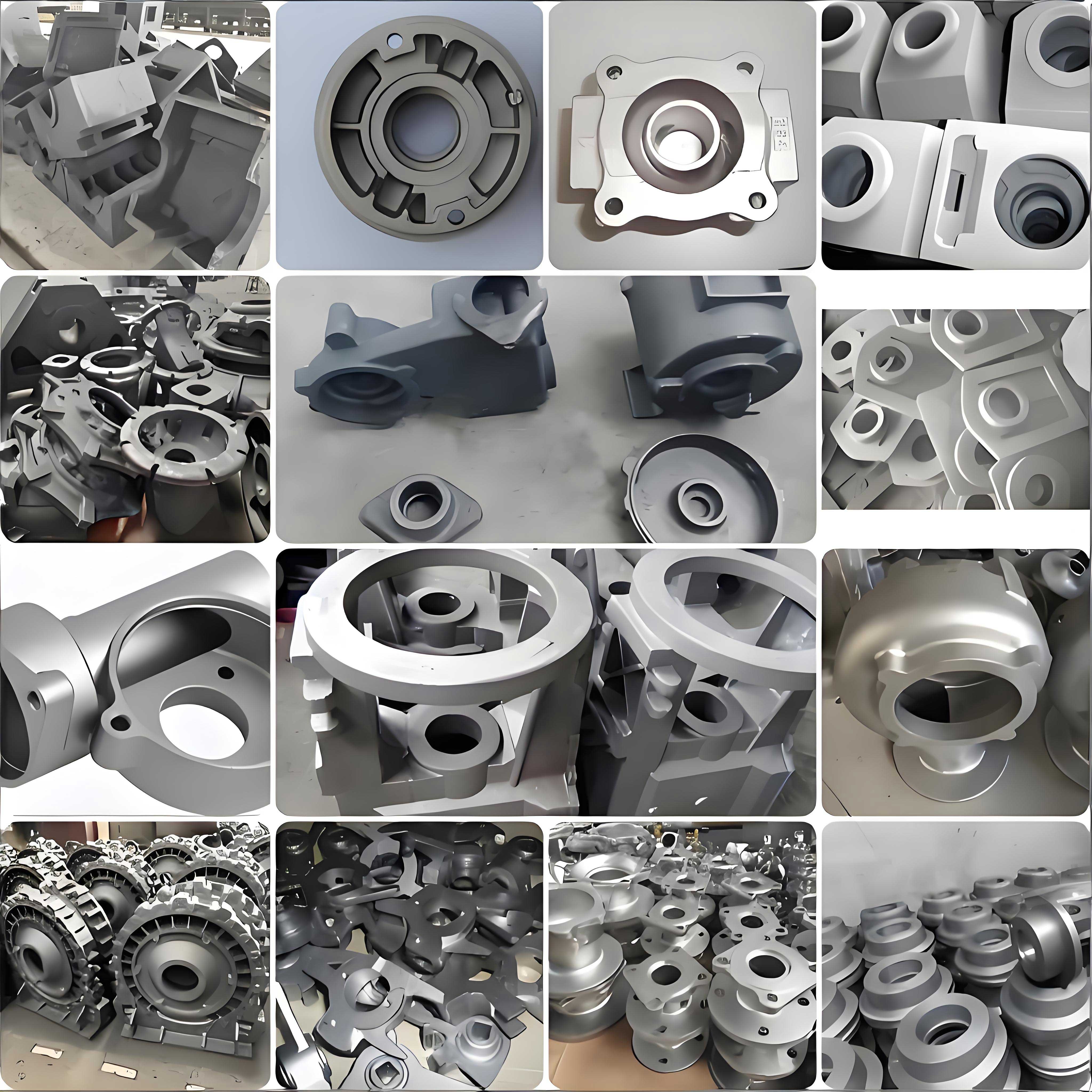
Our initial production setup utilized a high-pressure horizontal molding line with green sand, employing a box size of 1000 mm × 800 mm × 350/300 mm. The mold hardness was consistently maintained between 85-95 g/mm² using an SYS-B hardness tester. The process was automated with a pouring machine, achieving a cycle time of 140 molds per hour. The original gating system was designed as a partially closed type, with a cross-sectional area ratio of $$ \Sigma F_{\text{sprue}} : \Sigma F_{\text{runner}} : \Sigma F_{\text{ingate}} = 1 : 1.8 : 1.5 $$. Iron was introduced from both sides of the casting through seven ingates, with a sprue diameter of 40 mm, runner dimensions of 25/20 mm × 38 mm, and ingate thicknesses of merely 5 mm. To manage solidification in the thick frame mounting holes, four chills measuring 35 mm × 35 mm × 30 mm were placed. Additionally, two foam ceramic filters (75 mm × 75 mm × 22 mm) were installed in the runner system to purify the molten iron. The pouring temperature was controlled between 1390-1400°C, with a pouring time of 20-22 seconds. The typical chemical composition of the nodular cast iron is summarized in Table 1.
| Element | Range |
|---|---|
| C | 3.60 – 3.75 |
| Si | 2.10 – 2.30 |
| Mn | 0.40 – 0.55 |
| S | 0.005 – 0.020 |
| P | 0.03 – 0.05 |
| Cu | 1.40 – 1.60 |
Despite these controls, non-destructive testing via X-ray radiography revealed a troubling incidence of shrinkage porosity, primarily located within the thick frame mounting hole regions. The defect rate from X-ray inspection was around 30%, and subsequent machining operations confirmed internal shrinkage in approximately 8% of the produced castings, rendering them unacceptable for service. This defect manifested as dispersed micro-porosity that could compromise the mechanical integrity under cyclic loading. As engineers responsible for quality and process efficiency, we recognized that addressing this issue was paramount to reducing customer complaints and avoiding costly claims due to machining failures.
To diagnose the root cause, we turned to computational modeling using MAGMA simulation software. The fundamental principle behind solidification defects in nodular cast iron relates to the volume contraction during the phase change from liquid to solid. The total volumetric shrinkage ($$ \Delta V $$) can be estimated as:
$$ \Delta V = V_L \cdot (\beta_L + \beta_S) $$
where $$ V_L $$ is the volume of liquid metal, $$ \beta_L $$ is the liquid contraction coefficient, and $$ \beta_S $$ is the solidification shrinkage coefficient. For nodular cast iron, the solidification shrinkage is typically around 4-5%, but it can be mitigated by effective feeding. The key is to ensure directional solidification toward a feeder (riser) that remains liquid longest to supply compensating metal.
We constructed a 3D model of the entire casting system, including the gating, chills, and filters, and exported it in STL format for MAGMA. The domain was discretized using approximately 5 million finite difference mesh cells to capture the thermal gradients accurately. The material properties were assigned from the database: the casting as GJS-700 nodular cast iron with a solidus temperature of 1166°C and a liquidus of 1169°C, a latent heat of crystallization of 200 kJ/kg. The mold was defined as green sand with an initial temperature of 40°C and 3.5% moisture content, while the cores were set as Coldbox_silica at 20°C. The chills were modeled as GJS-600 with an initial temperature of 35°C. The interfacial heat transfer coefficients (HTC) were selected from standard TempIron profiles for metal-mold interfaces, and a constant HTC of 1200 W/m²K was used for the chill-casting interface. The pouring temperature was set to 1400°C, with a filling time of 21 seconds.
The filling simulation confirmed a smooth, non-turbulent flow pattern, with all ingates feeding uniformly and no splashing. However, the solidification simulation unveiled the critical issue. As shown in the thermal analysis, the thin ingates (5 mm thick) solidified rapidly, severing the feeding path to the thick frame mounting hole region early in the process. At approximately 20% solid fraction, an isolated liquid pool formed around the mounting hole, as illustrated by the thermal gradient plots. This isolation occurred because the cooling capacity of the small chills was insufficient to overcome the large thermal mass of the 47.5 mm thick section. The Niyama criterion, a common indicator for shrinkage porosity prediction, is given by:
$$ N_y = \frac{G}{\sqrt{\dot{T}}} $$
where $$ G $$ is the temperature gradient (K/m) and $$ \dot{T} $$ is the cooling rate (K/s). Regions with a low Niyama value are prone to shrinkage defects. Our simulation output clearly highlighted areas within the mounting hole with critically low Niyama values, correlating with the actual defect locations.
Based on this analysis, we concluded that the original gating design failed to establish effective directional solidification toward a feed source for the heavy sections. The thin ingates froze too quickly, acting as thermal chokes rather than feeding channels. To rectify this, we redesigned the process to incorporate a dedicated feeder riser at the problematic frame mounting hole location. The new design featured a cylindrical riser with dimensions of Ø80 mm × 100 mm, connected to the casting via a neck of 20 mm × 20 mm cross-section. This riser now served as the primary ingate, replacing the original thin section ingress. The principle was to ensure that the riser remained liquid longer than the casting, creating a thermal gradient that promotes feeding. The modified layout is summarized in Table 2.
| Parameter | Original Process | Modified Process |
|---|---|---|
| Ingate Type | Thin sheet (5 mm thick) | Riser neck (20×20 mm) |
| Feeder for Mounting Hole | None (only chills) | Ø80×100 mm riser |
| Gating System Ratio | 1:1.8:1.5 | Adjusted to 1:1.5:1.2* |
| Chill Usage | 4 small chills | Reduced to 2 chills** |
| Projected Solidification Sequence | Random, with isolated liquid | Directional, toward riser |
* Ratios approximate, based on new riser ingate area integration.
** Chills retained in secondary thick areas.
We simulated the revised design, and the results were encouraging. The solidification progression now showed a clear directional pattern: the casting sections solidified first, followed by the riser neck, and finally the riser itself. The isolated liquid zone in the mounting hole disappeared, and the Niyama criterion values improved significantly above the critical threshold. The feeding efficiency of a riser can be assessed by the modulus method, where the riser modulus ($$ M_R = V_R / A_R $$, volume to surface area ratio) should exceed that of the casting section it feeds. For our thick mounting hole, the modulus was calculated as:
$$ M_{\text{hole}} \approx \frac{\pi (d_h/2)^2 \cdot t_h}{2\pi (d_h/2)^2 + \pi d_h t_h} $$
where $$ d_h $$ is the hole diameter and $$ t_h $$ is the thickness. With $$ d_h \approx 50 \text{ mm} $$ and $$ t_h = 47.5 \text{ mm} $$, $$ M_{\text{hole}} \approx 11.8 \text{ mm} $$. The designed riser had a modulus $$ M_R \approx 16.7 \text{ mm} $$, ensuring adequate feeding capacity.
Upon implementing the modified tooling and process, we conducted a trial production of 10 castings. All castings were subjected to full machining of the frame mounting holes. The results were unequivocal: no shrinkage porosity was detected in any of the machined surfaces. X-ray inspection prior to machining also confirmed the absence of internal defects, aligning perfectly with the simulation predictions. While the process yield decreased slightly from 60% to about 57.9% due to the additional riser metal, and post-casting riser removal added to the finishing workload, the benefits far outweighed these drawbacks. The reduction in defect rate to near-zero eliminated quality claims related to machining failures and substantially improved customer satisfaction. The mechanical properties of the nodular cast iron remained compliant with the QT800-2 specification, as verified by tensile testing and microstructural analysis, which showed a fully pearlitic matrix with nodular graphite of grades 1-3.
This experience underscores the value of integrating simulation tools like MAGMA into the foundry process development cycle for nodular cast iron components. By virtually analyzing the filling and solidification dynamics, we can preemptively identify defect-prone zones and optimize feeder placement and gating design. The success of this project also highlights several general principles for producing sound heavy-section nodular cast iron castings:
- Thermal Gradient Management: Ensure a positive temperature gradient from the casting extremities toward the feeder(s) to facilitate directional solidification.
- Feeder Design: Size feeders based on modulus calculations and ensure they are thermally connected via adequately sized necks to prevent premature freezing.
- Gating Strategy: Avoid thin ingates that can act as chokes; instead, use feeders as ingates where possible to maintain a hot metal source.
- Cooling Aids: Use chills judiciously to accelerate solidification in isolated thick areas, but recognize their limitations and complement with feeders when necessary.
In conclusion, the journey from defect-ridden production to a robust process for this nodular cast iron bracket was a testament to systematic problem-solving. The combination of foundational casting principles, advanced simulation capabilities, and empirical validation allowed us to transform a challenging casting into a reliable product. The continued evolution of nodular cast iron applications demands such integrative approaches to push the boundaries of performance, quality, and efficiency in foundry operations. Future work may explore further optimization of riser sizes using algorithmic methods or investigate the effects of minor alloying elements on the shrinkage behavior of nodular cast iron under similar conditions.