
In my extensive research and practical experience in the field of advanced manufacturing, I have consistently focused on enhancing the quality and efficiency of shell castings through innovative techniques. Shell castings, particularly those produced via low-pressure die casting, are critical components in various industries such as aerospace, automotive, and machinery due to their complex geometries and high-performance requirements. However, defects like shrinkage porosity, gas entrapment, and cold shuts often compromise the integrity of these shell castings, leading to increased costs and production delays. To address these challenges, I have leveraged computer-aided engineering (CAE) and numerical simulation tools to optimize the casting process, enabling virtual trials that predict defect formation and guide工艺 improvements. This article details my first-person approach to optimizing the low-pressure casting process for shell castings, emphasizing the integration of numerical simulation, iterative design modifications, and empirical validation.
The fundamental principle behind low-pressure casting involves filling the mold cavity from below with molten metal under controlled pressure, which promotes directional solidification and reduces turbulence. For shell castings, this method is advantageous because it minimizes air entrainment and enhances feeding efficiency. However, the intricate shapes of shell castings—such as thin walls, internal cores, and varying thicknesses—create thermal gradients that can lead to isolated liquid pools and subsequent shrinkage defects. My objective was to develop a robust methodology using numerical simulation to analyze the filling and solidification dynamics of shell castings, thereby identifying potential defect zones and optimizing the gating system, riser design, and process parameters without extensive physical prototyping.
To initiate this optimization, I first constructed a detailed three-dimensional geometric model of the shell casting and its associated gating system using CAD software. The model included the casting itself, the sprue, runners, gates, and any necessary cores, all assembled in a virtual environment to replicate the actual low-pressure die casting setup. For instance, a typical shell casting might resemble a disc-shaped casing with internal cavities, similar to the one referenced in my study. This digital representation was exported in STL format for subsequent mesh generation in CAE software. The accuracy of this model is paramount, as it directly influences the simulation results; hence, I ensured that all geometries were precise, with smooth surfaces to avoid discretization errors.
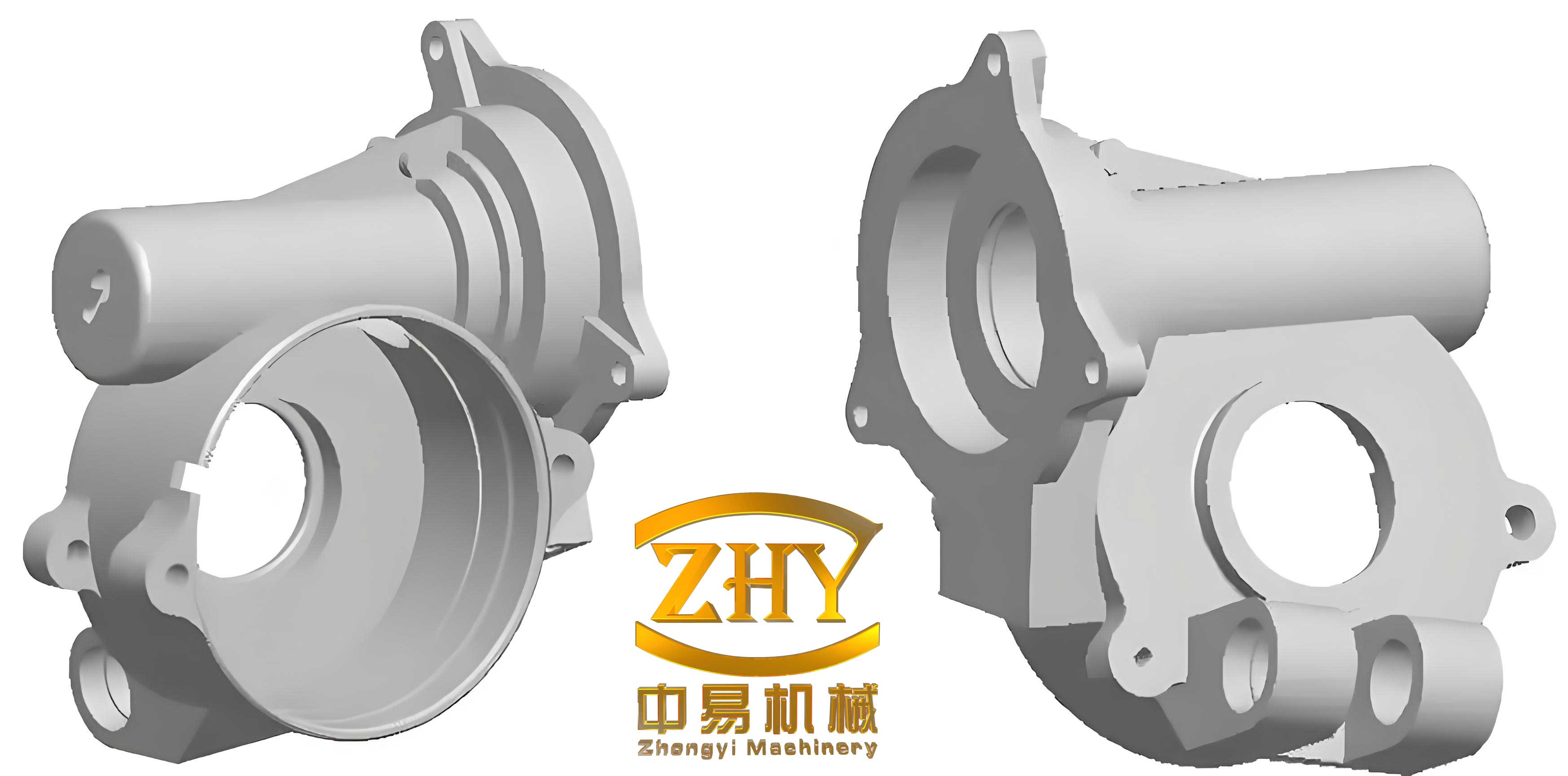
Mesh generation is a critical step in numerical simulation, as it discretizes the continuous geometry into finite elements for computational analysis. I employed an automatic meshing algorithm with adaptive refinement to balance accuracy and computational efficiency. The mesh quality was verified by checking element connectivity and aspect ratios; any non-connected elements were corrected by reducing the mesh size incrementally. For shell castings, which often have thin sections, I used a finer mesh in regions of high curvature or thickness variation to capture thermal gradients accurately. The resulting mesh typically consisted of millions of tetrahedral elements, ensuring that the simulation could resolve complex fluid flow and heat transfer phenomena. The governing equations for the casting process include the Navier-Stokes equations for fluid motion and the energy equation for heat transfer, which I solved using finite element methods. These equations can be expressed as follows:
$$ \frac{\partial \rho}{\partial t} + \nabla \cdot (\rho \mathbf{u}) = 0 $$
$$ \rho \left( \frac{\partial \mathbf{u}}{\partial t} + \mathbf{u} \cdot \nabla \mathbf{u} \right) = -\nabla p + \mu \nabla^2 \mathbf{u} + \rho \mathbf{g} $$
$$ \rho c_p \frac{\partial T}{\partial t} + \rho c_p \mathbf{u} \cdot \nabla T = \nabla \cdot (k \nabla T) + Q $$
Here, $\rho$ is the density, $\mathbf{u}$ is the velocity vector, $p$ is the pressure, $\mu$ is the dynamic viscosity, $\mathbf{g}$ is gravitational acceleration, $c_p$ is the specific heat capacity, $T$ is the temperature, $k$ is the thermal conductivity, and $Q$ represents any heat source terms. For shell castings, these equations are coupled with phase change models to account for solidification, often using enthalpy methods or tracking the liquid fraction. The material properties, such as those for aluminum-silicon alloys commonly used in shell castings, were input into the simulation from empirical databases. Table 1 summarizes key material properties for a typical Al-Si alloy used in my simulations.
| Property | Value | Unit |
|---|---|---|
| Density ($\rho$) | 2700 | kg/m³ |
| Specific Heat ($c_p$) | 900 | J/(kg·K) |
| Thermal Conductivity ($k$) | 150 | W/(m·K) |
| Liquidus Temperature | 615 | °C |
| Solidus Temperature | 555 | °C |
| Latent Heat of Fusion | 390 | kJ/kg |
Boundary conditions and process parameters were carefully defined to mimic the low-pressure casting environment. I set the pressure-time curve based on typical low-pressure profiles, where pressure increases gradually to fill the mold and is then maintained to aid feeding during solidification. The initial temperature of the molten metal was set above the liquidus point, while the mold temperature was assumed to be preheated to reduce thermal shock. Heat transfer coefficients at the metal-mold interface were calibrated from experimental data to ensure realistic cooling rates. These inputs are crucial for accurate simulation of shell castings, as even minor deviations can lead to significant errors in defect prediction.
The filling phase simulation revealed the flow patterns and temperature distribution during mold filling. For shell castings, I observed that the molten metal advanced smoothly from the bottom upward, with minimal turbulence due to the controlled pressure. This is beneficial for shell castings because it reduces oxide formation and gas entrapment. The temperature field showed a gradual decrease from the gate regions to the extremities, indicating progressive cooling. However, in some designs, I identified areas where liquid metal could become trapped, leading to potential cold shuts or misruns. By analyzing velocity vectors and temperature contours, I optimized the gating system to ensure uniform filling. For example, enlarging the sprue diameter or modifying its shape from stepped to conical improved pressure transmission, as evidenced by reduced velocity fluctuations in the simulation outputs.
Solidification simulation followed the filling analysis, focusing on predicting shrinkage porosity and hot spots. The Niyama criterion is often used to assess porosity risk in castings, defined as:
$$ N = \frac{G}{\sqrt{\dot{T}}} $$
where $G$ is the temperature gradient and $\dot{T}$ is the cooling rate. Regions with low Niyama values indicate a high probability of shrinkage defects. In my simulations for shell castings, I computed this criterion across the casting volume to identify critical zones. Initially, a disc-shaped shell casting exhibited shrinkage porosity in a thick section远离 the gate, consistent with thermal isolation. To address this, I iteratively modified the工艺, adding feeding channels or side risers to improve补缩. Each modification was simulated, and the defect distribution was compared. Table 2 outlines the iterative optimization steps I undertook for a representative shell casting.
| Step | Modification | Simulated Defect Volume Reduction | Key Observation |
|---|---|---|---|
| Initial Design | Standard gating with stepped sprue | Baseline (high porosity) | Shrinkage in thick section |
| Revision 1 | Enlarged conical sprue | 15% reduction | Improved pressure but isolated liquid persists |
| Revision 2 | Added one feeding channel | 40% reduction | Better feeding, but defect still visible |
| Revision 3 | Added side riser plus channel | Over 80% reduction | Defect eliminated in critical area |
The numerical results clearly demonstrated that单纯 enlarging the gating system was insufficient for shell castings with complex thermal profiles. Instead, a combination of strategic riser placement and enhanced feeding paths was necessary. For instance, in the third revision, I introduced a side riser adjacent to the problematic thick section, which acted as a thermal reservoir, promoting directional solidification toward the gate. This approach is supported by solidification theory, where the solid fraction $f_s$ evolves according to:
$$ \frac{\partial f_s}{\partial t} = \frac{1}{L} \left( k \nabla^2 T – \rho c_p \frac{\partial T}{\partial t} \right) $$
with $L$ as the latent heat. By ensuring that $f_s$ increases uniformly, isolated liquid pools are minimized, reducing shrinkage in shell castings. The simulation outputs, such as liquid fraction maps and porosity indices, provided visual confirmation of these improvements. For example, after the final optimization, the porosity volume in the critical region decreased to negligible levels, validating the design changes.
To further quantify the benefits, I analyzed the thermal history at key points in the shell casting. Using data extracted from simulations, I plotted cooling curves and calculated solidification times. The results showed that optimized designs reduced the temperature differentials across the casting, leading to more uniform cooling. This is essential for shell castings, as residual stresses and distortions are also mitigated. Additionally, I evaluated the yield improvement by comparing the weight of the initial gating system to the optimized one; typically, optimization reduced material waste by 10-20% while enhancing quality, making the process more economical for high-volume production of shell castings.
Empirical validation was conducted by fabricating molds based on the optimized design and casting actual shell castings using low-pressure equipment. The castings were inspected via non-destructive testing methods such as X-ray radiography and ultrasonic scanning. The results correlated well with simulation predictions: the previously defective areas showed no significant shrinkage, and overall soundness was achieved. This convergence between virtual and physical outcomes underscores the reliability of numerical simulation for shell castings. It also highlights the importance of integrating CAE into the manufacturing workflow, as it reduces trial-and-error cycles and accelerates time-to-market.
Beyond this specific case, I have applied similar methodologies to various other shell castings, such as turbine housings and pump bodies. The principles remain consistent: accurate modeling, thorough simulation, and iterative refinement. However, each shell casting presents unique challenges due to geometry variations. For instance, thin-walled shell castings require careful control of filling speed to avoid mistruns, while thick-walled ones demand robust feeding systems. I often use sensitivity analyses to determine the impact of process parameters like pouring temperature, pressure ramp rate, and mold coating thickness. These analyses can be summarized using response surface methodologies, where key performance metrics (e.g., porosity volume, tensile strength) are modeled as functions of input variables. Such approaches enable optimization of multiple objectives simultaneously, which is crucial for complex shell castings.
Looking forward, advancements in numerical simulation for shell castings include multiphysics coupling—integrating fluid flow, heat transfer, stress analysis, and even microstructure prediction. For example, phase-field models can simulate dendritic growth during solidification, providing insights into mechanical properties. Additionally, machine learning algorithms are being explored to automate optimization, where simulation data trains models to recommend design changes. In my work, I have begun incorporating these techniques to further enhance the quality of shell castings. The ultimate goal is to achieve first-time-right manufacturing, where every shell casting meets specifications without defects, driven by digital twins that mirror the physical process in real-time.
In conclusion, my first-hand experience with numerical simulation has revolutionized the approach to optimizing low-pressure casting processes for shell castings. By virtually probing filling and solidification phenomena, I can preemptively identify defect zones and implement targeted improvements, significantly reducing costs and improving reliability. The iterative process of model refinement, simulation, and validation has proven effective across diverse shell casting applications. As technology evolves, the integration of more sophisticated simulations and data-driven methods will further elevate the quality and efficiency of producing shell castings, solidifying their role in critical engineering applications. This journey underscores the transformative power of CAE in modern foundry practices, making it an indispensable tool for any serious practitioner in the field of shell castings.