
In my extensive experience in the foundry industry, lost foam casting has emerged as a pivotal technology for producing complex and high-integrity shell castings, such as transmission housings. This process, which gained widespread adoption in China in the late 20th century, involves creating a foam pattern that vaporizes upon contact with molten metal, leaving behind a precise casting. The appeal lies in its design freedom, reduced machining needs, and ability to fabricate intricate geometries. However, achieving consistent quality in shell castings demands meticulous control over every工艺 parameter. Here, I will delve into the工艺 design, critical parameters, and defect mitigation strategies, emphasizing the use of tables and formulas for clarity and precision. The goal is to provide a comprehensive guide that ensures high yield and reliability in producing shell castings through lost foam casting.
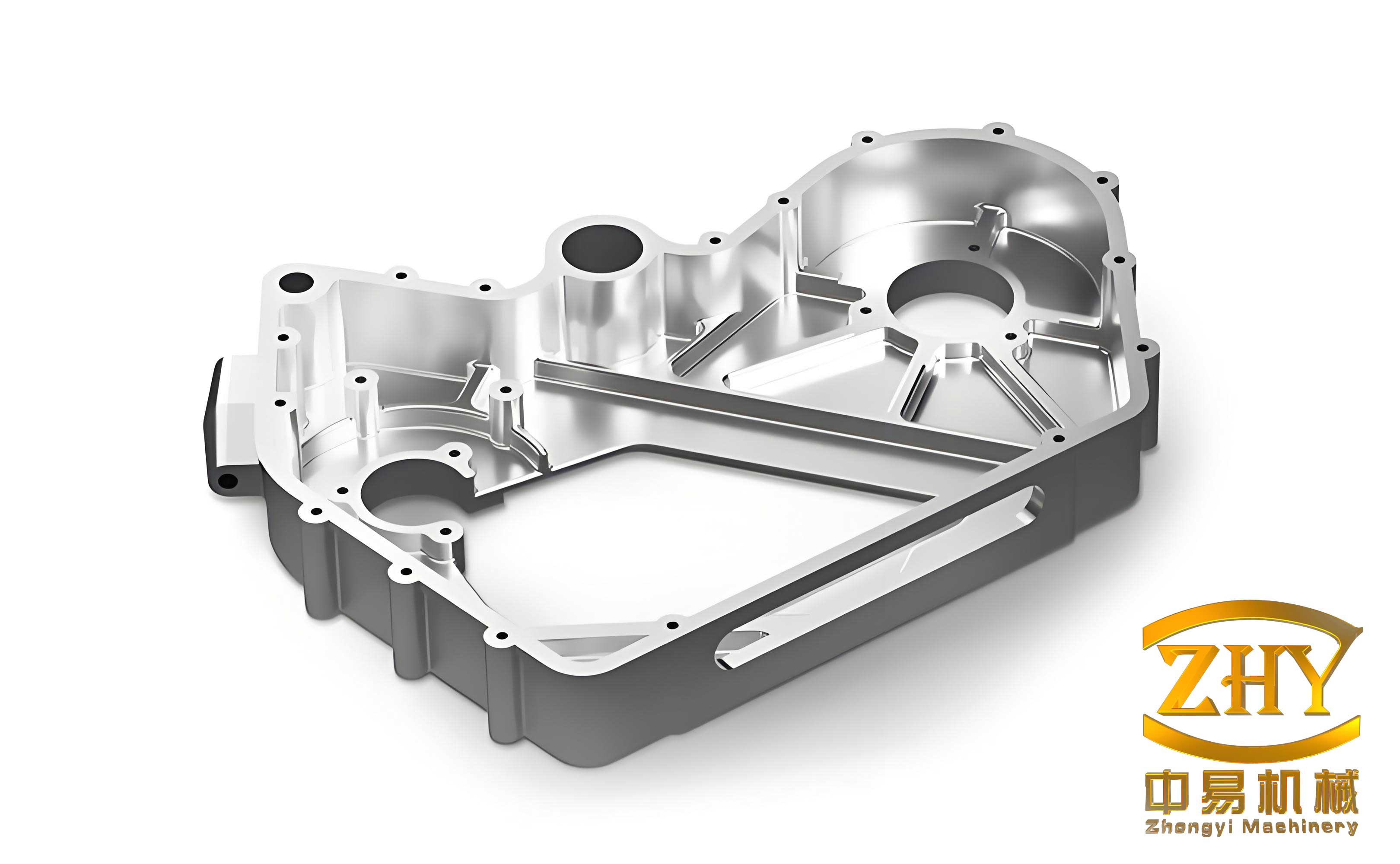
The design of the gating system is arguably the most challenging aspect of lost foam casting for shell castings. Unlike traditional casting, where gating is constrained by mold partitions, lost foam offers unrestricted placement, necessitating a tailored approach. From my实践, I have found that bottom-gating systems are superior for shell castings like transmission cases, as they minimize turbulence and defect formation. In a bottom-gate system, molten metal enters the cavity through two or more ingates at the base, reducing冲刷力 and ensuring a more stable fill. The key parameters include ingate size, sprue height, and pouring time, which can be optimized using fluid dynamics principles. For instance, the flow rate Q (in m³/s) can be expressed as:
$$ Q = A \cdot v $$
where A is the cross-sectional area of the ingate and v is the velocity of the metal stream. To prevent反喷 (back-pressure喷溅), the pouring sequence must be carefully controlled: a fast initial pour to establish flow, followed by a slower rate to maintain stability. I recommend using computational simulations to model the fill pattern, but empirical adjustments are often necessary. Below is a table summarizing optimal gating parameters for typical shell castings:
| Parameter | Recommended Value | Rationale |
|---|---|---|
| Sprue Diameter | 30-40 mm | Ensures adequate metal supply without excessive turbulence |
| Ingate Number | 2-4 | Distributes flow, reduces局部过热 |
| Pouring Temperature | 1420-1480°C | Balances fluidity and gas evolution |
| Pouring Time per Casting | 10-15 seconds | Minimizes temperature drop and defect risk |
Beyond gating, other工艺 parameters profoundly influence the quality of shell castings. The coating application is critical for creating a barrier between the foam pattern and the sand mold. Based on my work, I use a slurry of桂林 5号铸粉 (a proprietary coating) mixed with water at a 1:10 ratio. This coating is applied manually in two layers, each dried in a controlled environment. The drying process can be modeled using heat transfer equations, such as Fourier’s law for conduction:
$$ q = -k \frac{dT}{dx} $$
where q is the heat flux, k is the thermal conductivity, and dT/dx is the temperature gradient. For practical purposes, I maintain a drying temperature of 50±5°C for 15-20 hours to ensure complete moisture removal. After drying, the patterns are placed in a砂箱 measuring 1200 mm × 1000 mm × 900 mm, allowing multiple shell castings per batch. Sand filling is done via rain-sand方法, followed by compaction on a 3D vibration table. The振动 parameters, including amplitude (0.5-1.0 mm) and frequency (40-80 Hz), must be optimized to achieve uniform sand density without distorting the foam. The compaction force F can be estimated as:
$$ F = m \cdot a $$
where m is the mass of the sand and a is the acceleration from vibration. For melting, I employ a 3-ton medium-frequency furnace, charging it with scrap steel and pig iron. The melt is superheated to 1520°C before tapping into a 0.5-ton ladle for pouring. Maintaining the pouring temperature within 1420-1480°C is essential to prevent premature foam decomposition and ensure complete mold filling. Below, I summarize the key工艺 parameters in a table:
| Process Step | Parameter | Specification | Impact on Shell Castings |
|---|---|---|---|
| Coating | Composition | 桂林 5号铸粉 : Water = 1:10 | Provides耐火性 and gas permeability |
| Drying | Temperature/Time | 50±5°C, 15-20 h | Eliminates moisture, prevents cracking |
| Sand Filling | Method | Rain-sand with vibration | Ensures uniform mold support |
| Vibration | Amplitude/Frequency | 0.5-1.0 mm, 40-80 Hz | Compacts sand without pattern damage |
| Melting | Temperature | 1520°C (tap), 1420-1480°C (pour) | Controls fluidity and gas evolution |
Despite careful工艺 design, defects can arise in shell castings, with形变 (distortion), carbon defects, and粘砂 (sand adhesion) being the most prevalent. In my experience,形变 occurs due to the low strength of foam patterns during handling, coating, and sand filling. To counteract this, I have tested several reinforcement methods. The most effective involves bonding bamboo strips or similar rigid elements to weak areas of the pattern using adhesive. This approach minimizes added mass and simplifies post-casting清理. The deformation δ can be approximated by beam theory:
$$ \delta = \frac{F L^3}{3 E I} $$
where F is the applied force, L is the length, E is the Young’s modulus, and I is the moment of inertia. By increasing I through reinforcement, δ is reduced. Carbon defects, manifested as black inclusions on顶面 and侧面, result from incomplete vaporization of foam decomposition products. Key factors include foam composition, pouring speed, and gating design. The carbon content ω(C) in the foam influences gas generation, which can be modeled as:
$$ G = k \cdot \omega(C) \cdot e^{-E_a/(RT)} $$
where G is the gas evolution rate, k is a constant, E_a is the activation energy, R is the gas constant, and T is the temperature. To mitigate carbon defects, I select foams with low ω(C) and添加 methyl violet to enhance degradation. Additionally, optimizing pouring speed and using bottom-gating with risers at the top help evacuate gases and residues. The table below outlines defect causes and solutions for shell castings:
| Defect Type | Primary Causes | Prevention Methods | Relevant Formula/Parameter |
|---|---|---|---|
| Distortion | Weak foam pattern, handling stress | Reinforce with bamboo strips; optimize vibration parameters | $$ \delta = \frac{F L^3}{3 E I} $$ |
| Carbon Defects | High foam carbon, slow pouring, improper gating | Use low-carbon foam; increase pouring speed; bottom-gate design | $$ G = k \cdot \omega(C) \cdot e^{-E_a/(RT)} $$ |
| Sand Adhesion | Coating failure, loose sand, high pouring temperature | Apply self-hardening resin sand in死角; ensure proper drying and vibration | Sand density ρ ≥ 1.6 g/cm³ |
粘砂 is particularly troublesome in shell castings, occurring in死角 and hot spots where sand fuses with the metal. This defect stems from multiple factors: coating cracking, inadequate sand compaction, insufficient drying, low负压度, high pouring temperature, and suboptimal涂料 strength. From my trials, the most effective solution is to line the pattern interior with a layer of self-hardening resin sand after drying, focusing on corners and complex geometries. This added layer enhances耐火性 and prevents metal penetration. The risk of粘砂 can be quantified using the penetration probability P:
$$ P = 1 – e^{-(\sigma / \sigma_c)^2} $$
where σ is the interfacial stress and σ_c is the critical strength of the coating-sand interface. By increasing σ_c through resin sand, P is minimized. Furthermore, maintaining a负压度 of 0.04-0.06 MPa during pouring helps stabilize the mold and reduce gas-related issues. It’s crucial to train operators on standardized procedures to avoid human error, as even minor deviations can compromise shell castings quality.
To achieve consistent results in shell castings production, a holistic approach is necessary. Each parameter interlinks, and small adjustments can have cascading effects. For instance, the pouring temperature directly impacts foam decomposition kinetics, which in turn affects carbon defect formation. I often use a multivariate optimization model to balance these factors, represented as:
$$ Y = f(T_p, v_p, \omega(C), t_d, …) $$
where Y is the casting quality metric, T_p is pouring temperature, v_p is pouring velocity, ω(C) is foam carbon content, and t_d is drying time. Through iterative testing and statistical analysis, I have identified optimal windows for these variables. Additionally, regular monitoring of sand properties, such as粒度 distribution and moisture content, is vital. The table below provides a checklist for quality assurance in shell castings:
| Checkpoint | Target Value | Measurement Method | Frequency |
|---|---|---|---|
| Foam Density | 20-25 kg/m³ | Weight-volume ratio | Per batch |
| Coating Thickness | 1-2 mm per layer | Ultrasonic gauge | Per pattern |
| Sand Compactness | ≥ 85% density | Sand hardness tester | Per sand fill |
| Pouring Temperature | 1420-1480°C | Thermocouple | Each pour |
| Negative Pressure | 0.04-0.06 MPa | Vacuum gauge | Continuous |
The economic and technical benefits of optimized lost foam casting for shell castings are substantial. By reducing machining allowance and minimizing defect rates, overall production costs decrease while part performance improves. In my work, I have seen yield rates for transmission shell castings exceed 95% through diligent application of these principles. Future advancements may involve integrating real-time sensors and AI for adaptive process control, but the fundamentals remain rooted in understanding material behaviors and interactions. For anyone embarking on lost foam casting for shell castings, I emphasize the importance of systematic experimentation and documentation—each foundry environment is unique, and tailored solutions yield the best outcomes.
In conclusion, the成功 production of high-integrity shell castings via lost foam casting hinges on a deep grasp of工艺 mechanics. From gating design to defect mitigation, every step must be engineered with precision. The formulas and tables presented here serve as a foundation for optimizing parameters and ensuring repeatability. As the demand for complex shell castings grows in automotive and industrial sectors, mastering these techniques will be key to competitive advantage. I encourage continuous learning and collaboration within the foundry community to push the boundaries of what’s possible with lost foam casting for shell castings.