
In my extensive experience as a casting engineer, the production of high-quality shell castings, such as tractor holder housings, presents significant challenges due to complex geometries, varying wall thicknesses, and stringent material requirements. Shell castings are critical components in heavy machinery, where defects like shrinkage porosity, cold shuts, blowholes, and cracks must be meticulously controlled to ensure structural integrity and performance. This article details a comprehensive casting process developed for tractor holder housing shell castings, focusing on design strategies, material optimization, and quality assurance. Throughout this discussion, the term “shell castings” will be emphasized to highlight the broader applicability of these techniques to similar thin-walled or complex-shaped cast components.
The holder housing shell casting, as illustrated, has a mass of 23 kg with a轮廓尺寸 of approximately 295 mm × 195 mm. It features a multi-layer flange design with significant variations in wall thickness: the cylindrical section is 9 mm thick, the first flange plate is 16 mm, the second flange plate is 15 mm, and the connecting plate between them is 12 mm. Large thermal junctions, around 50 mm in diameter, exist at the intersections of the cylinder and flanges, creating inherent risks for shrinkage defects due to inadequate feeding paths. The material specification demands high-strength pearlitic ductile iron equivalent to QT700-3, with tensile strength ≥700 MPa, elongation ≥3%, hardness of 225–305 HB, nodularity grades 1–3, and pearlite content ≥90%. Such shell castings must be free from shrinkage cavities, porosity, cold shuts, misruns, and cracks to meet operational demands.
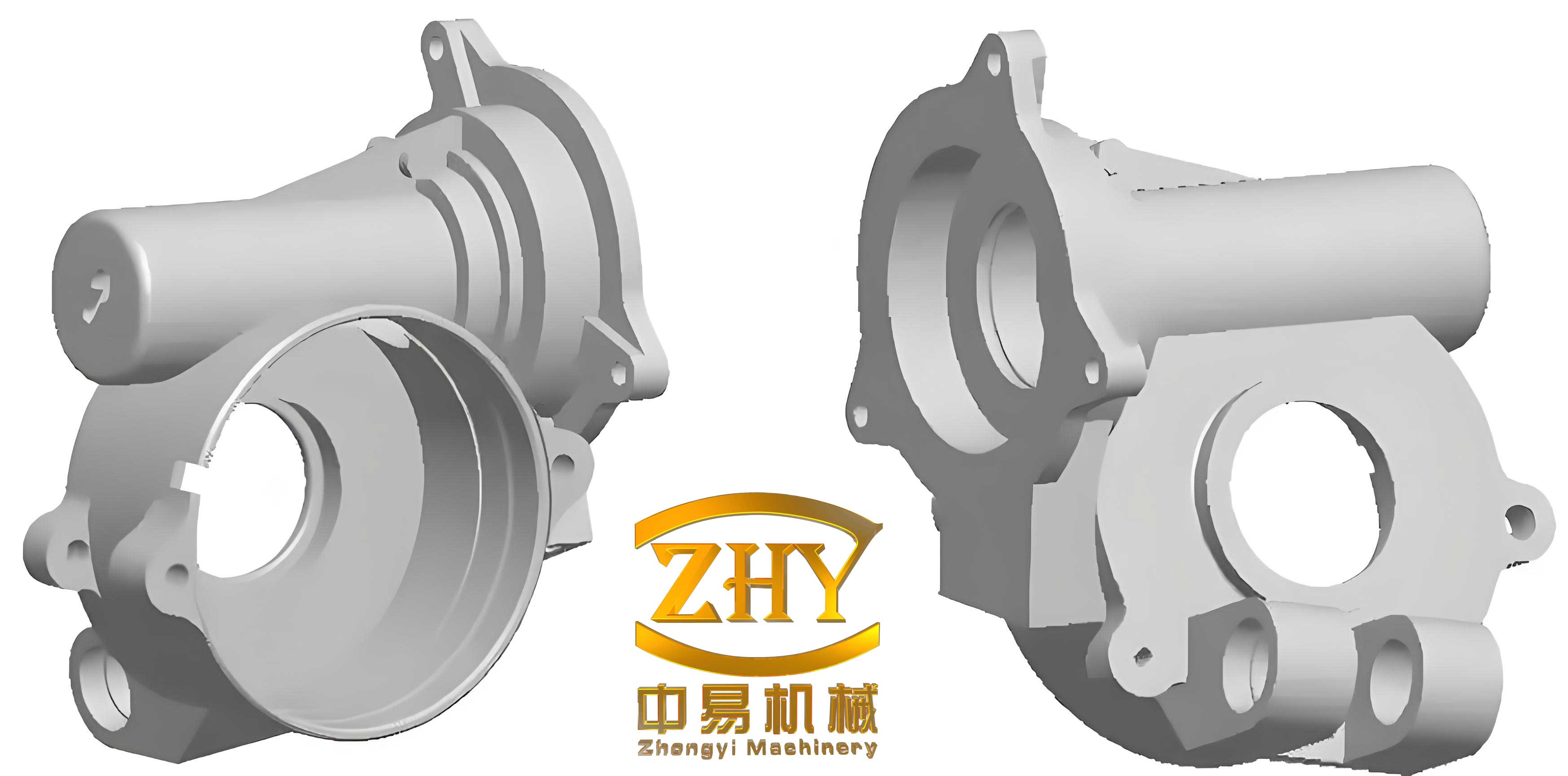
The casting process design begins with selecting an appropriate parting plane and pouring position to facilitate molding, core placement, and effective feeding. For these shell castings, I chose a pouring orientation with the cylinder facing downward and the parting surface located below the upper flange. This configuration allows for straightforward mold assembly and core setting, while positioning the thermal junctions favorably for riser feeding. The linear shrinkage allowance is set at 0.8%, and dimensional tolerances conform to CT9 grade. Each shell casting requires three sand cores: Core #1 is a hand-made gas-fired core (2 per box), while Cores #2 and #3 are produced via hot-box process (1 each per box), all using resin-coated sand. Molding is conducted on a Swiss GF air-impulse line with flask dimensions of 900 mm × 700 mm × 300/300 mm, accommodating two shell castings per mold. The air-impulse pressures are 0.38–0.40 MPa for the cope and 0.40–0.42 MPa for the drag, achieving a mold hardness >90 on the B-scale. Core setting sequence involves placing Core #1 first, followed by Core #2, and then mating Core #3 onto Core #2, ensuring precise alignment for these intricate shell castings. A filter is finally inserted into the gating system.
The gating system is designed as a pressurized type to promote rapid and turbulent-free filling. The cross-sectional area ratios are critical for controlling flow dynamics in shell castings. Based on empirical data, the ratio is defined as:
$$\Sigma F_{\text{sprue}} : \Sigma F_{\text{runner}} : \Sigma F_{\text{gate}} = 2.90 : 2.43 : 1.0$$
where the total gate area \(\Sigma F_{\text{gate}} = 4.88 \, \text{cm}^2\). To address the large thermal junctions, the feeding strategy incorporates a top riser embedded within Core #3. Molten metal flows from the pouring cup through the sprue into the main runner, then via branch runners it ascends through Core #2 into the central cavity of Core #3, entering the riser before being directed through three layers of gates into the first flange plate. This riser, located internally within the sand core, benefits from enhanced insulation and acts as an efficient feeder for the hot spots, a technique particularly effective for shell castings with restricted feeding channels. Production trials confirmed the absence of shrinkage defects, validating this approach.
Material control is paramount for achieving the desired mechanical properties in shell castings. The chemical composition must balance strength, ductility, and castability. For pearlitic ductile iron shell castings, I employ a Cu-Sb alloying system combined with low-rare-earth nodularizers and optimized inoculation. The base iron is melted in a 3-ton medium-frequency induction furnace using Q10 pig iron, ensuring precise temperature control and composition homogeneity. Key elements are selected based on their influence on microstructure: carbon enhances fluidity and graphitization, silicon promotes ferrite but must be controlled for strength, manganese strengthens but can segregate, while copper and antimony synergistically increase pearlite content without excessive brittleness. The target composition ranges are summarized in Table 1.
| Element | Base Iron | After Treatment |
|---|---|---|
| C | 3.60–3.80 | 3.60–3.80 |
| Si | 1.0–1.3 | 2.2–2.6 |
| Mn | ≤0.20 | 0.40–0.55 |
| P | ≤0.05 | ≤0.05 |
| S | ≤0.045 | ≤0.02 |
| Mgres | – | 0.030–0.050 |
| REres | – | 0.020–0.040 |
| Cu | – | 0.5–0.8 |
| Sb | – | 0.01–0.03 |
Nodularization is performed using FeSiRE3Mg8 nodularizer containing 2.5–3.5% Ca and ≤0.7% MgO. The reaction kinetics can be modeled using the magnesium recovery equation:
$$\eta_{\text{Mg}} = \frac{M_{\text{Mg,res}}}{M_{\text{Mg,added}}} \times 100\%$$
where \(\eta_{\text{Mg}}\) is the magnesium recovery rate, typically maintained at 40–50% for these shell castings. Inoculation is critical to suppress carbide formation and enhance nodule count. I adopt a double inoculation process: primary inoculation with a Ba-containing inoculant (0.20–0.25%, 3–10 mm grain size) in the ladle, followed by secondary stream inoculation with 75SiFe (0.10%, 0.5–1.5 mm grain size) during pouring. The effectiveness of inoculation can be expressed in terms of nodule density \(N_d\) (nodules/mm²), which correlates with mechanical properties. For high-quality shell castings, \(N_d\) should exceed 150 nodules/mm², achievable through proper inoculation practices.
The mechanical performance of shell castings is rigorously tested via standard tensile and hardness specimens cut from separately cast keel blocks. Table 2 presents a subset of data from production trials, demonstrating consistent compliance with specifications. The results highlight the efficacy of the integrated process for shell castings.
| Sample | Chemical Composition (wt%) – Key Elements | Microstructure | Mechanical Properties |
|---|---|---|---|
| C, Si, Mn, Mgres, Cu, Sb | Nodularity Grade, Pearlite (%) | σb (MPa), δ (%), HB | |
| 1 | 3.68, 2.45, 0.44, 0.055, 0.658, 0.015 | 2, 95 | 864.2, 3.14, 262 |
| 2 | 3.72, 2.45, 0.42, 0.055, 0.658, 0.015 | 2, 95 | 877.2, 4.00, 271 |
| 3 | 3.65, 2.44, 0.45, 0.053, 0.51, 0.015 | 2, 90 | 831.7, 3.71, 263 |
| 4 | 3.71, 2.55, 0.042, 0.048, 0.69, 0.017 | 2, 95 | 884.6, 3.50, 257 |
| 5 | 3.70, 2.55, 0.038, 0.048, 0.69, 0.017 | 2, 95 | 878.0, 3.00, 269 |
To further optimize shell castings, I analyze the solidification behavior using thermal modulus calculations. The thermal modulus \(M\) (volume-to-surface area ratio) determines feeding requirements. For the critical sections in these shell castings, such as the cylinder-flange junction, \(M\) can be approximated as:
$$M = \frac{V}{A}$$
where \(V\) is volume and \(A\) is surface area. For a cylindrical junction with diameter \(D = 50 \, \text{mm}\) and wall thickness variations, \(M\) values range from 0.5 to 1.0 cm, necessitating riser design with modulus \(M_r > 1.2 M_c\) (where \(M_c\) is casting modulus) to ensure soundness. The riser efficiency \(\eta_r\) for shell castings is given by:
$$\eta_r = \frac{V_f}{V_r} \times 100\%$$
where \(V_f\) is feed metal volume and \(V_r\) is riser volume. With the internal top riser, \(\eta_r\) approaches 15–20%, adequate for these shell castings.
Defect prevention in shell castings also involves controlling pouring parameters. The pouring temperature \(T_p\) is maintained at 1380–1400°C to balance fluidity and shrinkage. The pouring time \(t_p\) for shell castings can be estimated using empirical formulas:
$$t_p = k \sqrt{W}$$
where \(W\) is casting weight in kg and \(k\) is a coefficient (typically 1.8–2.2 for ductile iron shell castings). For a 23 kg casting, \(t_p\) is around 8–10 seconds. Additionally, mold rigidity and venting are crucial to avoid gas-related defects in shell castings. The resin sand mixture for cores includes 1.2–1.5% binder and 0.3–0.5% catalyst, cured at 180–220°C to achieve tensile strength >2.5 MPa, ensuring dimensional stability.
In terms of metallurgical aspects, the role of alloying elements in shell castings warrants detailed discussion. Copper enhances pearlite formation and strength through solid solution hardening, while antimony refines pearlite and increases hardenability. The combined effect can be modeled using a pearlite potential index \(P_p\):
$$P_p = a[\text{Cu}] + b[\text{Sb}] + c[\text{Mn}] – d[\text{Si}]$$
where \(a, b, c, d\) are coefficients derived from regression analysis. For shell castings targeting ≥90% pearlite, \(P_p\) should exceed 0.5. Furthermore, the nodularization process relies on controlling residual magnesium and rare earths. Too low levels lead to poor nodularity, while excesses cause carbides and dross. The optimal range for shell castings is 0.04–0.06% Mgres and 0.02–0.04% REres, as established through experimentation.
Quality assurance for shell castings extends to non-destructive testing. I recommend ultrasonic inspection for internal defects and dye penetrant testing for surface cracks, especially in stress-concentration areas like flange transitions. Statistical process control charts for key parameters (e.g., chemical composition, pouring temperature, mechanical properties) help maintain consistency across production batches of shell castings.
The economic viability of this process for shell castings is enhanced by yield improvement. The casting yield \(Y\) is calculated as:
$$Y = \frac{W_c}{W_m} \times 100\%$$
where \(W_c\) is casting weight and \(W_m\) is total metal poured. With optimized gating and risering, yield for these shell castings reaches 65–70%, reducing material costs and energy consumption. Moreover, the use of low-rare-earth nodularizers and efficient inoculation lowers additive expenses, making it suitable for high-volume production of shell castings.
Comparative analysis with alternative processes, such as sand casting with external risers or die casting, reveals advantages for shell castings. The internal riser design minimizes machining allowances and improves aesthetic appeal, while the alloy system ensures machinability and wear resistance. For future developments, simulation software can predict solidification patterns and optimize feeding for even more complex shell castings, reducing trial-and-error iterations.
In conclusion, the integrated casting process—encompassing strategic parting plane selection, internal top riser feeding, Cu-Sb alloying, low-rare-earth nodularization, and double inoculation—proves highly effective for producing tractor holder housing shell castings. Defects like shrinkage porosity, cold shuts, and cracks are consistently mitigated, and mechanical properties reliably meet QT700-3 standards. This methodology underscores the importance of holistic design and material engineering for high-performance shell castings in agricultural and industrial machinery. As demand for lightweight and durable components grows, these principles will continue to guide advancements in shell casting technology.