
In my extensive experience within the foundry industry, the production of high-integrity shell castings for demanding applications, such as automotive steering systems, presents a significant technological challenge. The core requirement is to achieve a defect-free, pressure-tight microstructure that can withstand rigorous service conditions. This article delves into the methodological advancements and technical intricacies involved in producing such shell castings, with a particular focus on overcoming leakage defects through innovative foundry practices. The journey from conventional methods to optimized processes highlights the evolution in shell castings manufacturing.
The specific component under discussion is a pressure-resistant shell casting, analogous to a valve body, used in an integral hydraulic power steering gear. Its primary function necessitates withstanding an internal oil pressure of 20 MPa for a duration of 5 minutes without any seepage or leakage. The material specification is QT600, a grade of ductile iron (spheroidal graphite iron), prized for its strength and castability. Geometrically, the shell casting features a relatively uniform wall thickness of approximately 10 mm in its main body. However, it incorporates several thickened sections: three flange ends with a thickness of around 30 mm and four mounting bosses. These sections act as thermal hotspots, fostering a pronounced tendency for shrinkage porosity and micro-shrinkage defects in conventional casting processes. The formation of such defects is catastrophic for pressure integrity, making the production of these shell castings notoriously difficult.
To contextualize the problem, I will compare several prevalent casting methodologies for producing these critical shell castings. The comparison is best summarized in the following table, which encapsulates key performance metrics.
| Casting Method | Principle | Typical Yield for Shell Castings | Estimated Rejection Rate (Leakage) | Surface Finish & Dimensional Accuracy | Suitability for High-Pressure Shell Castings |
|---|---|---|---|---|---|
| Green Sand Casting | Traditional sand molds with clay binders. | 45% – 65% | >50% | Adequate | Poor. Inadequate feeding leads to leakage. |
| Resin Sand Casting (Cold-Box) | Chemically bonded sand molds for improved accuracy. | Similar to Green Sand (~50-70%) | Remains High (~40-50%) | Good to Very Good | Moderate. Improves geometry but not inherent soundness. |
| Metal Mold with Sand Liner (Chilled Mold) | Rapid cooling in a permanent metal mold. | High (70-80%) | Moderate to High | Excellent | Moderate. Risk of mistruns and high stress. |
| Iron Mold with Sand Coating (Coated Permanent Mold) | A permanent iron mold lined with a thin, precise sand layer. | 82% – 85% | <10% | Excellent | Excellent. Enables controlled solidification. |
As the table illustrates, green sand casting, while flexible, suffers from a low yield and an unacceptably high scrap rate due to leakage for these shell castings. The fundamental issue lies in the feeding requirements of ductile iron. Ductile iron solidifies over a wide temperature range, exhibiting a strong tendency for pasty solidification and dispersed micro-shrinkage. In sand molds, which are highly yielding, the volumetric contraction during solidification must be compensated by extensive feeder heads (risers) to ensure a sound casting. For a complex shell casting with multiple isolated hot spots, this necessitates multiple risers, drastically reducing the casting yield. Even with optimized risering, the random nature of sand mold expansion often fails to effectively utilize the graphite expansion phase of ductile iron for self-feeding.
Resin sand casting improves the geometric fidelity and surface finish of the shell castings but does not fundamentally alter the metallurgical dynamics of feeding. The mold, while more dimensionally stable, still possesses significant yield, failing to harness the potential of the graphite expansion. Consequently, the rejection rate for pressure-tight shell castings remains prohibitively high.
The breakthrough for producing these demanding shell castings came from adopting and refining the iron mold with sand coating process, often referred to as coated permanent mold or chill mold with sand liner casting. This process uniquely combines the benefits of a rigid, high-thermal-conductivity metal mold with the adjustability of a sand layer. The iron mold provides minimal yield and rapid heat extraction, while the thickness of the sand coating can be precisely varied across different sections of the mold cavity. This allows the foundry engineer to design the thermal profile of the mold, thereby dictating the solidification sequence of the shell casting.
The core principle can be described using a simplified thermal model. The solidification time, $t_s$, for a section can be approximated by Chvorinov’s rule, modified for a composite mold:
$$ t_s = B \left( \frac{V}{A} \right)^n $$
where $V$ is the volume of the casting section, $A$ is its surface area, $n$ is an exponent (often ~2), and $B$ is the mold constant. For a shell casting in an iron mold with a sand coating, $B$ is not uniform. It is a function of the coating thickness $d_c$ and the thermal properties of the coating and iron mold. A thicker sand coating increases the thermal resistance, effectively increasing $B$ for that local area and slowing down solidification. By strategically making the sand coating thinner over hot spots (like the flanges) and thicker over thinner sections, we can promote directional solidification towards a designated feed zone or, more elegantly, create conditions for simultaneous solidification.
For ductile iron shell castings, the latter approach is particularly powerful. By designing the mold coating to minimize thermal gradients, we aim for nearly simultaneous solidification across the casting. The rigid iron mold restrains the outward expansion of the casting during the eutectic solidification phase when graphite precipitates. The volumetric expansion associated with graphite formation (graphitization expansion) is internally harnessed to compensate for the liquid and solidification shrinkage. This phenomenon of “self-feeding” or “autogenous feeding” is expressed conceptually by considering the volume change during solidification:
$$ \Delta V_{total} = \Delta V_{shrinkage} + \Delta V_{graphite} + \Delta V_{mold\ yield} $$
In a rigid iron mold, $\Delta V_{mold\ yield} \approx 0$. For successful production of sound shell castings, the process must ensure that:
$$ |\Delta V_{graphite}| \geq |\Delta V_{shrinkage}| $$
The sand coating’s thickness and the iron mold’s stiffness are the primary levers to control the pressure dynamics within the solidifying shell casting to meet this condition. The following formula relates the internal pressure $P_i$ developed during solidification to the mold rigidity and graphite expansion:
$$ P_i = f(E_m, \nu_m, \epsilon_g) $$
where $E_m$ is the effective modulus of the mold system, $\nu_m$ is its Poisson’s ratio, and $\epsilon_g$ is the strain due to graphite expansion. A high $E_m$ (from the iron mold) leads to a higher $P_i$, which suppresses the formation of shrinkage pores within the shell casting.
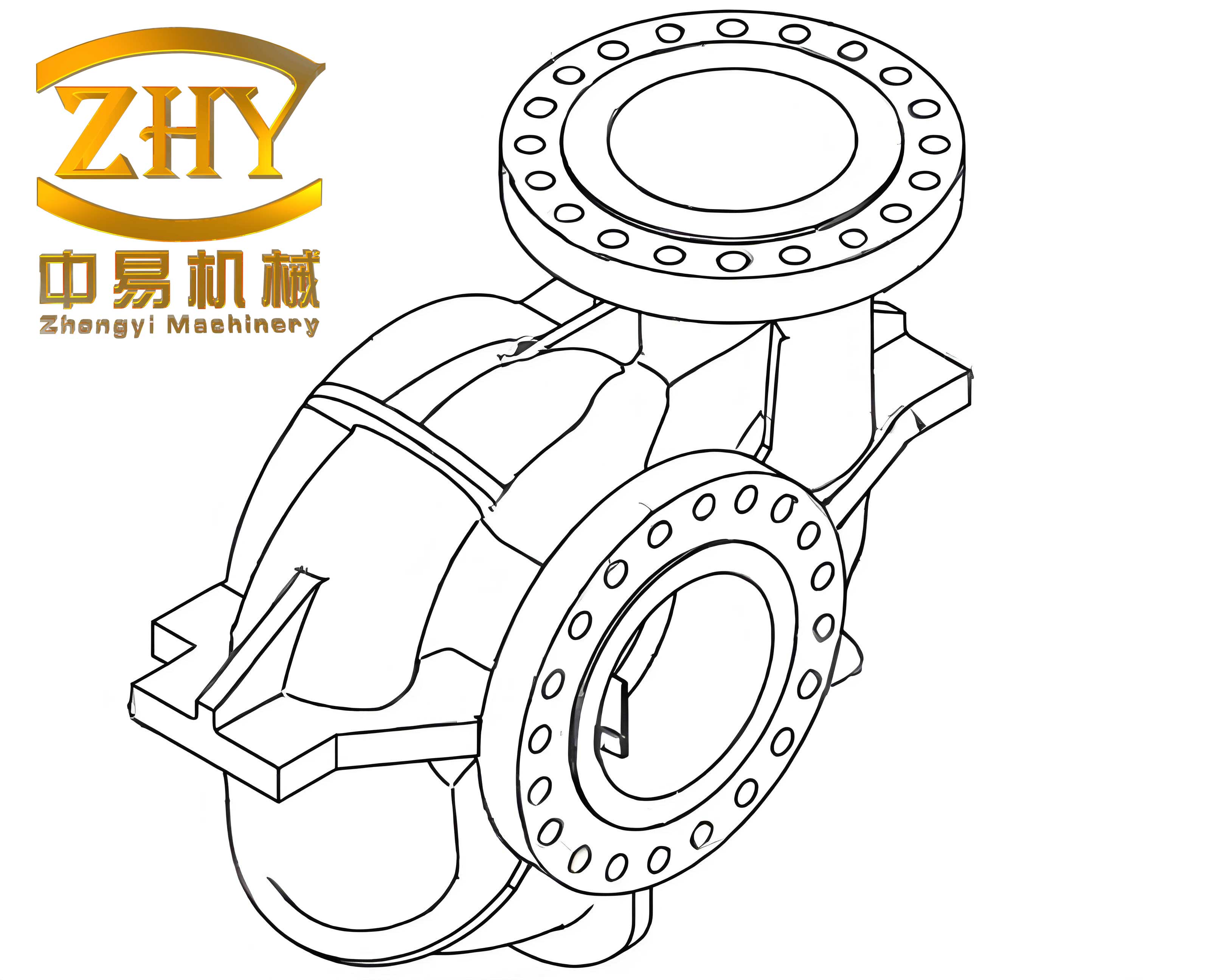
The practical implementation of this process for our steering shell castings involved meticulous tooling design. A major constraint was the need to produce both left-hand and right-hand versions of the shell casting without duplicating the entire tooling set. The solution was to design a single iron mold and pattern plate that could accommodate both variants through clever core design. The internal cavity of the shell casting is formed by sand cores. We decomposed the main core into two interoperable pieces—Core 1# and Core 2#. This modular pair could be assembled in two different configurations to produce either the left or right shell casting cavity within the same mold. This innovative approach saved substantial capital investment in tooling while providing production flexibility for these shell castings.
The final casting layout was arranged with four shell castings per mold (two left and two right), positioned vertically with the output port facing upwards to facilitate core venting. A pressurized gating system was employed to ensure rapid and complete filling. The key parameters are summarized below:
| Process Parameter | Value or Specification |
|---|---|
| Mold Type | Iron Mold with Resin-Coated Sand Liner |
| Sand Coating Thickness (Variable) | 3-8 mm (thinner on hot spots) |
| Cavities per Mold | 4 |
| Metal | Ductile Iron QT600 (0.045% Mg, 3.7% C, 2.5% Si) |
| Inoculation | Primary (FeSi) in furnace, Secondary (FeSi) in stream |
| Pouring Temperature | 1360 – 1380 °C |
| Pouring Time (per mold) | 15 – 20 seconds |
| Gating System Type | Pressurized (Choke at sprue base) |
| Calculated Casting Yield | 82% – 85% |
The production trials were conducted using cupola-melted iron that was subsequently treated for spheroidization and inoculation. The secondary inoculation at the pouring stream was critical to ensure a high nodule count and fine graphite structure, which enhances the self-feeding capability. The controlled, relatively slow pour over 15-20 seconds allowed for gentle filling, minimizing turbulence and aiding in the release of gases from the cores.
The results were markedly superior to previous methods. The shell castings produced exhibited excellent surface finish, with sharp definition and smooth as-cast surfaces. Machining revealed dense, sound metal with no surface-breaking defects. The ultimate validation came from the pressure test: each shell casting was subjected to 20 MPa hydraulic pressure for 5 minutes. The acceptance rate consistently achieved 90% or higher, a dramatic improvement from the >50% rejection experienced with sand casting. The internal soundness of these shell castings was directly attributable to the controlled solidification environment provided by the iron mold and sand coating.
The success of this process can be further analyzed through the lens of solidification modeling. The thermal modulus $G$ (temperature gradient) and solidification rate $R$ determine the microstructure and soundness. In our iron mold process for shell castings, we engineer a high $G$ at the metal-mold interface due to the chill effect, promoting a fine, equiaxed zone. Deeper within the wall, the combination of the sand liner’s insulation and the exothermic graphitization reaction helps maintain a more isothermal condition, supporting the self-feeding mechanism. The fraction of graphite expansion utilized for feeding, $F_g$, can be conceptually modeled as:
$$ F_g = k \cdot \frac{E_m \cdot \alpha_g}{P_c} $$
where $k$ is a process constant, $\alpha_g$ is the volumetric expansion coefficient due to graphite, and $P_c$ is the critical pressure for pore nucleation. For our shell castings, the high $E_m$ of the iron mold system maximizes $F_g$, effectively eliminating shrinkage porosity.
In conclusion, the transition to iron mold with sand coating technology represents a paradigm shift for manufacturing high-pressure shell castings from ductile iron. This process delivers unparalleled advantages: exceptional casting yield exceeding 82%, a drastic reduction in leakage-related scrap to below 10%, and superior surface and dimensional quality. It masterfully exploits the inherent material property of ductile iron—its graphitization expansion—by pairing it with a mold system of precisely calibrated rigidity and thermal control. The development of flexible, modular core systems further enhances its economic viability for producing variant shell castings. This case study firmly establishes that for critical, pressure-containing shell castings, moving beyond traditional expendable mold methods to engineered permanent mold processes is not just beneficial but essential for achieving the required levels of quality, consistency, and cost-effectiveness. The principles outlined here are broadly applicable to a wide range of valve bodies, pump casings, and other complex, pressure-tight shell castings across various industries, paving the way for more reliable and efficient component manufacturing.