
In our production of high-integrity aluminum alloy castings, a significant challenge was presented by a series of thin-walled, tall shell castings. These components are characterized by their substantial height-to-diameter ratio, complex internal ribbing, and stringent requirements for pressure tightness and mechanical properties. Traditional gravity sand casting with conventional risers proved inadequate. During pouring, by the time the molten metal ascended through the sprue and reached the top riser, its temperature had dropped significantly. Furthermore, the presence of a top mold (cope) created a chilling “edge effect,” resulting in the riser being cooler than the casting body below it. Consequently, the riser’s effectiveness in feeding shrinkage during solidification was minimal, often leading to shrinkage porosity and scattered micro-shrinkage defects in the final shell castings, compromising their leak-tightness.
To overcome these inherent limitations, we developed and implemented a riserless gating process based on the principles of counter-pressure casting, also known as differential pressure casting. This method involves placing the mold in a sealed chamber above a crucible of molten metal connected via a stalk (lift tube). The entire system is pressurized. By carefully controlling the pressure differential between the chamber (mold cavity) and the crucible, the metal is forced upward into the mold cavity in a precisely controlled manner. The metal remains under this stabilizing pressure throughout the filling, solidification, and cooling phases. This approach transforms the solidification dynamics, enabling the production of sound, dense shell castings without the need for traditional risers.
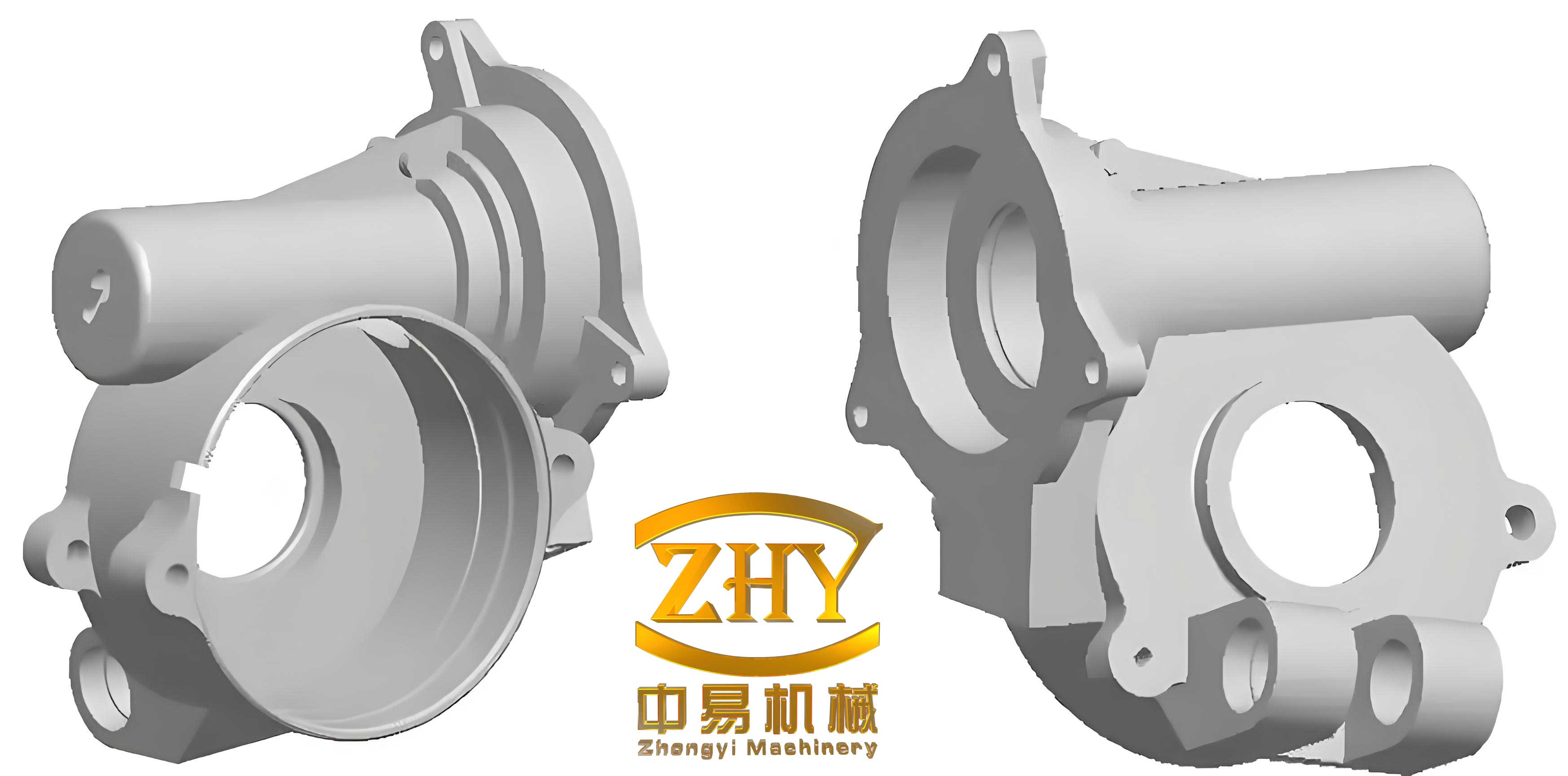
Analysis of the Shell Casting and Process Challenges
The specific shell casting under consideration is a critical component with demanding specifications. A summary of its key characteristics and requirements is presented in the table below.
| Feature | Specification / Value |
|---|---|
| Weight | Approximately 120 kg |
| Structure | Thin-walled cylindrical shell with internal reinforcing ribs |
| Height | Large (substantial) |
| Large End Diameter | Ø 480 mm |
| Small End Diameter | Ø 340 mm |
| Average Wall Thickness | 8 mm |
| Internal Bore Finish | As-cast, non-machined |
| Maximum Allowable Porosity (per GB/T 9438) | Grade 3 |
| Internal Pressure Test | 22.5 MPa (gas) |
| External Pressure Test | 15 MPa (water) |
The combination of great height, significant variation in section thickness (from thin walls to thicker ribs), and the extreme pressure performance requirements placed this component beyond the reliable capability of standard foundry processes. The core challenge was to achieve directional solidification from the top (thin, small end) down to the bottom (thicker, large end) while maintaining a metallostatic head pressure to feed shrinkage throughout the entire process, all without relying on a thermally inefficient top riser.
Core Principle: Counter-Pressure Casting
Counter-pressure casting provides the necessary controlled environment. The fundamental principle relies on applying a pressure difference (ΔP) across the molten metal column to drive and control filling. The key advantages for producing shell castings are:
- Laminar Filling: The metal rises smoothly into the mold cavity, minimizing turbulence, air entrapment, and oxide film formation.
- Pressure-Enhanced Feeding: The applied pressure is maintained during solidification, dramatically increasing the feeding capacity of the molten metal. This pressure compensates for shrinkage, suppressing the formation of macro-shrinkage and micro-porosity.
- Refined Microstructure: Pressure during solidification increases the nucleation rate, refines grain structure, and can force interdendritic liquid into incipient shrinkage zones.
- Reduced Gas Porosity: The increased pressure raises the solubility of gases (like hydrogen) in the liquid aluminum, reducing their tendency to precipitate and form pinholes during solidification.
The governing equation for the metal front velocity during filling is derived from the balance between the driving pressure differential and the system’s hydraulic resistance:
$$ \Delta P = h \rho g + k \rho v^2 $$
Where:
ΔP = Pressure differential between crucible and mold chamber [Pa]
h = Instantaneous height of the metal column in the stalk and mold [m]
ρ = Density of the molten alloy [kg/m³]
g = Acceleration due to gravity [m/s²]
k = System’s hydraulic resistance coefficient (depends on gating design, mold permeability, etc.)
v = Velocity of the metal front [m/s]
By carefully controlling ΔP throughout the cycle, the velocity v can be kept within an optimal range for laminar flow.
Process Design for Riserless Shell Castings
1. Pouring Position and Solidification Control
The casting is oriented with the larger diameter end at the bottom, connected directly to the gating system. The smaller diameter end is at the top, with no riser. This orientation, combined with the controlled filling from below, establishes a strong thermal gradient. The mold walls and the chilling effect at the top (small end) promote solidification starting at the top and progressing downwards, while the bottom remains liquid longest, fed continuously by the pressurized metal source below. This creates perfect conditions for directional solidification.
2. Gating System Design
For thin-walled, tall shell castings, a vertical slot gating (or “knife gate”) system was selected. This design combines the advantages of bottom gating (smooth, non-turbulent fill) with some characteristics of top gating in terms of thermal management. Multiple vertical slots are arranged around the circumference of the casting’s bottom flange.
The number and dimensions of the slots are critical. They must provide sufficient total cross-sectional area to allow rapid filling to prevent mistuns, yet be thin enough to solidify quickly and not create hot spots. The number of slots (n) can be determined empirically and verified by the following relationship considering the casting’s perimeter (C) and chosen slot width (b_slot):
$$ n = \frac{C}{A \cdot b_{slot}} $$
Where A is a layout factor. For our casting, four slots were used, strategically placed to avoid alignment with the thick internal ribs to prevent localized overheating.
The entire gating system is designed as “unpressurized” or open (i.e., total cross-sectional area increases from the stalk exit to the slots). This further promotes calm filling. The system comprises:
- Stalk (Lift Tube): Connects the crucible to the gating system within the pressure chamber.
- Spherical Slag Trap: Located at the top of the stalk to buffer initial metal flow and capture primary oxides.
- Radial Runner: Distributes metal from the slag trap to the base of the slots.
- Ceramic Foam Filters: Placed in each radial runner segment to filter out inclusions.
- Vertical Slot Gates: The final passage into the mold cavity. Their thickness is tapered, being slightly thicker at the bottom to delay solidification there and support feeding.
The cross-sectional area of the stalk/runner system is sized based on the desired fill time and the principles of hydraulic flow. An approximate formula for the stalk area (A_stalk) is:
$$ A_{stalk} = \frac{W}{\rho \cdot \mu \cdot t \cdot \sqrt{2gH}} $$
Where:
W = Total poured weight (casting + gating system) [kg]
μ = Discharge coefficient (for aluminum, ~0.45-0.55)
t = Target fill time [s]
H = Effective metallostatic head during pressure differential filling [m]
3. Mold and Core Technology
Given the height of the shell casting, a three-part flask assembly was used for the outer mold to facilitate molding, core setting, and finishing. The molds were made with green sand. The internal cavity of the shell is formed by a large, complex dry sand core. To manage its size and ensure accuracy, the core box was split into three sections aligned with precision dowels. The core was reinforced with a steel skeleton and baked to achieve the necessary strength and low gas evolution.
4. Critical Process Parameters & Their Interdependence
The success of the counter-pressure riserless process hinges on the precise selection and control of several interlinked parameters. The table below outlines the key parameters and their typical ranges for aluminum shell castings.
| Parameter | Symbol | Role & Consideration | Typical Range/Value |
|---|---|---|---|
| Pouring Temperature | T_pour | Lower than in gravity casting. Reduces total shrinkage and grain size but must be high enough for complete filling. | ~680 – 710 °C (Al alloys) |
| Fill Time | t_fill | Determines fill velocity. Too slow risks mistuns; too fast causes turbulence. | 10 – 30 s (depending on casting mass & geometry) |
| Fill (Front) Velocity | v_fill | Directly controlled via ΔP. Must ensure laminar flow. | 20 – 50 mm/s |
| Pressure Differential | ΔP | The primary control variable. Drives filling and applies solidification pressure. | 20 – 80 kPa |
| Maximum Pressure (Holding) | P_max | Pressure maintained during solidification. Critical for feeding and densification. | 300 – 800 kPa |
| Holding/Pressure Time | t_hold | Must exceed the local solidification time of the heaviest section. | 3 – 10 minutes |
The optimal fill velocity (v_fill_opt) is a function of casting geometry and alloy properties. It can be estimated from the target fill time (t_fill) and the casting height (H_cast):
$$ v_{fill\_opt} \approx \frac{H_{cast}}{t_{fill}} $$
This velocity is then used, along with the system resistance (k), to back-calculate the required pressure differential profile ΔP(t) using the flow equation mentioned earlier.
An example of recorded parameters for a successful trial of the shell casting is shown below:
| Casting ID | T_pour (°C) | P_chamber (kPa) | ΔP (kPa) | v_fill (mm/s) | t_hold (s) |
|---|---|---|---|---|---|
| Shell-01 | 695 | 550 | 45 | 35 | 300 |
| Shell-02 | 690 | 580 | 50 | 38 | 320 |
Defect Suppression Mechanism and Feasibility of Riserless Approach
The elimination of traditional risers for these shell castings is not merely an omission but a calculated replacement of their function by the controlled pressure field. The technical justification is multi-faceted.
1. Feeding and Shrinkage Elimination
In conventional casting, the total volume deficit (V_shrinkage) due to contraction must be fed by risers. For an alloy solidifying over a temperature range, it can be modeled as:
$$ V_{shrinkage} = V_{casting} \cdot [\alpha_l (T_{pour} – T_{liquidus}) + \alpha_s + \alpha_f (T_{solidus} – T_{room})] $$
Where α_l, α_s, α_f are coefficients of liquid, solidification (phase change), and solid contraction, respectively. In counter-pressure casting, the high pressure P_max applied during solidification effectively increases the feeding pressure far beyond that provided by a small riser’s metallostatic head. This pressure can force interdendritic liquid into regions that would otherwise become porous. The feeding distance is vastly extended, making the entire casting cavity act as its own feeding reservoir from the bottom up.
2. Gas Porosity Reduction
According to Sieverts’ law, the solubility of diatomic gases (like H₂) in liquid metal is proportional to the square root of the partial pressure:
$$ S = k_s \sqrt{P_{H_2}} $$
Where S is solubility, and k_s is a constant. By solidifying under several atmospheres of pressure, the solubility of hydrogen in the liquid aluminum at the solidification front is increased. This shifts the thermodynamic equilibrium, making it less favorable for hydrogen to precipitate and form gas pores, thereby drastically reducing pinhole defects in the shell castings.
3. Structural Justification for Omission of Top Riser
As analyzed earlier, the thermal geometry of this specific tall shell casting with a top mold (cope) inherently leads to a cold top section. A riser placed there would freeze prematurely, losing its feeding capability and potentially creating a thermal barrier that disrupts desirable directional solidification. By removing it and relying on the enforced directional solidification from top-down, fed by the pressurized source at the bottom, a more robust and reliable thermal gradient is established.
Experimental Results and Comparative Analysis
The effectiveness of the counter-pressure riserless process was rigorously evaluated by comparing it against the previous gravity sand casting process with risers for the same shell castings. The results demonstrate conclusive advantages.
1. Microstructural and Defect Analysis
Metallographic examination of sections from castings produced by both methods revealed stark differences:
- Counter-Pressure Castings: The microstructure was dense and uniform. No shrinkage porosity or gas pinholes (above Grade 3) were detected. The grain structure was notably finer.
- Gravity Castings: The microstructure exhibited micro-shrinkage and scattered porosity, typically rated at Grade 4-5. The grain structure was coarser and more dendritic.
The suppression of shrinkage and gas defects is the direct result of pressure-enhanced feeding and increased gas solubility, as previously explained.
2. Mechanical Properties
Tensile test bars machined from representative sections of the shell castings (after T6 heat treatment) showed a significant improvement in mechanical properties for the counter-pressure samples. The data is summarized below:
| Property | Counter-Pressure Casting | Gravity Sand Casting | Improvement |
|---|---|---|---|
| Tensile Strength (UTS) | 345 MPa | 295 MPa | +17% |
| Yield Strength (0.2% PS) | 290 MPa | 240 MPa | +21% |
| Elongation (%) | 8.5 | 4.0 | +113% |
| Brinell Hardness (HB) | 105 | 95 | +11% |
The increases in strength and, most notably, ductility (elongation) are directly attributable to the denser, more homogeneous microstructure with fewer stress-concentrating defects.
3. Economic and Quality Metrics
The transition to a riserless process also yielded substantial practical benefits beyond quality, impacting yield, machining, and consistency.
| Metric | Gravity Casting (with Risers) | Counter-Pressure Riserless Casting | Benefit |
|---|---|---|---|
| Casting Yield (Product Weight / Total Poured Weight) | ~62% | ~78% | Elimination of riser metal significantly reduces melt volume and energy consumption. |
| Typical Machining Allowance | 4 – 5 mm | 2 – 3 mm | Improved dimensional accuracy and surface integrity allow for nearer-net-shape machining. |
| Internal Quality Consistency | Variable, often requiring repair | Consistently high, leak-tight | Dramatically reduces scrap and rework rates, improving production predictability. |
| Pressure Test Pass Rate | < 85% | > 99% | Essential for meeting the stringent performance specifications of the shell castings. |
Conclusion
This detailed process experiment demonstrates that the strategic application of counter-pressure casting principles enables the successful production of high-integrity, thin-walled, tall aluminum shell castings using a riserless gating approach. The key to success lies in a holistic design integrating:
- Controlled Solidification: Achieving directional solidification through casting orientation and thermal management of the mold.
- Optimized Gating: Employing a multi-slot, filtered, open system to ensure calm, rapid filling.
- Precise Parameter Control: Mastering the interrelationship between pouring temperature, fill velocity (via ΔP), holding pressure, and holding time.
The process fundamentally alters the solidification conditions by applying a sustained, high pressure. This pressure acts as a powerful feeding force to eliminate shrinkage defects and modifies gas solubility to suppress pinhole formation. The resulting castings exhibit superior metallurgical quality—characterized by a refined, dense microstructure—which translates directly into enhanced and more consistent mechanical properties, particularly ductility and pressure tightness.
Furthermore, the elimination of bulky risers provides a significant economic advantage through increased yield, reduced machining, and lower scrap rates. For foundries facing the challenge of producing complex, high-performance thin-walled shell castings with demanding specifications, the counter-pressure riserless casting process presents a robust and technically sound solution.