
In the field of advanced manufacturing, the production of high-integrity shell castings through investment casting presents significant challenges, particularly for thin-walled and geometrically complex components. This study focuses on the gravity filling process for thin-walled complex cone shells, utilizing ZL205A aluminum alloy, a material renowned for its high strength after heat treatment. The objective is to design a robust casting methodology that ensures defect-free shell castings with superior mechanical properties. Through a combination of process design, finite element method (FEM) simulation, and experimental validation, we explore the intricacies of filling, solidification, and microstructure evolution. The insights gained here are pivotal for advancing the manufacturing of lightweight and durable shell castings used in aerospace and other high-performance applications.
The demand for aluminum alloys in structural applications stems from their low density, high specific strength, and excellent corrosion resistance. Among these, ZL205A alloy is particularly valued for its tensile strength exceeding 420 MPa after T5 heat treatment, making it ideal for critical shell castings. However, its high copper content (4.6–5.3 wt%) and wide solidification temperature range (544–633°C) introduce challenges such as segregation, shrinkage porosity, and hot tearing. These issues are exacerbated in thin-walled complex cone shells, where wall thickness variations and intricate geometries hinder proper filling and directional solidification. This work addresses these challenges by implementing a bottom-pouring gravity filling system in investment casting, supported by comprehensive FEM simulations to optimize the process parameters.
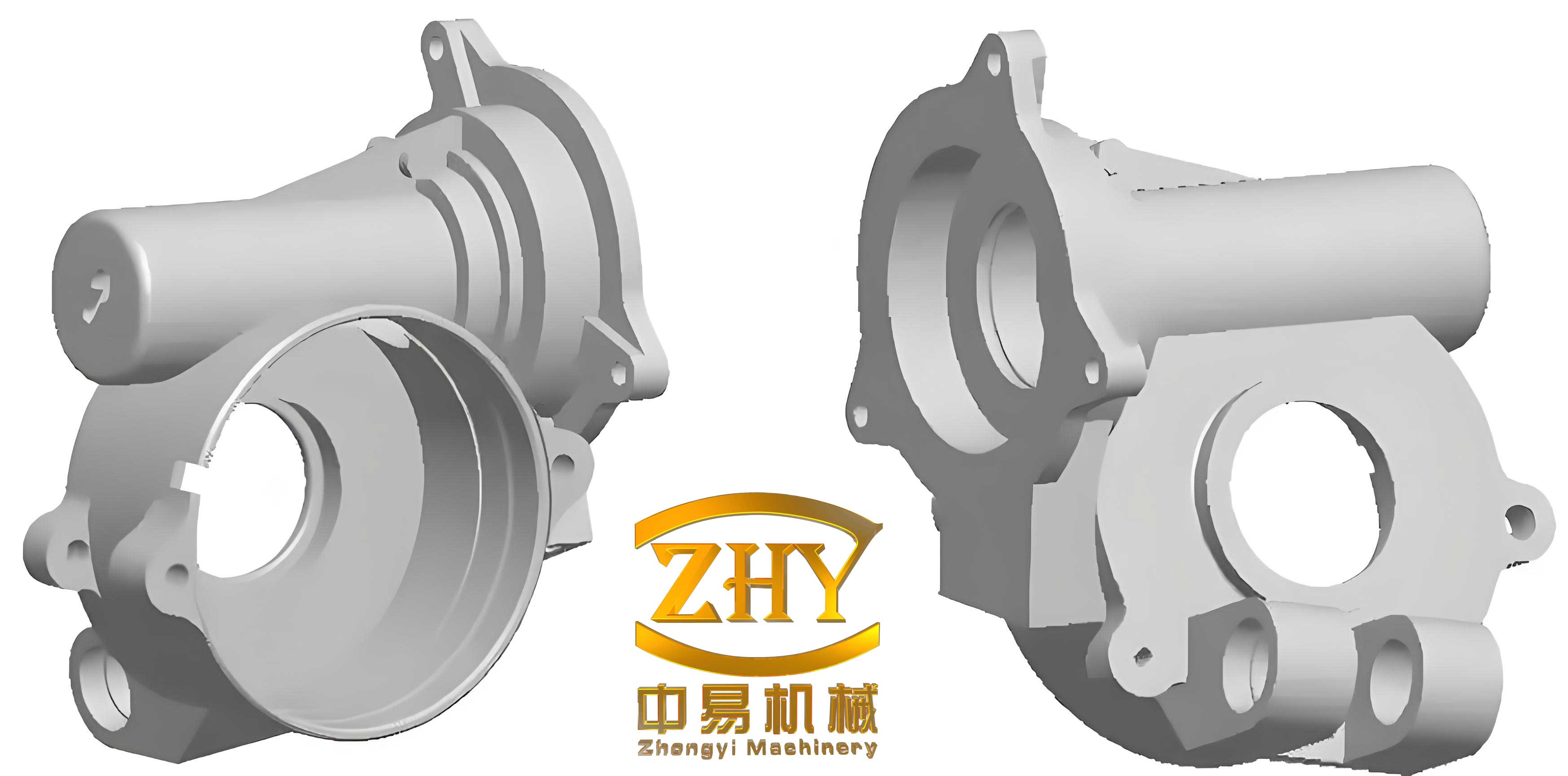
The shell castings under consideration feature a conical geometry with an average wall thickness of 4.5 mm, incorporating a bottom ring, intermediate ribs, a top ring, and multiple pin bosses. The rib thickness is 3.5 mm, while the junction between the rib and bottom ring has a thickness difference of 6.5 mm, creating potential hot spots for shrinkage. The transition regions in the ribs have small radii of 2 mm, increasing the risk of hot cracks. To achieve high-quality shell castings, a systematic approach is required, encompassing material analysis, process design, and numerical simulation. This article details each step, emphasizing the role of gravity filling in controlling the microstructure and properties of the final shell castings.
Material Characteristics and Process Design
ZL205A aluminum alloy is selected for its balanced mechanical properties, but its casting behavior must be carefully managed. The chemical composition of the alloy is summarized in Table 1, highlighting the high copper content that influences fluidity and solidification morphology. The solidification interval of 89°C promotes mushy solidification, which can lead to macro-segregation and porosity in shell castings if not controlled. To mitigate these effects, the gravity filling process is designed to ensure progressive solidification from the bottom to the top of the cone shell.
| Element | Cu | Mn | Cd | Ti | Zr | V | B | Zn | Al |
|---|---|---|---|---|---|---|---|---|---|
| Content | 4.6–5.3 | 0.4 | 0.24 | 0.20 | 0.12 | 0.18 | 0.4 | 0.1 | Balance |
The investment casting process begins with the creation of a ceramic mold, into which the molten alloy is poured under gravity. Initially, a top-pouring system was attempted, but it resulted in shrinkage porosity and gas defects in the ring regions of the shell castings. Consequently, a bottom-pouring gravity filling system was developed, as illustrated in the design schematic. This system includes a tapered sprue (bottom diameter 12 mm, top diameter 30 mm), a horseshoe-shaped runner, two side gap gates, and a top insulating riser. The ingate connects to the top ring of the shell casting, with dimensions of 18 mm × 4 mm × 30 mm. The side gap gates measure 170 mm × 5 mm, and the riser has an inner diameter of 114 mm, outer diameter of 148 mm, and height of 32 mm. This configuration aims to distribute melt evenly, preheat the mold, and facilitate directional solidification for high-integrity shell castings.
The heat treatment parameters for achieving T5 temper in ZL205A shell castings are critical for optimizing mechanical properties. As shown in Table 2, the solution treatment involves holding at 538°C for 14 hours, followed by water quenching at 40°C. Aging is conducted at 155°C for 9 hours in air. This regimen enhances the precipitation strengthening effect, contributing to the high strength and ductility of the final shell castings.
| Process Step | Temperature (°C) | Time (h) | Medium | Cooling/Heating Rate |
|---|---|---|---|---|
| Solution Treatment | 538 | 14 | Air Furnace | Controlled |
| Quenching | 40 | Immediate | Water | Rapid |
| Aging | 155 | 9 | Air | Slow Cooling |
Finite Element Method Simulation of the Casting Process
To predict and optimize the gravity filling process for shell castings, FEM simulations were performed using ProCAST software. The computational domain included the shell casting and the ceramic mold, with mesh sizes of 4 mm for the casting (548,296 elements) and 8 mm for the mold (489,652 elements). The interface heat transfer coefficient was set to 500 W/(m²·K), assuming rigid contact. The pouring temperature was 720°C, and the gravity filling velocity was 1 cm/s. These parameters were chosen to replicate industrial conditions for producing thin-walled shell castings.
The governing equations for fluid flow and heat transfer during casting are essential for understanding the simulation results. The filling process is modeled using the incompressible Navier-Stokes equations, simplified for gravity-driven flow:
$$ \rho \left( \frac{\partial \mathbf{u}}{\partial t} + \mathbf{u} \cdot \nabla \mathbf{u} \right) = -\nabla p + \mu \nabla^2 \mathbf{u} + \rho \mathbf{g} $$
where \( \rho \) is the density, \( \mathbf{u} \) is the velocity vector, \( t \) is time, \( p \) is pressure, \( \mu \) is the dynamic viscosity, and \( \mathbf{g} \) is gravitational acceleration. For shell castings, the thin walls necessitate careful control of flow to avoid turbulence and air entrapment.
Heat transfer during solidification is described by the energy equation:
$$ \frac{\partial (\rho c_p T)}{\partial t} = \nabla \cdot (k \nabla T) + \rho L \frac{\partial f_s}{\partial t} $$
Here, \( c_p \) is the specific heat, \( T \) is temperature, \( k \) is thermal conductivity, \( L \) is latent heat of fusion, and \( f_s \) is the solid fraction. The evolution of \( f_s \) is critical for predicting shrinkage defects in shell castings and is modeled using a microsegregation approach. The solidification kinetics can be approximated by the Scheil equation for non-equilibrium conditions:
$$ f_s = 1 – \left( \frac{T_m – T}{T_m – T_l} \right)^{1/(1-k)} $$
where \( T_m \) is the melting point of pure aluminum, \( T_l \) is the liquidus temperature, and \( k \) is the partition coefficient. These equations underpin the simulation of temperature and solid phase distribution in shell castings.
Analysis of Filling Flow Field
The FEM simulation results for the filling flow field reveal the effectiveness of the bottom-pouring gravity system. At 3 s, the sprue is completely filled, and by 5 s, the horseshoe runner is fully occupied, initiating the upward filling of the shell casting cavity. By 9 s, the molten alloy begins to enter the cavity through the side gap gates, promoting uniform filling. At 14 s, approximately 50% of the cavity is filled, with the top riser contributing to accelerated filling. By 18 s, about 85% of the shell casting volume is filled, and complete filling is achieved at 21 s. The total filling time of 21 s indicates a stable and controlled process, minimizing turbulence and oxide formation in the thin-walled shell castings. The progressive filling from the bottom ensures that air is expelled through the riser, reducing gas defects in the final shell castings.
The velocity distribution during filling can be quantified using the Reynolds number, which for thin sections in shell castings is kept low to maintain laminar flow:
$$ Re = \frac{\rho u D_h}{\mu} $$
where \( D_h \) is the hydraulic diameter of the flow channels. In this design, \( Re \) is estimated to be below 2000, ensuring smooth filling. The pressure drop along the flow path is also minimal due to the gradual tapering of the sprue, which maintains a consistent metallostatic pressure for feeding the shell castings during solidification.
Solidification Temperature Field and Solid Phase Distribution
The solidification temperature field simulation shows that directional solidification is achieved from the bottom to the top and from the inside to the outside of the cone shell. At 21 s, the entire shell casting is filled, and the melt remains in a liquid state. By 44 s, solidification begins at the inner regions, while the side gap gates remain hot to provide feeding. At 88 s, the bottom ring solidifies first, followed by progressive solidification upward. By 214 s, the shell casting is mostly solid, and the riser effectively feeds the bottom ring region. Complete solidification occurs at 374 s, with the entire casting and gating system solidified. This sequential cooling is vital for reducing thermal stresses and preventing hot tears in the rib regions of the shell castings.
The solid phase distribution simulation focuses on the rib section of the shell castings. At 21 s, filling is complete. By 94 s, solid nuclei appear in the core of the rib, indicating the onset of solidification. The solid fraction \( f_s \) increases gradually, reaching 100% in the rib region by 424 s. The evolution of \( f_s \) over time can be modeled using an Avrami-type equation for shell castings:
$$ f_s(t) = 1 – \exp(-k t^n) $$
where \( k \) and \( n \) are constants dependent on alloy composition and cooling rate. For ZL205A shell castings, the values are derived from simulation data to predict microstructural features. The complete solidification time of 424 s ensures that sufficient feeding occurs, minimizing shrinkage porosity in the critical sections of the shell castings.
The temperature gradient \( G \) and solidification rate \( R \) are key parameters influencing the microstructure of shell castings. They are related to the cooling rate \( \dot{T} \) by:
$$ \dot{T} = G \times R $$
In this process, \( G \) is highest at the bottom ring and decreases upward, promoting columnar grain growth in shell castings. The simulated values range from 10 to 50 K/cm, depending on the location, which aligns with desired directional solidification for high-quality shell castings.
Microstructure and Mechanical Properties of Shell Castings
Microstructural analysis of the as-cast and T5 heat-treated shell castings reveals refined grain structures. The average grain size in the as-cast condition is 112 μm, which reduces to 94 μm after T5 treatment. This refinement is attributed to the controlled solidification and precipitation hardening in ZL205A shell castings. The grain size distribution can be described by a log-normal function:
$$ f(d) = \frac{1}{d \sigma \sqrt{2\pi}} \exp\left(-\frac{(\ln d – \mu)^2}{2\sigma^2}\right) $$
where \( d \) is grain diameter, and \( \mu \) and \( \sigma \) are parameters. For these shell castings, \( \mu \) corresponds to 4.6 for as-cast and 4.5 for T5, indicating uniformity.
Mechanical properties were evaluated using specimens extracted from the rib region of the shell castings after T5 heat treatment. The results, summarized in Table 3, demonstrate that the shell castings meet the design specifications. The average tensile strength is 453 MPa, yield strength is 400 MPa, elongation is 8.9%, and Brinell hardness is 114 HB. These properties surpass the minimum requirements of 420 MPa tensile strength, 380 MPa yield strength, and 4.5% elongation, highlighting the efficacy of the gravity filling process for producing high-performance shell castings.
| Property | Average Value | Standard Deviation | Design Requirement |
|---|---|---|---|
| Tensile Strength (MPa) | 453 | 10.2 | ≥420 |
| Yield Strength (MPa) | 400 | 8.5 | ≥380 |
| Elongation (%) | 8.9 | 0.7 | ≥4.5 |
| Brinell Hardness (HB) | 114 | 3.1 | Not Specified |
The relationship between mechanical properties and microstructure for shell castings can be expressed through the Hall-Petch equation:
$$ \sigma_y = \sigma_0 + \frac{k_y}{\sqrt{d}} $$
where \( \sigma_y \) is yield strength, \( \sigma_0 \) is friction stress, \( k_y \) is the strengthening coefficient, and \( d \) is grain size. For ZL205A shell castings, \( k_y \) is approximately 0.15 MPa·m¹/², derived from experimental data. This confirms that grain refinement contributes significantly to the strength of the shell castings.
Discussion on Process Optimization for Shell Castings
The success of the gravity filling process for thin-walled complex cone shells hinges on several factors. First, the bottom-pouring design minimizes turbulence and oxide inclusion, which are common defects in shell castings. Second, the use of side gap gates and a top riser ensures adequate feeding during solidification, reducing shrinkage porosity. Third, the FEM simulations provide insights into temperature and solid phase distributions, allowing for preemptive adjustments. For instance, the simulation predicted hot spots at the rib-bottom ring junction, which were mitigated by optimizing the riser size. This proactive approach is essential for mass-producing consistent shell castings.
The economic and technical benefits of this process are substantial. By reducing defect rates, the yield of shell castings improves, lowering production costs. Moreover, the mechanical properties achieved enable the use of these shell castings in safety-critical applications, such as aerospace components. Future work could explore the integration of additive manufacturing for mold fabrication, further enhancing the geometric flexibility of shell castings.
Conclusion
In summary, the gravity filling technology for investment casting thin-walled complex cone shells using ZL205A alloy has been demonstrated to produce high-quality shell castings. The bottom-pouring system, complemented by FEM simulations, ensures a total filling time of 21 s, complete solidification at 374 s, and full solid phase precipitation at 424 s. This facilitates directional solidification from bottom to top and inside to outside, minimizing defects in the shell castings. The microstructure exhibits refined grains, with average sizes of 112 μm as-cast and 94 μm after T5 treatment. The mechanical properties, including tensile strength of 453 MPa and elongation of 8.9%, meet and exceed design specifications. This study underscores the importance of integrated process design and simulation for advancing the manufacturing of reliable shell castings, paving the way for broader applications in high-performance industries. The methodologies developed here can be adapted to other alloy systems and geometries, contributing to the ongoing evolution of investment casting technology for shell castings.