
In my extensive experience in the foundry industry, the production of large steel shell castings for cone crushers presents a significant technical challenge due to their complex geometry, stringent quality requirements, and demanding service conditions. These shell castings are critical components in crushing equipment, where they house wear-resistant liners, crushing cones, motors, and transmission gears. Operating under severe vibration and dusty environments, any failure due to casting defects can lead to substantial production losses and economic damage. Therefore, developing a robust casting process is essential for ensuring product reliability, cost-effectiveness, and batch production efficiency. This article delves into the comprehensive process design, simulation validation, and quality control measures for manufacturing cone crusher shell castings, specifically focusing on the CH660 model’s bottom shell. Throughout this discussion, I will emphasize the key aspects of shell castings production, incorporating tables and formulas to summarize critical data.
The cone crusher shell casting in question is a large-scale component with a maximum diameter of 2200 mm, a height of 1095 mm, and a rough weight of 8200 kg. The wall thickness varies significantly, ranging from 55 mm to 150 mm, featuring intricate geometries such as flanges, ribs, and a motor housing cavity. This shell casting is produced in batches, with an annual demand exceeding a hundred pieces. The material specification is an internal standard K1 (GS200+N), which requires precise chemical composition and mechanical properties. The quality standards are rigorous, including dimensional accuracy per ISO 806 Table ICT12, surface finish, and non-destructive testing. The heat treatment involves normalizing followed by tempering. Below, I present the chemical composition and mechanical property requirements for these shell castings.
| Element | Range |
|---|---|
| C | ≤0.18 |
| Si | 0.30–0.60 |
| Mn | 0.80–1.20 |
| P | ≤0.030 |
| S | ≤0.025 |
| Cu | ≤0.30 |
| Property | Requirement |
|---|---|
| Yield Strength | ≥200 MPa |
| Tensile Strength (Rm) | >400 MPa |
| Elongation (A) | >25% |
| Impact Energy (AKV) | ≥35 J |
The surface quality and inspection standards for these shell castings are based on international norms, as summarized below.
| Inspection Type | Standard | Description |
|---|---|---|
| Surface Defects | MSS-SP-55-2001 | Visual inspection for roughness and defects |
| Ultrasonic Testing (UT) | SS-EN12680; ASTM A-609 | Internal flaw detection |
| Magnetic Particle Testing (MT) | SS-EN1309; ASTM A-125 | Surface crack detection |
Developing a casting process for such shell castings begins with a thorough technical analysis. The low carbon content (≤0.18%) in these steel shell castings results in high pouring temperatures, increasing the risk of secondary oxidation. The substantial variation in wall thickness, with hot spots dispersed across flanges and connection points, creates challenges in feeding and solidification, potentially leading to shrinkage cavities, porosity, sand sticking, cold shuts, dimensional deviations, and cracking. To address these issues, a multi-faceted approach is necessary, encompassing mold design, gating and feeding systems, and process control.
The casting scheme for the cone crusher shell castings was meticulously planned. First, the parting line selection aimed to minimize core usage and mold dimensions. A three-part mold (three flask) was adopted, which reduces the number of large cores and facilitates feeding. For batch production, pattern plates were used in the upper and middle flasks to ensure dimensional consistency. The core design involved three cores, with Core No. 2 integrating the motor housing and gearbox cavity to maintain accuracy in critical dimensions. The molding material chosen was modified phenolic resin-bonded sand, which offers high strength, low gas evolution, and reduced cracking tendency, essential for producing precision shell castings. The properties of the resin are listed below.
| Parameter | Value |
|---|---|
| pH | 7–7.5 |
| Density (g/cm³) | 1.10–1.30 |
| Free Acid (%) | ≤0.2 |
| Free Phenol (%) | ≤0.5 |
| Specific Strength (MPa) | ≥1.0 |
The base sand was 30/50 mesh with SiO2 content ≥98%, resin addition of 0.8%–1.0%, and mold strength of 0.5–0.6 MPa. The gating and feeding system is critical for shell castings. Based on the modulus method, the riser design ensures adequate feeding to prevent shrinkage. The modulus (M) is calculated as the volume (V) divided by the cooling surface area (S):
$$ M = \frac{V}{S} $$
For complex shell castings, I used SolidWorks to separate different sections, compute their volumes and surface areas, and derive moduli. The riser modulus must satisfy Mriser ≥ 1.2 × Mcasting to ensure proper feeding. Hot spots were identified at the upper and lower flanges and central areas. Consequently, a layered riser arrangement was implemented: eight risers at the lower flange with chills between them, seven risers at the middle flange and motor housing, and five exothermic risers at the top. The gating system employed a fast-pouring approach with an open design, where the cross-sectional area ratios were set as Fsprue : Frunner : Fingate = 1 : 1.5 : 3. This promotes rapid mold filling, reducing defects like sand sticking and gas porosity. The pouring time (t) was calculated using the empirical formula:
$$ t = \frac{G}{N \cdot n \cdot v_g} $$
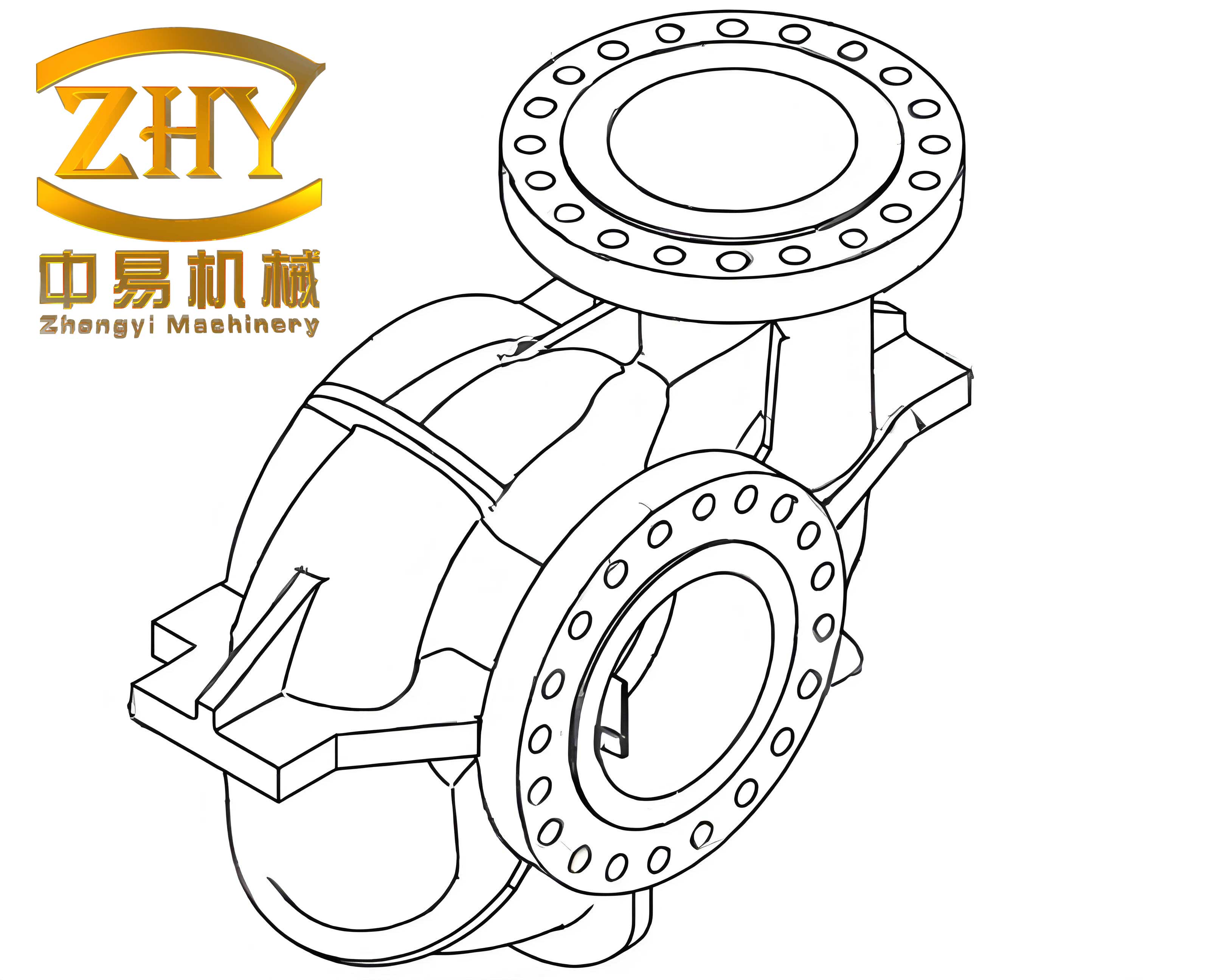
where G is the total poured weight (12,500 kg), N is the number of ladles (1), n is the number of nozzles per ladle (2), and vg is the mass flow rate (150 kg/s). This yields a pouring time of approximately 41.6 seconds, achieved via a twin-nozzle ladle. The yield of the casting process was 65.6%. To visualize the intricate geometry of such shell castings, refer to the following image link inserted here to illustrate typical shell casting features.
Process validation through simulation is indispensable for optimizing shell castings production. I utilized CAE/InteCAST software to simulate the solidification and feeding behavior. The 3D model from SolidWorks was imported, and multiple iterations were run to predict shrinkage and porosity tendencies. The simulation helped adjust riser sizes, chill placements, and pouring parameters, ensuring that defects were confined to the risers. The simulation procedure involved defining geometry, meshing, setting boundary conditions, and analyzing temperature fields and solidification sequences. The final simulation results confirmed a sound casting with no internal defects in the shell castings body, validating the feeding system design.
The production process for these shell castings involves meticulous steps in molding, core making, assembly, melting, and heat treatment. For molding, pattern plates ensured dimensional accuracy. Core No. 1 was tightly rammed with coke additions to improve collapsibility, while Core No. 2, with its complex shape, required a custom-made core support to prevent distortion during handling. All cores were vented using ropes to the mold exterior. To minimize micro-cracking, chromite sand (20–40 mm thick) was applied at riser junctions, thick sections, and critical areas of Core No. 2. The molds and cores were coated with three layers of zirconite-based paint, totaling 0.8–1.2 mm thickness, and dried between coats. Over 20 inspection gauges were fabricated to check mold and core dimensions before assembly, ensuring precision for these large shell castings. Upon closing, the mold joints were sealed with ≤1 mm thick clay strips, and all blind risers were vented to the outside. Pre-heating the mold cavity with hot air at 250°C for 6–8 hours before pouring was crucial to eliminate moisture, with the heat source removed 15 minutes prior to pouring to prevent condensation.
Melting and heat treatment are vital for achieving the desired properties in shell castings. The steel was melted in an electric arc furnace, with charge carbon set 0.30%–0.40% above specification to account for decarburization. Deoxidation was performed using aluminum under a white slag for 15–20 minutes to control phosphorus and sulfur levels. The internal control standards for chemical composition were stricter, as shown below.
| Element | Range |
|---|---|
| C | 0.12–0.17 |
| Si | 0.38–0.57 |
| Mn | 0.82–0.92 |
| P | ≤0.025 |
| S | ≤0.020 |
| Cu | ≤0.20 |
The ladle was preheated to >800°C to avoid thermal shock and cleanliness issues. After pouring, the shell castings were held in the mold for 80–96 hours to slow cool, then risers were cut off at room temperature. Heat treatment consisted of normalizing at 900–930°C for 6–7 hours, followed by forced air cooling to 580°C and natural cooling to 300°C. Tempering was done at 600–630°C for 6–7 hours, with furnace cooling to 300°C before air cooling. This regimen refined the microstructure and relieved residual stresses in the shell castings.
Quality control and testing confirmed the success of the process for these shell castings. Surface roughness was assessed using comparison samples, meeting all specifications. Mechanical properties and chemical composition were verified through testing; the results from random samples are tabulated below.
| Property | Specification | Sample 1 | Sample 2 | Sample 3 |
|---|---|---|---|---|
| Yield Strength (MPa) | ≥200 | 252 | 267 | 280 |
| Tensile Strength (MPa) | >400 | 457 | 424 | 445 |
| Elongation (%) | >25.0 | 30.0 | 31.3 | 34.6 |
| Impact Energy (J) | ≥35 | 62 | 58 | 75 |
| Element | Sample 1 | Sample 2 | Sample 3 |
|---|---|---|---|
| C | 0.14 | 0.16 | 0.16 |
| Si | 0.31 | 0.30 | 0.36 |
| Mn | 0.84 | 0.87 | 0.80 |
| P | 0.018 | 0.012 | 0.017 |
| S | 0.014 | 0.010 | 0.011 |
| Cu | 0.008 | 0.009 | 0.008 |
Dimensional accuracy was checked with tapes and gauges, conforming to ISO 806 ICT12. Non-destructive testing (MT and UT) also met the required standards. The shell castings were successfully integrated into crusher assemblies by the end-user, with field validation confirming performance under operational conditions. Since March 2011, this process has enabled batch production of hundreds of shell castings annually.
In conclusion, the production of large steel shell castings for cone crushers demands a holistic approach. Key learnings include: (1) For low-carbon steel shell castings with complex shapes and wall thickness variations, modified phenolic resin sand reduces cracking and enhances dimensional accuracy. (2) Using SolidWorks for modulus calculation and CAE simulation for feeding system validation streamlines design, cuts trial costs, and optimizes riser efficiency in shell castings. (3) Fast pouring minimizes defects like sand sticking and gas porosity, improving surface quality and feeding effectiveness for shell castings. (4) Tight control of phosphorus and sulfur enhances mechanical properties and reduces hot tearing in shell castings. (5) Comprehensive inspection gauges are essential for maintaining precision in complex shell castings. This process framework not only ensures high-quality shell castings but also supports sustainable batch production, underscoring the importance of integrated design, simulation, and control in advanced manufacturing of shell castings.
Throughout this endeavor, the focus on shell castings has highlighted how meticulous process engineering can overcome the challenges associated with large, critical components. The success of these shell castings in service validates the technical decisions made, from material selection to heat treatment. As demand for durable shell castings grows, continued refinement of these methods will be pivotal in advancing foundry capabilities and meeting global industrial needs.