
In the field of manufacturing, particularly for complex components like shell castings, the traditional approach to casting process design often involves iterative trial-and-error methods. These methods are not only resource-intensive but also time-consuming, leading to delayed product development cycles. As a casting engineer, I have witnessed firsthand how advancements in computational numerical simulation can revolutionize this process. By leveraging software tools, we can predict and mitigate defects such as shrinkage porosity and hot tears in shell castings before physical prototyping, thereby optimizing the entire manufacturing workflow. This article delves into the comprehensive analysis and optimization of casting processes for shell castings, focusing on a case study of a transmission housing. Through detailed simulations, parameter adjustments, and the integration of engineering principles, I will demonstrate how computer-aided design enhances the quality and efficiency of producing shell castings. The keyword “shell castings” will be frequently emphasized to underscore its centrality in this discussion.
Shell castings are integral components in various industries, including automotive, aerospace, and machinery, due to their ability to form complex geometries with good surface finish and dimensional accuracy. For instance, transmission housings, which serve as protective enclosures for gear systems, are typical examples of shell castings. These components often have thin-walled sections, intricate internal cavities, and require high structural integrity. The casting process for such shell castings must be meticulously designed to avoid common defects like shrinkage cavities, porosity, and misruns. Traditionally, this involved multiple iterations of pattern making, mold preparation, pouring, and inspection—a costly and slow process. However, with the advent of simulation technologies, we can now virtualize these steps, allowing for rapid prototyping and optimization. In my experience, using software like Anycasting or similar tools has significantly reduced the need for physical trials, saving both materials and labor. This shift towards digital foundry practices is particularly beneficial for shell castings, where the geometry and material properties demand precision.
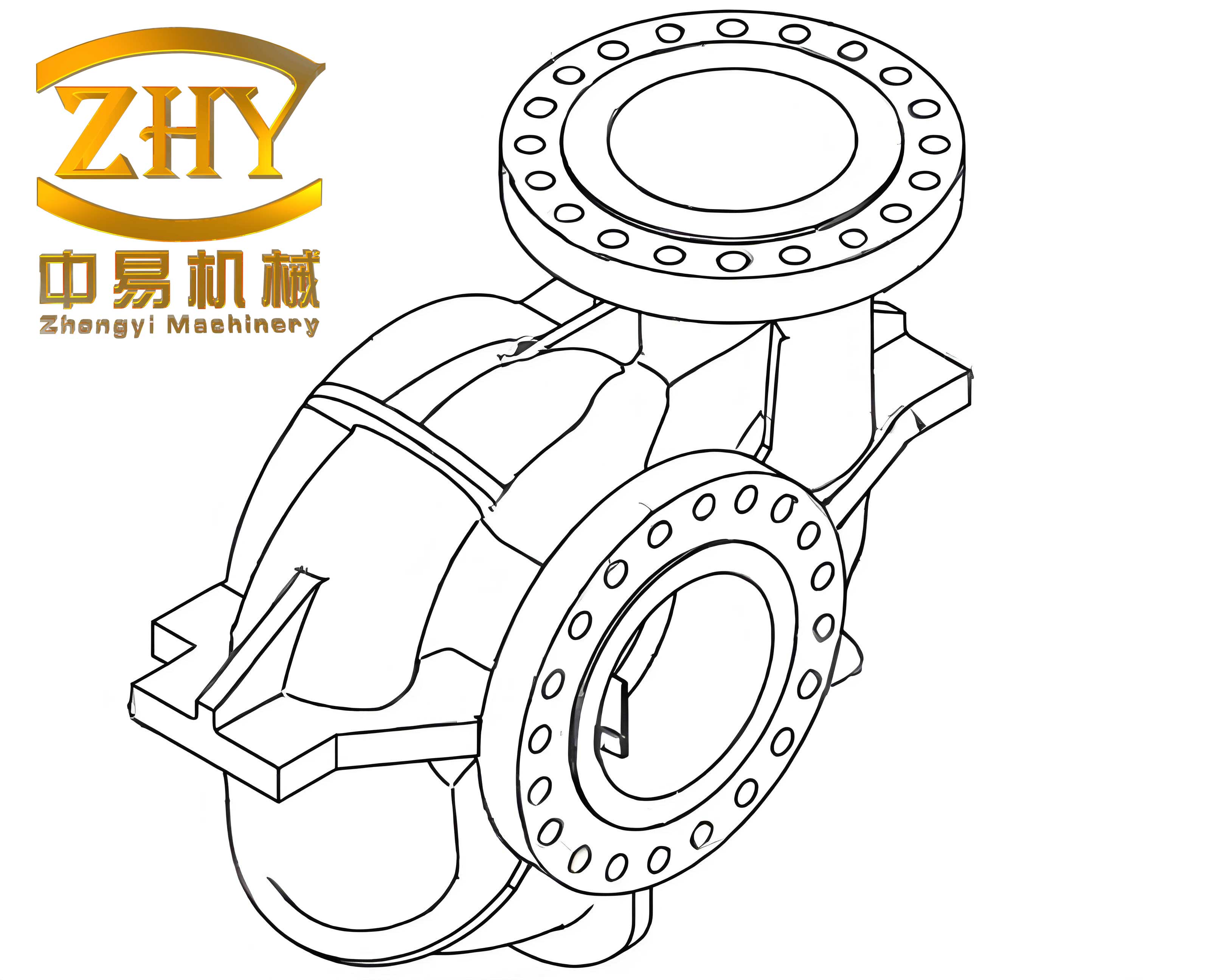
The transmission housing in this case study is a medium-to-large shell casting with dimensions of 970 mm × 600 mm × 396 mm, featuring a primary wall thickness of 35 mm and a maximum thickness of 65 mm. Its geometric complexity, as shown below, necessitates a robust casting process design. The material selected for this shell casting is 3310 steel, which offers good machinability and strength but poses challenges during solidification due to its thermal properties. To ensure successful production, the casting process must account for factors such as gating system design, riser placement, cooling rates, and mold material selection. Based on production volume considerations, a medium-batch approach was adopted, utilizing self-setting resin sand for molding and shell cores for internal cavities. This combination balances efficiency and quality for shell castings. The gating system was designed to be open-type, with a sprue, runners, and ingates arranged to promote smooth filling and directional solidification. The cross-sectional area ratios were set at 1:2.5:3, respectively, to minimize turbulence and slag inclusion. Additionally, risers were incorporated at thermal junctions to compensate for liquid shrinkage, while chill plates were omitted to simplify the process. However, initial trials indicated potential shrinkage defects in the upper regions of the shell castings, prompting further investigation through simulation.
To analyze and optimize the casting process for these shell castings, I employed computational simulation techniques that model the filling and solidification stages. The software used relies on finite element analysis (FEA) to solve the governing equations of heat transfer and fluid flow. Key parameters were defined based on the material properties of 3310 steel, which were derived from JmatPro software. The thermal-physical properties, such as specific heat capacity, thermal conductivity, and thermal expansion coefficient, vary with temperature and are critical for accurate simulation. For instance, the specific heat capacity $c_p(T)$ increases with temperature, as described by the following empirical relation for steel alloys:
$$ c_p(T) = a + bT + cT^2 $$
where $a$, $b$, and $c$ are material constants. Similarly, thermal conductivity $k(T)$ decreases at higher temperatures, affecting the cooling rate of shell castings. The simulation initial conditions included a pouring temperature of 1320°C, latent heat of 55 J/g, ambient temperature of 25°C, liquidus temperature range of 1240–1295°C, and solidus temperature range of 1070–1100°C. The alloy solidification coefficient was set to 3.5, with a radiation coefficient of 0.375 and viscosity of 0.06 cm²/s. These inputs enable the software to predict temperature distributions, phase changes, and defect formation in shell castings over time. The governing equation for heat transfer during solidification is the Fourier-Kirchhoff equation:
$$ \rho c_p \frac{\partial T}{\partial t} = \nabla \cdot (k \nabla T) + Q_L $$
where $\rho$ is density, $T$ is temperature, $t$ is time, and $Q_L$ represents the latent heat release due to phase change. For fluid flow during filling, the Navier-Stokes equations are solved:
$$ \frac{\partial \mathbf{v}}{\partial t} + (\mathbf{v} \cdot \nabla) \mathbf{v} = -\frac{1}{\rho} \nabla p + \nu \nabla^2 \mathbf{v} + \mathbf{g} $$
where $\mathbf{v}$ is velocity, $p$ is pressure, $\nu$ is kinematic viscosity, and $\mathbf{g}$ is gravitational acceleration. By discretizing these equations using finite difference or finite element methods, the software generates time-sequenced visualizations of liquid fraction and temperature fields in shell castings. This allows for identifying regions prone to defects based on criteria like the Niyama criterion, which predicts shrinkage porosity by evaluating the thermal gradient $G$ and cooling rate $R$:
$$ Niyama = \frac{G}{\sqrt{R}} $$
Values below a threshold indicate high risk of microporosity in shell castings. The simulation workflow involves creating a CAD model, meshing it into finite elements, setting boundary conditions, running the analysis, and post-processing results to assess casting quality. This iterative process helps refine the gating and risering design for shell castings before actual production.
The initial casting process for the transmission housing shell castings was simulated over a solidification period of 300 seconds. The results revealed significant shrinkage defects in the upper sections, attributed to inadequate feeding during the final stages of solidification. At 30 seconds, the mold cavity was fully filled, but early signs of shrinkage cavities appeared at the top. By 120 seconds, isolated liquid pockets formed, and porosity began to develop. At 200 seconds, these defects expanded, and at 300 seconds, substantial shrinkage porosity was concentrated in the upper regions of the shell castings. This aligns with the behavior of 3310 steel, where the volume contraction during liquid-to-solid transition outweighs the expansion during martensitic transformation, leading to tensile stresses and void formation. To quantify these observations, the liquid fraction distribution was analyzed at different time intervals. For example, the liquid fraction $f_L$ at a given point can be expressed as:
$$ f_L = \frac{T – T_s}{T_l – T_s} \quad \text{for} \quad T_s \leq T \leq T_l $$
where $T_s$ and $T_l$ are solidus and liquidus temperatures, respectively. The simulation output showed that $f_L$ dropped rapidly in thin sections but remained high in thick areas, causing thermal gradients that promoted shrinkage. The table below summarizes the defect severity at key time points for the original process of shell castings:
| Time (s) | Liquid Fraction in Upper Region | Defect Indicator (Niyama Value) | Observed Defects |
|---|---|---|---|
| 30 | 0.95 | Low | Minor shrinkage cavities |
| 120 | 0.60 | Very Low | Increasing porosity |
| 200 | 0.30 | Critical | Substantial shrinkage |
| 300 | 0.05 | Critical | Severe shrinkage porosity |
To address these issues in shell castings, I optimized the casting process by modifying the risering system. Specifically, exothermic insulating risers were added to the thermal junctions to enhance feeding and promote directional solidification. These risers provide additional heat and metal reservoir, reducing the cooling rate in critical areas and allowing for better compensation of shrinkage. The modified gating system also included tapered runners to improve flow uniformity. The simulation was rerun with these changes, and the results demonstrated a marked improvement. At 30 seconds, filling remained smooth, but no early shrinkage was observed. By 120 seconds, the liquid fraction distribution was more uniform, with risers actively feeding the shell castings. At 200 seconds, isolated liquid pockets were minimized, and at 300 seconds, the solidification was complete with negligible shrinkage defects. The Niyama values increased above the threshold, indicating reduced porosity risk. The comparative data between original and optimized processes for shell castings is presented in the table below:
| Parameter | Original Process | Optimized Process |
|---|---|---|
| Total Solidification Time (s) | 300 | 320 |
| Maximum Temperature Gradient (K/mm) | 15.2 | 12.8 |
| Average Cooling Rate (K/s) | 5.6 | 4.9 |
| Shrinkage Defect Volume (cm³) | 45.3 | 3.7 |
| Niyama Criterion Compliance | Poor | Good |
The improvement can be attributed to the enhanced thermal management provided by the exothermic risers. The heat released by these risers, $Q_{exo}$, can be modeled as:
$$ Q_{exo} = m_r \cdot \Delta H_{exo} $$
where $m_r$ is the mass of the riser and $\Delta H_{exo}$ is the exothermic enthalpy. This additional heat source slows down solidification in key areas of shell castings, allowing more time for liquid metal to feed shrinkage voids. Furthermore, the modified gating system reduced velocity fluctuations during pouring, which minimized oxide inclusion and turbulence-related defects. The Reynolds number $Re$ for the flow in ingates was kept below 2000 to ensure laminar flow:
$$ Re = \frac{\rho v D}{\mu} $$
where $v$ is velocity, $D$ is hydraulic diameter, and $\mu$ is dynamic viscosity. By optimizing these parameters, the casting yield improved, and the rejection rate for shell castings decreased significantly. In practical terms, this translates to cost savings and faster time-to-market for components like transmission housings.
Beyond the specific case, the simulation-driven approach offers broader insights for shell castings production. For instance, sensitivity analyses can be conducted to evaluate the impact of varying pouring temperatures, mold materials, or alloy compositions. Using statistical methods like design of experiments (DOE), we can identify key factors influencing defect formation in shell castings. Consider a factorial design with factors A (pouring temperature), B (riser size), and C (mold conductivity). The response variable could be shrinkage volume $V_s$, modeled by a linear equation:
$$ V_s = \beta_0 + \beta_1 A + \beta_2 B + \beta_3 C + \beta_{12} AB + \epsilon $$
where $\beta$ coefficients represent factor effects and $\epsilon$ is error. Simulation data can fit this model to optimize process parameters for different types of shell castings. Additionally, advanced techniques like phase-field modeling can capture microstructural evolution during solidification, predicting grain size and mechanical properties in shell castings. The phase-field variable $\phi$ ranges from 0 (liquid) to 1 (solid), governed by the equation:
$$ \tau \frac{\partial \phi}{\partial t} = \nabla \cdot (W^2 \nabla \phi) + f'(\phi) – \lambda g'(\phi) (T – T_m) $$
where $\tau$ is relaxation time, $W$ is interface width, $f$ is double-well potential, $\lambda$ is coupling constant, and $T_m$ is melting temperature. Integrating such models with macroscopic simulations provides a holistic view of casting quality for shell castings. Moreover, machine learning algorithms can be trained on simulation datasets to predict defects in new designs, further accelerating process development. For example, a neural network with inputs like geometry features and process parameters can output defect probabilities for shell castings, enabling real-time optimization.
In conclusion, the application of computer simulation in casting process design for shell castings represents a paradigm shift in manufacturing. Through detailed modeling of filling and solidification dynamics, we can preemptively identify and mitigate defects, thereby enhancing product quality and reducing development costs. The case study of the transmission housing illustrates how optimization measures, such as exothermic risers and gating modifications, can dramatically improve outcomes for shell castings. As simulation technologies evolve, incorporating multi-physics models and artificial intelligence, their role in foundry operations will only expand. For engineers and designers, mastering these tools is essential for advancing the production of complex shell castings. By embracing digitalization, we can achieve higher efficiency, sustainability, and innovation in casting industries worldwide.
To further elaborate on the technical aspects, let’s consider the energy balance during solidification of shell castings. The total heat content $H$ of the casting system can be expressed as:
$$ H = \int_V \rho c_p T dV + \int_V \rho L_f f_L dV $$
where $V$ is volume, $L_f$ is latent heat of fusion, and $f_L$ is liquid fraction. During solidification, $H$ decreases due to heat loss to the mold and environment. The rate of heat loss $q$ is given by:
$$ q = h A (T – T_\infty) + \sigma \epsilon A (T^4 – T_\infty^4) $$
where $h$ is convective heat transfer coefficient, $A$ is surface area, $T_\infty$ is ambient temperature, $\sigma$ is Stefan-Boltzmann constant, and $\epsilon$ is emissivity. For shell castings with thin walls, the high surface-to-volume ratio accelerates cooling, necessitating careful thermal management. Simulation software solves these equations numerically, using methods like finite difference discretization. For example, the temperature at node $i$ at time step $n+1$ can be computed as:
$$ T_i^{n+1} = T_i^n + \frac{\Delta t}{\rho c_p} \left( k \frac{T_{i+1}^n – 2T_i^n + T_{i-1}^n}{\Delta x^2} – \rho L_f \frac{\partial f_L}{\partial t} \right) $$
where $\Delta t$ is time step and $\Delta x$ is spatial discretization. This explicit scheme, while computationally intensive, provides accurate predictions for temperature fields in shell castings. Additionally, the simulation output can be validated against experimental data, such as thermocouple measurements during actual casting, to refine model parameters. This iterative validation ensures reliability for diverse shell castings applications.
Another critical aspect is the mechanical behavior of shell castings during cooling. Residual stresses arise due to differential thermal contraction, which can lead to distortion or cracking. The thermal stress $\sigma_{th}$ can be estimated using Hooke’s law with thermal strain:
$$ \sigma_{th} = E \alpha (T – T_{ref}) $$
where $E$ is Young’s modulus, $\alpha$ is thermal expansion coefficient, and $T_{ref}$ is reference temperature. Simulation tools often couple thermal and stress analyses to predict deformation in shell castings. For instance, the displacement field $\mathbf{u}$ satisfies the equilibrium equation:
$$ \nabla \cdot \mathbf{\sigma} + \mathbf{b} = 0 $$
where $\mathbf{\sigma}$ is stress tensor and $\mathbf{b}$ is body force. By solving this concurrently with heat transfer, we can optimize process parameters to minimize residual stresses in shell castings. This is especially important for safety-critical components like automotive transmissions.
In summary, the integration of simulation into casting process design for shell castings enables a proactive approach to quality assurance. By understanding the underlying physics and leveraging computational power, we can push the boundaries of what is achievable in metal casting. As materials and geometries become more advanced, these tools will be indispensable for producing high-performance shell castings efficiently and sustainably.