
The production of large, pressure-resistant aluminum alloy housings, or shell castings, for high-voltage switchgear represents a significant challenge in modern foundry practice. These components are critical in power transmission infrastructure, requiring exceptional internal integrity, mechanical properties, and leak-tightness to withstand operational pressures and ensure grid reliability. Traditional manufacturing methods often struggle to meet these stringent demands consistently. This article details a comprehensive process improvement for such shell castings, shifting from conventional methods to an optimized Low-Pressure Die Casting (LPDC) technique with a core-mounted gating system, validated through numerical simulation and successful batch production.
The evolution of power networks has driven demand for larger and more complex shell castings. These components typically feature intricate geometries with varying wall thicknesses and are designated as pressure vessels. Consequently, they must be free from shrinkage porosity, gas holes, inclusions, and hot tears. Standard mechanical property requirements often exceed an ultimate tensile strength of 295 MPa, elongation of 3%, and a Brinell hardness greater than 80. Furthermore, they must pass rigorous pressure tests, such as a hydrostatic test at 1.26 MPa for 30 minutes and an SF6 gas leak test at 0.5 MPa over 24 hours.
Limitations of Conventional Casting Processes
Historically, large shell castings were produced via sand casting using gravity pouring. This method, while flexible, inherently introduces turbulence during mold filling. The metal stream falls freely, leading to splashing, oxidation, and air entrainment. This results in a high propensity for defects like dross inclusions and gas porosity within the final shell casting, adversely affecting its pressure integrity and mechanical performance. The lack of directional solidification control also makes it difficult to feed isolated thick sections adequately.
Metal mold low-pressure casting with a slit gate system offered a substantial improvement. In this setup, the shell casting cavity is formed between metal dies and sand cores. Liquid aluminum is pushed upward from a pressurized furnace through a vertical stalk into a thin, vertical slit gate that runs along the height of the casting. The principle advantages are smoother, bottom-up filling and solidification under pressure, which improves density. The process can be described by the fundamental pressure equation governing the rise in the stalk:
$$ P = \rho g H + \Delta P_{friction} + \Delta P_{acceleration} $$
Where \( P \) is the applied furnace pressure, \( \rho \) is the molten aluminum density, \( g \) is gravity, and \( H \) is the height of the metal column from the bath to the top of the casting cavity.
Despite these advantages, the slit-gate method has critical drawbacks concerning solidification control. The goal of achieving directional solidification from the casting extremities back to the gate and finally to the stalk is often compromised. The thin slit gate can freeze off prematurely, isolating thick sections of the shell casting from the liquid metal feed source before they have fully solidified. Conversely, if the gate is too wide, it creates an enormous thermal mass that can draw heat from the casting, potentially causing shrinkage cracks in adjacent areas. The thermal interaction between the gate and the casting wall is complex. Defects such as shrinkage porosity and cracks frequently occur at or near the junction of the slit gate and the shell casting body. Furthermore, the removal of the extensive gate leaves a prominent mark on the casting surface, requiring additional finishing.
The Core-Mounted Gating System: Principle and Rationale
The proposed improvement involves a fundamental redesign of the gating system: the Core-Mounted or “Core-Heart” Pouring Method. Instead of using an external slit gate in the metal die, the entire gating system—consisting of a central downsprue and multiple radial ingates—is integrated within the resin sand core that forms the internal cavity of the shell casting.
The governing principle is to leverage the different thermal properties of the materials. The metal die has high thermal conductivity, extracting heat rapidly from the outer surfaces of the shell casting. The resin sand core has low thermal conductivity and high heat capacity, acting as an insulator. By placing the gating channels inside this insulating sand core, their solidification is significantly delayed relative to the casting walls formed against the metal die. This establishes a clear thermal gradient, enabling true directional solidification: the thin sections of the shell casting solidify first, followed by thicker sections (hot spots), then the ingates, and finally the central downsprue, which remains liquid longest to provide effective pressure-fed feeding. The feeding efficiency can be related to Niyama’s criterion for predicting shrinkage porosity, where a higher thermal gradient \( G \) over the square root of cooling rate \( \sqrt{\dot{T}} \) indicates soundness:
$$ NY = \frac{G}{\sqrt{\dot{T}}} $$
The insulating effect of the sand core on the gating system helps maintain a high \( G \) in the feeding paths toward the casting hot spots.
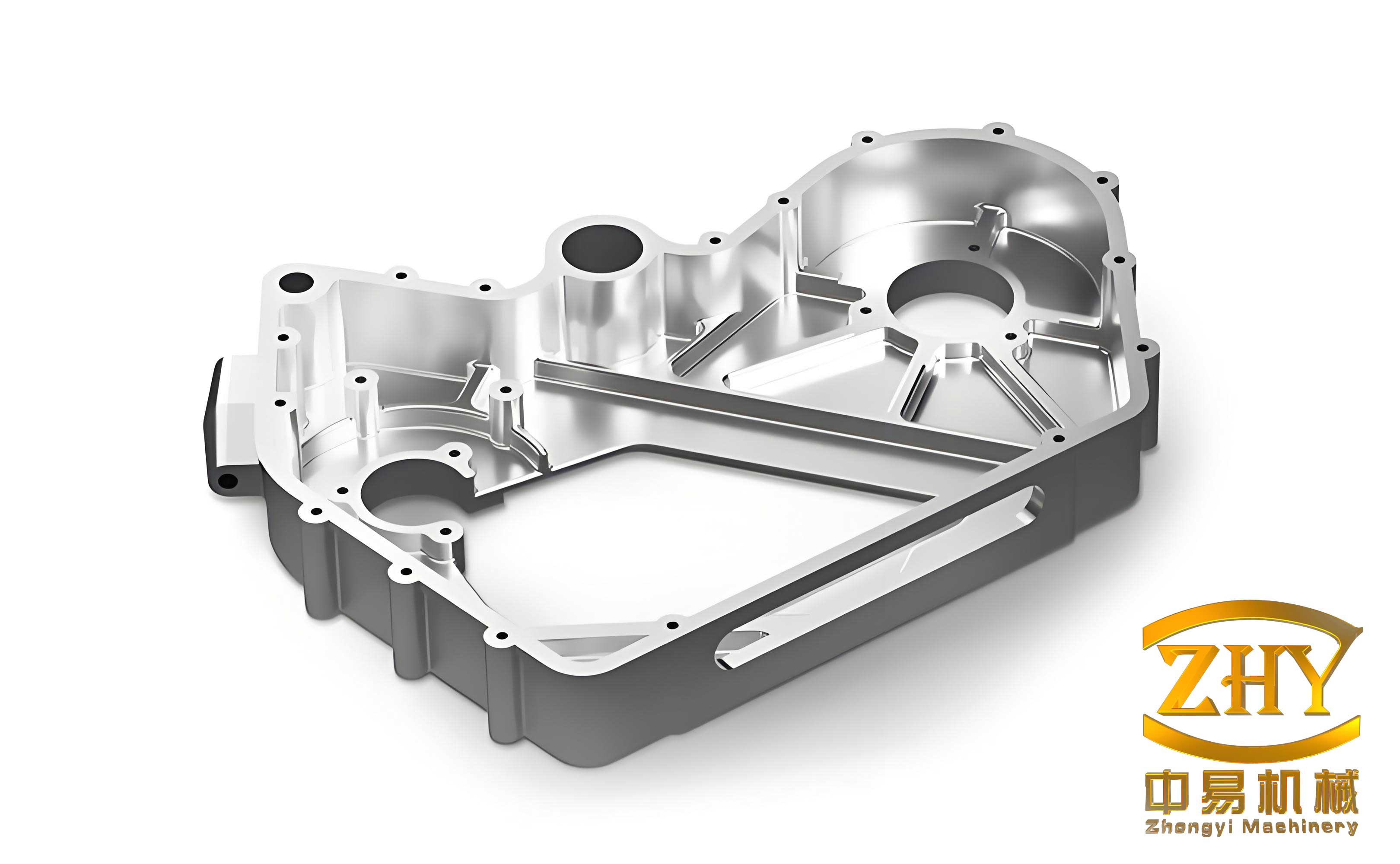
Process Design and Optimization
The development of this process is illustrated using a representative component: a four-way connector housing for supporting a high-voltage bushing. This shell casting measures approximately 1030 mm x 525 mm x 555 mm, with a nominal wall thickness of 12 mm and localized thick sections up to 69 mm, weighing about 79 kg in alloy ZL101A (A356 equivalent).
1. Mold and Core Design
The low-pressure casting mold is constructed from ductile iron (QT60-2) for durability. It features a vertical parting line and left/right opening. The key innovation lies in the design and fabrication of the resin sand core.
Core Manufacturing Strategy: Two primary approaches were evaluated.
| Method | Advantages | Disadvantages |
|---|---|---|
| Single-Piece Core | Simpler core-making steps; no parting lines on core, thus no fins on casting interior. | Extreme difficulty in placing and removing gating system patterns; challenging to apply coating to internal gating channels. |
| Split-Core Assembly | Easy placement and removal of gating patterns; straightforward coating application. | Requires precise gluing/bonding of core halves; risk of mismatch, core gas at seam, or dimensional inaccuracy leading to flash or run-outs. |
The split-core method was selected for practicality. The core box is designed to create two halves. After curing, the halves are bonded together with adhesive. Mechanical reinforcement, such as wires or rods embedded across the joint in core print areas, is crucial to withstand metallostatic and pressurization forces without separation.
Gating System Design within the Core: The system consists of a primary vertical downsprue connected to radial ingates that open into the casting’s thick flange sections. Design rules applied:
- Downsprue Diameter: Sized to provide sufficient feed metal volume and delay solidification. A diameter of 80 mm was chosen.
- Ingate Cross-Section: The total cross-sectional area of the ingates should be roughly equal to or slightly less than the thermal modulus of the casting section they feed to encourage proper temperature gradient. Individual ingate diameter was initially set at 45 mm.
- Ingate Number and Placement: Ingates must be positioned to feed major hot spots evenly. Initial design for the four-way shell casting used two ingates per flange. To facilitate removal, the ingate is necked down to 30 mm for the last 50 mm before meeting the casting.
A ceramic foam filter is placed at the entrance of the gating system within the sprue base to trap oxides. The mold cavity is coated with a zircon-based spray to control heat transfer and improve surface finish.
2. Pouring and Pressure Schedule
The thermal parameters are critical. A lower pouring temperature reduces total contraction and shrinkage volume. A range of 680–710°C was selected for alloy ZL101A. The pressure cycle is the controlling factor for mold filling and feeding. An optimized profile consists of four distinct phases, mathematically modeled as a piecewise function:
Phase 1 – Slow Ascension: A low pressure ramp lifts metal quietly up the stalk to just below the mold entrance. This minimizes turbulence.
$$ P_1(t) = k_1 t \quad \text{for} \quad 0 \leq t \leq t_1 $$
Phase 2 – Mold Filling: Pressure increases at a controlled rate to fill the cavity smoothly. Filling velocity \( v \) is kept low (e.g., 1-3 mm/s) to ensure laminar flow.
$$ \frac{dP_2}{dt} = \text{constant}, \quad \text{targeting} \quad v = \frac{A_{stalk}}{A_{cavity}(h)} \cdot \frac{dh}{dt} $$
Phase 3 – Rapid Intensification: Once the cavity is full, pressure is quickly raised to a maximum holding value \( P_{max} \) to commence feeding. This compensates for solidification shrinkage.
$$ P_3(t) = P_2(t_2) + \Delta P_s \left(1 – e^{-(t-t_2)/\tau}\right) $$
Phase 4 – Prolonged Holding: Pressure is maintained at \( P_{max} \) until the entire casting, including the gating system, has solidified. This is the most critical phase for eliminating shrinkage in shell castings.
$$ P_4(t) = P_{max} \quad \text{for} \quad t_3 \leq t \leq t_{total} $$
The total pressure curve can be summarized as:
$$ P(t) =
\begin{cases}
k_1 t & 0 \leq t \leq t_1 \\
P(t_1) + k_2 (t – t_1) & t_1 < t \leq t_2 \\
P(t_2) + \Delta P_s \left(1 – e^{-(t-t_2)/\tau}\right) & t_2 < t \leq t_3 \\
P_{max} & t_3 < t \leq t_{total}
\end{cases} $$
Where \( k_1, k_2 \) are ramp rates, \( \Delta P_s \) is the intensification pressure step, and \( \tau \) is a time constant for the pressure rise.
3. Numerical Simulation and Iterative Optimization
Computer-aided engineering (CAE) simulation is indispensable for validating and refining the design before tooling manufacture. Using casting simulation software (e.g., CASTEM, MAGMAsoft, ProCAST), the following analyses were conducted for the shell casting:
Solidification Sequence & Thermal Gradients: The simulation clearly showed the intended effect: the metal-die-cooled walls of the shell casting solidified first, with solidification fronts progressing inward. The hot spots at flange intersections were the last areas of the casting proper to solidify.
Shrinkage Porosity Prediction: Initial simulation with two ingates per flange predicted macro-shrinkage cavities in the center of the thickest sections (69mm thick bosses). The criterion often used is a local pressure drop below a critical threshold or a Niyama value below a critical limit during solidification. The model indicated that two ingates could not supply enough feed metal to compensate for the volumetric shrinkage in these large thermal masses.
$$ V_{shrinkage} \approx \beta \cdot V_{hotspot} $$
Where \( \beta \) is the volumetric shrinkage coefficient of the alloy (~4-6% for Al-Si alloys). The feeding range \( L_f \) of an ingate is limited by the permeability of the mushy zone and the available pressure head:
$$ L_f \propto \frac{\Delta P \cdot d^2}{\mu \cdot \beta} $$
Where \( \Delta P \) is the feeding pressure, \( d \) is the dendrite arm spacing, and \( \mu \) is the viscosity of the interdendritic liquid. For the large hot spots in this shell casting, \( L_f \) was exceeded with only two feed points.
Design Modification: The solution was to increase the number of feeding points. The design was iterated to incorporate four ingates per major flange, effectively reducing the required feeding distance \( L_f \) for any point in the hot spot by half. The revised simulation confirmed a sound thermal gradient and the elimination of predicted shrinkage cavities. The final gating system inside the core provided multiple, short paths for liquid feed metal, ensuring directional solidification toward the downsprue.
| Design Iteration | Ingates per Flange | Predicted Shrinkage Severity in Hot Spot | Feeding Distance Status |
|---|---|---|---|
| Initial | 2 | High (Macro-porosity predicted) | Exceeds Limit \( L_f \) |
| Optimized | 4 | Low/None | Within Limit \( L_f \) |
Production Results and Quality Validation
The optimized process was put into production using a J458 low-pressure casting machine. The practical steps involved: assembling the bonded sand core with internal gating into the preheated metal die, closing the mold, executing the automated pressure cycle, cooling, de-molding, and finally removing the sand core via shakeout and shot blasting.
The quality of the produced shell castings was rigorously assessed:
1. Non-Destructive Testing (NDT): X-ray radiography of critical sections, particularly the thick flange intersections, showed a dramatic reduction in shrinkage porosity compared to parts made with the slit-gate method. The castings were free from macro-shrinkage cavities.
2. Mechanical Properties: Tensile test specimens taken from separately cast coupons or designated areas of the casting (if allowed) met and exceeded specifications.
| Property | Specification Requirement | Average Result (Improved Process) |
|---|---|---|
| Ultimate Tensile Strength | > 295 MPa | 310 – 325 MPa |
| Elongation | > 3 % | 4.5 – 6.0 % |
| Brinell Hardness (HB) | > 80 | 85 – 95 |
3. Pressure Tightness Tests:
- Hydrostatic Test: All shell castings successfully held 1.26 MPa of water pressure for 30 minutes without any leakage or pressure drop.
- SF6 Gas Leak Test: Pressurized with SF6 to 0.5 MPa, the castings showed no measurable leakage over a 24-hour period, confirming exceptional integrity for gas-insulated switchgear applications.
4. Surface Quality and Dimensional Accuracy: The absence of a large external slit gate eliminated a major surface blemish and reduced finishing work. Dimensional consistency was improved due to the stability of the metal die and the controlled solidification minimizing warpage.
Conclusion and Future Perspectives
The transition to a low-pressure casting process utilizing a core-mounted gating system represents a significant advancement for manufacturing high-integrity aluminum alloy shell castings. This method directly addresses the core challenges of feeding thick sections and achieving sound, pore-free structures. The insulating effect of the sand core on the integrated gating system is the key enabler, promoting a favorable thermal gradient for directional solidification. Numerical simulation proved to be a vital tool for diagnosing feeding issues and optimizing the ingate configuration, preventing costly trial-and-error on the foundry floor.
The success of this approach is not limited to a single geometry. The principles can be adapted to a wide range of large, complex, and thick-walled shell castings across various industries where pressure tightness and high mechanical properties are paramount. Future work may focus on further refining the design rules for gating within complex cores, optimizing the thermal properties of core materials to better control solidification, and integrating real-time process monitoring with closed-loop control of the pressure curve based on cavity temperature feedback. The continued evolution of this process ensures that aluminum alloy shell castings will meet the ever-increasing demands of performance and reliability in critical engineering applications.