
In the field of heavy machinery manufacturing, the production of large-scale shell castings is a critical and challenging task. These components, such as the upper housing for crushers, demand high precision, structural integrity, and reliable mechanical properties to withstand extreme operational conditions. As a casting engineer involved in product development, I have dedicated significant effort to refining the manufacturing processes for such complex shell castings. This article details my experience and the systematic approach taken to redesign the casting process for a crusher upper shell, moving from a traditional method to an optimized one that leverages modern simulation tools and practical innovations. The focus is on enhancing quality, improving operational efficiency, and ensuring the reproducibility of high-integrity shell castings.
The original casting process for the crusher upper shell employed a combination of template and core assembly molding. While this method offered advantages in pattern making speed and material savings, it frequently led to significant quality issues. Major defects included severe dimensional deviations, large gaps between sand cores, and a high propensity for sand dropping. Additionally, the need for core supports (chaplets) introduced extra steps in finishing operations, such as their removal, which increased labor costs and extended production timelines. These challenges underscored the necessity for a comprehensive process overhaul to achieve consistent quality in these large shell castings.
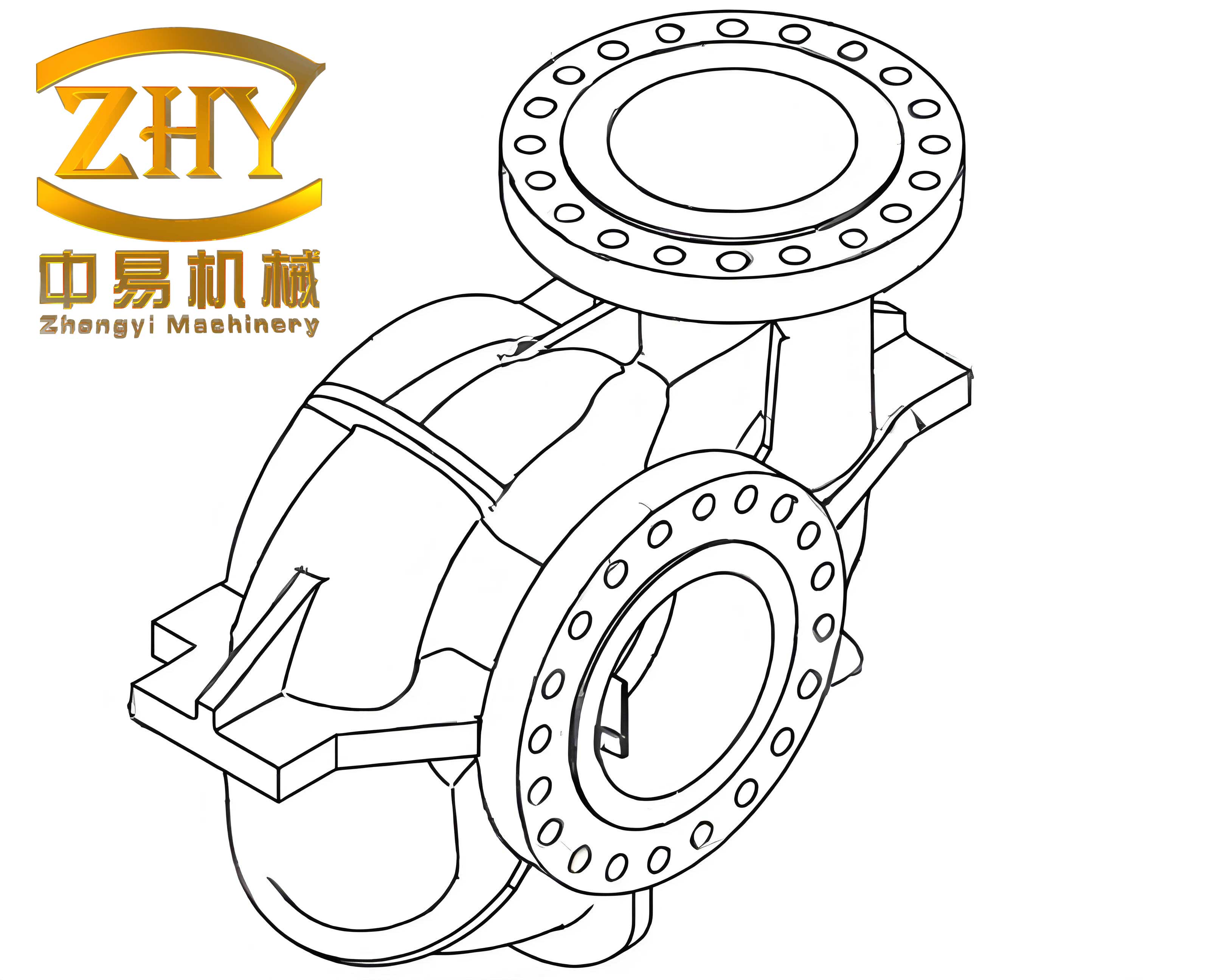
The crusher upper shell is a large ring-shaped casting, a typical configuration for heavy-duty shell castings. Its key specifications are as follows:
| Parameter | Value |
|---|---|
| Outline Dimensions | Ø6020 mm × 2500 mm |
| Main Wall Thickness | 110 – 130 mm |
| Material Grade | GS20Mn5N (Cast Steel) |
| Net Weight | 49.5 tonnes |
| Gross Weight (with risers) | 62 tonnes |
The material, GS20Mn5N, has specific chemical and mechanical requirements that must be met to ensure performance. The chemical composition and mechanical properties are critical design inputs for the casting process.
| Element | Minimum | Maximum/Target |
|---|---|---|
| C | – | 0.17 – 0.23 |
| Si | – | 0.30 – 0.60 |
| Mn | – | 1.00 – 1.50 |
| P | – | |
| S | – | |
| Cr | – | |
| Ni | – | |
| Mo | – |
| Property | Symbol | Requirement |
|---|---|---|
| Yield Strength | ReH | ≥ 280 MPa |
| Tensile Strength | Rm | 500 – 600 MPa |
| Elongation | A | ≥ 20 % |
| Impact Energy (Charpy V-notch, 20°C) | Akv | ≥ 40 J |
The core of the new process design was a fundamental shift in the molding method. We abandoned the template and core assembly approach in favor of a hollow solid pattern molding technique. Although this change increased the initial complexity and cost of pattern making, it provided substantial long-term benefits for producing consistent shell castings. The hollow solid pattern ensured accurate dimensional control of both the external shape and internal wall thickness, eliminating the gaps inherent in core assembly and the associated need for core supports. This directly addressed the primary defects of the old process.
Casting Process Design and Parameters
The redesigned process was built on several key decisions regarding molding, gating, and feeding systems, all tailored for large, ring-shaped shell castings.
1. Molding Method and Parting Line Selection: The casting was produced using a pit molding method with a complete hollow solid pattern. An outer jacket was used for the drag, and a pre-formed flask was employed for the cope. The parting line was placed at the larger diameter (bottom) of the shell. To establish a favorable temperature gradient for directional solidification, the casting was oriented with the smaller-diameter opening facing upward. This orientation promotes feeding from the top risers down through the casting walls.
2. Key Process Parameters:
– Pattern Allowance (Shrinkage): Given the relatively uniform wall thickness of this shell casting, a linear shrinkage allowance of 1.8% was applied uniformly.
– Machining Allowance: Based on casting standards and the massive size of the component, machining allowances were set at 25 mm for the top surfaces and 20 mm for the side surfaces. Additional allowance was added between the flanges to act as a process margin.
– Draft Angles: All external ribs on the pattern were made as loose pieces with draft angles of 2-3 degrees to facilitate pattern withdrawal.
3. Pattern and Core Box Construction: The hollow solid pattern was constructed for stability and precision. The core box was designed as a collapsible type. To ensure proper placement of feeding and chilling aids, location lines for risers, gates, pads, and external chills were engraved on the pattern. Fillet radii (R=20-30 mm) were applied to sharp corners to reduce stress concentration and improve metal flow.
4. Molding and Core Materials: The molds and cores were made using an ester-cured sodium silicate sand system to ensure good dimensional stability and collapsibility. The mold surfaces were coated with a zircon-based alcohol-borne paint, applied by brushing in multiple layers to a total thickness of 0.5-1.0 mm. Critical areas prone to burn-on were reinforced with additional coating layers or locally replaced with chromite sand.
5. Feeding System Design Using Modulus Method and Simulation: The feeding system is the heart of producing sound shell castings. The design must satisfy two fundamental criteria: the riser must solidify later than the casting section it feeds, and it must contain sufficient liquid metal to compensate for solidification shrinkage. We employed a combination of the modulus method and computer simulation for optimization.
First, the casting was divided into several “independent feeding zones,” each served by a dedicated riser. The modulus (M) of a casting section, which governs its solidification time, is calculated as its volume (V) divided by its cooling surface area (Ac):
$$ M_{casting} = \frac{V}{A_c} $$
For a riser to be effective, its modulus should be greater than that of the casting. A common rule is:
$$ M_{riser} \geq 1.2 \times M_{casting} $$
Using 3D modeling software (like SolidWorks), the volume and surface area of each zone were measured to calculate its modulus. A mix of eight top open risers and two blind risers, all made with insulating sleeves, was initially laid out. Common riser parameters based on geometry are summarized below:
| Riser Type | Dimensions (H=Height, D=Diameter) | Modulus (M) | Approx. Volume |
|---|---|---|---|
| Spherical | H = D | D/6 | 0.523D3 |
| Cylindrical Open | H = D | D/6 | 0.785D3 |
| Cylindrical Open | H = 1.2D | 0.176D | 0.942D3 |
| Cylindrical Open | H = 1.5D | 0.188D | 1.178D3 |
| Cylindrical Blind | H = D | D/6 | 0.654D3 |
| Cylindrical Blind | H = 1.2D | 0.178D | 0.812D3 |
| Cylindrical Blind | H = 1.5D | 0.190D | 1.047D3 |
To further promote directional solidification and prevent hot spots at the riser neck, the riser bases were necked down (padded). Additionally, external chills were strategically placed around the lower perimeter of the shell casting to accelerate cooling in thicker sections and enhance the feeding efficiency of the risers from above. The layout of chills and risers was then validated and refined using casting simulation software. The simulation allowed us to visualize solidification sequences, identify potential shrinkage cavities, and minimize riser sizes to an optimal level, thereby improving yield. The final simulation confirmed a sound casting with no major shrinkage defects.
6. Gating System Design: Given the significant height of this shell casting, a bottom gating system alone could cause excessive turbulence and erosion. Therefore, a stepped gating system was designed. The sprue was placed in the central cavity, feeding into a circular horizontal runner. Three levels of tangential ingates introduced molten metal into the mold cavity, promoting a smooth, upward fill and minimizing turbulence. This design supports rapid pouring, which reduces the “washing effect” on the mold and helps maintain the desired thermal gradient. The gating system was designed as open-type, with the following approximate area ratios:
$$ F_{nozzle} : F_{sprue} : F_{runner} : F_{ingate} = 1 : 2 : 2 : (3 \text{ to } 4) $$
All gating channels were formed using ceramic tubes to ensure smooth surfaces and consistent dimensions.
7. Dimensional Control Measures: To control distortion and ensure dimensional accuracy of the large ring-shaped shell casting, two strengthening ribs (ties) were installed on the inner side below the blind risers to maintain the internal diameter. Furthermore, the central core was packed with broken sand blocks to provide compliant support, allowing the casting to contract freely according to the designed shrinkage allowance without creating excessive stress or distortion.
Melting, Pouring, and Heat Treatment
The total required metal weight for the casting, including the gating and feeding system, was approximately 93 tonnes. The steel was melted and refined using a 75-tonne LF (Ladle Furnace) process to achieve the precise chemical composition and cleanliness required for high-quality shell castings. The ladle was thoroughly preheated to minimize heat loss during transfer and pouring. The target pouring temperature was carefully controlled within the range of 1540 – 1560°C. During pouring, when the metal level reached about half the height of the risers, the pouring rate was reduced, and exothermic insulating compounds were added to the risers to prolong their liquid state and enhance feeding efficiency.
After shakeout, the casting first underwent a stress-relief annealing treatment. Following this, the risers and gating system were removed. The casting was then subjected to a full heat treatment cycle comprising normalizing and tempering to achieve the required mechanical properties. The typical cycle was:
– Normalizing: 920 – 940°C, followed by air cooling.
– Tempering: 530 – 550°C, followed by air cooling.
The resulting mechanical properties met and often exceeded the specifications for GS20Mn5N, as shown in a sample test result below, confirming the integrity of the shell castings produced.
| Sample | ReH (MPa) | Rm (MPa) | A (%) | Akv at 20°C (J) |
|---|---|---|---|---|
| 1 | 365 | 531 | 30.5 | 72, 120, 110 |
| 2 | 322 | 531 | 31.5 | 127, 76, 116 |
Conclusion and Broader Implications
The implementation of this optimized casting process, centered on the hollow solid pattern molding technique and validated through computer simulation, resulted in a dramatic improvement in the quality of the crusher upper shell castings. The chronic issues of dimensional inaccuracy, sand inclusions, and core gaps were effectively eliminated. The removal of core supports simplified finishing operations, reducing labor costs and shortening the overall production cycle. The success of this project demonstrates a robust methodology for manufacturing large, complex shell castings. It underscores the importance of integrating fundamental casting principles—such as proper feeding and gating design—with modern tools like 3D modeling and solidification simulation. This approach not only ensures the production of high-integrity components but also provides a valuable, transferable framework for optimizing processes for other similar large-scale shell castings in heavy machinery and other demanding industries. The lessons learned here, particularly the balance between initial pattern investment and long-term gains in quality and efficiency, are crucial for advancing foundry practices for critical shell castings.