
In my extensive practice within the foundry industry, the application of high-grade vermicular graphite cast iron in cylinder head casting parts has proven to be a pivotal advancement for enhancing engine performance. Cylinder heads are core components of engines, primarily subjected to thermal loads from combustion chambers and serving as supports for camshafts and rocker arms. Consequently, these casting parts must exhibit excellent comprehensive properties, including high-temperature strength, fatigue resistance, and thermal conductivity. Traditionally, materials for medium- and heavy-duty diesel engine cylinder head casting parts have included ordinary gray iron, alloyed gray iron, and vermicular graphite cast iron. Among these, vermicular graphite cast iron, as an intermediate material between gray and nodular iron, significantly improves strength while minimizing the reduction in thermal conductivity due to graphite morphology changes. High-vermicularity, high-grade vermicular graphite cast iron offers substantial strength enhancement with minimal thermal performance degradation, thereby boosting the high-cycle safety factor of engine cylinder heads and extending engine lifespan and operational efficiency.
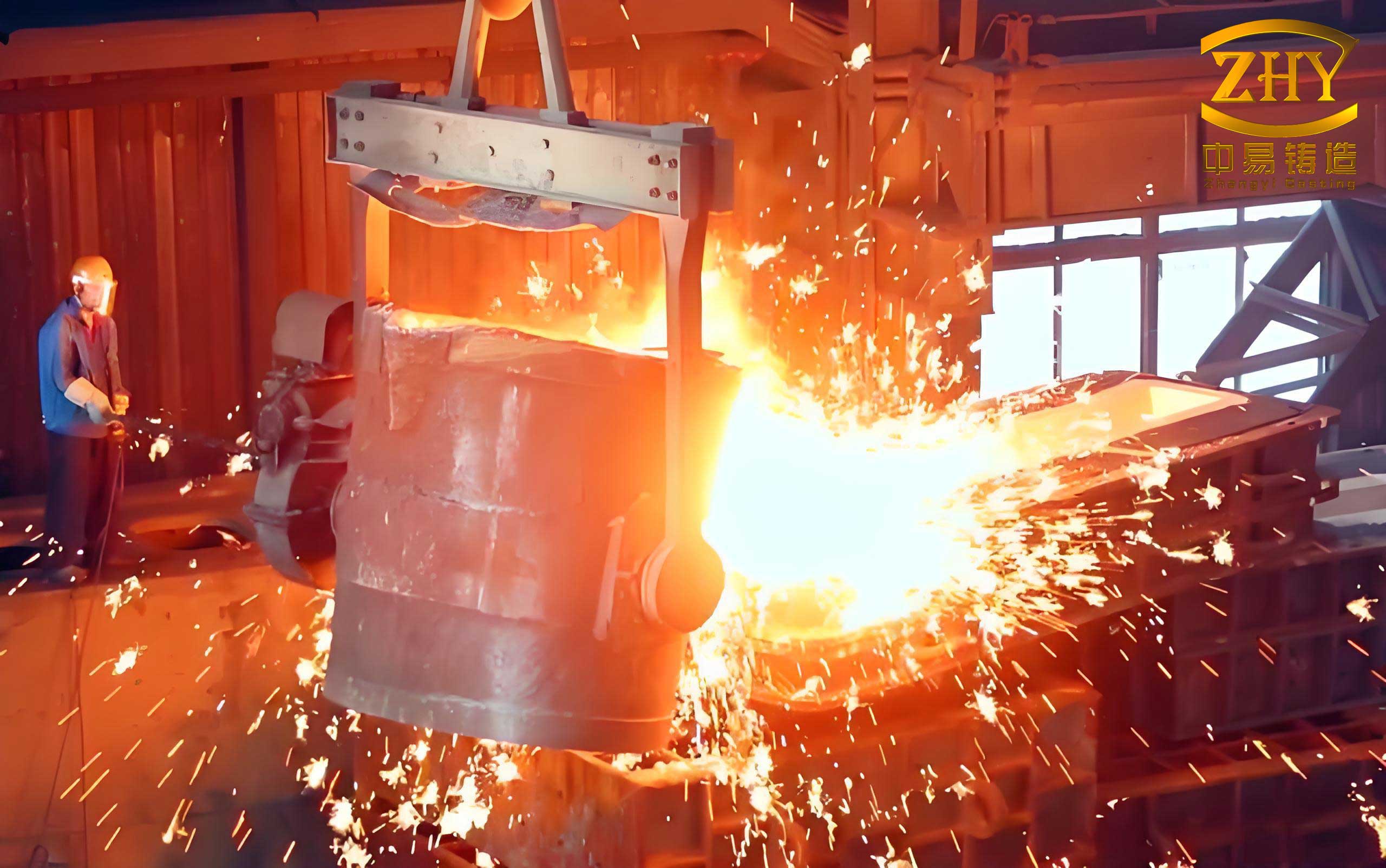
The development of vermicular graphite cast iron dates back to the mid-20th century, with international advancements driven by the need for energy-efficient and environmentally friendly engines. In domestic contexts, early projects focused on rare earth applications in cast iron, leading to improved performance in casting parts. Today, major engine manufacturers globally have adopted this material for critical components like cylinder blocks and heads, leveraging its superior properties for lightweight and compact designs. However, producing high-grade vermicular graphite cast iron for cylinder head casting parts involves challenges such as material stability, shrinkage porosity, and process consistency, which I have addressed through systematic improvements in metallurgy and casting techniques.
To quantify the advantages, the key physical properties of common cast iron materials are summarized in Table 1. This comparison highlights the superior tensile strength, elastic modulus, and bending fatigue strength of vermicular graphite cast iron, albeit with a slight trade-off in thermal conductivity. The performance metrics justify its selection for demanding casting parts like cylinder heads.
| Property Parameter | Ordinary Gray Iron (HT250) | Alloyed Gray Iron (HT300) | Vermicular Graphite Cast Iron (RuT450) |
|---|---|---|---|
| Tensile Strength (MPa) | 250 | 300 | 450 |
| Elastic Modulus (GPa) | 105 | 115 | 145 |
| Thermal Conductivity (W·(m·K)-1) | 46 | 38 | 36 |
| Bending Fatigue Strength (MPa) | 150 | 170 | 300 |
The international adoption of vermicular graphite cast iron in casting parts is evidenced by its use in various engine series, as detailed in Table 2. This widespread application underscores its reliability and performance benefits in high-stress environments.
| No. | Automotive Manufacturer | Engine Type | Vermicular Iron Casting Parts |
|---|---|---|---|
| 1 | Audi | 3.0–6.0 L Diesel | Cylinder Block |
| 2 | DAF | 12.6–12.9 L Diesel | Cylinder Block, Cylinder Head |
| 3 | Ford | 2.7–12.7 L Diesel | Cylinder Block, Cylinder Head |
| 4 | MAN | 10.5–12.4 L Diesel | Cylinder Block |
| 5 | Mercedes-Benz | 10–16 L Diesel | Cylinder Block, Cylinder Head |
| 6 | Volvo | Heavy-Duty Diesel | Cylinder Block |
| 7 | Scania | 11–13 L Diesel | Cylinder Head |
Domestically, the development and application of high-grade vermicular graphite cast iron have accelerated, with several foundries implementing it for cylinder head casting parts, as shown in Table 3. This trend reflects a commitment to advancing material science for casting parts in the automotive sector.
| No. | Foundry | Engine Type | Vermicular Iron Casting Parts |
|---|---|---|---|
| 1 | Weichai | W9–W15 (7–13 L) | Cylinder Head |
| 2 | Sinotruk | MAN Series | Cylinder Head, Cylinder Block |
| 3 | Yuchai | K5, K8, K11, K13, K15 | Cylinder Head |
| 4 | Shangchai | 11 L | Lower Cylinder Block/Cylinder Block |
| 5 | Shanxi International Yashine | Ford 9–11 L | Cylinder Head |
| 6 | JMC Heavy Duty | Ford 9–11 L | Cylinder Head |
| 7 | FAW Foundry (Wuxi Branch) | 5–16 L | Cylinder Head |
In producing high-grade vermicular graphite cast iron for cylinder head casting parts, we encounter specific technical requirements: hardness of HBW200–260 (with HBW220–260 in critical areas like the bridge region), pearlite content ≥85%, vermicularity ≥80%, tensile strength ≥400 MPa, and absence of visible shrinkage porosity in bolt holes or other key sections, validated through pressure testing. However, challenges arise in material stability, shrinkage defects, and process consistency. For instance, fluctuations in tensile strength (400–530 MPa) and vermicularity (as low as 75%) occur due to the narrow stable range for vermicular graphite formation. The equivalent magnesium content range for optimal vermicularity is approximately 0.008%, as described by the relationship between graphite morphology and magnesium content: $$ \text{Vermicularity} = \frac{1}{1 + e^{-k(\text{Mg} – \text{Mg}_0)}} $$ where $k$ is a constant and $\text{Mg}_0$ is the target magnesium content. Magnesium loss in molten iron is rapid, about 0.001% per 5 minutes, further tightening control limits: $$ \Delta \text{Mg} = -0.001 \times t $$ where $t$ is time in minutes. This necessitates precise process control to ensure quality casting parts.
Shrinkage porosity in casting parts often localizes at isolated hot spots like bolt and guide holes, exacerbated by process variations. The tendency for shrinkage can be modeled using the solidification parameter: $$ S = \int_{0}^{t_f} \frac{T_l – T(t)}{T_l – T_s} \, dt $$ where $S$ is the shrinkage risk, $T_l$ is the liquidus temperature, $T_s$ is the solidus temperature, and $t_f$ is the solidification time. To mitigate this, we optimized gating and chilling systems. Additionally, process inconsistencies, such as fluctuations in interfering elements (e.g., sulfur, oxygen) and equipment issues like wire feeding failures, disrupted production continuity, leading to a 30% rejection rate initially. By implementing corrective measures, we improved the reliability of casting parts.
Our improvement strategy centers on the OCC (Oxidation Control and Correction) process, which integrates melting, treatment, and detection for high-grade vermicular graphite cast iron casting parts. The workflow involves: (1) melting in electric furnaces to achieve base iron; (2) transmitting parameters (e.g., liquidus temperature from thermal analysis, sulfur from carbon-sulfur analyzers, elemental composition from spectrometers) to the OCC control center; (3) calculating wire feeding amounts based on input data; (4) executing wire feeding for vermicularization and inoculation; and (5) verifying indices before pouring. For cylinder head casting parts, we adopted a riserless vertical gating system with mold dimensions of 1300 mm × 900 mm × 350 mm × 2, as illustrated in the gating design. This approach enhances feeding efficiency for casting parts.
Melting practices are critical for consistent casting parts. We select raw materials meticulously: pig iron with ω(S) ≤0.03% (grades like Q10 or Q12), scrap steel with low sulfur and stable titanium content (e.g., scrap A with ω(Ti) 0.04–0.07%), and low-sulfur carburizers (ω(S) ≤0.03%). Titanium in scrap steel stabilizes graphite formation, broadening the vermicularization window, but must be controlled below 0.08% to avoid graphite aberrations and machining issues. Charge ratios influence properties; increasing scrap steel by 10% boosts strength by 10–15 MPa but raises shrinkage risk. We balance this with returns from vermicular iron casting parts, segregated and processed to avoid contamination. Carbon equivalent (CE) is chosen near the eutectic point to optimize feeding, calculated as: $$ \text{CE} = \text{C} + 0.33(\text{Si} + \text{P}) $$ Targeting slightly hypoeutectic compositions ensures strength while minimizing shrinkage in casting parts.
For off-specification iron, we developed remediation techniques. If magnesium indices are low, we add rare earth (RE) or perform secondary wire feeding. Conversely, excess magnesium is corrected by diluting with base iron. Results from these adjustments are shown in Table 4, demonstrating restored properties for casting parts.
| Initial Mg Index | Remediation Method | Addition | Pearlite (%) | Vermicularity (%) | Hardness (HBW) | Tensile Strength (MPa) |
|---|---|---|---|---|---|---|
| 11.2 | Add RE | 1.0 kg | 95 | 90 | 221 | 436 |
| 12.1 | Add RE | 0.8 kg | 95 | 90 | 223 | 439 |
| 12.9 | Add RE | 0.5 kg | 95 | 95 | 220 | 431 |
| 10.9 | Secondary Wire | 3.0 m | 90 | 95 | 226 | 453 |
| 10.3 | Secondary Wire | 4.0 m | 95 | 90 | 223 | 441 |
| 9.5 | Secondary Wire | 5.0 m | 95 | 95 | 220 | 433 |
| 7.0 | Secondary Wire | 6.0 m | 90 | 90 | 227 | 460 |
| 17.7 | Add Base Iron | 60 kg | 95 | 90 | 235 | 471 |
| 18.4 | Add Base Iron | 110 kg | 95 | 95 | 230 | 463 |
| 19.9 | Add Base Iron | 125 kg | 95 | 90 | 228 | 449 |
| 17.7 | Add Base Iron | 120 kg | 95 | 95 | 231 | 457 |
Process monitoring includes thermal analysis for CE, carbon-sulfur measurement, spectroscopy, and on-site metallography. We use small cylindrical samples and triangular test blocks for rapid assessment of vermicularity in casting parts. Criteria for triangular tests are summarized in Table 5, aiding in real-time quality control for casting parts.
| Phenomenon | Good Vermicularization | Poor Vermicularization | No Vermicularization |
|---|---|---|---|
| Fracture Surface | Silvery-gray, fine structure, slight center shrinkage | Silvery-gray or excessive white iron | Dark gray, coarse structure |
| Edge and Top | Rounded edges, moderate depression at top and sides | No depression at top and sides | Sharp edges, no depression |
| Odor When Quenched | Strong carbide smell | Faint carbide smell | No carbide smell |
Gating and chilling optimizations are essential for defect-free casting parts. We adjusted ingate positions to reduce hot spots near bolt and tappet holes, lowering shrinkage risk. The thermal gradient improvement can be expressed as: $$ \nabla T = \frac{T_h – T_c}{d} $$ where $T_h$ is the hot spot temperature, $T_c$ is the chill temperature, and $d$ is the distance. By increasing $d$ or decreasing $T_h$ via chilling, shrinkage is minimized. External chills were applied to guide holes, reducing defect rates from 2% to below 0.3%. For inaccessible areas like injector holes, chills embedded in sand cores enhanced cooling, virtually eliminating porosity. These modifications enabled riserless production of cylinder head casting parts, improving yield and consistency.
In conclusion, the successful application of high-grade vermicular graphite cast iron in cylinder head casting parts hinges on stable raw materials, precise process control, and adaptive remediation. Key lessons include: using low-sulfur, consistent charge materials; optimizing CE near the eutectic point; implementing OCC-based vermicularization with corrective actions for off-spec iron; and refining gating and chilling designs to mitigate shrinkage. These strategies ensure material stability, reduce defects, and maintain production continuity for high-performance casting parts. Future work may focus on advanced modeling to predict vermicularity and shrinkage, further enhancing the reliability of casting parts in demanding engine applications. Through these practices, we have demonstrated that high-grade vermicular graphite cast iron is a viable and superior material for cylinder head casting parts, contributing to the evolution of durable and efficient engines.