
In the production of complex thin-walled shell castings, such as clutch housings, achieving high-quality outputs free from defects like gas pores, sand inclusions, and core fractures remains a significant challenge. These defects not only compromise the mechanical properties and pressure tightness of the castings but also lead to increased scrap rates and production costs. Based on my extensive experience in foundry process design, this article delves into a comprehensive analysis of common defects in shell castings, particularly focusing on a case study involving a clutch housing component. I will explore the root causes, derived from limitations in initial process design, and present a series of interconnected technological improvements. The goal is to provide a detailed, first-person account of how systematic modifications—incorporating enhanced venting, core design changes, and reinforcement techniques—can dramatically improve product quality. Throughout this discussion, the term ‘shell castings’ will be emphasized to underscore its relevance in industrial applications. I will utilize tables and mathematical formulas to summarize key relationships and parameters, offering a quantitative perspective on defect formation and mitigation strategies.
The clutch housing in question, a typical example of demanding shell castings, had a maximum envelope dimension of 363mm × 384mm × 220mm and weighed 18kg. Its material was HT250 (gray cast iron), with a minimum wall thickness of 5mm. The requirement for pressure tightness testing mandated a dense, defect-free microstructure. The original production process employed green sand molding with air impulse compaction, using a mold box with internal dimensions of 1200mm × 800mm × (350/350)mm. To optimize productivity, a pattern of four castings per mold was adopted. The gating system was a horizontal, center-poured design with ingates on the parting plane, chosen for its smooth filling characteristics and reduced buoyancy on cores. Each casting had three ingates. All cores were made from shell sand (coated sand), known for its high gas evolution. The original venting strategy involved shared exhaust channels for cores, overflow risers at the top flange, and vent pins on various bosses. Despite these measures, batch production revealed persistent defects: gas pores concentrated at the highest points of the bottom face, sand inclusions on the top flange surface, and core fractures at the connecting points of interlocking cores.
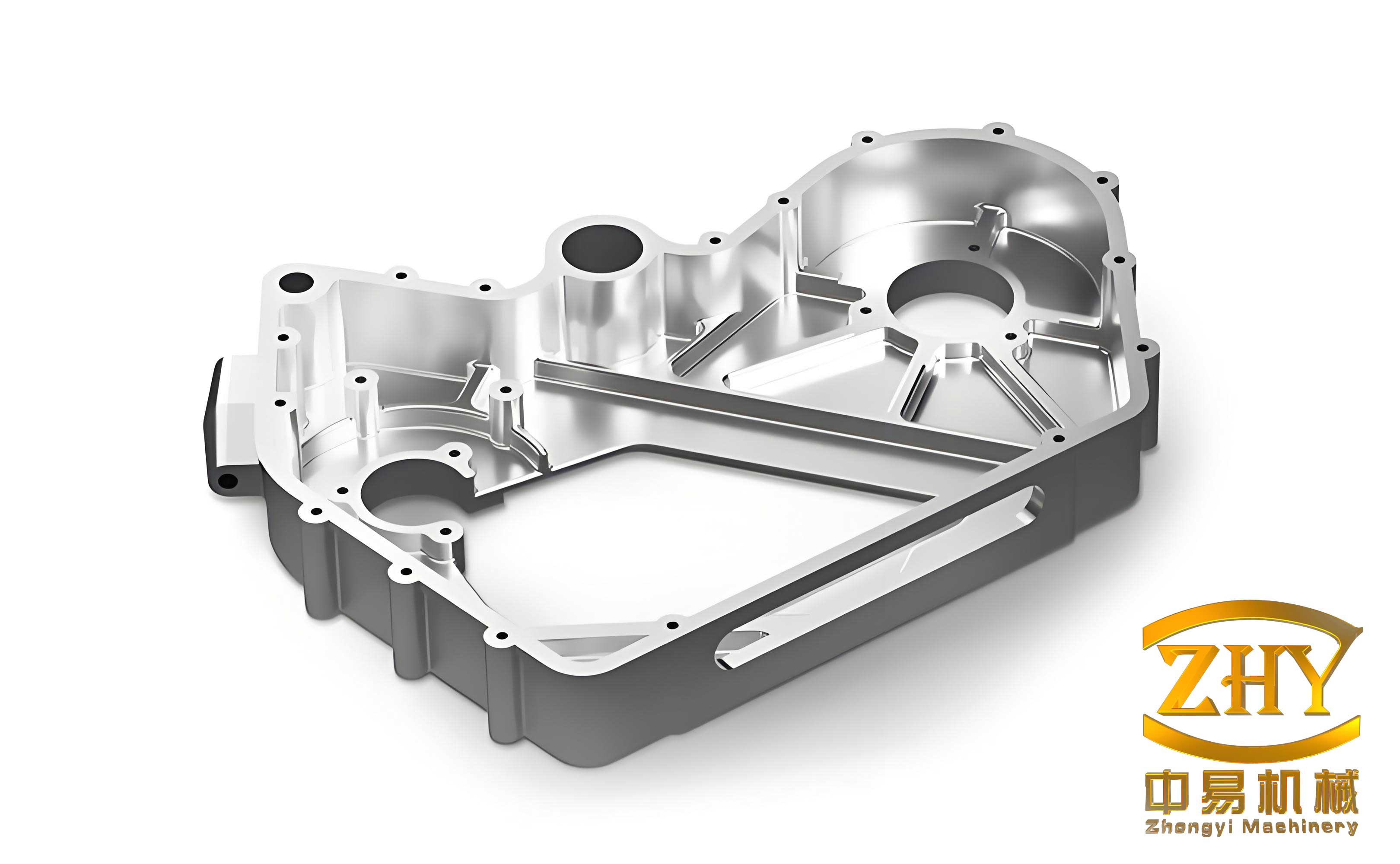
The analysis of gas pore defects, prevalent in such shell castings, pointed directly to inadequate venting of core gases. The original design had two large cores sharing a single exhaust channel, creating a bottleneck. During pouring, the rapid gas evolution from the heated shell sand cores could not escape quickly enough, leading to gas entrapment in the solidifying metal. The pressure buildup from evolved gases can be described by a modified form of the ideal gas law, considering the confined volume of the mold cavity:
$$ P_g(t) = \frac{n_g(t) R T}{V_c} $$
where \( P_g(t) \) is the instantaneous gas pressure at the metal-core interface, \( n_g(t) \) is the number of moles of gas evolved from the core up to time \( t \), \( R \) is the universal gas constant, \( T \) is the absolute temperature at the interface, and \( V_c \) is the effective volume available for the gas near the core surface. A critical pressure \( P_{crit} \) exists, above which the gas force overcomes the metallostatic pressure and surface tension, allowing it to penetrate the liquid metal and form a pore. This can be expressed as:
$$ P_g(t) > P_{metal} + P_{surface} $$
$$ P_{metal} = \rho g h $$ $$ P_{surface} = \frac{2 \gamma \cos \theta}{r} $$
Here, \( \rho \) is the metal density, \( g \) is gravity, \( h \) is the metallostatic head, \( \gamma \) is the surface tension of the metal, \( \theta \) is the contact angle, and \( r \) is the effective pore radius. For shell castings with thin walls, the metallostatic head \( h \) is often low, making them particularly susceptible to gas penetration even at moderate \( P_g \) values. The gas evolution rate \( \dot{n}_g \) from a shell sand core is a function of temperature and resin content, often modeled empirically. Reducing resin content to lower \( \dot{n}_g \) was not viable as it would compromise core strength, already a concern. Therefore, the solution focused on drastically increasing the venting cross-sectional area \( A_v \) to reduce the effective gas pressure by providing an easy escape path. The volumetric flow rate of gas \( Q \) through a vent can be approximated by Darcy’s law for flow through porous media or by considering viscous flow in channels:
$$ Q \approx \frac{A_v \Delta P}{\mu L} $$
where \( \Delta P \) is the pressure differential, \( \mu \) is the gas viscosity, and \( L \) is the vent length. By designing dedicated, larger vents for each core, placed at the highest points, \( A_v \) was increased, reducing \( \Delta P \) and thus \( P_g(t) \), keeping it below \( P_{crit} \).
Sand inclusion defects, localized on the top flange, were traced to low mold hardness in vertical wall sections near the mold box walls. The air impulse compaction process often leads to “bridging” in deep grooves of the pattern, resulting in uneven compaction. The mold hardness in these areas measured only 50-60 on a standard scale, below the required 70+. The susceptibility to erosion can be related to the shear stress exerted by the flowing metal. The critical shear stress \( \tau_c \) for sand erosion depends on the mold’s compressive strength \( \sigma_c \), which correlates with hardness. An empirical relation might be: \( \tau_c \propto \sigma_c \). The actual shear stress \( \tau \) from the fluid flow can be estimated from boundary layer theory:
$$ \tau_w = \frac{1}{2} C_f \rho_m V^2 $$
where \( C_f \) is the skin friction coefficient, \( \rho_m \) is the metal density, and \( V \) is the local flow velocity. In areas of low hardness (\( \sigma_c \) low), \( \tau_c \) is low, and if \( \tau_w > \tau_c \), sand grains are dislodged. The original process had this flange surface formed by the mold sand. The solution was to modify the core design, extending the core print so that this critical surface was formed by the core itself. Shell sand cores have significantly higher surface hardness and erosion resistance than green sand molds, thereby eliminating the source of sand inclusions for this shell casting component.
Core fracture occurred at the small, protruding core prints that connected two major cores. These prints acted as cantilever beams supporting the weight and buoyancy forces of the core assembly. The failure stress \( \sigma_f \) at the root of the print must exceed the core material’s tensile strength \( \sigma_t \). The bending stress in a cantilever of length \( L_p \), cross-sectional area \( A_p \), subjected to a force \( F \) (from core weight and buoyancy) is:
$$ \sigma_f = \frac{M y}{I} = \frac{F L_p \cdot (d/2)}{(b d^3 / 12)} = \frac{6 F L_p}{b d^2} $$
assuming a rectangular cross-section with width \( b \) and depth \( d \). Here, \( y \) is the distance from neutral axis, \( I \) is the area moment of inertia, and \( M \) is the bending moment. The original design had small \( d \) and \( b \), leading to high \( \sigma_f \). Simply using higher-strength shell sand (increasing \( \sigma_t \)) would increase cost and gas evolution. The innovative solution was to embed a steel rod (core rod) inside the slender core print during core shooting. This rod acts as reinforcement, drastically increasing the effective bending strength of the composite section. The moment of inertia of the reinforced section \( I_{eff} \) becomes much larger than that of sand alone, reducing the bending stress \( \sigma_f \) on the sand matrix below its tensile strength.
The following table summarizes the primary defects, their root causes, and the corresponding corrective actions implemented for these shell castings:
| Defect Type | Primary Root Cause | Key Corrective Action | Governing Principle/Formula |
|---|---|---|---|
| Gas Pores (Blowholes) | Insufficient venting cross-section for core gases; shared vent channels causing back-pressure. | Provide dedicated, larger exhaust channels for each core, located at the highest point. | $$ P_g = \frac{n_g R T}{V} $$; Ensure \( P_g < \rho g h + \frac{2 \gamma \cos \theta}{r} \) via increased \( A_v \). |
| Sand Inclusions | Low mold hardness (<70) on vertical walls near box edges due to compaction bridging. | Modify core design to form the critical vertical surface with the core instead of the mold sand. | Prevent erosion where \( \tau_w = \frac{1}{2} C_f \rho_m V^2 > \tau_c(\sigma_c) \). |
| Core Fracture | High bending stress in slender cantilever core prints connecting major cores. | Embed steel core rods within the vulnerable core prints during core manufacturing. | Reduce \( \sigma_f = \frac{6 F L_p}{b d^2} \) by increasing effective \( I \) via reinforcement. |
The implementation of these modified processes required precise adjustments. For venting, each core was given its own exhaust channel running through the core print to the mold exterior, effectively doubling the total vent area compared to the shared system. The design ensured the vent outlet was at the highest possible point in the mold cavity relative to that core’s position. For the sand inclusion issue, the 2# core’s print was enlarged so that its side surface defined the entire top flange vertical face, eliminating reliance on the weak mold sand in that area. For core reinforcement, Ø10mm holes were incorporated into the corebox for the 2# core’s small prints. Before shooting, a steel rod was placed in each hole. After curing, the rod was encapsulated within the sand. Corresponding Ø12mm sockets were created in the mating 1# core. During core assembly, adhesive was applied to the socket, and the steel rod from the 2# core was inserted, creating a strong mechanical bond.
The results were quantitatively significant. After the process changes, core fracture defects were completely eliminated. The scrap rates due to gas pores and sand inclusions saw a substantial reduction of over 70%. This demonstrated the effectiveness of targeted, physics-based solutions. The table below provides a hypothetical before-and-after comparison of defect rates, illustrating the impact of the optimizations on the production yield of these shell castings:
| Production Phase | Gas Pore Scrap Rate (%) | Sand Inclusion Scrap Rate (%) | Core Fracture Scrap Rate (%) | Overall Yield (%) |
|---|---|---|---|---|
| Before Process Improvement | 5.2 | 3.8 | 4.5 | 86.5 |
| After Process Improvement | 1.5 | 1.0 | 0.0 | 97.5 |
The success of this case study highlights several generalizable principles for the manufacture of complex shell castings. First, venting design must be aggressive and dedicated, especially when using high-gas-evolving core materials like shell sand. The total vent area should be calculated based on an estimate of total gas volume and the desired pressure drop, using principles of fluid dynamics. Second, process designers should aim to avoid relying on green sand molds to form deep, vertical surfaces, particularly in areas with potential compaction issues. Utilizing cores for such surfaces enhances dimensional accuracy and eliminates a major source of sand defects. Third, for slender core sections or cantilevered prints subject to significant loads, internal reinforcement with metallic inserts is a highly effective and economical solution compared to switching to premium core sands.
Further analytical considerations can be applied to optimize these shell castings processes. For instance, the gating system design influences the filling turbulence and thus the potential for gas entrapment and mold erosion. The Reynolds number \( Re = \frac{\rho V D}{\mu} \) should be kept below a critical value to ensure laminar or non-erosive flow in the gates and cavity. The pouring time \( t_p \) must be synchronized with the gas evolution curve of the cores \( n_g(t) \) to ensure vents are most effective during peak gas generation. A more sophisticated model might involve solving coupled equations for fluid flow, heat transfer, and gas generation. However, the practical improvements outlined here often provide the most immediate return on investment.
In conclusion, the journey to produce high-integrity shell castings free from major defects is a systematic exercise in identifying root causes and implementing precise countermeasures. Through the detailed analysis presented from my first-hand experience, it is evident that defects like gas pores, sand inclusions, and core fractures in components such as clutch housings are predominantly linked to process design limitations rather than material deficiencies alone. By embracing improvements such as individualized core venting, strategic use of cores to replace vulnerable mold surfaces, and the incorporation of simple reinforcement techniques for weak core sections, foundries can achieve remarkable improvements in quality and yield. The economic benefits are clear: higher productivity from multi-cavity molds like the one-by-four pattern used here, reduced scrap and rework costs, and increased customer satisfaction. The principles discussed are universally applicable to a wide range of shell castings, emphasizing that robust process engineering, guided by fundamental physical and mechanical principles, is key to manufacturing excellence in the foundry industry. Future work could involve implementing real-time monitoring of mold gas pressure or using simulation software to predict and optimize vent placement and gating design for new shell casting geometries, further pushing the boundaries of quality and efficiency.