
In modern foundry practices, the production of high-quality shell castings, particularly for complex geometries like valve housings, often relies on iterative trial-and-error methods that extend lead times and increase costs. As a casting engineer, I have explored the use of numerical simulation software to mitigate these challenges. ProCAST, a finite element-based tool, enables comprehensive analysis of heat transfer, filling dynamics, stress coupling, and defect prediction, making it invaluable for optimizing processes. This article details my application of ProCAST to simulate the sand casting of an aluminum alloy suction valve shell, a critical component in pressure systems. The focus is on evaluating filling patterns, temperature fields, and defect formation to refine the gating and riser design, ultimately enhancing the integrity of shell castings.
The suction valve shell casting, with its intricate internal passages and varying wall thicknesses, represents a typical challenge in shell castings production. Its 3D model, derived from CAD software, reveals a轮廓尺寸 of 721 mm × 352 mm × 352 mm and a mass of approximately 30.0 kg. The wall thickness ranges from 10.0 mm to 30.6 mm, with an average of 12.2 mm, predisposing it to defects like porosity and cold shuts due to uneven solidification. Such shell castings must withstand internal pressure and bolt constraints, demanding high mechanical properties and soundness.
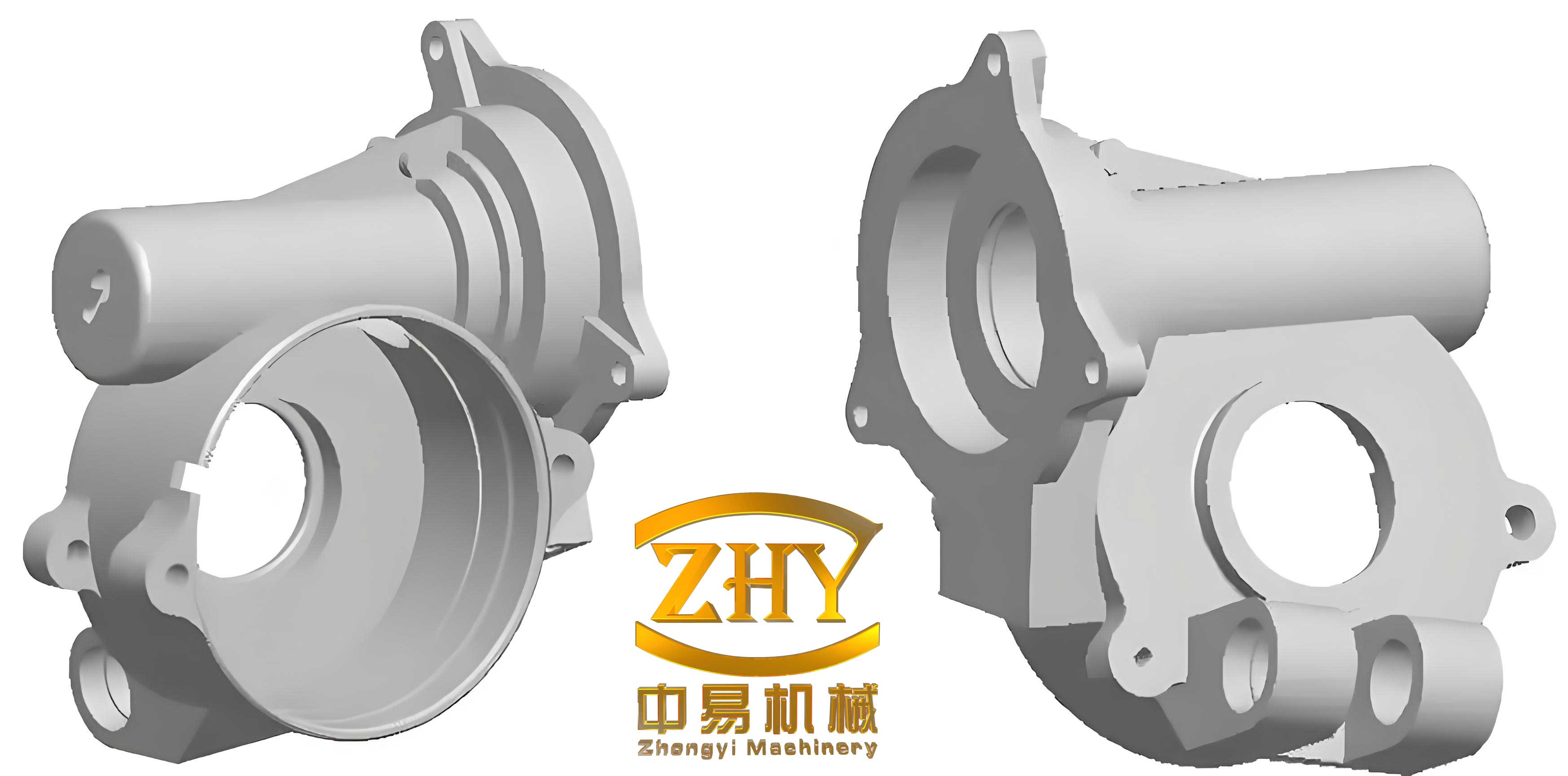
For this shell casting, I selected ZL114A alloy due to its excellent castability and performance. Its physical and chemical properties are summarized in Tables 1 and 2. The alloy exhibits high tensile strength (310 MPa) and good elongation, suitable for pressure-bearing shell castings. The density is 2.7 g/cm³, with a solidus-liquidus range of 557–613°C, influencing the solidification behavior.
| Alloy Grade | Density (g/cm³) | Solidus-Liquidus (°C) |
|---|---|---|
| ZL114A | 2.7 | 557–613 |
| Si | Ti | Be | Cu | Mg | Zn | Al |
|---|---|---|---|---|---|---|
| 6.25 | 0.18 | 0.07 | 0.15 | 0.55 | 0.08 | Bal. |
Aluminum alloy shell castings are prone to gas porosity and pinholing, exacerbated by the average wall thickness of 12.2 mm. Thus, mold sand must exhibit low gas evolution, good flowability, and easy compactability. After thorough comparison, I opted for alkaline phenolic resin self-hardening sand, which provides high precision, smooth surfaces, and strength for shell castings.
The casting orientation significantly affects solidification. For shell castings, key surfaces should face downward or upright to minimize defects. Considering aluminum’s tendency to form oxide films during filling, I chose a bottom-gating system with horizontal pouring to ensure平稳充型 and reduce oxidation. The plan involved one casting per mold box. According to GB/T 6414-1999, dimensional tolerance was set at CT11-12 grade, corresponding to 3.6 mm for the casting dimensions. Machining allowances were assigned F-H grade, with 5 mm for flanges. Given the铝硅合金’s constrained shrinkage, a casting shrinkage rate of 1% was applied. Wooden patterns with a draft angle of 0°35′ were used, and bolt holes under 20 mm diameter were not cast. Cores were supported by chaplets.
Pouring time critically influences mold filling and quality. For shell castings, it can be estimated using:
$$ \tau = s_1 \sqrt[3]{G \delta} $$
where $\tau$ is the pouring time in seconds, $G$ is the total weight including risers (kg), $\delta$ is the average wall thickness (mm), and $s_1$ is a metal-dependent coefficient. For the suction valve shell, with $G \approx 35$ kg (including allowances), $\delta = 12.2$ mm, and $s_1 = 0.8$ for aluminum alloys, the calculation yields:
$$ \tau = 0.8 \times \sqrt[3]{35 \times 12.2} \approx 15 \text{ seconds}. $$
I designed two gating schemes for comparison. Scheme 1 employed vertical molding and horizontal pouring, with an open gating system and area ratios $\sum F_{\text{sprue}} : \sum F_{\text{runner}} : \sum F_{\text{ingate}} = 1:2:3$. This bottom-gating, reverse rain-type arrangement placed the gating within the core, minimizing冲击 but risking cold shuts in upper regions of the shell casting. Scheme 2 used horizontal molding and pouring with the same area ratios, but the gating was external, simplifying molding but potentially causing inadequate filling in top sections.
To simulate these schemes, I imported IGES files into ProCAST’s Mesh module. Mesh sizes were varied: 4 mm for the casting, cores, and gating system, and 30 mm for the mold box, balancing accuracy and computational speed. For Scheme 1, the mesh comprised 218,212 2D elements and 6,094,124 3D elements. Scheme 2 had 147,876 2D elements and 3,951,294 3D elements. The mesh quality was verified to ensure reliable results for shell castings analysis.
Key parameters were set based on material properties and process conditions. The heat transfer coefficient between the resin sand mold/core and the aluminum alloy was set to 300 W/m²·K, while that between the mold and air was 10 W/m²·K. The pouring temperature was 740°C, and the pouring time was 15 seconds, consistent with the calculation. These parameters are summarized in Table 3.
| Parameter | Value | Unit |
|---|---|---|
| Mold Material | Alkaline Phenolic Resin Sand | – |
| Heat Transfer Coefficient (Mold-Metal) | 300 | W/m²·K |
| Heat Transfer Coefficient (Mold-Air) | 10 | W/m²·K |
| Pouring Temperature | 740 | °C |
| Pouring Time | 15 | s |
| Alloy Density | 2700 | kg/m³ |
| Solidus Temperature | 557 | °C |
| Liquidus Temperature | 613 | °C |
The filling process was simulated using ProCAST’s fluid flow and heat transfer modules. For Scheme 1, the filling time distribution showed complete filling at 16.42 seconds, close to the calculated 15 seconds. The maximum velocity was below 1.8 m/s, indicating平稳充型. However, velocity fields revealed滞后 in the third flange area, potentially leading to gas entrapment. Defect prediction, based on the Niyama criterion for porosity, highlighted shrinkage porosity and micro-shrinkage at the lower outer shell and near the ingates. This is attributed to糊状凝固, where interdendritic feeding is insufficient in thick sections of shell castings. The Niyama criterion is expressed as:
$$ N_y = \frac{G}{\sqrt{\dot{T}}} $$
where $G$ is the temperature gradient (K/m) and $\dot{T}$ is the cooling rate (K/s). Regions with $N_y$ below a threshold (e.g., 1 K¹/²·s¹/²·m⁻¹) indicate shrinkage risk. In Scheme 1, these regions correlated with defect zones.
For Scheme 2, filling completed at 15.41 seconds, with maximum velocities under 1.6 m/s. The process was more uniform, but defects concentrated in thick flanges due to slower cooling and inadequate feeding. Comparative results are in Table 4.
| Aspect | Scheme 1 | Scheme 2 |
|---|---|---|
| Filling Time (s) | 16.42 | 15.41 |
| Max Velocity (m/s) | 1.8 | 1.6 |
| Defect Severity | Moderate, scattered | Low, localized |
| Primary Defect Locations | Lower shell, ingate junctions | Thick flanges |
| Solidification Pattern | Uneven, directional | More sequential |
Scheme 2 proved superior for shell castings, with fewer defects and smoother filling. However, the thick flange areas exhibited shrinkage due to last-solidification zones. To optimize, I added a top riser to enhance feeding. The riser design followed modulus principles, ensuring it solidifies later than the casting. The modulus $M$ is defined as volume-to-surface area ratio:
$$ M = \frac{V}{A} $$
For the flange, $M_{\text{flange}} \approx 0.012 \text{ m}$, so the riser modulus $M_{\text{riser}} > M_{\text{flange}}$. A腰圆柱形明冒口 (cylindrical open riser) was placed atop the flange, with dimensions calculated to provide sufficient feed metal. The riser volume $V_r$ was determined using the feeding demand equation:
$$ V_r = \beta \cdot V_c \cdot \varepsilon $$
where $V_c$ is the casting volume, $\varepsilon$ is the solidification shrinkage (约 6% for aluminum alloys), and $\beta$ is a safety factor (1.2–1.5). For this shell casting, $V_r \approx 0.0012 \text{ m}^3$.
After modifying the工艺, I reran the simulation. The results showed that the riser effectively fed the flange, transferring shrinkage to itself. Defect distribution maps indicated no porosity in the flange, confirming the优化. This underscores the value of simulation in iterating shell castings designs without physical trials.
Beyond filling and solidification, I analyzed thermal stresses to assess cracking risks in shell castings. The stress-strain relationship during cooling is governed by:
$$ \sigma = E \cdot \varepsilon_{\text{thermal}} $$
where $\sigma$ is stress, $E$ is Young’s modulus (70 GPa for ZL114A), and $\varepsilon_{\text{thermal}} = \alpha \Delta T$, with $\alpha$ as the thermal expansion coefficient (24 × 10⁻⁶ K⁻¹). ProCAST’s coupled thermo-mechanical solver revealed peak stresses below the alloy’s yield strength, indicating no hot tearing.
Microstructural simulation was also conducted to predict grain size in shell castings. Using the cellular automaton method, the grain growth velocity $v$ is given by:
$$ v = \mu \cdot \Delta T $$
where $\mu$ is the kinetic coefficient and $\Delta T$ is the undercooling. The simulation showed fine equiaxed grains in thin walls and coarser structures in thick sections, aligning with expectations for aluminum shell castings.
In summary, ProCAST enabled a comprehensive evaluation of the suction valve shell casting process. The software’s ability to model complex phenomena—from fluid flow to defect formation—proved instrumental in optimizing gating and risering for high-integrity shell castings. The成功 of Scheme 2 with riser addition highlights how simulation can reduce defects and improve yield. Future work could explore other alloy systems or advanced gating designs for shell castings, leveraging ProCAST’s capabilities further.
The application of numerical simulation in foundries is transforming shell castings production. By predicting outcomes virtually, engineers can minimize trials, cut costs, and enhance quality. For shell castings with demanding specifications, tools like ProCAST are indispensable. My experience demonstrates that even for intricate geometries, simulation-driven design leads to robust processes, ensuring that shell castings meet stringent performance criteria in industries such as automotive, aerospace, and hydraulics.