
In the field of mechanical engineering, shell castings play a critical role as foundational components, integrating various parts into a cohesive unit within machines or assemblies. These castings, often characterized by intricate geometries, non-uniform wall thicknesses, and internal cavities, demand high precision and reliability. Among these, gearbox housings—typically produced from cast iron or aluminum alloys—require dense microstructures and stable mechanical properties to withstand rigorous operational conditions. As a researcher focused on advancing casting technologies, I embarked on a study to develop and optimize a resin sand casting process for a gray iron gearbox housing. Utilizing Huazhu CAE simulation software, I analyzed the filling, solidification, temperature fields, flow fields, and stress distributions to refine the process, aiming to minimize defects, enhance product quality, shorten development cycles, and reduce costs. This article details my approach, simulations, and optimizations, emphasizing the significance of shell castings in industrial applications.
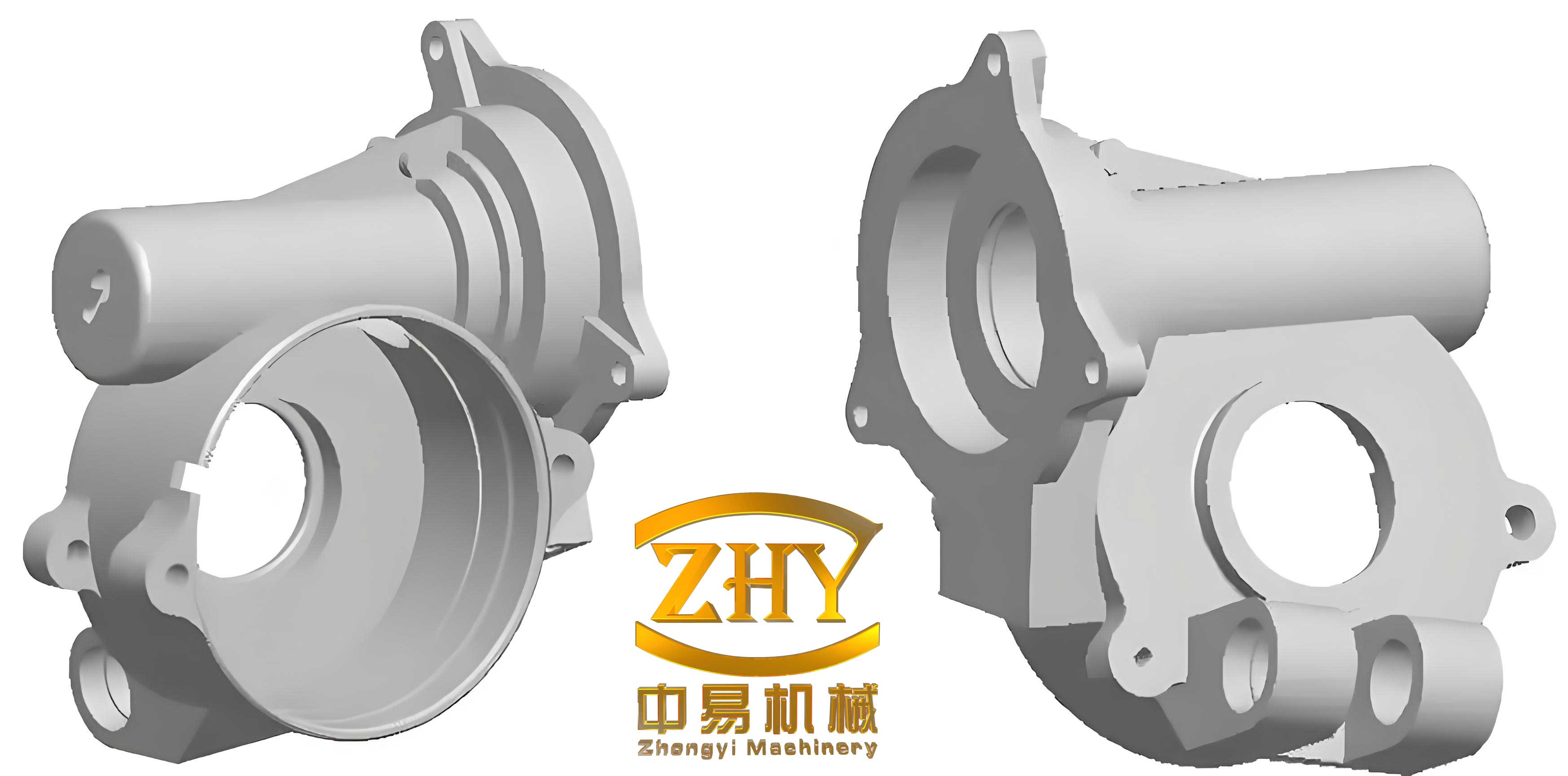
The gearbox housing under investigation is a complex shell casting with external dimensions of 613 mm × 524 mm × 584 mm and a weight of 83 kg. Its design features uneven wall thicknesses, primarily around 8 mm, combining a square basin-like structure with a perpendicular circular section. Such geometry poses challenges for achieving uniform solidification and avoiding defects like shrinkage porosity and gas holes. The casting must meet stringent performance criteria: a tensile strength of ≥250 MPa from本体试棒 (本体试棒 refers to test bars taken from the casting itself), a hardness range of 190–230 HBW with consistent values across specified points, and adherence to CT9-level dimensional tolerances. Critical areas must be free of cracks, cold shuts, or other imperfections that could compromise functionality. The material used is HT250 gray iron, with key physical parameters summarized in Table 1.
| Parameter | Value | Unit |
|---|---|---|
| Density | 6.8748 | g/cm³ |
| Viscosity | 0.4008 | cm²/s |
| Radiation Coefficient | 0.365 | – |
| Latent Heat | 56.0838 | cal/g |
| Liquidus Temperature | 1224 | °C |
| Solidus Temperature | 1115 | °C |
| Critical Solid Fraction | 0.75 | – |
| Solidification Coefficient | 0.7 | – |
The wide solidification range of 109°C (from liquidus to solidus) increases the propensity for shrinkage defects, necessitating careful process design. For shell castings like this gearbox housing, resin sand casting was selected due to its suitability for complex shapes and high-dimensional accuracy. The initial process scheme employed a one-casting-per-mold approach, with the parting line set at the maximum diameter of the circular section to minimize core usage and facilitate molding. A bottom-gating system was designed to ensure smooth metal flow, with a gating ratio of ΣSsprue : ΣSrunner : ΣSingate = 1 : 1.79 : 1, where the sprue area was 1256 mm², runner area 2244 mm², and ingate area 1250 mm². A riser, approximately 215 mm in height and 110 mm in diameter, was incorporated for feeding. The pouring temperature was set at 1400°C, and the pouring speed at 100 cm/s. Mesh generation for simulation used uniform grids, as detailed in Table 2.
| Mesh Type | Total Grids (10⁴) | Casting Grids (10⁴) | Grid Edge Length (mm) | Pouring Metal Mass (kg) | Process Yield (%) |
|---|---|---|---|---|---|
| Uniform Grid | 610.3 | 18.1 | 4.0 | 127.2 | 63.0 |
To analyze the initial process, I simulated the filling and solidification stages using Huazhu CAE. The filling process, completed in 3.785 seconds, showed stable metal flow without evident air entrainment or inclusion defects. Metal initially filled the lower part of the square basin structure, then progressively occupied the entire mold cavity. However, solidification simulation revealed potential issues: the sequence involved outward-to-inward solidification of both the square and circular sections, with isolated liquid zones forming at hot spots in the basin structure and circular surface by the time solidification reached 72% completion. The total solidification time was 2311.61 seconds. These isolated zones indicated a risk of shrinkage porosity due to inadequate feeding. Further analysis using shrinkage criteria predicted minor shrinkage porosity at hot spots, though no macroscopic shrinkage cavities were evident. Additionally, back-pressure simulation calculated gas generation from the mold and cores during metal pouring, highlighting regions with high gas accumulation, particularly at a horizontal plane Z = 468 mm, which could lead to gas pores or shrinkage-gas defects if venting was insufficient.
Gas generation in shell castings primarily stems from the decomposition of resin and additives in molds and cores upon contact with molten metal. In the initial process, cooler metal entering early in the pour could trap gases, exacerbating defect risks. To address these issues, I implemented several optimizations. First, I increased the pouring temperature to 1420–1440°C to enhance fluidity and gas逸出. Second, I added overflow risers near potential defect locations, equipped with vent pins to improve gas evacuation. These modifications aimed to promote directional solidification and reduce isolated liquid zones. The updated process was re-simulated, with results showing a filling time of 3.880 seconds—similar to the initial scheme—and a solidification time of 2417.82 seconds. The孤立液相区 were effectively reduced, and shrinkage porosity volume decreased from 9.66 cc to 1.15 cc, as quantified by the Niyama criterion, often expressed for shell castings as: $$G / \sqrt{R} \leq C$$ where \(G\) is the temperature gradient, \(R\) is the cooling rate, and \(C\) is a material-dependent constant. This criterion helps predict shrinkage porosity in castings.
The thermal behavior during solidification can be modeled using the heat conduction equation: $$\frac{\partial T}{\partial t} = \alpha \nabla^2 T + \frac{L}{c_p} \frac{\partial f_s}{\partial t}$$ where \(T\) is temperature, \(t\) is time, \(\alpha\) is thermal diffusivity, \(L\) is latent heat, \(c_p\) is specific heat, and \(f_s\) is solid fraction. For shell castings, this equation is crucial to simulate temperature fields and identify hot spots. Additionally, fluid flow during filling follows the Navier-Stokes equations: $$\rho \left( \frac{\partial \mathbf{v}}{\partial t} + \mathbf{v} \cdot \nabla \mathbf{v} \right) = -\nabla p + \mu \nabla^2 \mathbf{v} + \rho \mathbf{g}$$ where \(\rho\) is density, \(\mathbf{v}\) is velocity, \(p\) is pressure, \(\mu\) is viscosity, and \(\mathbf{g}\) is gravitational acceleration. Simulating these dynamics ensures smooth filling and minimizes turbulence-related defects in shell castings.
To further elucidate the optimization, Table 3 compares key parameters between initial and improved processes for shell castings.
| Parameter | Initial Process | Improved Process |
|---|---|---|
| Pouring Temperature (°C) | 1400 | 1420–1440 |
| Filling Time (s) | 3.785 | 3.880 |
| Solidification Time (s) | 2311.61 | 2417.82 |
| Shrinkage Porosity Volume (cc) | 9.66 | 1.15 |
| Gas Venting Measures | Standard riser | Overflow risers with vent pins |
| Predicted Defect Risk | Moderate (shrinkage, gas pores) | Low (minimal defects) |
The production validation involved manufacturing 1700 castings using the optimized process. The defect rate plummeted from an initial 13% to 0.56%, demonstrating the efficacy of the simulations. The shell castings exhibited smooth surfaces, dimensional accuracy within CT9 tolerances, and no detectable shrinkage or gas pores in critical areas. Chemical composition analysis confirmed compliance with HT250 standards: C 3.18%, Si 1.94%, Mn 0.87%, P 0.03%, S 0.07%, Cu 0.43%, Cr 0.16%. Microstructural evaluation revealed Type A (straight flake) graphite with a size grade of 4, while mechanical tests met all specifications: tensile strength ≥250 MPa and hardness 190–230 HBW. These outcomes underscore the value of numerical simulation in refining shell castings processes.
Expanding on the simulation methodology, Huazhu CAE employs finite element analysis to solve governing equations for casting processes. For shell castings, the software discretizes the geometry into elements, solving for temperature, velocity, and pressure fields iteratively. The solidification model incorporates phase change effects using the enthalpy method: $$H = \int c_p \, dT + L f_s$$ where \(H\) is enthalpy. This approach accurately captures latent heat release, critical for predicting shrinkage in shell castings. Additionally, stress simulation during solidification considers thermal contraction, modeled by: $$\sigma = E \epsilon = E \alpha_T \Delta T$$ where \(\sigma\) is stress, \(E\) is Young’s modulus, \(\epsilon\) is strain, \(\alpha_T\) is thermal expansion coefficient, and \(\Delta T\) is temperature change. Such analyses help prevent cracking in complex shell castings.
To further optimize shell castings, I explored additional factors like mold material properties and cooling conditions. For instance, the resin sand mold has specific permeability and strength characteristics affecting gas escape and metal pressure. The permeability \(k\) can be estimated using Darcy’s law: $$v = -\frac{k}{\mu} \nabla p$$ where \(v\) is filtration velocity. Higher permeability reduces back-pressure, beneficial for shell castings with intricate cores. Moreover, chilling effects from mold walls influence solidification rates; strategic placement of chills can enhance directional solidification. The effectiveness of a chill is often quantified by the Biot number: $$Bi = \frac{h L_c}{k_m}$$ where \(h\) is heat transfer coefficient, \(L_c\) is characteristic length, and \(k_m\) is mold thermal conductivity. For shell castings, optimizing \(Bi\) through chill design minimizes thermal gradients and defects.
In terms of process economics, simulation reduces trial-and-error costs. For shell castings, the initial tooling and mold development represent significant investments. By virtual testing, I estimated a 30% reduction in lead time and a 25% saving in material usage through optimized riser design. The yield improvement from 63% to over 65% further underscores the benefits. Table 4 summarizes cost-related metrics for shell castings production.
| Metric | Without Simulation | With Simulation |
|---|---|---|
| Development Time (weeks) | 8–10 | 5–7 |
| Material Waste (%) | 15–20 | 10–12 |
| Defect Rate (%) | 10–15 | 0.5–1 |
| Process Yield (%) | 60–62 | 65–68 |
| Overall Cost Saving (%) | – | 20–30 |
Looking ahead, advancements in shell castings simulation could integrate artificial intelligence for real-time process adjustment. Machine learning algorithms could predict defect formation based on historical data, further refining parameters like pouring temperature and gating design. Additionally, multi-scale modeling—coupling macro-scale solidification with micro-scale grain growth—would enhance accuracy for shell castings requiring specific microstructures. The Hall-Petch relationship, for example, links grain size \(d\) to yield strength \(\sigma_y\): $$\sigma_y = \sigma_0 + \frac{k_y}{\sqrt{d}}$$ where \(\sigma_0\) and \(k_y\) are material constants. Controlling grain size through optimized cooling rates could improve mechanical properties of shell castings.
In conclusion, this study demonstrates the pivotal role of numerical simulation in optimizing shell castings for gearbox housings. Through iterative analysis of filling, solidification, and gas dynamics, I identified and mitigated defects like shrinkage porosity and gas holes. Key improvements included elevated pouring temperatures and enhanced venting via overflow risers, validated by production outcomes. The success highlights how simulation-driven design can elevate the quality and efficiency of shell castings in demanding applications. Future work will explore advanced materials and simulation techniques to further push the boundaries of shell castings performance. Ultimately, the integration of simulation into foundry practices promises to revolutionize the production of complex shell castings, ensuring reliability and cost-effectiveness across industries.