
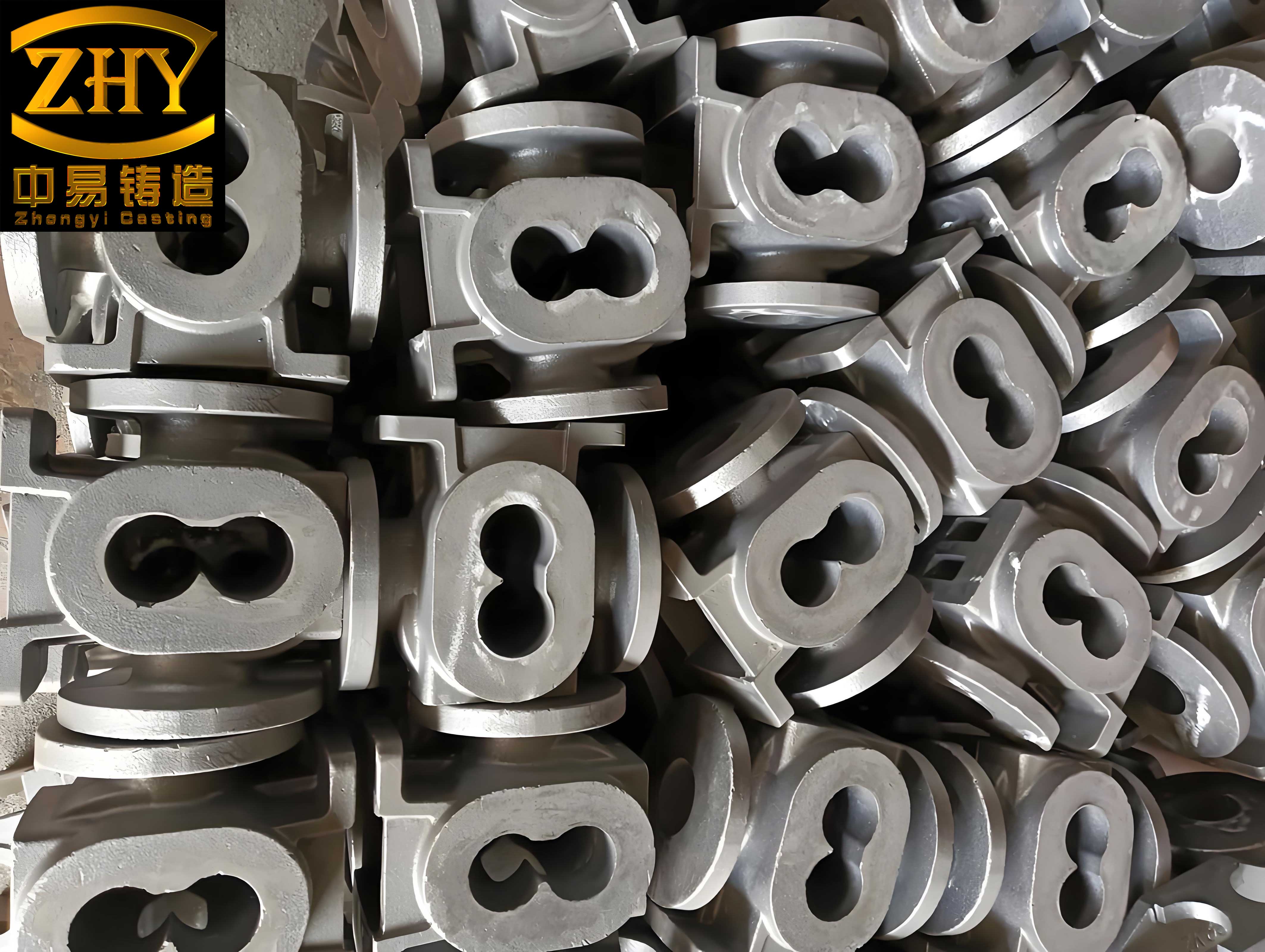
In the manufacturing of railway locomotives and vehicles, the axle box plays a critical role in supporting the full weight of the vehicle through springs and enduring multi-directional impact loads during operation. The quality of this cast component is paramount to the safety and reliability of high-speed rail systems. This article delves into the casting process design for an axle box made of nodular cast iron, specifically EN-GJS400-18LT (equivalent to QT400-18AL), highlighting challenges encountered during trial production and the methodologies employed to overcome them. Through a first-person perspective as part of a research and engineering team, I will detail our approach, which integrated traditional foundry practices with advanced numerical simulation to achieve a defect-free casting. The focus is on optimizing the gating system to eliminate shrinkage porosity, a common defect in nodular cast iron castings, and ensuring the final product meets stringent quality standards such as EN 12681 for X-ray inspection. Throughout this discussion, the term ‘nodular cast iron’ will be frequently emphasized, as it is the core material under study.
The axle box casting, with its complex geometry, presents significant challenges due to varying wall thicknesses. The component has an overall outline dimension of 426 mm × 233 mm × 230 mm, a rough weight of 41 kg, and wall thicknesses ranging from a minimum of 12 mm to a maximum of 48 mm, with a main body thickness of 14 mm. The average modulus of the casting is calculated to be 1.2 cm. Modulus, defined as the ratio of volume to cooling surface area, is a crucial parameter in casting design, as it influences solidification patterns. It can be expressed mathematically as:
$$ M = \frac{V}{A} $$
where \( M \) is the modulus (in cm), \( V \) is the volume (in cm³), and \( A \) is the surface area through which heat is dissipated (in cm²). For irregular shapes, this calculation becomes integral to predicting hot spots. The uneven wall thickness in the axle box leads to differential cooling rates, which, if not managed properly, can result in defects like shrinkage porosity and cavities. Nodular cast iron, while offering excellent mechanical properties such as ductility and impact resistance, is particularly prone to shrinkage issues due to its solidification characteristics, which include a significant graphite expansion phase. This expansion can be harnessed for self-feeding, but it requires precise control over the casting process to avoid defects.
Our initial trial casting process employed a conventional approach. The mold was parted along the middle plane of the casting, a common technique to simplify pattern making and molding. The gating system was designed as a closed-open type, with area ratios for the ingate, runner, and sprue set at \( A_{\text{ingate}} : A_{\text{runner}} : A_{\text{sprue}} = 2.3 : 1 : 1.6 \). A single ingate was positioned at a rectangular boss on the casting. To aid directional solidification, three risers were placed on the cope side, and two chill plates with a thickness of 30 mm were positioned adjacent to the casting walls. This setup was intended to promote controlled cooling. However, upon conducting X-ray inspection as per standards, shrinkage porosity was detected precisely at the rectangular boss area where the ingate was attached. The defect manifested as diffuse micro-porosity, which compromises the structural integrity of nodular cast iron components. The table below summarizes the initial casting parameters:
| Parameter | Value | Description |
|---|---|---|
| Material | EN-GJS400-18LT | Nodular cast iron with ferritic matrix |
| Casting Weight | 41 kg | Rough weight including machining allowance |
| Average Modulus | 1.2 cm | Calculated based on volume and surface area |
| Gating System Ratio | 2.3:1:1.6 | Ingate : Runner : Sprue cross-sectional area |
| Number of Ingates | 1 | Located at rectangular boss |
| Risers | 3 | Positioned on cope side |
| Chills | 2 | 30 mm thick, conforming to casting shape |
The appearance of shrinkage in nodular cast iron castings is often linked to an imbalance in the solidification sequence. During cooling, nodular cast iron undergoes three distinct stages of contraction: liquid contraction, solidification contraction, and solid-state contraction. The first two stages are primarily responsible for shrinkage defects. The solidification of nodular cast iron is unique due to graphite nodule formation, which causes volumetric expansion that can offset some of the contraction. This phenomenon is described by the following relationship for volume change during solidification:
$$ \Delta V_{\text{total}} = \Delta V_{\text{liquid}} + \Delta V_{\text{solidification}} + \Delta V_{\text{graphite expansion}} $$
where \( \Delta V_{\text{total}} \) is the net volume change, \( \Delta V_{\text{liquid}} \) is the contraction during liquid cooling, \( \Delta V_{\text{solidification}} \) is the contraction during phase change, and \( \Delta V_{\text{graphite expansion}} \) is the expansion due to graphite precipitation. For sound castings, the design must ensure that the graphite expansion compensates for the contractions, or external feeding via risers adequately supplies liquid metal. In our initial design, the ingate remained open too long, allowing liquid metal to back-feed into the riser, thereby creating a shrinkage cavity in the casting at the ingate junction. This is a classic issue in nodular cast iron casting where feeding paths need to be timed correctly.
To diagnose the problem systematically, we turned to computer-aided engineering (CAE) simulation using MAGMAsoft, a powerful tool for modeling casting processes. The software employs finite difference methods to solve heat transfer equations during solidification. The governing equation for heat conduction in the casting-mold system is:
$$ \rho c_p \frac{\partial T}{\partial t} = \nabla \cdot (k \nabla T) + L_f \frac{\partial f_s}{\partial t} $$
where \( \rho \) is density, \( c_p \) is specific heat, \( T \) is temperature, \( t \) is time, \( k \) is thermal conductivity, \( L_f \) is latent heat of fusion, and \( f_s \) is solid fraction. The simulation model incorporated the exact 3D geometry of the casting, gating, and risers, which was created in UG software and imported into MAGMA. The results clearly indicated a hot spot at the junction of the rectangular boss and the ingate. The hot spot is a region that remains liquid longer than surrounding areas, leading to shrinkage upon final solidification. The simulation predicted shrinkage porosity at that location, which matched the X-ray findings. This validation confirmed that the defect was due to an unfavorable solidification pattern rather than random process variations.
The simulation output provided insights into the modulus relationship between the ingate and the boss. The modulus of a section determines its solidification time; higher modulus means slower solidification. The initial ingate had a modulus that was too large relative to the boss, causing it to solidify after the boss, which disrupted feeding. The critical ratio identified was:
$$ R = \frac{M_{\text{ingate}}}{M_{\text{boss}}} $$
where \( R \) is the modulus ratio, \( M_{\text{ingate}} \) is the modulus of the ingate, and \( M_{\text{boss}} \) is the modulus of the rectangular boss. In the initial design, \( R \) was approximately 0.4, which led to shrinkage. Our goal was to adjust this ratio to eliminate the defect. We considered two optimization strategies: increasing riser size or decreasing ingate size. Increasing riser size would enhance feeding capacity but reduce yield and increase material costs. Decreasing ingate size, on the other hand, promotes earlier solidification of the ingate, isolating the casting from the riser and allowing the nodular cast iron’s self-feeding through graphite expansion to compensate for shrinkage. This approach aligns with the principle of均衡凝固 (balanced solidification), where internal and external feeding are dynamically balanced.
We focused on reducing the ingate cross-sectional dimensions. Three alternative ingate sizes were proposed: 20 mm × 25 mm, 25 mm × 30 mm, and 35 mm × 40 mm. Each was simulated in MAGMA to predict shrinkage behavior. The table below compares the modulus calculations and simulation outcomes for these options:
| Ingate Dimensions (mm) | Cross-sectional Area (mm²) | Ingate Modulus \( M_{\text{ingate}} \) (cm)* | Boss Modulus \( M_{\text{boss}} \) (cm)* | Modulus Ratio \( R \) | Simulation Result for Shrinkage |
|---|---|---|---|---|---|
| 35 × 40 (Initial) | 1400 | ~0.48 | ~1.2 | ~0.4 | Shrinkage present |
| 25 × 30 | 750 | ~0.30 | ~1.2 | ~0.25 | Shrinkage eliminated |
| 20 × 25 | 500 | ~0.24 | ~1.2 | ~0.20 | Shrinkage eliminated |
*Modulus values are approximated based on geometric calculations for rectangular sections. The exact modulus depends on volume and surface area; for an ingate with rectangular cross-section of width \( w \) and height \( h \), and length \( l \), the modulus can be estimated as \( M = \frac{w h l}{2(w h + w l + h l)} \) for a standalone section, but in practice, it is influenced by connection to the casting.
The simulations confirmed that for \( R < 0.4 \), shrinkage porosity was eliminated. The underlying mechanism is that a smaller ingate solidifies earlier, cutting off the liquid path from the riser before the casting’s critical sections solidify. This forces the nodular cast iron to utilize its graphite expansion for internal feeding, which is sufficient to compensate for shrinkage in the boss area. The solidification time of a section can be estimated using Chvorinov’s rule:
$$ t_s = B \left( \frac{V}{A} \right)^2 = B M^2 $$
where \( t_s \) is solidification time, \( B \) is a mold constant dependent on mold material and thermal properties, and \( M \) is modulus. By reducing \( M_{\text{ingate}} \), we reduce \( t_s \) of the ingate, ensuring it solidifies before the boss. For the boss, with \( M_{\text{boss}} \approx 1.2 \) cm, its solidification time is relatively long, but the early sealing of the ingate prevents back-feeding.
We selected the 20 mm × 25 mm ingate for final implementation, as it provided a good balance between ensuring early solidification and maintaining adequate initial filling. This choice also facilitated easier cutting and grinding during post-casting operations. The modified gating system was tested in production, and X-ray inspection of the resulting nodular cast iron axle boxes showed no signs of shrinkage at the boss area. The castings were dense and met all technical quality requirements. The success of this optimization underscores the importance of modulus control in nodular cast iron casting design.
Beyond the specific case, this study highlights broader principles for casting nodular cast iron components. The interaction between gating design and solidification behavior is complex, especially for materials with expansion phases. Key factors to consider include:
- Modulus Matching: Ensure that feeding paths (ingates, runners) have a lower modulus than the sections they feed to promote directional solidification toward the riser or to allow self-feeding.
- Simulation-Driven Design: Use CAE tools like MAGMA to predict hot spots and shrinkage regions, reducing trial-and-error iterations.
- Graphite Expansion Utilization: Design the process to harness the expansion of nodular cast iron by controlling cooling rates and isolation of feeding channels.
To further elucidate the mathematical foundation, we can derive a criterion for shrinkage avoidance based on modulus ratio. Let \( t_{\text{ingate}} \) and \( t_{\text{boss}} \) be the solidification times of the ingate and boss, respectively. To prevent back-feeding, we need:
$$ t_{\text{ingate}} < t_{\text{boss}} $$
Applying Chvorinov’s rule:
$$ B M_{\text{ingate}}^2 < B M_{\text{boss}}^2 $$
which simplifies to:
$$ M_{\text{ingate}} < M_{\text{boss}} $$
However, in practice, due to thermal connections and geometry effects, a stricter condition is often required, such as \( R < 0.4 \) as found empirically. This can be expressed as:
$$ \frac{M_{\text{ingate}}}{M_{\text{boss}}} \leq C $$
where \( C \) is a critical ratio specific to the casting geometry and material. For this nodular cast iron axle box, \( C = 0.4 \).
In conclusion, the optimization of the casting process for the railway locomotive axle box made of nodular cast iron demonstrates the effectiveness of integrating simulation with traditional foundry knowledge. By reducing the ingate size to achieve a modulus ratio below 0.4, we eliminated shrinkage defects and produced high-integrity castings. This approach not only ensures quality but also enhances production efficiency by minimizing rework. The repeated emphasis on nodular cast iron throughout this discussion underscores its significance in demanding applications where durability and safety are paramount. Future work could explore the application of these principles to other complex nodular cast iron castings, potentially developing generalized guidelines for modulus ratios in various geometries.
Finally, it is worth noting that the use of advanced simulations like MAGMA allows for a deeper understanding of thermal dynamics during solidification. The software can model the evolution of solid fraction, temperature gradients, and stress development, providing a comprehensive view of the casting process. For nodular cast iron, which exhibits a eutectic transformation with graphite nucleation, the simulation parameters must accurately capture the latent heat release and expansion effects. This requires detailed material property data, which we incorporated into our models. The successful outcome validates the precision of these simulations and their value in modern foundry practice for nodular cast iron components.