
In my experience with heavy-duty casting applications, the production of large pump bodies for sand suction pumps presents unique challenges due to their demanding operational environments. These pumps are critical for dredging, river desilting, and land reclamation projects, where they handle abrasive mixtures with high solids content, often exceeding 40%. The pump body, as a core component, must exhibit exceptional integrity to prevent leaks and withstand wear, necessitating a defect-free structure without shrinkage porosity or voids. This article delves into my first-person investigation into the casting process for a massive nodular cast iron sand suction pump body, weighing approximately 46,600 kg with dimensions of 5,800 mm × 3,480 mm × 2,200 mm and wall thicknesses ranging from 75 mm to 355 mm. The material specification is QT500-7 nodular cast iron, requiring high tensile strength and elongation. Through meticulous design and control, I aimed to overcome the inherent difficulties of thick-section nodular cast iron casting, employing expanded polystyrene (EPS) mold casting with furan resin sand. Below, I detail the comprehensive approach, incorporating tables and formulas to summarize key aspects.
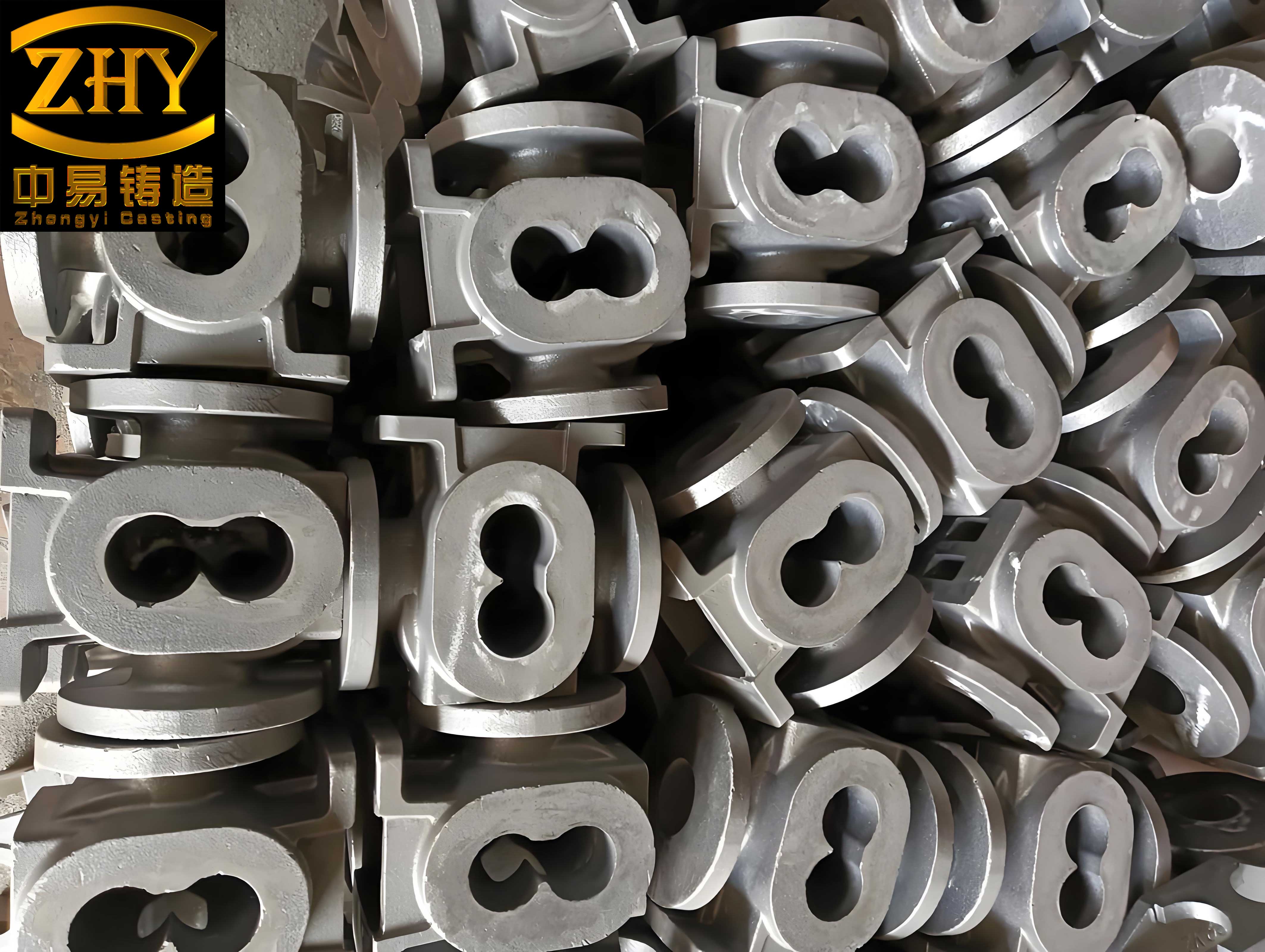
The use of nodular cast iron is pivotal for such applications due to its superior ductility and strength compared to gray iron, but its casting requires precise control to avoid defects like shrinkage and poor nodularity. My process began with the EPS mold design, which eliminates draft angles and simplifies pattern-making by adding only machining allowances and shrinkage rates. The mold was segmented into modules for CNC machining and hot-wire cutting, then assembled with high precision. To enhance surface finish, I applied two coats of graphite-based coating at 0.2 mm per layer, mitigating sand inclusion risks during pouring. This method, often referred to as lost foam or EPS mold casting, leverages the foam’s vaporization upon metal contact, but it demands careful gating and venting design to ensure proper filling and defect reduction.
For the gating system, I adopted a two-tier bottom-pour stepped design to facilitate controlled filling and minimize turbulence. The system includes a sprue, runners, and ingates, with calculations based on fluid dynamics principles. The metal head pressure was determined using the formula: $$H_p = H_{\text{box}} + H_{\text{pour}} – \frac{C}{2}$$ where \(H_p\) is the metal head pressure (mm), \(H_{\text{box}}\) is the flask height (mm), \(H_{\text{pour}}\) is the pouring cup height (mm), and \(C\) is the casting height (mm). The pouring time was estimated as: $$t = \sqrt[3]{\frac{G_L}{K}}$$ where \(t\) is the pouring time (s), \(G_L\) is the total metal weight (kg), and \(K\) is a constant dependent on casting geometry. For this nodular cast iron pump body, I used \(K = 1.2\) based on empirical data. The choke area \(A_{\text{choke}}\) was calculated to ensure adequate flow: $$A_{\text{choke}} = \frac{G_L}{\mu \rho \sqrt{2g H_p}}$$ where \(\mu\) is the discharge coefficient (taken as 0.4 for resin sand), \(\rho\) is the density of nodular cast iron (7.3 kg/mm³), and \(g\) is gravitational acceleration (9.8 m/s²). From this, the sprue area \(A_{\text{sprue}} = A_{\text{choke}} / 0.8\), runner area \(A_{\text{runner}} = A_{\text{sprue}} \times 1.2\), and ingate area \(A_{\text{ingate}} = A_{\text{sprue}} \times 0.8\). The final dimensions were adjusted based on available standard sizes, as summarized in Table 1.
| Component | Calculated Area (mm²) | Adjusted Dimensions | Remarks |
|---|---|---|---|
| Sprue | 1,250 | Diameter: 40 mm | Bottom-pour design |
| Runner | 1,500 | Rectangular: 50 mm × 30 mm | Two-tier stepped |
| Ingate | 1,000 | Rectangular: 40 mm × 25 mm | Multiple ingates for uniform flow |
| Pouring Time | Approximately 120 seconds for three-ladle pouring | ||
Chill design was crucial to accelerate solidification in thick sections and prevent shrinkage defects. For nodular cast iron, prolonged solidification can lead to graphite degeneration, floating, or coarse graphite, reducing mechanical properties. I employed external chills made of cast iron for sections with modulus less than 9 cm, and internal chills for the core regions exceeding 300 mm thickness. The chill volume was determined based on the casting modulus \(M\), calculated as: $$M = \frac{V}{A}$$ where \(V\) is the volume of the section (mm³) and \(A\) is the cooling surface area (mm²). For the pump body’s thickest area, \(M\) exceeded 10 cm, necessitating internal chills to limit solidification time under 50 minutes, ensuring nodularity above 80%. Additionally, external chills were placed around the flange areas for bolt holes to avoid porosity. The chill layout is summarized in Table 2.
| Location | Chill Type | Dimensions | Purpose |
|---|---|---|---|
| Flange Bolt Hole Area | External Cast Iron Chill | Ring-shaped, thickness: 50 mm | Prevent shrinkage in threaded holes |
| Bearing Seat | External Cast Iron Chill | Rectangular plates, 100 mm × 200 mm | Avoid defects in high-stress zones |
| Core Thick Section | Internal Steel Chill | Cylindrical, diameter: 30 mm, length: varied | Accelerate solidification, reduce shrinkage |
| General Wall Areas | External Chill Arrays | Multiple small chills spaced 150 mm apart | Enhance overall cooling rate |
Riser and venting design complemented the gating system to ensure soundness. Nodular cast iron exhibits significant shrinkage volume during solidification, requiring effective risers for feeding. I used six insulated sleeve risers, each 180 mm in diameter, positioned on the bearing seat faces to provide directional solidification. The riser volume was calculated using the modulus method: $$V_{\text{riser}} = 1.2 \times V_{\text{casting}} \times \beta$$ where \(\beta\) is the shrinkage factor for nodular cast iron, typically 4-6%. For this pump body, \(\beta = 5\%\) was applied. Additionally, two conventional risers (140 mm diameter) were placed on the feet for compensation and slag trapping. Venting channels were incorporated at high points and along ribs to expel gases during pouring, critical for EPS mold casting where foam decomposition generates volatiles. The vent area was sized as 20% of the total ingate area to ensure efficient gas escape.
In the molding process, I used furan resin sand with a resin addition of 1.2% for both the mold and cores. The EPS pattern was placed on a molding platform, and the mold was built in four sections to facilitate core assembly and inspection. Six core boxes were employed, with the largest core being a combined unit for internal cavities. Core reinforcement involved welded steel frames (50 mm × 60 mm) for most cores, while the massive core utilized a cast iron core grid for stability. All cores were coated with zircon-based paint at a Baume degree of 65-70 to improve surface finish and resist metal penetration. For the parting lines, I used wooden and welded barriers with sodium silicate sand to prevent run-outs, along with steel plates on the sides to resist mold expansion.
The melting and treatment of nodular cast iron were critical phases to achieve the desired QT500-7 grade. I started with a base iron composition, aiming for low sulfur and phosphorus to enhance nodularization. The chemical composition before and after treatment is detailed in Table 3. Pre-treatment involved adding 0.4% inoculant to the furnace to increase nucleation sites, improving fluidity and reducing shrinkage tendency. For spheroidization, I used a heavy rare-earth magnesium ferrosilicon alloy (DY-7F) at 1.05% addition, followed by inoculation with CALBALLOY at 0.4% during tapping and YFY-1A at 0.15% during pouring via a flow-through method. This multi-stage inoculation process is essential for nodular cast iron to maintain high nodularity and minimize fading. The reaction was conducted in a covered ladle to prevent magnesium loss, and the residual magnesium was controlled at 0.035-0.055% to ensure proper nodule formation.
| Element | Before Treatment | After Treatment | Target Range |
|---|---|---|---|
| Carbon (C) | 3.4–3.5 | 3.2–3.4 | 3.2–3.6 |
| Silicon (Si) | 1.5–1.6 | 2.3–2.5 | 2.2–2.8 |
| Manganese (Mn) | 0.35–0.45 | 0.35–0.45 | 0.3–0.5 |
| Phosphorus (P) | ≤0.04 | ≤0.04 | ≤0.05 |
| Sulfur (S) | ≤0.03 | ≤0.02 | ≤0.02 |
| Copper (Cu) | – | 0.65–0.75 | 0.6–0.8 |
| Magnesium (Mg) | – | 0.035–0.055 | 0.03–0.06 |
Pouring was executed using three ladles to manage the large volume, with a target temperature of 1,330–1,350°C to balance fluidity and shrinkage. I emphasized a fast, continuous pour to maintain thermal gradient and avoid mistruns. Prior to pouring, four 10-ton weights were placed on the mold with steel pipe supports to counteract metallostatic pressure and prevent mold lifting. The pouring rate was controlled to achieve the calculated pouring time, ensuring minimal turbulence and slag entrapment. After pouring, the nodular cast iron casting was allowed to cool in the mold for 240 hours, leveraging the insulating properties of resin sand for stress relief and slow cooling to below 300°C before shakeout. This extended cooling is vital for thick-section nodular cast iron to avoid thermal stresses and promote homogeneity.
Upon shakeout, the pump body casting was inspected and tested for mechanical properties and microstructure. The results from attached test lugs demonstrated compliance with QT500-7 standards, as shown in Table 4. The nodular cast iron exhibited high tensile strength, elongation, and nodularity, with graphite spheroidization exceeding 90% in most samples. Microstructural analysis revealed a matrix of ferrite and pearlite, with pearlite content around 55-60%, contributing to the balance of strength and ductility. The hardness values were consistent, indicating uniform cooling. These outcomes validate the effectiveness of the casting process for producing high-integrity nodular cast iron components.
| Sample | Tensile Strength (MPa) | Yield Strength (MPa) | Elongation (%) | Hardness (HB) | Graphite Nodule Size (μm) | Nodularity (%) | Pearlite Content (%) |
|---|---|---|---|---|---|---|---|
| 1 | 460 | 325 | 11.0 | 175 | 4.92 | 92.06 | 54.91 |
| 2 | 490 | 330 | 7.0 | 177 | 4.45 | 92.00 | 60.71 |
| 3 | 485 | 330 | 7.5 | 179 | 5.21 | 90.54 | 57.89 |
| Average | 478.3 | 328.3 | 8.5 | 177.0 | 4.86 | 91.53 | 57.84 |
| QT500-7 Requirement | ≥420 | – | ≥5 | – | – | ≥80 (Grade 3) | – |
The successful production of this nodular cast iron pump body underscores the importance of integrated process design. From EPS mold preparation to gating calculations, chill application, and controlled treatment, each step contributed to mitigating defects common in thick-section nodular cast iron. The use of formulas, such as those for metal head pressure and modulus, enabled precise sizing of components, while tables facilitated data organization. Key lessons include the necessity of multi-stage inoculation for nodular cast iron to maintain nodularity, the effectiveness of internal chills for rapid solidification, and the benefits of prolonged mold cooling for stress reduction. This approach not only yielded a high-quality casting but also provides a replicable framework for similar large-scale nodular cast iron applications, emphasizing the versatility and reliability of nodular cast iron in demanding environments. Future work could explore optimization of chill materials or advanced simulation tools to further enhance efficiency.